10 mins
Datacenter Site Selection in 2026: Hyperscale, Hyperlocal, and Why Deliverability Wins
Datacenter site selection is the process of deciding where to build or source compute capacity based on power, land, regulation, connectivity, and community acceptance, and in 2026 it is splitting into two tracks: hyperscale campuses measured in hundreds of megawatts and hyperlocal sites of 1 to 20 megawatts closer to users. Both are driven by the same underlying forces, namely deliverability, regional regulation, financing and chip access, and the adaptive reuse of existing power.

A team has capacity to place and two very different ways to place it. One is a gigawatt campus years from ready-for-service. The other is a 1 to 20 megawatt modular site on stranded power that can be live in under six months. Choosing between them, across the US, Europe, and APAC, is now one of the hardest and most consequential decisions in digital infrastructure.
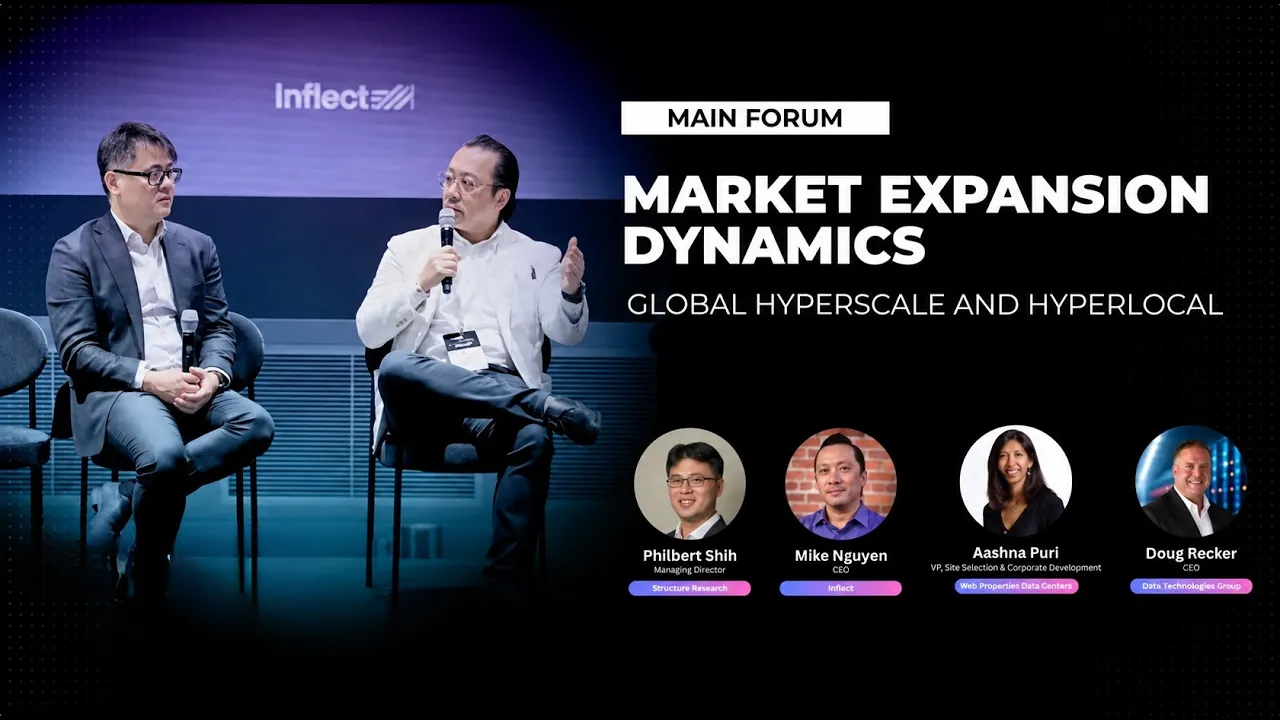
Demand is outpacing primary-market capacity, which is pushing activity into secondary and hyperlocal markets everywhere. At InfraSTRUCTURE 2026, Inflect Founder and CEO Mike Nguyen joined a Main Forum panel on this shift, "Market Expansion Dynamics: Global Hyperscale and Hyperlocal," moderated by Philbert Shih of Structure Research, with Aashna Puri, VP of Global Site Selection and Corporate Development at Iron Mountain datacenters, and Doug Recker of Duos Technologies Group. Here is what they said is actually driving the map.
Why datacenter Site Selection Now Comes Down to Deliverability
Datacenter site selection in 2026 comes down to deliverability, which Iron Mountain defines as the overlap of three things: entitled land, real and available power, and a local community willing to partner on the project. When all three line up, the exact size of the project matters far less than whether it can actually be delivered on time.
Puri made the point directly. "The scale almost doesn't matter," she said. "If you can bring capacity online, let's say before 2030, there is so much demand for it." For a global operator running about 30 datacenters with expansion in every region, the job is less about chasing the biggest site and more about finding the places where land, power, and community all say yes at once.
That reframing turns the old tiering model on its head. In the US especially, Puri said, the lines between tier one, tier two, and tier three markets are blurring because every workload is scaling, so the question is no longer which tier a market sits in but whether a specific site is deliverable.
How US, European, and APAC Markets Differ for Datacenter Buildout
The US, Europe, and APAC each require a different site-selection playbook: the US is blurring its tier distinctions as every workload scales, Europe is governed by sovereignty and sustainability regulation alongside a wave of new Chinese hyperscaler regions, and APAC spans many countries with currency exposure and national sovereign-AI demand. A strategy that works in one region can fail in another for reasons that have nothing to do with the technology.
Europe's defining variable is regulation. "The added layer in Europe is regulation, around sovereignty and around sustainability, and that dictates where capacity can sit and how much scale it can have," Puri said. The newer dynamic there is the arrival of Chinese hyperscalers standing up their first regions, which she compared to how US hyperscalers expanded years ago. "That creates an anchor that gives us confidence in future growth in those locations."
APAC adds more variables again, with many countries, currency exposure, and a mix of US hyperscaler, Chinese hyperscaler, and national sovereign-AI demand in the same region. The throughline across all three regions, Puri said, is that location strategy has to be local and nuanced rather than templated.
Recommend reading: Data Center Colocation Trends 2026: Power, AI Density, and the New Rules of Colocation
Who Really Decides Where Neoclouds Build
Where a neocloud can build is often not its own decision, because its financiers, investors, and chip supply determine which markets are open to it, and a company that cannot get funded, get GPUs, or put people on the ground cannot enter a market no matter how attractive it looks. Understanding that is central to how Inflect advises buyers on the demand side.
Nguyen, whose company operates as a marketplace and advisory across network, GPU, CPU, cloud, and datacenter space from retail colocation to gigascale campuses, said the real constraint is often upstream of the operator. "It's not the neocloud's choice," he said. "Whoever is financing them says 'I'm not ready for you to go into this market,' and so they don't." Third parties, in other words, frequently drive where neoclouds can and cannot go.
When a market looks ready but a buyer hesitates, the reasons are usually concrete. "You ask them why aren't you ready, and it's right in your wheelhouse," Nguyen said. "They can't get funded, they can't get the chips, they can't actually be there." He also flagged the herd behavior that moves the market, where a geopolitical moment or a single proven project sends everyone rushing into the same geography at once, which is why he works to prepare buyers before those moments hit.
The Hyperlocal Play: 1 to 20MW, Stranded Power, and Modular Speed
The fastest-growing opportunity is hyperlocal: 1 to 20 megawatt modular datacenters built on stranded power in tier three and tier four markets, deployable in under six months, which the largest and most financeable buyers are now taking as quickly as they can be delivered. Recker's company, Duos Technologies, moved into exactly this space after years in traditional brick-and-mortar datacenters.
"Everybody's on the gigawatt and 100 megawatt sites. Our approach is the 1 to 20 meg," Recker said. To prove modular deployment could be fast and secure, Duos bought $144 million of GPUs to show NVIDIA it could deploy quickly in a modular environment, and the company now has a pipeline of more than 190 megawatts in 10 to 20 megawatt increments. One cluster in Columbus, Georgia brought seven megawatts of critical power online in under 75 days.
The unlock is stranded power. "You go to tier three and tier four markets where there's five or 20 meg of stranded power sitting at a substation," Recker said, or land held by hyperscalers and bitcoin miners that is only lightly used. Fiber, which used to rule those sites out, is now being built to follow the power. And the demand is coming from the top of the market, not the edge of it: the most financeable buyers, Recker said, "want 10 bank, they want 20 bank, they want whatever they can get." Inference is still a small share of that pipeline, around 10% today.
Turning Old Buildings Into Datacenters: Adaptive Reuse and the Enterprise Squeeze
Old office, industrial, and telecom buildings are becoming datacenters because they already have the two things that matter, power and fiber, and because the enterprise shift from 20-40kW to 85kW cabinets is leaving older facilities landlocked and in need of replacement capacity. Reusing these assets is often faster than greenfield, with the catch that permitting in tier one markets remains the hard part.
Recker described the mechanics plainly. With modular, "you don't care how old the switchgear is inside," he said, because you drop your own modules outside and use the existing transformer and fiber. The constraint he keeps hitting is the permit desk: "When that permit comes across the desk and it says datacenter, everybody stops," which is why Duos leans toward tier three and tier four markets where it can deploy in under six months. The same squeeze is hitting enterprises directly, as cabinets jump from 20-40kW to 85kW and landlocked facilities, like a 20-year-old site in Jacksonville with no room for more generators or cooling, simply cannot keep up.
Recommend Reading: Edge Computing Colocation: When to Choose a Modular Data Center Instead of a Hyperscale Build
At the large-scale end, the same adaptive-reuse logic is already producing marquee projects. In Béthune, in northern France, Nebius is redeveloping a former Bridgestone tyre plant into a datacenter campus of up to 240MW, with the first phase due online in 2026. Nguyen pointed to this kind of site on the panel: an old industrial plant that lost thousands of jobs when it closed, brought back as a tax base, an employer, and a project the local community and prefecture actively wanted. Inflect's advisory team works on sourcing and structuring exactly this class of large-scale European capacity, where a legacy site becomes a modern AI campus and an anchor for the town around it.
Recommend Reading: France AI Data Center Investment: Inside the Nebius, Azur Datacenters and Inflect 240MW Deal
What Comes Next: Inference, Legislation, and Community
The next 24 months will be shaped by three forces the panel is watching closely: inference overtaking model training, legislation tightening across all three regions, and community acceptance becoming a hard limit on where workloads can sit. None of these replaces the others, and all of them keep the overall market growing.
Recker expects a large secondary market to open up as the biggest new campuses shed the capacity they do not want, feeding neocloud and enterprise demand. Puri framed the shift as uneven rather than a clean handoff: the industry is still growing up and to the right, but inference is accelerating faster than model building, which changes how hyperlocal datacenters and edge use cases develop worldwide. Community engagement, she added, started in Europe with rules on power usage effectiveness, water, and heat reuse, and has now become one of the key limiting factors on development in the US too.
Her closing watchlist was simple. "The two areas I'm watching very closely are legislation and community," Puri said, because both increasingly dictate where capacity is allowed to sit, across every region the panel discussed.
Find Your Next Site & Source Global Datacenter Capacity
Whether you are weighing a gigawatt campus or a 1 to 20 megawatt hyperlocal site, Inflect can help you:
Compare colocation, GPU, and wholesale capacity across 100+ countries, including secondary markets and stranded-power and adaptive-reuse sites
See real options with instant pricing instead of waiting on quotes
Pressure-test deliverability, power timelines, and financing before you commit
Get expert advisory on regional strategy across the US, Europe, and APAC
Find the right solution at the right price at inflect.com, and follow Inflect on LinkedIn, and check out which events we are going on our events page.
About the Author

Chanyu Kuo
Director of Marketing at Inflect
Chanyu is a creative and data-driven marketing leader with over 10 years of experience, especially in the tech and cloud industry, helping businesses establish strong digital presence, drive growth, and stand out from the competition. Chanyu holds an MS in Marketing from the University of Strathclyde and specializes in effective content marketing, lead generation, and strategic digital growth in the digital infrastructure space.
Contact:
Email: