14 mins
Edge Computing Colocation: When to Choose a Modular Data Center Instead of a Hyperscale Build
Hyperscale operators are placing multibillion-dollar bets on facilities that will not open for years. McKinsey projects that data center capacity needs will nearly triple by 2030, with AI capacity growing 3.5 times and accounting for roughly 70 percent of total demand (Source: McKinsey & Company, 2025). That growth is being met almost entirely through large, centralized, site-built facilities designed for sustained, high-density compute.

Edge computing does not run on that timeline. A 5G MEC rollout, a retail chain adding in-store inference, or an IoT deployment spanning dozens of secondary markets needs infrastructure in place in months, not years, in far more locations than a hyperscale build strategy can reasonably cover. That mismatch is structural: hyperscale facilities are engineered for scale and density at a handful of sites, while edge workloads need distribution and speed across many, pulling site selection, construction method, and vendor evaluation in different directions.
This post gives buyers a framework for choosing between a modular deployment and a hyperscale build for edge computing colocation, including a side-by-side comparison of cost and timeline, the specific conditions that favor each model, and the criteria to use when evaluating providers.
Modular vs. Hyperscale Data Centers for Edge: Key Differences
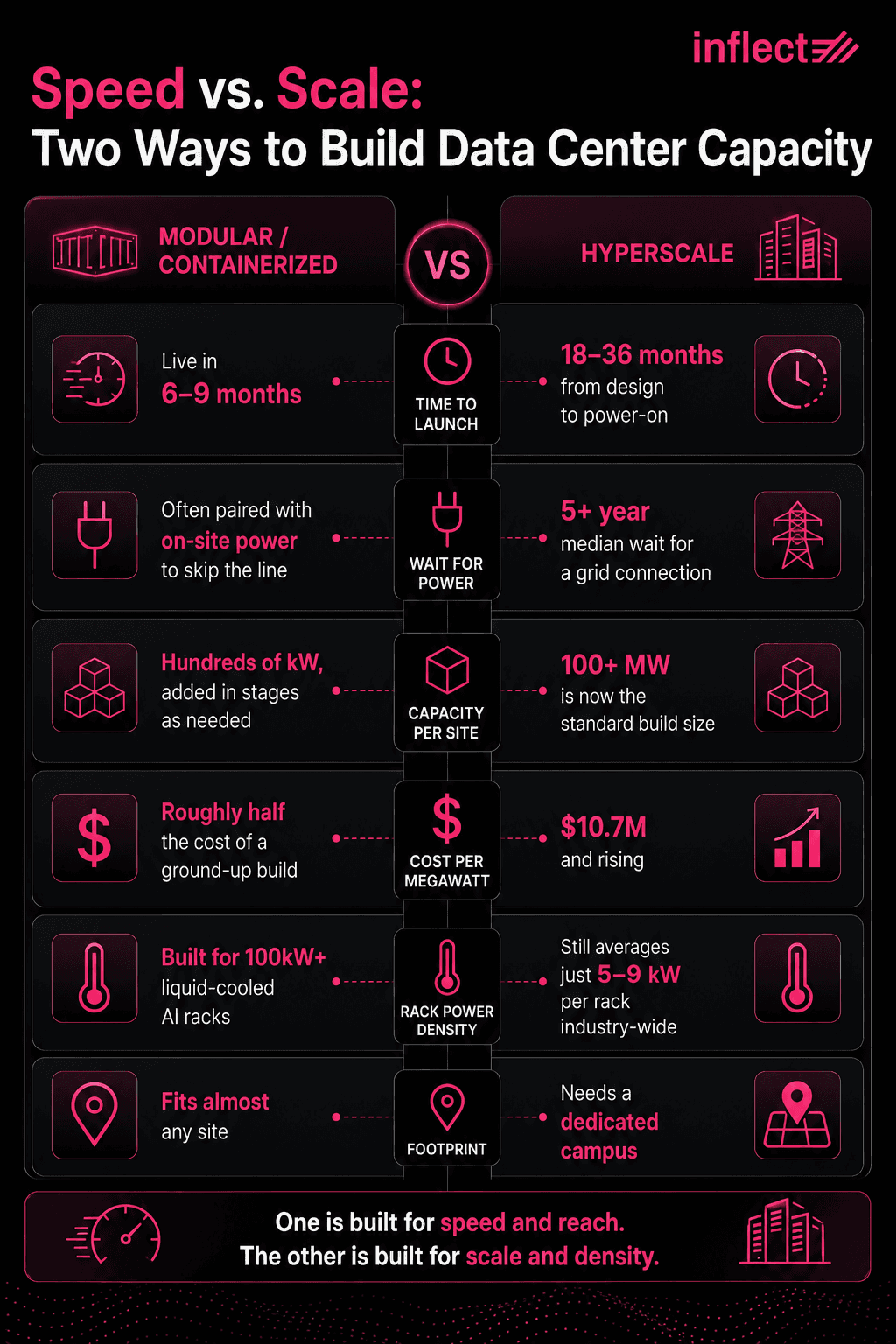
Modular and hyperscale data centers differ across five dimensions that matter most to edge buyers: construction method, deployment timeline, capital structure, power density, and physical footprint. Both can house the same servers, run the same data storage and data processing workloads, and support the same network connections, but the way each is built determines how quickly a buyer can get capacity live in a given market and how much capital is committed before the first workload runs.
The distinction is not cosmetic. A buyer choosing between a modular approach and traditional data centers is really choosing between speed and distribution on one side, and scale and density on the other. Understanding where each model's advantages come from makes the rest of the decision far more concrete.
Modular and Containerized Data Center Architecture for Edge Deployments
Modular and containerized data centers are built from prefabricated components, standardized power, cooling systems, and IT modules manufactured in a factory, then shipped to the site and assembled rather than constructed floor by floor on location. Every major hyperscaler now runs a modular program, and several are already on second-generation designs, with pre-assembled skids that integrate racks, power distribution, and security systems compressing on-site assembly from roughly fifteen weeks to two or three. Internal targets at multiple operators now aim for shell-start to first operational room in under 35 weeks, and some pre-engineered deployments have reported sub-nine-month timelines end to end (Source: Data Center Dynamics, 2026).
For technical teams: at the smaller scale more typical of edge sites, factory-built pods engineered for high performance computing workloads are already running in production. Duos Edge AI deploys 55-foot factory-built pods housing 576 GPUs with integrated liquid cooling, completing the deployment, including site prep, in six months. Grand View Research projects that the modular data center market will more than double by 2030, reflecting how far factory assembly has moved from pilot programs into a standard construction path (Source: Data Center Dynamics, 2026).
Hyperscale Build Characteristics and Typical Deployment Timelines
Hyperscale data centers are purpose-built, site-specific facilities designed and constructed on location using a traditional design-permit-build sequence that typically runs 18 to 24 months, though McKinsey notes that power constraints alone can extend that timeline by an additional 24 to 72 months in tightly constrained markets (Source: McKinsey & Company, 2025). Construction for conventional data centers, the traditional facilities most buyers still default to, follows a 24 to 36 month stick-built schedule when measured from design through commissioning (Source: Data Center Dynamics, 2026).
Scale is the tradeoff for that timeline. CBRE reports that 100+ megawatt projects are becoming the norm in North America (Source: CBRE, 2025), and JLL puts average global construction cost at $10.7 million per megawatt in 2025, up from $7.7 million in 2020, with 2026 forecast to rise another 6 percent to $11.3 million per megawatt (Source: JLL, 2026). That capital intensity only makes sense when a buyer needs sustained, concentrated capacity in one place, not distributed footprint across many markets. For buyers weighing cost efficiency against speed, the comparison below breaks the tradeoff down dimension by dimension.
Modular vs. Hyperscale Comparison
Dimension | Modular / Containerized | Hyperscale |
|---|---|---|
Typical deployment timeline | 6 to 9 months for pre-engineered pods; some factory-built deployments in under 9 months (Source: Data Center Dynamics, Modular by Necessity, 2026) | 18 to 24 months design-to-commissioning; 24 to 36 months for conventional stick-built (Source: McKinsey & Company, 2026) |
Time to power / grid interconnection | Often paired with behind-the-meter or smaller utility interconnects, reducing exposure to queue delays | Median interconnection queue duration exceeds 5 years for large projects reaching commercial operation in 2025 (Source: Lawrence Berkeley National Laboratory, 2026) |
Typical site capacity | Hundreds of kilowatts to a few megawatts per module, scalable in increments | 100+ megawatts increasingly the norm for new builds (Source: CBRE, 2025) |
Construction cost per MW | Reported at roughly half of traditional builds in some configurations (Source: Data Center Dynamics, Modular by Necessity, 2026) | $10.7 million per MW average in 2025, forecast at $11.3 million per MW in 2026 (Source: JLL, 2026) |
Power density | Increasingly built around 100kW+ direct liquid-cooled racks for AI pods | 5 to 9 kW per rack most common industry-wide, with high-density AI halls climbing toward 10 to 30 kW and beyond (Source: Uptime Institute, 2025) |
Land / real estate footprint | Small, deployable on constrained or non-standard sites | Large, typically requires dedicated greenfield or purpose-built campuses |
Source: Compiled from Data Center Dynamics (2026), McKinsey & Company (2025), CBRE (2025), JLL (2026), Lawrence Berkeley National Laboratory (2026), and Uptime Institute (2025) as cited above.
Quick Decision Snapshot: Modular vs. Hyperscale
The fastest way to sort a project is to match it against these conditions:
Choose modular when you need capacity live in months, are deploying across multiple edge locations in secondary or constrained markets, or are uncertain how much capacity you will ultimately need at a given site.
Choose hyperscale when you need sustained, high-density compute at scale in one location, your demand growth is predictable, and the market is well suited with mature power and fiber infrastructure already in place.
When to Choose Modular Data Centers for Edge Computing
Modular data centers are the better fit for edge computing under four conditions: latency-sensitive workloads in underserved or secondary markets, rapid deployment mandates for 5G MEC, IoT, and retail edge rollouts, capacity uncertainty that favors incremental right-sizing, and remote or constrained sites where a full hyperscale build is impractical.
Latency-Sensitive Workloads in Underserved or Secondary Markets
Latency-sensitive applications, including real-time video analytics, industrial automation, inventory management systems, and AR/VR, require compute physically close to the end user or device for lower latency, and secondary and tertiary markets rarely have existing hyperscale capacity to draw on. The edge data center market itself, distinct from edge computing broadly, was valued at $34.8 billion in 2025 and is projected to reach $105.8 billion by 2033, a 14.9 percent compound annual growth rate driven largely by this kind of distributed demand (Source: Grand View Research, 2026). Modular units let a buyer establish a presence in a market where no facility exists yet, without waiting for a multi-year build to justify the investment.
Rapid Deployment Requirements for 5G MEC, IoT, and Retail Edge
5G multi-access edge computing, IoT devices, and retail edge deployments typically need to go live on a schedule set by a network rollout or a store opening calendar, not a construction schedule, especially in markets where high demand for local connectivity has already outpaced available capacity. The global 5G edge computing market is projected to grow from $9.3 billion in 2026 to $51.4 billion by 2030, a 49.8 percent compound annual growth rate (Source: Grand View Research, 2026). At that pace, a deployment model built around 18 to 24 month lead times simply cannot keep up with the rollout schedule driving the demand in the first place.
Capacity Uncertainty and the Need to Right-Size Incrementally
Edge workloads often start small and scale unpredictably, and modular architecture gives buyers a flexible option to add power and cooling modules in increments to match evolving requirements as demand becomes clearer, rather than over-building for a projection that may not materialize. This matters most in the first 12 to 18 months of a new edge program, when usage patterns are still being established and careful planning around a large upfront capital commitment can limit real financial risk if the workload does not scale as forecast.
Remote, Constrained, or Non-Standard Sites
Some edge locations, including telecom central offices, retail back rooms, and rural or industrial sites, simply cannot accommodate a hyperscale footprint, and modular units, delivered as prefabricated units with a small physical envelope, are often the only construction method that fits. The same prefabrication that compresses timelines also standardizes the electrical and cooling interfaces enough to deploy on sites that would otherwise be excluded from consideration entirely.
When Hyperscale Data Centers Make Sense for Edge and Core Workloads
Hyperscale builds remain the better choice under four conditions: sustained high-density compute for artificial intelligence (AI) and GPU workloads, long-term capacity planning against predictable and growing demand, markets that already have mature power and fiber infrastructure, and workloads where centralized AI training needs to sit apart from distributed edge inference.
Sustained High-Density Compute for AI and GPU Workloads
AI model training clusters consume hundreds of megawatts of continuous, high-density computing power in a single deployment, a load profile that favors a centralized, purpose-built facility over a distributed set of smaller modular sites. Nvidia's GB200 NVL72 rack-scale systems draw approximately 120 kW at nominal load, with deployed racks reported in the 130 to 132 kW range once switches and interconnects are included. That same platform is also built for superior energy efficiency: Nvidia reports roughly 25 times the performance per watt of its previous-generation air-cooled systems (Source: Nvidia, 2026). Concentrating that density in one facility keeps cooling, power distribution, and networking within a single engineered system instead of coordinating it across dozens of independent modules.
Long-Term Capacity Planning With Predictable, Growing Demand
When demand growth is well forecast and expected to persist for years, the multi-year lead time of a hyperscale build becomes a planning input rather than a liability. Buyers with steady, compounding capacity needs can lock in the economics of scale at very large footprints without the integration overhead of adding modules one at a time. Successful implementation at this scale depends on matching that lead time to real business needs rather than a generic growth curve.
Markets With Mature Power and Fiber Infrastructure Already in Place
Hyperscale builds perform best in markets that already have the utility substations, transmission capacity, and fiber routes in place to support a 100+ megawatt facility, since those markets absorb the long interconnection process more predictably. JLL reports that 64 percent of capacity currently under construction is located in frontier markets such as West Texas, Tennessee, Wisconsin, and Ohio, where power and land are more available even if fiber connectivity still needs to catch up (Source: JLL, 2026). Operators in these markets increasingly pair grid power with on-site renewable energy sources and battery storage to reduce exposure to interconnection delays (Source: JLL, 2026).
Centralized AI Training vs. Edge Inference Workload Alignment
AI training and AI inference route to different infrastructure models: training clusters concentrate hundreds of megawatts of sustained compute in centralized hyperscale facilities, while inference increasingly moves to smaller, distributed edge and modular deployments closer to where data is generated. McKinsey's forecast of AI capacity growing 3.5 times by 2030 (Source: McKinsey & Company, 2025) is driven overwhelmingly by training demand concentrated in hyperscale campuses, while the inference side of that same growth is what is pushing modular deployment into edge markets in parallel. Buyers running both workload types should expect to operate a hybrid footprint rather than choosing one model exclusively.
How to Evaluate Edge Colocation and Modular Data Center Providers
Evaluating an edge colocation or modular deployment partner comes down to five criteria: power availability and interconnection timelines, fiber and network connectivity at the site, cooling capability for high-density racks, contract flexibility and expansion rights, and geographic footprint relative to end users.
Power Availability and Utility Interconnection Timelines
Power availability should be verified before any other criterion, since interconnection queues are now the single biggest source of schedule risk in the industry. Projects reaching commercial operation in 2025 spent a median of more than five years in interconnection queues before energization, and that delay applies to both new hyperscale builds and utility-scale power additions supporting them (Source: Lawrence Berkeley National Laboratory, 2026). Ask any prospective site or provider for a documented utility interconnection agreement status, not a projected timeline, and confirm which critical components, including transformers, switchgear, and backup generators, are already on order.
Fiber and Network Connectivity at the Edge Site
An edge site is only as useful as its network connectivity, so buyers should confirm carrier density, available dark fiber routes, peering options, and bandwidth costs before committing to a location. A site with excellent power but only one carrier route reintroduces the latency and reliability risk the deployment was meant to eliminate.
Cooling Capability for High-Density Edge Racks
Edge racks running AI inference increasingly require direct liquid cooling rather than traditional air cooling, since AI racks exceeding 100 kW per position need factory-plumbed liquid cooling connected to campus-level coolant distribution (Source: Data Center Dynamics, 2026). Confirm that a prospective site's cooling plant, not just its power capacity, can support the rack density your workload actually requires, and that fire suppression systems are rated for the cooling medium in use; getting this wrong quietly erodes operational efficiency long after commissioning.
Contract Flexibility and Expansion Rights
Edge deployments frequently need to expand or contract capacity faster than a standard colocation lease anticipates, so buyers should negotiate explicit expansion rights and reasonable exit terms up front rather than after a workload has already outgrown its footprint. This matters more for modular and edge sites than for hyperscale, since the entire value proposition of modular capacity is the ability to scale IT equipment and floor space incrementally rather than committing to a large fixed footprint years in advance.
Geographic Footprint and Proximity to End Users
The specific value of an edge site depends entirely on its proximity to the customers, devices, or data sources it serves, so evaluate providers on their actual footprint in the markets that matter to your deployment, not their total global site count. A provider with a small number of sites precisely located where your latency requirements demand them is worth more than a large network with no presence in your target markets. Regulatory requirements around data sovereignty and compliance can also narrow the list of viable markets, particularly for buyers handling sensitive information, before latency is even considered.
Matching Your Edge Deployment to the Right Infrastructure Model
The decision between modular and hyperscale infrastructure comes down to three key considerations a buyer should be able to answer before evaluating any specific provider. First, how many markets does this deployment need to reach, and on what timeline? A rollout spanning dozens of secondary markets on a compressed schedule points toward a modular solution nearly every time. Second, is the workload training or inference, and does it need sustained, concentrated density or distributed, latency-driven placement? Training clusters and other sustained high-density workloads favor hyperscale; inference and latency-sensitive applications favor modular and edge colocation. Third, how predictable is the demand curve, and how much capital risk is acceptable if it does not materialize? Predictable, compounding demand justifies the multi-year hyperscale commitment; uncertain or fast-changing demand favors the incremental right-sizing modular capacity provides.
For most edge use cases, modular data centers offer the faster path to market. Most organizations running both AI and edge workloads will end up operating a hybrid footprint rather than picking one model exclusively, using hyperscale capacity for training and centralized processing while sourcing modular and edge colocation capacity in the markets where latency requirements demand a local presence.
Sourcing Edge Colocation and Modular Capacity Through Inflect
Sourcing edge and modular capacity across dozens of markets the way a distributed rollout requires is fundamentally an aggregation problem, not a feature problem. A buyer evaluating power availability, fiber routes, and cooling capacity across multiple edge sites needs to compare providers across every target market at once, not run a separate sales process for each one.
Inflect is a digital infrastructure marketplace covering 6,000+ data centers and facilities across 100+ countries, giving buyers a single place to search, compare, and receive instant pricing for colocation capacity and modular data center solutions in the specific markets an edge rollout needs, without a sales call for every site. Providers available on the platform relevant to edge and modular deployments include Equinix, Digital Realty, CoreSite, TierPoint, Flexential, Megaport, and Colt, spanning retail colocation for single-site edge deployments up to wholesale capacity and cloud resources for the hyperscale side of a hybrid footprint. Buyers can also work with Inflect's free expert advisory team, at no charge, to sequence a multi-market edge rollout against real power and fiber availability rather than vendor-reported timelines.
Get edge and modular capacity sourced faster. Buyers deploying edge computing colocation face a sourcing problem that looks nothing like a single hyperscale lease negotiation, and getting it right is one of the competitive advantages that determines how fast a rollout reaches new markets.
Compare instant pricing for retail colocation, modular capacity, and wholesale hyperscale space across a global facility network in one search.
Evaluate power, fiber, and cooling availability market by market instead of running separate RFPs for every edge site.
Get free expert advisory to sequence a multi-market rollout around real interconnection timelines.
Source both the modular edge footprint and the hyperscale core capacity a hybrid AI and edge strategy requires, in one place.
Start comparing edge colocation and modular data center options on Inflect today.
About the Author

Haley Rogers
Content & Social Media Specialist
Haley Rogers is the Content & Social Media Specialist at Inflect, bringing over two years of experience in social media, marketing, and content strategy — including time at a fast-paced tech company before joining the Inflect team. She specializes in translating complex digital infrastructure topics into clear, engaging content, with a particular focus on blog writing and brand storytelling across channels.
Contact: