6 mins
Dedicated Internet Access for Finance, Trading, and Banking
In financial services, the network is not only the background infrastructure. It is also the product. Every transaction processed, every trade executed, every customer logging into online banking depends on a fast, reliable internet connection that performs the same way 24/7. There is no tolerance for congestion, no acceptable level of unpredictable latency, and no version of a network outage that does not carry direct financial and regulatory consequences. When financial institutions lose connectivity, they lose money.
Dedicated internet access (DIA) is a business internet service that provides a private connection used exclusively by your organization, with guaranteed bandwidth, contractual uptime, and committed performance backed by a service level agreement. For financial institutions where the cost of connectivity failure is measured in millions, it is the connectivity standard the work demands.
In financial services, every minute of downtime is a transaction that did not happen, a customer who lost trust, and a regulator who may ask questions.
What Makes Dedicated Internet Access Different for Financial Services
Dedicated internet access for Financial Services requires the bandwidth to be private, uncontended, and delivered at symmetrical speeds with a committed information rate that guarantees the full purchased capacity is always available, regardless of what other businesses on the same network are doing. Standard broadband connections share capacity. During peak periods, that shared bandwidth gets congested and speeds become unpredictable. For most businesses that is a minor inconvenience. For a trading desk, a payment processing system, or a branch handling real-time card authorizations, unpredictable latency and bandwidth drops directly affect operations and customer experience.
Unlike broadband internet, a dedicated internet connection gives your organization a private connection with no shared tenants, no contention, and no best-effort caveats. The upload speeds and download speeds are equal, giving you symmetrical capacity that matters for the two-way transaction flows, real-time data replication, and continuous synchronization that financial business operations depend on.
For financial institutions navigating SOX, PCI DSS, and FFIEC guidance, that distinction also carries a compliance dimension. Regulators and auditors expect financial institutions to operate on infrastructure with documented performance guarantees, not consumer-grade broadband with no SLA.
Network outage cost for Financial Services
Gartner’s widely cited benchmark: 5,600 USD per minute of IT/network downtime, i.e. ~300,000 USD per hour across industries (Motadata, 2026, PIVT Global, 2026).
For financial services specifically, recent breakdowns estimate 300,000–540,000 USD per hour of downtime for typical institutions (Kinect, 2026).
One analysis notes that financial institutions can lose roughly 10 million USD per hour during an outage when real‑time transactions and high‑frequency trading are impacted (CSG Technology, 2026).
Estimates put financial services downtime at 300k–10M dollars per hour when trading platforms, payment rails, or core banking apps go dark. Major banks can rack up hundreds of hours of downtime over just two years, with single incidents forcing multi‑million‑pound compensation payouts and majority failure rates in online payments. Furthermore, about one in three customers say a major outage is enough to make them change banks, turning network downtime directly into lost accounts and deposits. Therefore, for financial institutions and companies, a reliable DIA is extremely important for maintaining smooth business operation, customer trust and experience.
What Financial Buyers Look for in a DIA Provider
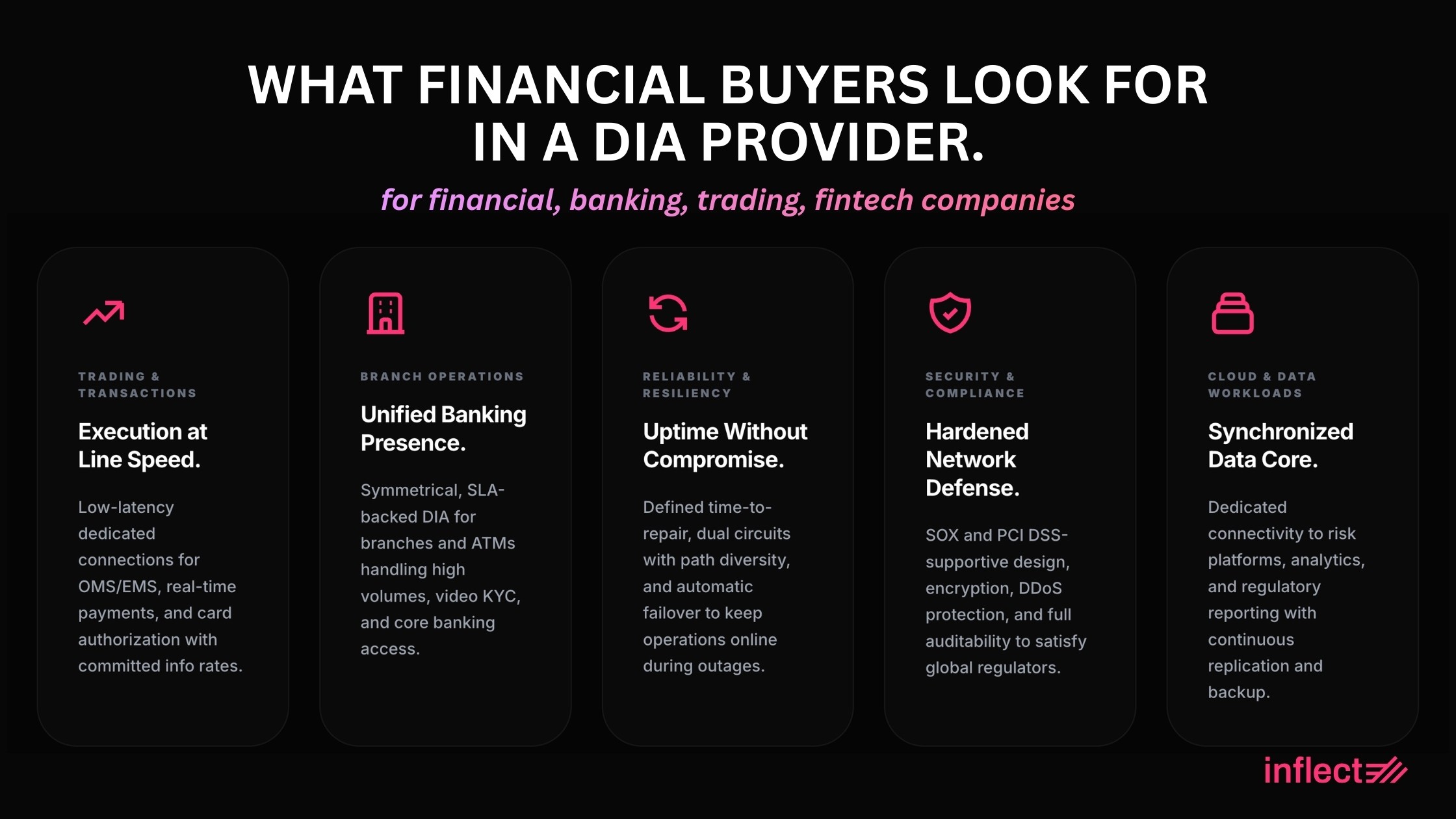
Finance, trading, and banking teams evaluate dedicated internet providers across five core dimensions: trading and transactions, brand operations, reliability and resiliency, security and compliance, and cloud and data workloads.
The table below reflects what consistently appears in financial services RFPs and procurement discussions.
Dimension | What Financial Buyers Expect |
Trading and Transactions | Low-latency, stable dedicated connections for trading platforms, OMS/EMS, real-time payments, and card authorization with committed information rates. |
Branch Operations | Symmetrical, SLA-backed DIA for branches and ATMs handling high transaction volumes, video KYC, VoIP, and secure access to core banking systems. |
Reliability and Resiliency | Strong service level agreements, defined time-to-repair, dual circuits with path diversity, and automatic failover to keep operations online during outages. |
Security and Compliance | SOX and PCI DSS-supportive design, encryption in transit, DDoS protection, edge firewall, and auditability to satisfy regulators and internal security policies. |
Cloud and Data Workloads | Reliable dedicated internet connectivity to cloud-hosted risk platforms, analytics, regulatory reporting, and data warehouses with continuous replication and backup. |
Top DIA Use Cases for Financial Institutions (Fintech, Banking, Trading Companies)
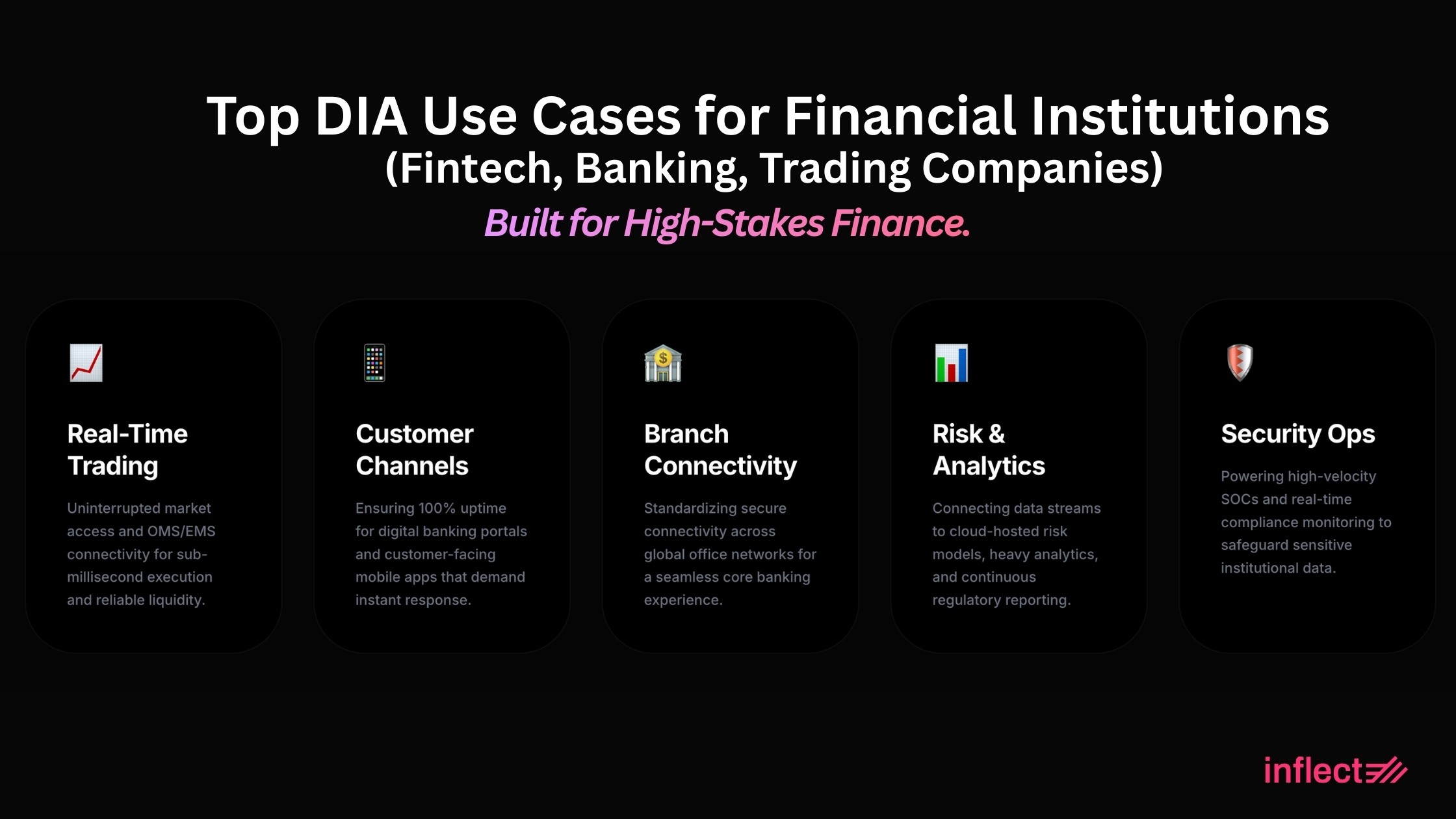
Finance, trading, and banking organizations use dedicated internet access across five critical areas: real-time trading and market access, digital banking and customer channels, branch and office connectivity, cloud-hosted data operations, and cybersecurity and compliance monitoring.
Real-Time Trading and Market Access
Dedicated internet access for trading environments provides the low-latency, stable connectivity that trading platforms, order management systems, and real-time market data feeds require, where milliseconds of latency difference directly affect trade execution quality and profitability. Trading desks and professional traders not fully colocated at exchanges depend on a reliable, uncontended internet connection to reach brokers, liquidity venues, and market data providers with consistent round-trip latency. On a shared broadband connection, congestion during peak market hours creates jitter that disrupts order execution at exactly the moment it matters most.
DIA delivers a committed information rate that ensures the full purchased bandwidth is always available, with fast upload speeds and download speeds that support the two-way data flows trading systems require, as well as the ability to transfer large files including market data archives and trade records quickly and reliably. For firms where sub-20 millisecond latency is a target, the uncontended nature of a dedicated connection removes one of the most controllable sources of variability in the network path.
Digital Banking and Customer-Facing Channels
Dedicated internet access keeps digital banking channels, mobile applications, ATM networks, call center systems, and card authorization services available and responsive around the clock, with the guaranteed bandwidth and uptime SLAs that financial institutions need to meet customer expectations and service availability commitments. Real-time payments, fraud detection checks, and account updates all depend on continuous, reliable internet connectivity between branches, core banking systems, and cloud services. When that connectivity degrades or fails, customer-facing services fail with it.
The business case for DIA in digital banking is straightforward. When customers cannot get online to access their accounts, financial institutions lose money and trust simultaneously. In banking, one survey found that 30% of customers would leave their bank after a major technology outage, and among 25–34‑year‑olds that jumps to 57%. A separate study shows 78% of customers abandon digital banking after technical issues. A dedicated internet connection with a documented uptime SLA is the infrastructure layer that helps prevent these experience‑killing outages (From Swipe to Stay: How Digital Banking Service Quality Drives Customer Retention through Customer Satisfaction, 2025, Consultancy, 2024).
Branch and Office Connectivity
Dedicated internet access at financial services branches and offices delivers the symmetrical speeds, high transaction bandwidth, and reliable connectivity that branch operations require for video KYC, VoIP, video conferencing, real-time analytics, and secure access to core banking systems. Branches handling high volumes of daily transactions cannot operate on shared broadband with no performance guarantees. The combination of customer-facing services, back-office processing, and compliance monitoring running simultaneously demands a dedicated connection that does not degrade under load.
For financial institutions with more locations to connect, a DIA provider with strong on-net coverage ensures consistent internet speed and security standards across every site, from headquarters to smaller regional offices. Inconsistent coverage across locations is one of the most common sources of operational friction in multi-branch institutions.
Cloud-Hosted Risk, Analytics, and Regulatory Reporting
Dedicated internet access provides the reliable, high-speed connectivity that financial institutions need to operate cloud-hosted risk management platforms, analytics tools, regulatory reporting systems, and data warehouse environments continuously, including real-time data replication, backup synchronization, and cross-site data movement without the variability of a shared internet connection. As more financial operations move to cloud environments, the quality of the internet connection between on-premises infrastructure and cloud platforms determines how effectively those platforms perform.
Business continuity depends on continuous, reliable data replication between sites and cloud environments. Transferring large files, including database backups and regulatory archives, requires consistent download speeds and upload speeds that a shared internet connection cannot guarantee. An unreliable connection introduces synchronization gaps that create reconciliation problems, compliance exposure, and recovery complexity.
Cybersecurity and Compliance Operations
Dedicated internet access supports financial services cybersecurity and compliance operations by providing the stable, uninterrupted connectivity that SIEM platforms, threat intelligence tools, and SOC monitoring services need to ingest real-time telemetry continuously, and that staff, auditors, and partners need to access financial systems securely via VPN or zero-trust frameworks. Financial institutions are the most targeted sector for DDoS attacks globally. According to a joint report by Akamai and FS-ISAC, financial services was the top target for volumetric DDoS attacks in 2024 for the second consecutive year, with application-layer attacks against the sector increasing 23 percent between 2023 and 2024 (Akamai, 2025).
A dedicated internet connection with integrated DDoS protection and edge security supports proactive monitoring and provides the first line of defense for public-facing financial services infrastructure. Without mitigation at the network edge, a single volumetric attack can simultaneously take customer-facing services offline and generate significant unexpected bandwidth costs.
The Compliance Case for Dedicated Internet Access
Dedicated internet access directly supports SOX, PCI DSS, and FFIEC compliance requirements by providing documented service level agreements, reliable connectivity guarantees, network security controls, and the auditability that regulators and internal risk teams require. Most compliance discussions in financial services focus on application security and data protection. Network infrastructure gets less attention, but it is equally scrutinized during audits.
PCI DSS requires financial institutions to maintain secure transmission of cardholder data and ensure business continuity for card processing systems. An uncontended, private dedicated internet connection with encryption in transit and documented SLAs satisfies that requirement more cleanly than a shared broadband circuit with no performance commitments. SOX compliance requires controls around data integrity, availability, and auditability for financial reporting systems. The network path carrying that data is part of that control environment.
When evaluating DIA providers for compliance alignment, financial institutions should ask for:
Committed information rate (CIR) documentation: CIR confirms that the purchased bandwidth is always available and not subject to oversubscription. This is the network-level equivalent of a guaranteed performance commitment, and auditors will ask for it (Lenovo, 2026).
SLAs covering latency, jitter, packet loss, and uptime: Uptime SLAs confirm the connection is operational. Latency and packet loss SLAs confirm it performs. For trading systems and real-time payment processing, performance SLAs carry more operational weight than uptime percentages alone.
Defined time-to-repair commitments: How quickly the provider restores service after a failure matters as much as how rarely it fails. Get specific MTTR (mean time to repair) commitments in writing, with escalation paths and service credit terms.
Edge security integration: DDoS protection, firewall options, IDS/IPS capabilities, and support for zero-trust frameworks at the network edge. Ask whether these are included or require separate procurement.
SOC reports and compliance attestations: Providers that carry current SOC 2 Type II reports and can map their controls to PCI DSS and FFIEC guidance reduce the vendor risk assessment burden for compliance and legal teams.
Redundant path diversity: Dual DIA circuits with physically diverse fiber routes ensure branches and trading floors stay online during outages. PCI DSS and SOX business continuity planning explicitly call for network redundancy.
Questions Worth Asking Before You Sign
Not all dedicated internet providers are built for the demands of financial services. The gaps that look minor on paper become compliance and operational problems in practice. Before committing to a provider, push on these:
What is the committed information rate, and is it contractual? Some providers quote headline speeds that are not actually guaranteed under load. CIR should be explicit in the contract, not assumed.
What are your latency and jitter SLAs, not just uptime? For trading platforms and real-time payment systems, connection performance matters more than whether the circuit is technically up. Get performance metrics in the SLA.
What is your time-to-repair commitment? Get a specific number and understand what it includes.
Do you have on-net coverage at all of our locations? For multi-branch institutions, a provider that covers headquarters but not regional branches creates the operational inconsistency you are trying to solve.
Can you provide diverse fiber routing for redundancy? Ask specifically whether the primary and secondary circuits enter the building on physically separate routes. A second circuit sharing the same conduit as the first does not provide real redundancy.
What compliance documentation can you provide? SOC 2 reports, PCI-relevant practices, CIR documentation, and SLA terms all go into vendor risk reviews. Providers that can deliver these quickly are demonstrably easier to work with during audits.
The Bottom Line
Dedicated internet access for financial services gives transaction systems, trading platforms, and customer-facing channels the connectivity standard they require to operate reliably, securely, and in compliance with the regulatory frameworks that govern them. Financial institutions that select internet service on price alone, treating connectivity as a commodity, accept risks in performance, reliability, and compliance posture that rarely make the decision cost effective when the full picture is on the table.
For banks, trading firms, and financial institutions where every minute of downtime has a measurable cost, a dedicated internet service with a committed information rate, documented SLAs, and integrated edge security is not an infrastructure upgrade. It is the baseline for any company operating in financial services where reliability is non-negotiable.
Recommend Reading: Top Dedicated Internet Access (DIA) Providers: An Expert's Guide
Source Dedicated Internet Access for Your Financial Institution
Symmetrical dedicated connections from 1 to 10 Gbps and above. Committed information rates. SLAs covering latency, jitter, and uptime. DDoS protection and edge security built for financial services.
→ Source Financial Services DIA →
Not sure about which one will meet all your requirements? Let our Financial Services DIA Expert handpick the right solutions for you
About the Author

Chanyu Kuo
Director of Marketing at Inflect
Chanyu is a creative and data-driven marketing leader with over 10 years of experience, especially in the tech and cloud industry, helping businesses establish strong digital presence, drive growth, and stand out from the competition. Chanyu holds an MS in Marketing from the University of Strathclyde and specializes in effective content marketing, lead generation, and strategic digital growth in the digital infrastructure space.
Contact:
Email: