7 mins
Top Dedicated Internet Access (DIA) Providers for Q2 2026: An Expert's Guide
If you've ever dealt with unreliable internet at a critical moment, during a video conference with investors, while processing customer transactions, or when your team is trying to access cloud applications, you know exactly why dedicated Internet access matters.
Over the years, I've helped hundreds of businesses navigate the DIA (dedicated internet access) landscape. I've worked with companies opening their first overseas office, financial institutions demanding rock-solid connectivity for trading floors, retailers rolling out new locations, and yes, even helped multiple autonomous vehicle companies turn parking lots into fully connected data hubs.
Here's what I've learned: choosing the right DIA provider isn't just about bandwidth numbers on a spec sheet. It's about understanding your specific use case, location, and business requirements. Then, finding the provider who can actually deliver.
Let me walk you through my top recommendations for Q2 2026, based on real-world experience working with both service providers and buyers.
Understanding Your DIA Options: On-Net vs. Off-Net Providers
Before we dive into providers, let's clarify something that dramatically impacts your pricing, installation timeline, and overall experience: whether your location is on-net or off-net.
On-net means the provider already has fiber infrastructure at or very near your building. This is the ideal scenario: faster installation (often weeks instead of months), significantly lower costs, and better pricing because the provider doesn't need to extend their network to reach you.
Off-net means the provider needs to build out infrastructure to connect your location to their network. This involves construction, permits, right-of-way negotiations, and significantly higher costs. We're often talking about installation timelines of 90-180 days and pricing that can be 2-3x higher than comparable on-net locations.
Understanding Your DIA Needs: Office vs. Datacenter
Office buildings and datacenters are the most common locations requiring DIA, and the requirements differ significantly based on how the connection will actually be used. Your choice of provider should align with whether you're supporting daily business operations or running mission-critical infrastructure.
For office buildings, businesses typically prioritize symmetrical bandwidth (equal upload and download speeds), reliability for daily operations, video conferencing, cloud application access, and consistent performance for their teams.
For datacenters, the conversation shifts to raw bandwidth capacity, redundancy, network stability, peering relationships, and scalability as your infrastructure grows.
Keep this distinction in mind as we go through the recommendations.
Best Pricing- DIA Service Providers
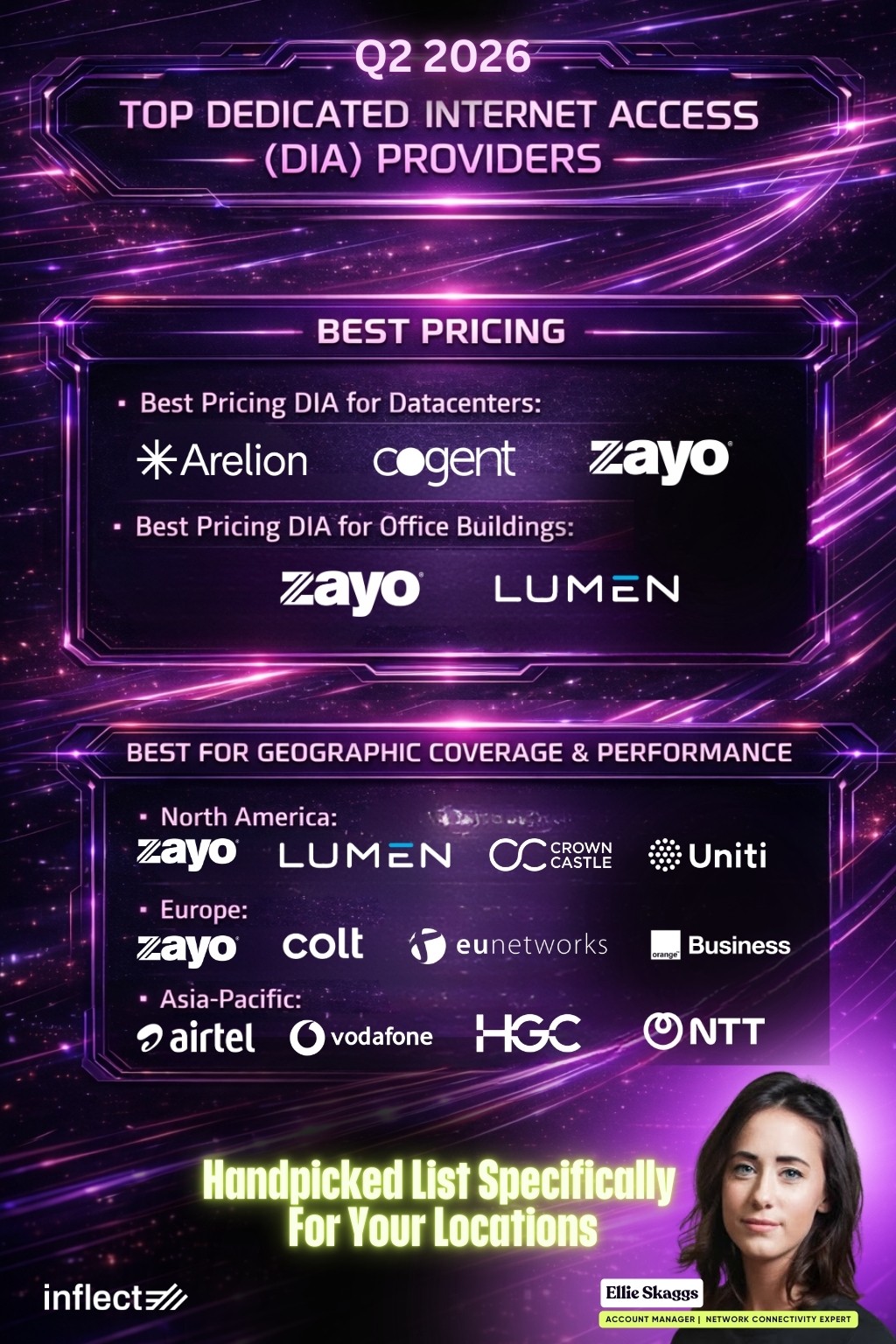
Best Pricing DIA for Datacenters: Arelion, Cogent, Zayo
When it comes to datacenter connectivity, Arelion, Cogent, and Zayo consistently offer the most competitive pricing in the market.
Cogent is particularly known for aggressive pricing on high-bandwidth circuits, while Arelion (formerly Telia Carrier) brings excellent international reach. Zayo rounds out the trio with strong North American coverage and, through Inflect, we've secured exclusive pricing that makes them even more attractive.
If you're comparing quotes, these three should absolutely be on your shortlist for datacenter DIA.
Best Pricing DIA for Office Buildings: Zayo, Lumen
For office locations, Zayo and Lumen are my go-to recommendations when budget is a primary concern.
We have exclusive pricing arrangements with Zayo through Inflect that can significantly reduce your costs compared to going direct. Lumen is also very competitive in the enterprise internet space, particularly in markets where they have strong fiber presence.
Both providers understand business needs, so you're not just getting a pipe; you're getting service level agreements (SLAs) that matter when your entire office depends on that connection.
Best for Geographic Coverage and Performance
Location isn't just important, it's fundamental. The best provider in New York might not even operate in Singapore. And even if they do, their network quality and peering relationships can vary dramatically by region.
Here's where I'd look based on your location:
North America: Zayo, Lumen, Crown Castle, Uniti
Zayo and Lumen dominate the North American market with extensive fiber networks reaching metro areas and secondary markets alike. Their infrastructure is mature, their support is established, and they understand the regulatory landscape.
Crown Castle has been making significant moves in the enterprise connectivity space, particularly in urban markets. Uniti is worth considering if you're in markets where the larger carriers might not have competitive options, they often have fiber where others don't.
Europe: Zayo, Colt, euNetworks, Orange
Europe requires providers who understand the complexity of multi-country operations and diverse regulatory environments.
Zayo maintains strong European presence, but Colt is the standout here. Their pan-European network is purpose-built for business connectivity, and they have deep expertise in financial services and enterprise connectivity.
euNetworks offers excellent performance in their coverage areas, particularly for latency-sensitive applications. Orange Business Services brings the scale and reach you'd expect from a major European telecom, with particularly strong presence in France and francophone markets.
Asia-Pacific: Airtel, Vodafone, HGC, NTT
The APAC region is diverse, and provider selection often comes down to the specific country and city.
Airtel is dominant in India and has growing presence across Asia. Vodafone brings global scale with strong positions in Australia and select Asian markets. HGC (Hutchison Global Communications) offers excellent Hong Kong and China connectivity, critical if you're operating in Greater China.
NTT Communications is the heavyweight here. Their Asian infrastructure is world-class, and they're often the best choice for Japan, Singapore, and when you need reliable connectivity across multiple APAC markets.
Why Work with Inflect Instead of Going Direct?
I get this question constantly: "Ellie, why shouldn't I just call Zayo or Lumen directly?"
Fair question. Here's the honest answer based on what I've seen over the years:
Better Pricing Through Negotiation
Service providers have different pricing tiers. Enterprise customers who bring volume get better rates than individual businesses buying a single circuit. When you work with Inflect, you benefit from our collective negotiating power. Those exclusive arrangements I mentioned with Zayo? That's real money back in your budget.
I've seen cases where our pricing comes in 20-30% lower than what the same company would get going direct. For a multi-year contract, that's significant.
Superior Customer Service and Aftercare
Here's what happens when you sign direct with a carrier: you get a sales rep who's helpful until the contract is signed, then you're handed off to an account manger or support queue, and hope to get the problems resolved if there’s any.
When you work through Inflect, you keep me. If there's an outage, a billing issue, or you need to upgrade capacity, you're not opening a ticket and hoping for the best. You're reaching out to me, and I'm escalating directly to our contacts at the provider.
I've helped clients resolve issues in hours that would have taken days or weeks through normal support channels. In many of the cases, that's the real difference and a lot of the time, that’s the primary consideration for buyers looking for DIA .
Streamlined Multi-Provider Management
Many growing businesses need DIA from different providers in different locations. Managing multiple carrier relationships, billing systems, and support contacts gets complicated fast.
We simplify that. One point of contact (me), consolidated billing options, and someone who actually knows your infrastructure and can make recommendations as you grow.
Choosing Your DIA Provider: What Really Matters
The DIA market has matured significantly. Most major providers can deliver reliable connectivity with good SLAs. What separates them is geographic footprint, pricing structure, support quality, and how well they align with your specific use case.
Speed and bandwidth matter, but so does stability. The cheapest option isn't always the best value if you're dealing with frequent outages or slow support response. Similarly, paying premium prices for features you don't need doesn't make business sense either.
Whether you're connecting a new office building, establishing connectivity for a datacenter, or building out infrastructure for something completely novel (yes, even parking lot data hubs), the right DIA solution needs to match your operational requirements, budget constraints, and growth trajectory.
Need help finding the right fit? I'd be happy to review your specific requirements and put together a shortlist of providers with actual quotes. Just reach out, and let's talk about what you're building.
About the Author

Ellie Skaggs
Account Manager
Ellie Skaggs is the Account Manager at Inflect with multiple years of experience helping businesses secure dedicated Internet access and networking connectivity solutions. Her portfolio spans diverse sectors and use cases, from office buildings and overseas locations to data centers. Notable projects include helping some of the largest autonomous vehicle companies transform parking lots into data hubs, as well as supporting leading financial institutions, retail companies, and enterprises across various industries with their DIA needs.
Contact: