10 mins
Colocation for Financial Services- What Banks, Trading Firms, and Fintechs Actually Need: 2026 Buyer's Guide
Financial services infrastructure carries obligations that no other industry matches. A bank's trading platform going offline costs money by the second. A broker-dealer failing to preserve records in the format SEC Rule 17a-4 requires faces regulatory action. A payment processor experiencing downtime during peak transaction hours creates cascading failures across its client base. The infrastructure decisions financial firms make, where their systems live, how they connect to markets, how sensitive financial data is retained and protected: these are simultaneously compliance decisions, competitive decisions, and risk management decisions across every segment of the financial services industry.
Colocation addresses all three dimensions when it is deployed correctly. The global colocation market reached $84.05 billion in 2024 and is projected to reach $204.41 billion by 2030 at a 14.4% compound annual growth rate, with financial services among the primary drivers of that growth. Financial firms across the financial services sector choose colocation services because the alternative, running owned or leased data centers that meet regulatory, latency, and uptime standards independently, requires capital and operational expertise that most firms cannot justify outside their core business. Colocation delivers the operational efficiency of purpose-built infrastructure without the capital commitment of building it. (Markets and Markets, 2025)
This guide covers what finance-specific colocation actually requires across compliance, latency, uptime, security, and interconnection, and what questions financial firms should ask before selecting a provider.
Financial services colocation is not a commodity infrastructure decision. The regulatory, latency, and uptime requirements of banks, broker-dealers, and trading firms make provider selection and contract terms materially consequential in ways that standard enterprise colocation is not.
Why Financial Services Firms Cannot Treat Colocation as a Generic IT Decision
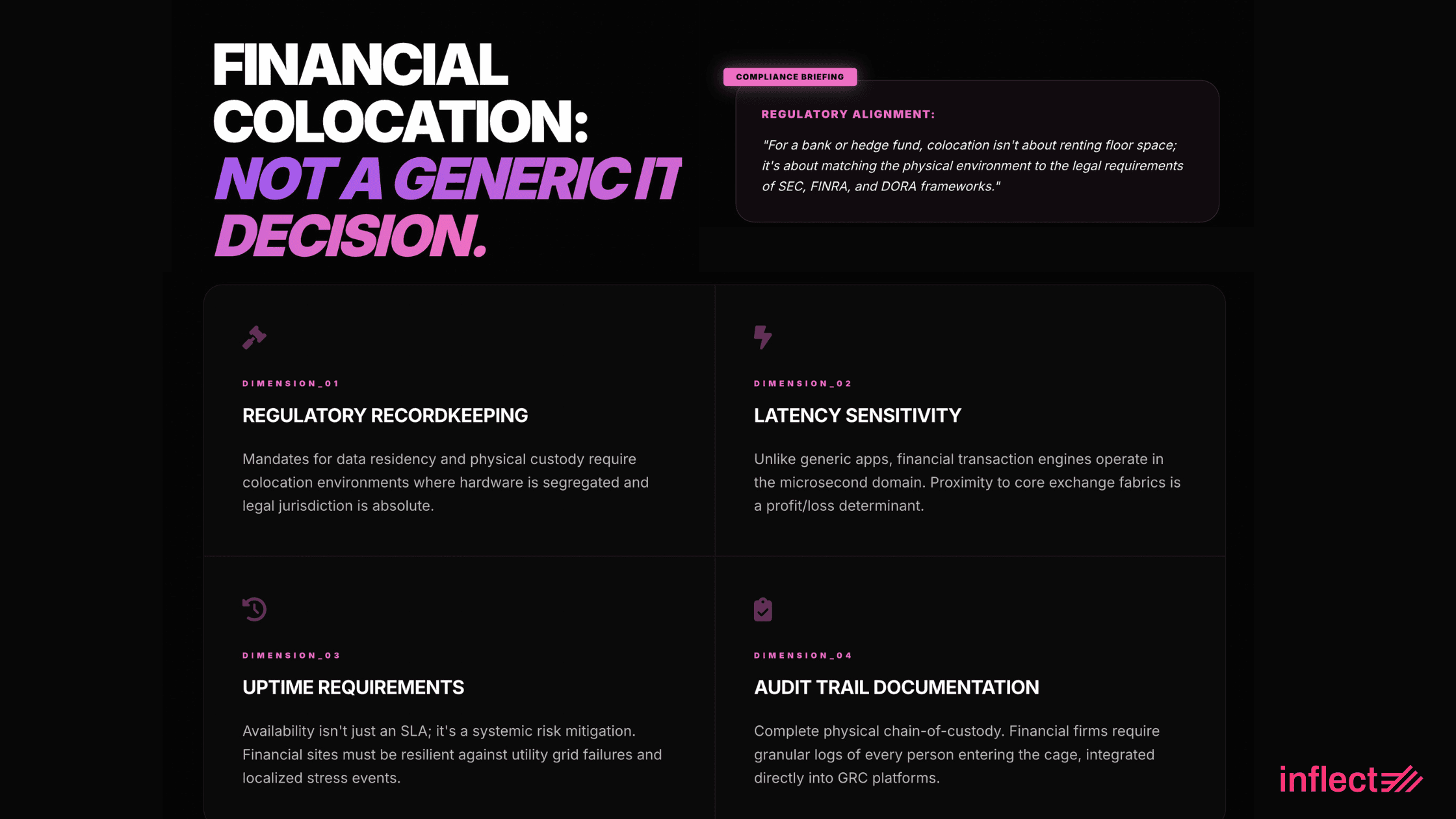
Financial firms across the financial sector face IT infrastructure requirements that are categorically different from general enterprise deployments across four dimensions that colocation directly affects: regulatory recordkeeping obligations, latency sensitivity, uptime requirements, and audit trail documentation.
Regulatory recordkeeping
The SEC and FINRA impose specific technical obligations on how financial records are stored, preserved, and made accessible. SEC Rule 17a-4 requires broker-dealers to retain records on non-rewritable, non-erasable storage, a requirement with direct implications for how storage systems within a colocation environment are configured and documented. FINRA Rule 4511requires records to be preserved for a minimum of six years with accessible retrieval. FINRA Rule 4370 requires formal business continuity plans that contemplate infrastructure failure scenarios. Colocation providers serving regulated financial clients must be able to support audit documentation, provide compliance attestations, and participate in the evidentiary requirements of regulatory examinations.
Latency sensitivity
Algorithmic and high frequency trading now accounts for approximately 55% of US equity trading volume, and for firms competing at trading venues, the margin between a profitable trade and a missed opportunity is measured in microseconds. Low latency connections and physical proximity to exchange matching engines are a direct competitive edge that colocation makes possible. (quantvps.com, 2026) Colocation within or directly adjacent to exchange data centers reduces network latency to single-digit microseconds, a performance level that is physically impossible to achieve from a remote data center regardless of network optimization. (BSO, 2025) The financial value of latency reduction in trading environments makes colocation location, not just facility specifications, is the primary procurement criterion for this segment.
Recommend reading: Dedicated Internet Access for Finance, Trading, and Banking
Uptime requirements
Financial transaction systems, payment rails, core banking platforms, and trading infrastructure are mission-critical applications that require continuous operation and high availability. Their uptime requirements translate to seconds of allowable downtime per year. At 99.999% availability, the annual downtime budget is approximately five minutes and fifteen seconds. A colocation provider offering 99.9% uptime SLAs leaves financial firms with over eight hours of potential annual downtime, which is commercially and regulatorily unacceptable for most financial applications.
Audit trail and physical access documentation
Regulatory examinations, internal audits, and incident investigations all require detailed records of who accessed physical infrastructure and when. Financial firms operating in colocation environments need providers that maintain granular access logs, biometric entry records, and documentation chains that satisfy both internal compliance requirements and external regulatory requests.
Compliance Requirements That Drive Colocation Decisions in Financial Services
Colocation compliance requirements for Financial Services are: SEC Rule 17a-4 and FINRA Rule 4511, PCI DSS, SOC 2 Type II, ISO 27001, DORA (Digital Operational Resilience Act). Financial firms select colocation facilities based on the compliance frameworks their infrastructure must support, and data security at those facilities is a regulatory requirement, not just a preference. Each framework imposes specific technical and procedural requirements on the facility itself, not just on the tenant's systems.
EC Rule 17a-4 and FINRA Rule 4511
SEC Rule 17a-4 and FINRA Rule 4511 govern electronic recordkeeping for broker-dealers and require records to be stored in a format that cannot be overwritten or erased, with a designated third-party having access to records for regulatory purposes. Colocation providers serving broker-dealers must be able to accommodate these storage configurations and provide documentation of physical access controls that protect record integrity. The firm retains responsibility for compliance even when infrastructure is outsourced, FINRA Rule 3190 makes explicit that outsourcing a function does not relieve the firm of its regulatory obligations, which means the compliance documentation generated by the colocation facility becomes part of the firm's compliance infrastructure.
PCI DSS
PCI DSS applies to any financial firm involved in payment processing, or storing or transmitting payment card data. PCI DSS requirements for physical security, network segmentation, and access controls map directly onto colocation environment specifications. A colocation provider seeking PCI DSS-compliant tenants must maintain current Attestation of Compliance documentation, support network segmentation that isolates cardholder data environments, and provide physical access controls that satisfy Requirement 9 of the PCI DSS standard.
SOC 2 Type II
SOC 2 Type II is the baseline certification that financial compliance and vendor management teams require from colocation providers. A SOC 2 Type II report provides independent auditor attestation that the facility's security, availability, processing integrity, confidentiality, and privacy controls operated effectively over a period of time, typically six to twelve months. Point-in-time certifications (SOC 2 Type I) are insufficient for most financial vendor management requirements. Confirm the report period, the auditor, and whether the scope covers the specific facility your infrastructure will occupy.
ISO 27001
ISO 27001 provides international certification of an information security management system and is increasingly required for financial firms with cross-border operations, particularly under European regulatory frameworks. ISO 27001 certification covers the management system, not just technical controls, making it a meaningful indicator of a provider's systematic approach to security governance.
DORA (Digital Operational Resilience Act)
DORA (Digital Operational Resilience Act) came into force for EU-regulated financial entities in January 2025 and imposes specific requirements on ICT third-party risk management, including colocation and data center providers. Financial firms with EU operations must ensure their colocation providers can satisfy DORA's contractual requirements for resilience testing, incident reporting, and exit planning.
Where Financial Services Firms Actually Use Colocation
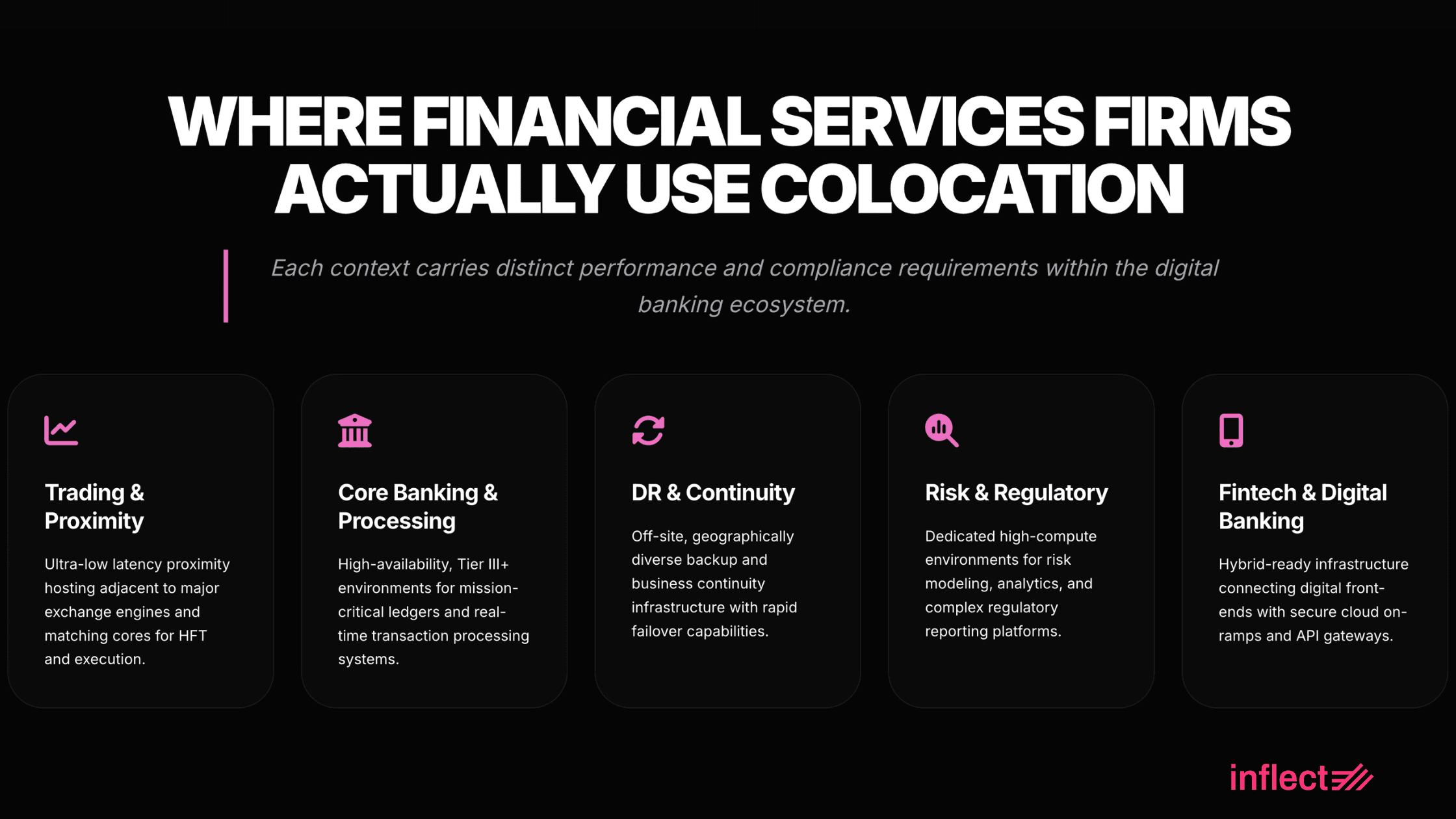
Financial services organizations use colocation across five distinct infrastructure contexts: Trading Infrastructure and Exchange Proximity, Core Banking and Transaction Processing Systems, Disaster Recovery and Business Continuity Infrastructure, Risk, Analytics, and Regulatory Reporting Platforms, and Fintech and Digital Banking Infrastructure. Each with different performance and compliance requirements.
Trading Infrastructure and Exchange Proximity
Trading firms, prime brokers, and market makers colocate trading infrastructure in or adjacent to major financial exchanges to achieve the sub-millisecond latency that algorithmic and high-frequency strategies require. For these firms, selecting the right colocation data center is inseparable from selecting access to the exchange itself. The key exchange colocation facilities in the US include NY4 in Secaucus (New Jersey), which hosts NYSE Euronext matching engines and a dense ecosystem of trading firms, and theCME Group facility in Aurora, Illinois. Placing infrastructure within the same data center as an exchange reduces network latency to single-digit microseconds. (BSO, 2025) At the distances involved in financial trading, fiber optic transmission adds approximately 4.9 microseconds of latency per kilometer, meaning physical proximity to the exchange's matching engine is not an optimization. It is the primary infrastructure decision for speed-sensitive strategies.
For technical teams evaluating trading colocation: the physical infrastructure of the colocation environment and its proximity to the matching engine are the primary latency variables. Cross-connects within exchange colocation environments typically cost $350 to $550 per month, with exchange-specific access ports sometimes carrying additional fees. CME Group charges approximately $12,000 per month for a 10G handoff at its Aurora facility, plus a $2,000 setup fee. Standard NICs add 20 to 50 microseconds of latency; advanced NICs with kernel bypass capabilities reduce this to 1 to 5 microseconds. For firms operating at the highest performance tier, FPGA-based NICs process data in hardware at 100 to 500 nanoseconds.
Core Banking and Transaction Processing Systems
Financial institutions including banks, credit unions, and payment processors colocate core banking platforms, transaction processing engines, and payment rails in carrier-neutral facilities equipped with battery backup systems, redundant cooling systems, diverse fiber entry, and proximity to financial networks. These deployments prioritize uptime and carrier diversity over raw latency. A core banking outage carries both operational and reputational costs that compound faster than in almost any other industry sector. For context, Splunk and Oxford Economics found in their 2024 research that the average annual cost of unplanned downtime for financial services organizations reaches $152 million. (Splunk, 2024) The business case for Tier III or Tier IV colocation over lower-tier alternatives is straightforward: the cost of the facility premium is trivial relative to the downtime exposure it eliminates.
Disaster Recovery and Business Continuity Infrastructure
FINRA Rule 4370 requires broker-dealers to maintain a formal business continuity plan, making disaster recovery colocation solutions a regulatory requirement rather than an optional operational resilience investment. Many financial firms satisfy this requirement by maintaining a geographically separated secondary colocation environment that holds hot or warm standby systems for critical applications. The secondary facility must be sufficiently distant from the primary to avoid single-event failure scenarios, a standard practice is to maintain primary and secondary colocation in metro areas at least 100 miles apart. For regulated firms, the secondary facility must meet the same compliance attestation standards as the primary, because it will host the same regulated workloads during a failover event.
Risk, Analytics, and Regulatory Reporting Platforms
Risk management platforms, real-time analytics systems, and regulatory reporting infrastructure increasingly run in colocation environments rather than on-premises, driven by the high performance computing demands of modern risk calculations, the growth of machine learning in risk modeling, and the data volumes that regulatory reporting now requires. Emerging technologies in AI-driven risk surveillance are accelerating this migration. These workloads are less latency-sensitive than trading infrastructure but have demanding connectivity requirements: they need reliable, high-bandwidth connections to market data feeds, trading systems, and the regulatory reporting destinations that receive trade reports and surveillance data. Carrier-neutral colocation facilities with access to multiple financial data networks, including Bloomberg and Refinitiv connectivity, provide the ecosystem access these systems require.
Fintech and Digital Banking Infrastructure
Fintech firms and digital banks colocate production infrastructure as part of their digital transformation strategy, achieving the combination of performance, compliance documentation, and carrier diversity that regulated financial operations require. The cost effectiveness and scalability of colocation allow these firms to expand their infrastructure as they grow without the capital expenditure of owning facilities. Fintech infrastructure requirements span the full range of the above use cases: payment processing requires PCI DSS compliance, lending platforms require data protection standards, and banking license holders face the full suite of federal and state banking regulations. For early-stage fintechs, colocation provides a path to institutional-grade infrastructure on an operational expense model without requiring the facility investment that regulators increasingly expect from firms seeking banking charters.
What Finance-Specific Colocation Contracts Must Include
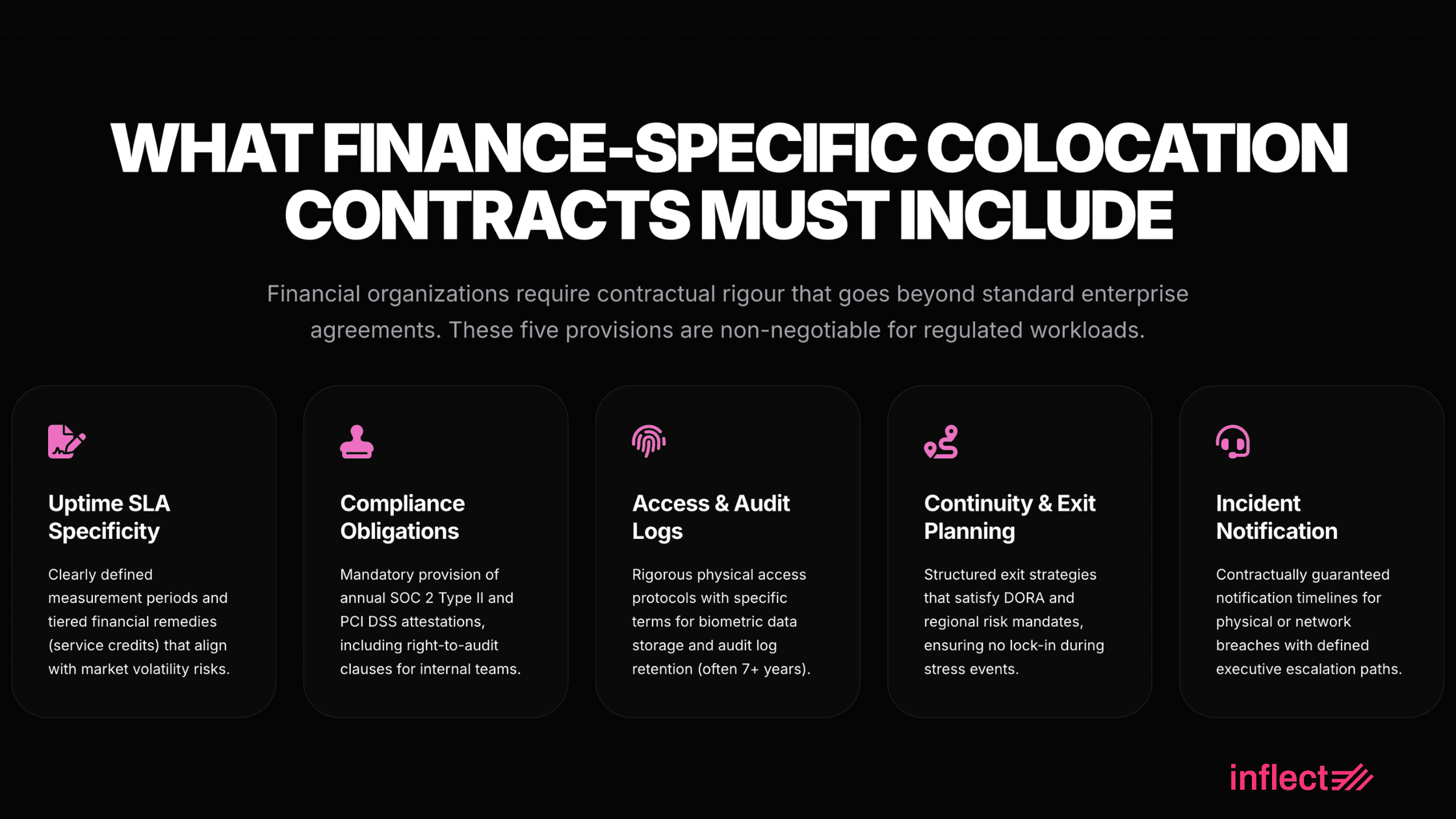
Finance-specific colocation contracts must include five provisions that go beyond standard enterprise agreements: Uptime SLA specificity with defined measurement periods and financial remedies, Compliance Documentation Obligations covering SOC 2 Type II and PCI DSS attestations, Physical Access Controls and audit log retention terms, Business Continuity and Exit Planning that satisfies DORA and internal risk requirements, and Incident Notification Timelines with defined escalation paths. Each is non-negotiable for regulated financial workloads regardless of which colocation provider is selected.
Uptime SLA specificity
The SLA must specify not just an uptime percentage but what the measurement period is, what constitutes a qualifying outage, what the financial remedies are per hour of downtime, and what the escalation path is during active incidents. A 99.999% uptime commitment with a 30-day measurement period and a maximum credit of one month's fees is substantively different from a 99.999% commitment measured annually with uncapped credits. Financial firms should model the realistic downtime exposure under each SLA structure before signing.
Compliance documentation obligations
The contract must require the provider to maintain and make available SOC 2 Type II reports, PCI DSS Attestation of Compliance (where applicable), and physical access logs in formats that satisfy regulatory examination requirements. The contract should also specify the provider's notification obligations in the event of a physical security incident that could affect the integrity of records or equipment.
Physical access controls and audit logs
The contract must specify the access control mechanisms, the format and retention period of access logs, and the process for obtaining access records for regulatory or legal purposes. Biometric access and multi-factor authentication at the cabinet level are standard requirements for regulated financial workloads; confirm these are included rather than available as optional add-ons.
Business continuity and exit planning
DORA and general risk management best practice require financial firms to document how they would exit the colocation relationship and transition infrastructure in an orderly manner. The contract should address data and equipment retrieval timelines, any restrictions on moving infrastructure to a competing facility, and what happens to access records and compliance documentation if the provider is acquired or fails.
Incident notification timelines
Financial regulators increasingly require rapid notification of technology incidents. The contract should specify the provider's obligation to notify the customer of any physical security event, power or cooling failure, or connectivity disruption within a defined timeframe, typically within one hour for significant incidents, with a defined escalation path to senior support personnel.
Questions Financial Firms Must Ask Before Selecting a Colocation Provider
Here are the most important questions that financial services companies, or institutions should ask before selecting a colocation provider:
Which compliance certifications does this facility hold, and when were they last renewed? Request copies of the current SOC 2 Type II report, PCI DSS Attestation of Compliance, and ISO 27001 certificate. Confirm the report period covers the specific hall where your infrastructure will be housed, not just the provider's headquarters.
What is your uptime SLA, and what does it actually cover? Ask specifically about power, cooling, and network path SLAs separately. A facility that guarantees power uptime but not cooling uptime creates an unacceptable gap for financial workloads.
What cross-connects and financial network access points are available in this facility? For trading firms, confirm direct connectivity to the relevant exchange data centers and financial networks. For banks and fintechs, confirm access to the payment rails and financial data networks your systems require.
How are physical access logs maintained and how can we obtain them for regulatory purposes? The answer to this question determines whether your colocation provider can function as an infrastructure partner during a regulatory examination or audit.
What are your notification obligations in the event of a physical or environmental incident? Get a specific timeline and escalation chain in writing, not a general assurance of rapid response.
Can you support DORA compliance documentation requirements, including resilience testing evidence and exit planning? For firms with EU operations, this is a contractual requirement, not a preference.
What is your mean time to repair for power and cooling incidents, and what is your generator runtime? Generator fuel supply and MTTR commitments matter more for financial workloads than for general enterprise deployments.
Why Financial Firms Choose Colocation Over Cloud for Regulated Workloads
Financial services firms operating regulated workloads often find that colocation provides a compliance profile that cloud providers cannot fully replicate, not because cloud is less secure, but because the ownership and documentation model of colocation gives financial firms direct control over their physical infrastructure in ways that cloud environments do not. Running sensitive systems in house is no longer viable for most firms, but colocation provides the same degree of control over the hardware itself.
SEC Rule 17a-4 requires broker-dealers to designate either an executive officer or an unaffiliated third party to submit an undertaking to their designated examining authority, confirming that records are stored in compliant formats. Configuring public cloud storage to meet the non-rewritable, non-erasable requirement of Rule 17a-4 is possible but requires careful architecture and ongoing documentation. In a colocation environment, the physical storage systems are owned and controlled by the firm, simplifying the compliance attestation process.
Physical access control and audit trail requirements are also more straightforwardly documented in colocation environments. The firm knows exactly where its hardware is, who has physical access to it, and what the access log looks like, because those are contractual deliverables from the colocation provider. In a cloud environment, the physical location of hardware and the access controls applied to it are the cloud provider's responsibility and are documented through their compliance reports rather than directly.
For firms with data residency requirements under GDPR, specific state laws, or banking regulations that require data to remain within defined geographic or jurisdictional boundaries, colocation provides explicit, auditable geographic control that cloud deployments require additional architectural effort to achieve.
This does not mean cloud is wrong for financial services, the many benefits of cloud computing make a hybrid architecture a strategic move for most businesses in the sector, with development, analytics, and non-regulated workloads in cloud environments, while regulated transaction processing, record storage, and trading infrastructure run in colocation. Colocation is the right home for the workloads where the firm must own the compliance documentation chain directly.
Choosing the Right Colocation Provider for Financial Services
Financial services companies selecting a colocation provider should evaluate candidates across five dimensions that separate financial-grade facilities from general enterprise colocation: compliance certifications, redundancy and uptime, interconnection, access log granularity, and proven experience with regulated clients.
Compliance certifications: Current SOC 2 Type II, PCI DSS Attestation of Compliance, and ISO 27001 with reports available for vendor management review. Confirm the scope covers the specific hall your infrastructure will occupy, not just the provider's corporate entity.
Redundancy and uptime: Tier III or Tier IV specifications with N+1 or 2N power and cooling redundancy, 99.999% uptime SLAs with substantive financial remedies, 24/7 highly trained on-site staff, and generator runtime sufficient for extended grid outages.
Carrier-neutral interconnection: Multiple network providers hosted within the facility, with cross-connects to financial networks, major exchange data centers, and cloud on-ramps. For trading firms, confirm direct connectivity to the relevant matching engine facilities.
Physical access logs: Granular biometric and multi-factor access records retained in a format and timeframe that satisfies regulatory examination requests. This is a contractual deliverable, not a best-effort service.
Experience with regulated financial clients: Demonstrable track record serving broker-dealers, banks, and fintechs with the compliance documentation depth and contractual commitments that regulated workloads require, not just general enterprise tenants.
The difference between a provider that serves financial firms and one genuinely built for financial services infrastructure does not show up in a facilities tour or a price comparison. It shows up when an auditor arrives.
Find Colocation for Your Financial Services Infrastructure
The many benefits of financial services colocation include carrier-neutral facilities with SOC 2 Type II, PCI DSS, and ISO 27001 certifications. 99.999% uptime SLAs with financial remedies. Exchange proximity and financial network cross-connects. Physical access logs and compliance documentation for regulatory examinations. Purpose-built for banks, broker-dealers, trading firms, and fintechs.
--> Compare Financial Services Colocation Providers
Need help finding the right Colocation for your business?
About the Author

Chanyu Kuo
Director of Marketing at Inflect
Chanyu is a creative and data-driven marketing leader with over 10 years of experience, especially in the tech and cloud industry, helping businesses establish strong digital presence, drive growth, and stand out from the competition. Chanyu holds an MS in Marketing from the University of Strathclyde and specializes in effective content marketing, lead generation, and strategic digital growth in the digital infrastructure space.
Contact:
Email: