15 mins
Wholesale Colocation Near You: How to Evaluate Data Centers Before Requesting a Quote
Which wholesale colocation providers can actually deliver the power you need, in the market you need it, on a timeline your project can survive? That question is harder to answer in 2026 than it was two years ago. Preleasing activity across primary North American markets now covers 74.3% of all capacity still under construction, and vacancy in those markets sits at a record-low 1.4% (Source: CBRE, 2025). Providers are marketing capacity that will not exist for years, and buyers who con

The cost of getting this wrong is not a weak SLA. It is a stalled deployment. The average wait for a new grid interconnection in the United States is now four years (Source: JLL, 2025), and the median time from interconnection request to commercial operation for new generation has doubled since the early 2000s, now running past four years for projects completed between 2018 and 2024 (Source: Lawrence Berkeley National Laboratory, 2025). A shortlist built on marketing claims instead of grid data can cost a project a full construction cycle. Many organizations moving workloads out of the public cloud into private suites make this mistake first, expecting capacity on demand rather than years in advance.
This blog post gives IT directors, procurement leads, and infrastructure teams a structured way to evaluate wholesale colocation providers, near you and beyond, before a single RFQ goes out. It covers what separates wholesale from retail and hyperscale deals, how to test power claims before you trust them, which location and connectivity criteria matter most for cloud computing and AI workloads, and which contract terms determine whether a deal ages well.
Are You Actually Looking for Wholesale Colocation?
Wholesale colocation is the right fit when an organization needs dedicated power capacity from roughly 250 kW up to several megawatts on a long-term lease, generally five to twenty years, delivered through private suites or dedicated halls rather than the per-rack or per-cabinet space and shorter terms typical of retail colocation. It typically suits an organization moving away from its own data center or a smaller off-site data center, giving the tenant control over its own servers, hardware, and networking equipment instead of a managed services model where the provider operates that equipment. Getting this category right first prevents a buyer from requesting quotes that a provider cannot realistically fulfill at the scale intended.
Power and Space Thresholds That Define a Wholesale Deal
Industry practice generally splits data center demand into three tiers: retail colocation below roughly 250 kW on annual or shorter terms, wholesale colocation from roughly 250 kW to a few megawatts on multi-year leases, and hyperscale data center deployments above 4 MW built to suit a single tenant. A buyer sourcing 500 kW to 5 MW of colocation power capacity sits squarely in the wholesale category, where pricing is quoted per kW per month rather than per rack. Smaller businesses and smaller companies with rack-level needs are better served by retail colocation data centers, since wholesale colocation market commitments are sized for large enterprises, not single racks.
What "Near You" Actually Means in Wholesale Colocation
"Near you" in a wholesale colocation search should mean the nearest market with confirmed grid capacity, permitted land, and network density for the workload, not simply the closest metro area on a map. Northern Virginia leads all US markets with 5.9 GW of planned capacity, followed by Phoenix at 4.2 GW and Dallas-Fort Worth at 3.9 GW (Source: JLL, 2025). A buyer searching for capacity near a specific headquarters or user base still has to weigh that proximity against which nearby market actually has power to sell.
Who Buys Wholesale Colocation (Hyperscalers, Enterprises, Colocation Resellers)
Wholesale colocation buyers generally fall into three groups: hyperscale customers such as cloud and AI companies leasing multi-megawatt blocks faster than they can build; enterprise customers consolidating on-premises infrastructure or shifting public cloud workloads into a dedicated footprint; and colocation resellers or cloud service providers subleasing capacity to retail customers. Synergy Research Group reports that hyperscale operators accounted for 48% of worldwide data center capacity at the end of Q4 2025 and are projected to reach 67% by 2031, while non-hyperscale colocation capacity accounted for another 20% and enterprise on-premises data centers 32%. That shift helps explain why competition for wholesale colocation capacity has intensified (Source: Synergy Research Group, 2026).
Common Mistakes When Evaluating Wholesale Colocation Before an RFQ
Buyers evaluating wholesale colocation before an RFQ most often make three mistakes: treating advertised power as power that is actually deliverable on the buyer's timeline, ignoring utility-level constraints outside the provider's control, and comparing wholesale pricing directly against retail per-rack quotes as if the two products were interchangeable. Each of these mistakes surfaces months into a deal, usually after a deposit or letter of intent is already signed. The rest of this post is built to catch them earlier.
How to Evaluate Power Capacity and Redundancy Before Requesting a Quote
Evaluating data center power capacity and redundancy before requesting a quote requires checking four factors: the redundancy architecture behind the power delivery, the gap between advertised and deliverable power, realistic interconnection timelines, and the provider's renewable energy commitments.
Power Delivery Architecture and Redundancy Tiers
Uptime Institute's Tier III standard requires concurrently maintainable, N+1 redundant power distribution components rated for 99.982% availability, while Tier IV adds fault tolerance with 2N or 2N+1 configurations rated for 99.995% availability (Source: Uptime Institute, 2025). A wholesale buyer should confirm which tier applies to the suite being leased, since a campus can hold mixed tier levels across different halls.
For technical teams: request the Tier Certification documentation for the specific power train serving your suite, not the facility's overall marketing tier, and confirm whether certification covers design only or design plus constructed facility.
Advertised vs. Deliverable Power in the Local Market
Advertised power is the capacity a provider markets as available; deliverable power is the capacity backed by signed utility agreements and a construction schedule the buyer can verify, and the gap between the two has widened as interconnection queues have grown. Commercial electricity rates have also risen nearly 30% since 2020, reaching an average of 9.7 cents per kWh in the first half of 2025, which is pushing new development toward lower-cost markets such as Salt Lake City at 5.7 cents per kWh and Denver at 6.4 cents per kWh (Source: JLL, 2025). A buyer comparing data center power availability by market should ask for the utility interconnection agreement date, not just the megawatt figure on a marketing sheet.
Time-to-Power and Interconnection Timelines
Time-to-power is the number of months or years between a signed colocation agreement and energized power at the rack, and it is now shaped as much by utility interconnection queues and substation capacity as by the provider's own construction schedule. Any need for new high-voltage transmission or incremental generation can extend interconnection timelines to 24, 36, or more than 48 months (Source: CBRE, 2025), and the median duration from interconnection request to commercial operation nationally has doubled to more than four years for projects completed between 2018 and 2024, with only 13% of requests filed between 2000 and 2019 having reached commercial operation by the end of 2024 (Source: Lawrence Berkeley National Laboratory, 2025). This is also where land and substation control separate providers that look similar on paper: two facilities can both claim future capacity, but only the one that controls adjacent land and holds a confirmed substation queue position can actually deliver it on schedule.
Renewable Energy and Sustainability Commitments
Renewable sources currently supply 27% of the electricity consumed by data centers worldwide, a share the International Energy Agency projects will rise to roughly 50% by 2030 as wind and solar generation expands (Source: International Energy Agency, 2026). A wholesale buyer building a case for sustainable digital infrastructure should ask for the specific renewable percentage tied to the facility's local grid mix, not a corporate-wide figure that may not apply locally.
How to Evaluate Location and Connectivity Before Requesting a Quote
Evaluating a data center's location and connectivity before requesting a quote means checking four things: carrier density and fiber access, the cloud and AI network ecosystems reachable on-site, latency fit for the workload, and how saturated the local power grid already is.
Proximity to Fiber Routes and Carrier Density
A wholesale site's value depends on how many carriers and fiber routes physically terminate there, since a carrier-neutral facility with dense fiber access lets a large tenant negotiate connectivity independently rather than relying on a single network provider. Buyers evaluating carrier-neutral data centers in the US should request a current list of on-net carriers and cross-connect pricing before assuming density based on the market's general reputation.
Cloud On-Ramps and AI Network Ecosystems
Facilities relevant to hybrid cloud and AI workloads should offer direct on-ramps to the major cloud providers, including AWS, Microsoft Azure, Google Cloud, and Oracle Cloud Infrastructure, along with access to emerging interconnection platforms that link GPU clusters across sites. This matters most for enterprises running hybrid cloud and AI deployments, where training happens in one location while inference needs low-latency paths to cloud services elsewhere.
Latency Requirements for Your Workload
Latency-sensitive applications, such as financial trading systems or real-time inference serving live traffic, need sites chosen for network proximity to end users or exchanges, while large batch workloads like AI model training and high performance computing can tolerate sites farther from population centers in exchange for cheaper, more available power. Some workloads run entirely within a single data center, while others split capacity across two or more markets for disaster recovery. A buyer should define the workload's actual latency tolerance in milliseconds before filtering markets, rather than defaulting to the nearest major metro.
Power Grid Constraints in Saturated Markets
The most established wholesale markets are also the most power-constrained: Northern Virginia currently holds 5.6 GW of operating capacity, more than triple the capacity of the next-largest market, Dallas-Fort Worth, at 1.5 GW (Source: JLL, 2025), and average wholesale asking rates in Ashburn, Virginia breached $215 per kW per month in the second quarter of 2025 (Source: CBRE, 2025). Buyers evaluating data center power availability by market should treat grid saturation, not just current pricing, as a leading indicator of future cost and how long a deal will take to energize.
How to Evaluate Facility Risk and Compliance Before Requesting a Quote
Evaluating facility risk and compliance before requesting a quote covers three areas: the certifications the facility holds, the physical security standards in place, and the financial stability of the provider and the underlying landlord.
Certifications That Matter for Wholesale Deals
Wholesale buyers most commonly request three certifications: SOC 2 Type II for security and operational controls, ISO 27001 for information security management, and Uptime Institute Tier Certification for the facility's power and cooling design. A buyer with sector-specific compliance obligations, such as HIPAA or PCI DSS, should confirm the facility supports those requirements directly rather than assuming general certifications cover them.
Physical Security Standards for Large Deployments
Large deployments warrant facility-wide physical security controls: perimeter fencing and vehicle barriers, mantrap entry vestibules, biometric access control at the suite level, fire suppression systems, and an on-site security operations center monitoring the facility around the clock. A wholesale tenant leasing an entire suite or hall should confirm whether these controls are shared across the campus or dedicated to its own footprint.
Assessing Provider and Landlord Financial Stability
Because wholesale leases commonly run ten years or longer, a buyer should assess the financial stability of both the data center operator and the landlord, since a change in ownership or financial distress can affect expansion rights and service continuity years into the lease. For publicly traded providers and REITs, this means reviewing recent SEC filings and credit ratings; for privately held operators, it means requesting audited financials or bank references as part of due diligence, not after a letter of intent is signed.
How to Evaluate Scalability and Contract Terms Before Requesting a Quote
Evaluating scalability and contract terms before requesting a quote means checking four commercial elements: expansion rights, SLA protections, minimum commitment structures, and pricing and escalation clauses.
Expansion Capacity and Phased Buildout Rights
A wholesale contract should specify a right of first refusal on adjacent capacity, since a facility full today may have no room for growth in year three of a ten-year lease. Buyers should confirm whether expansion capacity is contractually reserved or simply implied in sales conversations, since only the former survives a change in the provider's other commitments.
SLA Terms That Protect Large Deployments
SLA terms for wholesale deals should specify uptime guarantees and high availability commitments tied to the facility's certified tier to ensure continuous operation, defined remedies and service credits for outages, and clear escalation paths for both power and cooling incidents. A buyer should negotiate these terms before signing, since SLA language added after a contract is executed rarely improves in the buyer's favor.
Minimum Commitments and Take-or-Pay Structures
Many wholesale contracts include a minimum commitment or take-or-pay structure, where the buyer pays for reserved power capacity whether or not it is fully utilized; wholesale economics have historically favored deals above 1 MW, but providers have increasingly competed for deals in the 250 kW to 500 kW range as demand has intensified (Source: Data Center Knowledge, 2026). Buyers should model their actual ramp schedule against the minimum commitment before signing, since paying for unused reserved capacity for the first two years of a ten-year term is a common and avoidable cost.
Pricing Structures and Escalation Clauses
Wholesale colocation pricing is typically quoted as a reserved capacity fee per kW per month plus metered energy charges; average asking rates for 250-to-500-kW blocks in primary US markets reached $196.25 per kW per month in the second half of 2025, up 6.6% year over year, while pricing for 3-to-10-MW requirements rose 12.5% year over year (Source: CBRE, 2025). Most contracts also include an annual escalator, so a buyer evaluating colocation contract terms and SLAs should model total cost across the full lease term using the escalator rate, not just the year-one quoted price.
Wholesale Colocation Pre-RFQ Checklist (Power, Location, Risk, and Terms)
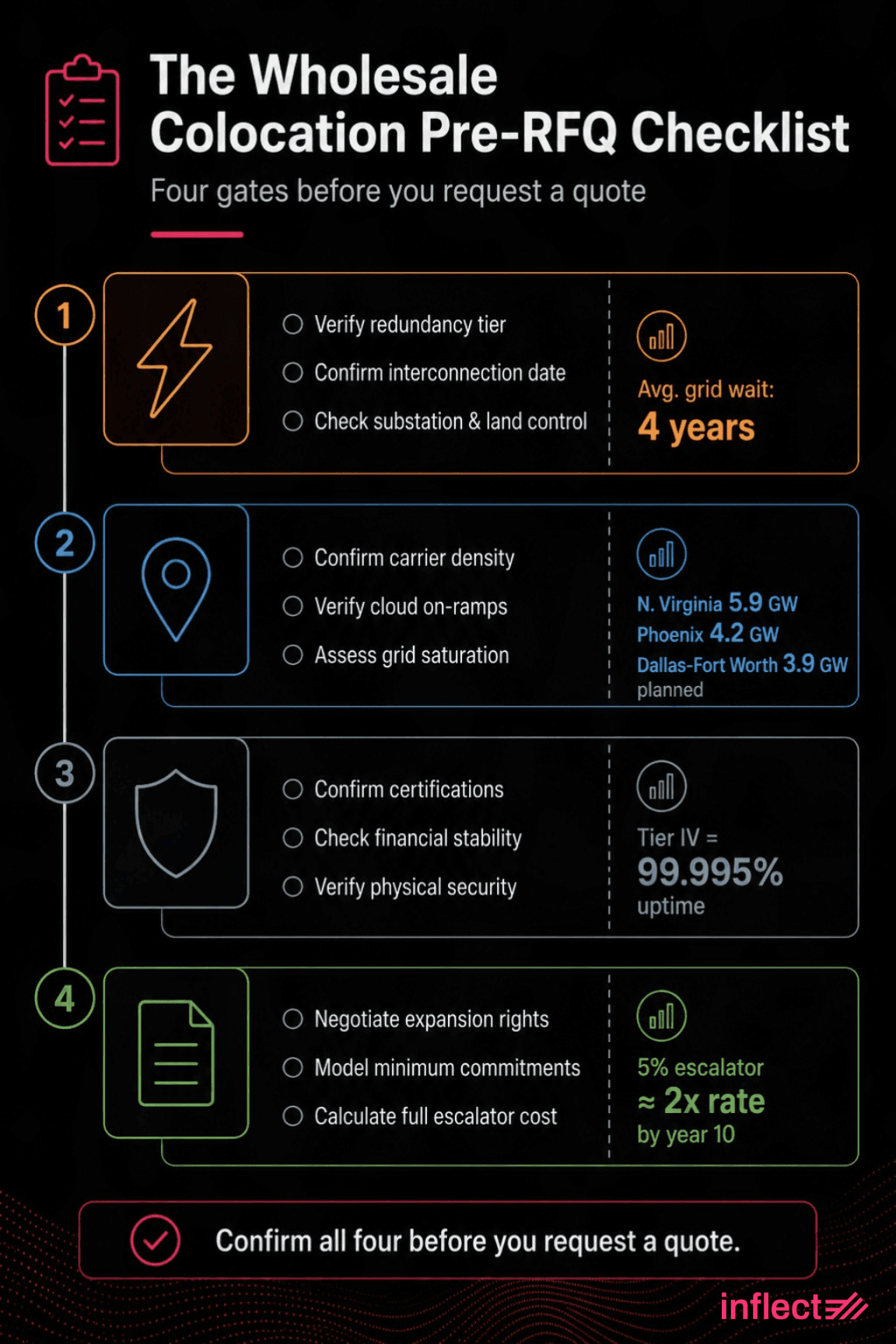
Power: Verify the redundancy tier certified for your specific suite. Confirm the utility interconnection agreement date behind any advertised megawatt figure. Request the substation queue position and confirm the provider controls adjacent land for future phases.
Location: Confirm on-net carrier count and cross-connect pricing. Verify direct on-ramps to the cloud platforms your workload depends on. Assess grid saturation in the target market, not just current asking rates.
Risk: Confirm SOC 2, ISO 27001, and Uptime Tier certification status for the specific facility. Review the provider's and landlord's financial filings or audited statements. Verify physical security controls at the suite level.
Commercial terms: Negotiate expansion rights or right of first refusal on adjacent capacity before signing. Model your ramp schedule against any minimum commitment or take-or-pay structure. Calculate total lease cost using the full escalator schedule, not the year-one rate.
How to Compare Wholesale Colocation Availability and Pricing Across Markets
Most of the evaluation work above depends on data providers do not volunteer upfront, which is why buyers increasingly compare options on a marketplace before engaging any provider directly. Inflect is a digital infrastructure marketplace giving buyers global reach to search wholesale colocation capacity by market and megawatt requirement and receive instant pricing without a sales call, spanning 6,000+ data centers and facilities across 100+ countries. Providers confirmed on the platform for large-scale colocation include Equinix, Digital Realty, NTT, QTS, CyrusOne, CoreSite, and Iron Mountain, alongside hundreds of others, so hyperscale customers and large enterprises sourcing 20 MW in Dallas, a dedicated suite in Northern Virginia, or capacity across Latin America and Asia Pacific can see options side by side instead of running separate outreach to each provider. Free expert advisory is available at no charge to buyers who want a second read on power deliverability or contract terms before finalizing a shortlist.
Buyers still complete their own due diligence on interconnection timelines, certifications, and financial stability using the criteria above; the marketplace shortens the search, not the evaluation.
Build Your Wholesale Colocation Shortlist Before You Request a Quote
Compare confirmed power capacity, not advertised capacity, across every market on your shortlist
Get instant, side-by-side pricing on wholesale colocation without a sales call
Access free expert advisory to pressure-test interconnection timelines and contract terms
Search specific megawatt requirements by market instead of contacting providers one at a time
Start your wholesale colocation search on Inflect to compare verified capacity and pricing for your business before you request a single quote.
About the Author

Haley Rogers
Content & Social Media Specialist
Haley Rogers is the Content & Social Media Specialist at Inflect, bringing over two years of experience in social media, marketing, and content strategy — including time at a fast-paced tech company before joining the Inflect team. She specializes in translating complex digital infrastructure topics into clear, engaging content, with a particular focus on blog writing and brand storytelling across channels.
Contact: