17 mins
What Happens When Your GPU Lease Ends: Migration, Renewal, and Exit Strategy Planning
What actually happens the day a GPU lease expires depends almost entirely on decisions made months earlier, and most infrastructure teams do not like the answer once they find out. A training run halts mid-epoch. The team goes looking for replacement capacity and finds the next available H100 or H200 allocation is eight to twelve weeks out, because the renewal notice window closed without anyone flagging it, or because the provider could not extend the allocation due to upstream HBM and packaging constraints. The model release slips a quarter. None of this was a technology failure. It was a planning failure with a fixed, foreseeable date attached to it.

That date is not a surprise. It is printed in the contract. Yet GPU lease terms get treated as a background procurement detail rather than an infrastructure milestone, largely because the team that signed the contract under capacity pressure eighteen months ago is not the team managing the workload today. The result is a recurring pattern across AI infrastructure teams: the lease end date arrives, and the choice between renewing, migrating, or exiting gets made in weeks instead of months, with far less leverage than the buyer actually had.
This post lays out what happens at each stage of a GPU lease end, a framework for deciding between renewal, migration, and exit, and the specific contractual and operational steps each path requires. The goal is to move that decision from a reactive scramble to a planned transition, starting with why the clock needs to start six months earlier than most teams assume.
Why GPU Lease End Dates Require Planning Six Months in Advance
GPU lease end planning has to start roughly six months before contract expiration because of two compounding forces: GPU capacity is scarce enough that replacement allocation is not available on demand, and most GPU contracts contain clauses that convert inaction into an outcome the buyer did not choose. Demand for cloud GPU and GPU infrastructure keeps compounding the first problem: the global GPU-as-a-service market was estimated at $4.37 billion in 2025 and is projected to grow at a 16.0 percent compound annual rate through 2033 (Source: Grand View Research, 2026). Both forces are structural, not provider-specific, and both punish teams that wait until the final quarter to act.
GPU Capacity Constraints That Affect Renewal, Migration, and Exit
GPU capacity constraints shape every lease end decision because they set the floor on how quickly a buyer can replace, upgrade, or walk away from an existing allocation. Nvidia H100 and H200, among the most powerful GPUs available for large-scale training, saw lead times swing from over 50 weeks in 2023 down to 8 to 12 weeks by April 2024, and have since extended again as demand and packaging bottlenecks reasserted themselves (Source: Tom's Hardware, 2024). That volatility matters because it means the lead time a team assumes when signing a contract is rarely the lead time they face at renewal. A buyer who assumes month-to-month flexibility because that was true two years ago may find that assumption no longer holds.
The underlying constraint sits further up the supply chain than the GPU itself. TSMC's CoWoS packaging capacity and HBM, the specialized GPU memory produced by SK Hynix and Samsung, are the binding limits on new GPU supply, and both remain fully allocated well into the current planning cycle. Capacity secured at signing is not capacity guaranteed at renewal, and any migration or exit plan has to build in a real acquisition window for replacement hardware, not a theoretical one.
Auto-Renewal Clauses and Notice Windows You Can Miss
Auto-renewal clauses convert a missed notice deadline into a new contract term automatically, and the notice window is typically 60 to 120 days before expiration depending on the provider. If that window passes without written notice, the buyer is often locked into another full term, sometimes at the original rate and sometimes at a rate the contract allows the provider to reset. For a multi-year GPU commitment, missing this window is not a minor administrative lapse. It can mean another one to three years at terms the buyer no longer wants.
The fix is procedural, not strategic: the notice deadline needs to sit on a calendar owned by someone who is still with the team at renewal time, not buried in a contract PDF from the original signing.
Rate Resets and Pricing Step-Ups at Lease End
Rate resets and pricing step-ups are contract clauses that allow the provider to reprice the agreement at renewal, often tied to list price, hardware generation, or a stated percentage increase. Buyers who negotiated an aggressive discount at signing, common when GPU providers were competing hard for anchor customers, are the most exposed to a step-up at renewal, since that discount was often tied to a promotional rate that does not carry forward automatically. Reading the repricing mechanism before signing is the only reliable way to know what renewal actually costs.
How to Decide: Renewal vs. Migration vs. Exit
Deciding between renewal, migration, and exit at GPU lease end comes down to three questions: is current capacity still available and cost-competitive, does a new GPU generation or provider offer a material performance gain, and is the underlying workload still growing. Renewal, migration, and exit each carry distinct advantages depending on workload characteristics, whether the underlying work is machine learning training, computer vision, fine-tuning, or large model training. Answering those three questions in order eliminates most of the ambiguity teams face when a lease end date approaches.
Stay If…
Renewal is the right call when current capacity is already reserved or contractually extendable, the switching cost of moving to a new provider exceeds roughly 15 to 25 percent of the total cost of the annual contract once migration engineering time and egress fees are counted, and there is no material hardware generation gap between the current fleet and what a new provider would offer (illustrative threshold, not a universal benchmark). This is especially true for high performance computing and scientific computing workloads that prioritize consistent performance and cost efficiency over chasing the newest hardware generation. In this scenario, the effort of renegotiation is almost always lower than the cost of a full migration.
Migrate If…
Migration is the right call when a next-generation GPU class, such as a move from H100 to H200 or B100-class hardware, offers a material performance-per-dollar gain for the workload, or when the current provider cannot guarantee a capacity extension at renewal. It is also the right call when regional availability, latency requirements, or data sovereignty requirements push the workload toward a location the current provider cannot serve, including facilities capable of supporting liquid cooling for high-density GPU racks.
Exit If…
Exit is the right call when the underlying workload is winding down, budget has been cut below the level needed to sustain the commitment, or the architecture itself is shifting away from dedicated GPU capacity toward lower-intensity inference, CPU-based serving, or a hybrid model. Exit is the only path of the three that closes out the relationship entirely, and it carries the most contractual cleanup of the three options.
Renewal Strategy: When to Stay and How to Renegotiate
Renewal is the strategy of extending an existing GPU contract on updated terms, and it works best when the buyer treats the renewal date as a negotiation opportunity rather than a formality to be accepted at whatever terms the provider proposes.
When Staying With Your Current Provider Actually Makes Sense
Staying with an existing GPU provider makes sense when the provider has consistently delivered the reserved capacity without shortfalls, the current rate remains competitive against the market at renewal, and switching would force a workload migration the team does not have engineering bandwidth to execute safely. Renewal is frequently the lower-risk option precisely because it avoids the operational disruption that migration and exit both introduce.
Renegotiation Leverage Points Before Your Lease Expires
Renegotiation leverage exists at three points in the lease cycle: the initial notice window, when the provider first learns the buyer may not renew automatically; the capacity conversation, when the buyer can ask for a hardware refresh as a condition of renewal; and the competitive quote, when the buyer has a comparable offer from an alternative provider in hand. Buyers who show up to a renewal conversation with a documented alternative quote and a clear cost comparison consistently negotiate better terms than those who do not, because the provider is no longer negotiating against inertia.
Rate Card Changes and Hardware Generation Upgrades at Renewal
Rate card changes at renewal typically move in one of two directions: the provider offers a lower per-GPU rate on the same hardware generation for a longer commitment, or a hardware generation upgrade at a comparable rate to retain the account. Buyers should request both options explicitly rather than accepting whichever one the provider proposes first, since a team running steady-state inference may prefer predictable operating costs on existing hardware, while a team still training frontier-scale models may get more value from the upgrade even at a higher per-unit cost.
Migration Strategy: Moving GPU Workloads Without a Compute Gap
Migration is the process of moving an AI workload from one GPU provider to another before or at lease end, and doing it without a compute gap requires securing replacement capacity, moving data, and sequencing the cutover before the current lease terminates rather than after.
Migration is the process of moving an AI workload from one GPU provider to another before or at lease end, and doing it without a compute gap requires securing replacement capacity, moving data, and sequencing the cutover before the current lease terminates rather than after.
Securing replacement capacity is the first and most time-sensitive step in any GPU migration, because reserved capacity at a new provider often carries the same multi-week to multi-month lead time as the original lease did. Buyers should reserve replacement capacity as soon as the migration decision is made, not once the current lease is close to expiring, since queue times for large GPU clusters and regional allocation limits do not shrink to fit a buyer's timeline. On-demand capacity, sometimes accessed through shared GPU pools, spot instances, or on-demand rates rather than reserved instances, can bridge a short gap, but it is priced at a premium and is not a substitute for a reserved allocation.
For technical teams: providers that support multi-instance GPU (MIG) partitioning can offer fractional allocations that ease queue times for smaller inference workloads, though large-scale distributed training clusters running across multiple GPUs still require dedicated, full-GPU allocation and InfiniBand connectivity between nodes.
Data Egress Costs and Transfer Timelines for Large Training Datasets
Data egress costs and data transfer timelines are the two variables that most often blow up a migration schedule, because moving petabyte-scale training data and model checkpoints between providers takes both time and money that teams underestimate. Standard cloud egress pricing runs $0.09 per GB for the first 10 TB after a free monthly allowance, stepping down at higher volumes (Source: Amazon Web Services, 2026). At that rate, moving 50 TB of training data costs roughly $4,400 in egress fees alone, before accounting for cross-region transfer or NAT gateway charges that can add significantly more.
For technical teams: transferring 5 petabytes of data over a sustained 40 Gbps link takes approximately 12 days under ideal, uninterrupted conditions (illustrative calculation based on raw throughput, not a vendor benchmark). Real transfers run longer once retries, shared bandwidth, and validation checksums are factored in, which is why migration timelines should be built around weeks, not days, for any dataset above the low single-digit terabyte range.
Model Weights and Checkpoint Sequencing
Checkpoint sequencing is the order in which model weights, optimizer states, and model checkpoints move to the new environment, and getting the order wrong is the most common cause of a failed or corrupted migration. The safest sequence starts with the most recent stable checkpoint, validates it in the new environment against a held-out evaluation set, and only then migrates the full checkpoint history and any in-flight training state, particularly for large model checkpoints that can run into hundreds of gigabytes each. Moving a live, in-flight training run should be avoided wherever possible. It is far safer to complete the current epoch, checkpoint cleanly, and migrate a stopped training job than to move a running one.
Parallel-Run (Dual Capacity) Strategies to Eliminate GPU Compute Gaps
Parallel-run strategies eliminate compute gaps by overlapping the old and new GPU environments for a defined transition window, occupying a middle ground between an abrupt cutover and an extended delay, so inference workloads or training jobs can shift gradually rather than cutting over all at once. This means running production inference on both the legacy and new provider simultaneously for one to two weeks, routing a small percentage of traffic to the new environment first, and only decommissioning the old capacity once the new environment has proven stable under real load. The approach mirrors what virtualization teams call live migration, and it preserves high availability throughout the cutover. Dual capacity costs more during the overlap window, but that cost is almost always smaller than the cost of an unplanned outage or a failed cutover that forces a rollback under pressure.
Exit Strategy: Obligations, Costs, and How to Protect Yourself Next Time
Exiting a GPU provider entirely, rather than renewing or migrating to a new one, triggers a distinct set of contractual and physical obligations that buyers need to plan for well before the termination date, and it is also the point in the lifecycle where the next contract should be shaped to avoid repeating the same exposure.
Data Deletion, Certification, and Compliance Requirements
Data deletion and certification requirements obligate the outgoing provider to destroy the buyer's data and provide documented proof of that destruction, and buyers in regulated industries need this certification on file as part of their own compliance record. Buyers should confirm in writing what deletion method the provider uses, what timeline applies after termination, and whether a formal certificate of destruction is issued automatically or must be requested.
Early Termination Fees and Minimum Commitment Clawbacks
Early termination fees and minimum commitment clawbacks are the financial penalties a buyer faces for leaving a GPU contract before its term ends or below its committed usage level. Multi-year GPU contracts, particularly with specialized GPU cloud providers, are frequently structured as take-or-pay agreements where the buyer commits to a fixed capacity and rate for two to five years and pays regardless of actual usage. This differs from the reserved instance commitments buyers may already know from hyperscalers such as Google Cloud or Azure, which typically offer more granular terms and shorter minimum commitments. Buyers considering an early exit should model the termination penalty at year one, two, and three of the commitment, since clawback exposure typically shrinks as the contract matures, and the best exit timing can differ from the date that feels most convenient operationally.
Hardware Return Requirements for Dedicated and Bare Metal GPU Leases
Hardware return requirements apply specifically to dedicated and bare metal GPU leases, where the buyer has physical or exclusive logical access to leased bare metal servers and equipment that must be returned, wiped, or accounted for at termination. Unlike shared cloud GPU instances, bare metal and colocated deployments often carry explicit return-condition clauses, including liability for damaged or missing components, so buyers should schedule decommissioning with enough lead time to avoid holdover fees for equipment not returned by the deadline.
Multi-Provider Sourcing Strategies to Reduce Lock-In
Multi-provider sourcing spreads GPU workloads across more than one provider so that no single contract's end date or capacity shortfall can force an unplanned compute gap. This can mean splitting training and inference workloads across two providers, keeping a smaller standby reservation with a secondary provider, or structuring workloads to be portable across hardware generations and GPU orchestration stacks from the outset. The tradeoff is added operational complexity in exchange for negotiating leverage and resilience against any single provider's constraints.
Protective Contract Clauses to Negotiate Into Your Next Lease
Protective contract clauses are the specific terms a buyer should request in any new GPU agreement to avoid repeating the same exit exposure: a defined notice period with no automatic renewal, an explicit data portability and export commitment, a capped or graduated early termination fee rather than a full remaining-term payout, and a clearly stated hardware return or decommissioning process with a realistic timeline. None of these clauses are unusual asks. They are simply the terms that get skipped when a contract is signed under capacity pressure rather than negotiated on a normal timeline.
Where to Find Replacement GPU Capacity for Each Path
Whichever path a buyer chooses, the practical bottleneck is the same: finding and pricing replacement or comparable GPU capacity fast enough to act on the decision. Inflect is a digital infrastructure marketplace where buyers can search, compare, and receive instant pricing across 6,000+ data centers and facilities in 100 or more countries, covering colocation, bare metal, GPU cloud, dedicated internet access, and private networking for AI workloads and beyond. That coverage includes providers such as Equinix, Digital Realty, CoreSite, and TierPoint, searchable by specific capacity and region rather than a generic inquiry form.
For a buyer heading into a renewal conversation, Inflect makes it possible to pull a comparable market quote in the same week, not the same quarter, which is exactly the renegotiation leverage described earlier, and a cost-effective way to confirm current terms are still competitive. For a buyer migrating, it means sourcing replacement capacity in a specific market without a sales call, plus expert advisory on the sourcing decision at no charge. Buyers do not need to have already decided between renewal, migration, or exit to start that search. Current market pricing in hand is what makes the decision faster and better informed, regardless of which path gets chosen.
Your GPU Lease End Planning Checklist
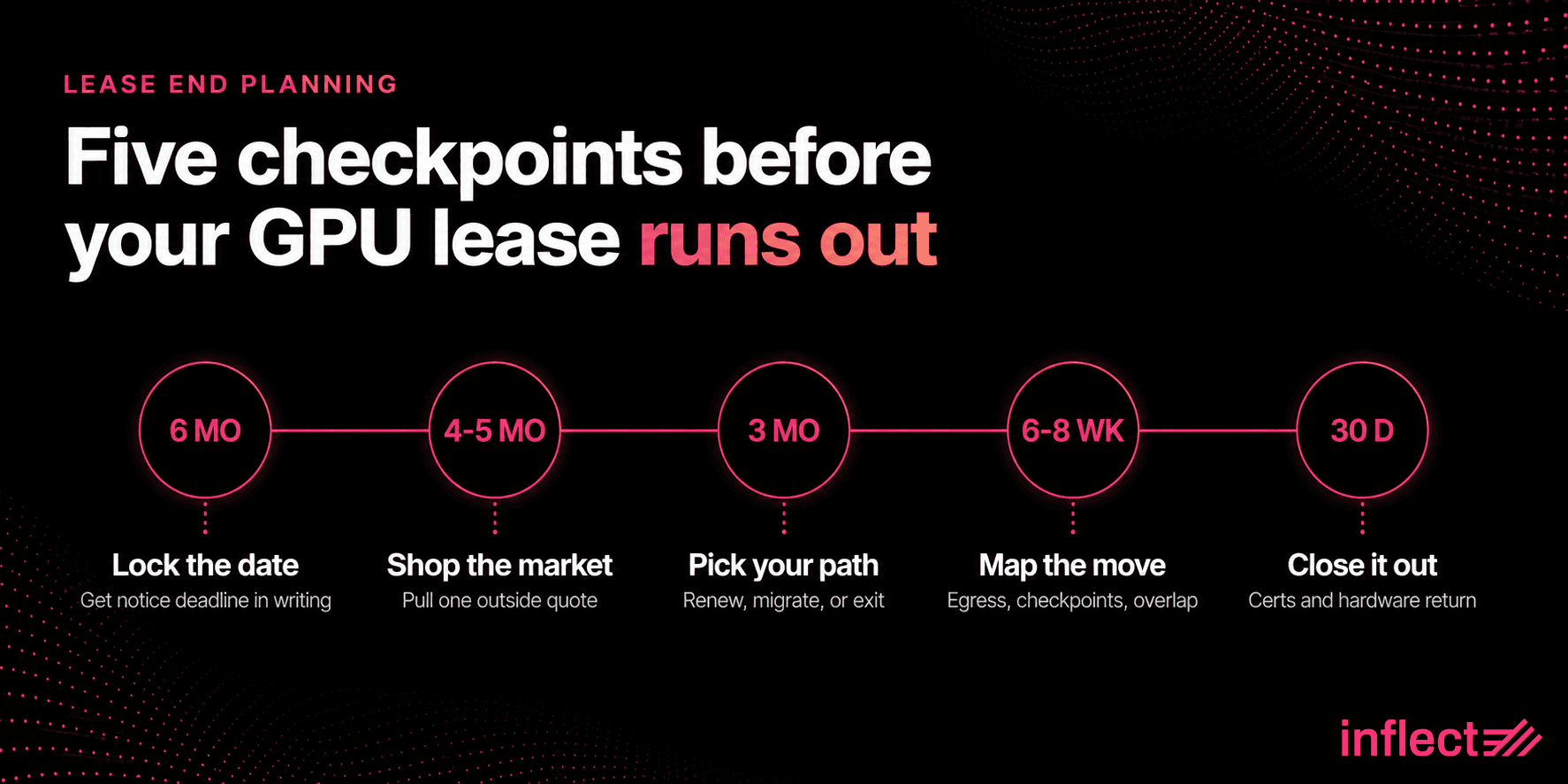
Six months out, confirm the renewal notice deadline in writing and calendar it with an owner who will still be on the team when it arrives, and confirm whether the current provider can guarantee a capacity extension.
Four to five months out, request a competitive quote from at least one alternative provider, even if renewal is the likely outcome, since that quote is the primary source of negotiating leverage.
Three months out, make the renew, migrate, or exit decision using the framework above, and if migrating or exiting, begin reserving replacement capacity immediately given current GPU lead times, since any delay here directly extends training time and pushes back downstream release schedules.
Six to eight weeks out, finalize the data migration plan, including egress cost estimates, checkpoint sequencing, and a parallel-run window if downtime is not acceptable.
Thirty days out, confirm data deletion and certification requirements if exiting, and confirm hardware return logistics for any dedicated or bare metal equipment.
Do not rely on a month-to-month extension or a verbal assurance of continued capacity unless it is explicitly guaranteed in the contract. Verbal continuity promises are not enforceable, and GPU capacity constraints do not make exceptions for buyers who assumed they had more time.
Start planning your GPU lease end now with Inflect:
Search thousands of facilities worldwide for renewal comparisons, migration targets, or replacement GPU capacity
Get instant pricing without a sales call, so a competitive quote is available in days, not weeks
Access free expert advisory to stress-test your renewal, migration, or exit decision before you commit
Source specific GPU resources and capacity in the region your workload actually needs, not just where a provider happens to have inventory
Start your search on Inflect before your renewal notice window closes.
About the Author

Haley Rogers
Content & Social Media Specialist
Haley Rogers is the Content & Social Media Specialist at Inflect, bringing over two years of experience in social media, marketing, and content strategy — including time at a fast-paced tech company before joining the Inflect team. She specializes in translating complex digital infrastructure topics into clear, engaging content, with a particular focus on blog writing and brand storytelling across channels.
Contact: