15 mins
Total Cost of Ownership for Modular Data Centers vs. Traditional Builds
The decision between a modular data center and a traditional data center is not purely a data center construction preference. It is a financial decision with consequences that compound over five to ten years across capital expenditure, construction timelines, energy costs, operational overhead, and the opportunity cost of delayed capacity. When those dimensions are evaluated together rather than as isolated line items, the TCO comparison between the two approaches tells a materially different story than the upfront unit costs suggest.
Recent data center construction benchmarks indicate that building a modern Tier III–style facility in major U.S. markets typically costs on the order of US$8–12 million per megawatt of IT load, once you account for redundant power, cooling, and security systems rather than just the shell. Analyses focused on AI‑optimized sites note that per‑megawatt costs can easily exceed US$20 million when you add liquid cooling, higher‑voltage distribution, and very dense rack layouts to support GPU‑heavy workloads. These are capital‑intensive, long‑horizon projects: Tier III data center builds are often planned on 12–18‑month schedules, and large or complex facilities can take 18–24 months or more from notice‑to‑proceed to fully commissioned capacity, with timelines shaped by long‑lead electrical and mechanical equipment, utility interconnects, permitting, and tight construction markets (TrueLook, 2025, Ingenious, 2025, ConstructElements, 2025, CBRE, 2026)
Prefabricated data center solutions address that profile directly, offering scalable infrastructure that can be deployed incrementally and adjusted as demand evolves. The global modular data center market was valued at $29.04 billion in 2024 and is projected to reach $75.77 billion by 2030, growing at a 17.4% compound annual growth rate, according to Grand View Research. That growth rate reflects a fundamental shift in how operators approach capacity decisions: toward faster, more capital-efficient, incrementally scalable infrastructure that ties spending to actual demand rather than projected future need. (Grand View Research, 2025)
This guide breaks down the full TCO comparison across each major cost dimension, builds a 5 to 10 year model framework, and identifies the scenarios where modular delivers the clearest financial advantage.
The real TCO question is not what the facility costs to build. It is what it costs per megawatt of productive capacity, per year, over a 10-year horizon, including the revenue foregone while a traditional build is still under construction.
Why TCO is the Right Framework for This Decision
Upfront capital cost per megawatt is the number most commonly cited in data center procurement discussions, but it captures only the first chapter of a financial story that runs for a decade or more. A facility that costs less to build but operates at a poor power usage effectiveness (PUE) will consume more energy per unit of IT load every year it runs. A facility that takes 22 months to build instead of 8 delays the revenue or cost savings the capacity was intended to generate, and that delay has a real financial value.
Total cost of ownership for a data center encompasses six dimensions:
Capital expenditure (CapEx): Design, engineering, site preparation, civil works, mechanical and electrical systems, IT fit-out, and commissioning.
Time to first revenue (or first utilization): The cost of delayed capacity: either revenue not yet earned from a new facility, or the colocation or cloud costs being paid while the owned facility is under construction.
Energy costs: Annual power consumption as a function of PUE and IT load, over the full operating life of the facility.
Operational expenditure (OpEx): Staffing, maintenance, monitoring, and the recurring operational costs of managing the physical infrastructure and the data center equipment within it.
Scalability cost: The cost of expanding compute capacity and storage when demand grows, including construction disruption, over-provisioning risk, and the capital efficiency of phased versus lump-sum investment.
Stranded asset risk: The financial exposure if demand does not materialize as projected and capacity sits underutilized, particularly relevant for traditional builds where the full capital outlay is committed upfront.
Evaluated across all six dimensions over a 5 to 10 year horizon, modular and prefabricated facilities consistently outperform traditional builds for most enterprise, edge, and mid-scale deployment scenarios.
Dimension 1: Capital Expenditure- Modular Data Centers vs. Traditional Builds
Industry sources consistently cite cost reductions of up to 30 percent for modular versus traditional stick-built construction, driven by factory prefabrication eliminating on-site labor variability, standardized designs removing custom engineering overhead, and controlled manufacturing reducing material waste and rework. (AnD Cable, 2025; Delta Power Solutions, 2026)
A traditional Tier III facility in the US runs $10 to $12 million per MW including mechanical and electrical systems, consistent with CBRE benchmarks cited above. (CBRE, 2025) Applying a 20 to 30 percent reduction yields an estimated range of $7 to $9 million per MW for comparable modular specifications. This is a modeled estimate based on the industry-cited cost reduction percentage applied to the CBRE traditional build benchmark; actual modular costs vary by specification, vendor, location, and configuration and should be validated with vendor-specific quotes for any formal investment case. For a 5 MW enterprise deployment, the difference between a $55 million traditional build and a $40 million modular deployment is $15 million in upfront capital, before financing costs are applied. At a typical cost of capital, the present value of that difference over a 10-year TCO model is materially significant.
The sources of the CapEx advantage are structural, not incidental:
Factory prefabrication eliminates on-site labor variability. Modular units arrive pre-integrated, assembled in controlled manufacturing environments by specialist crews. On-site installation is limited to connection and commissioning. Traditional builds expose every labor hour to weather delays, subcontractor coordination, and site conditions, all of which drive cost overruns and schedule variances.
Standardized designs eliminate custom engineering fees. A traditional build requires extensive site-specific mechanical and electrical design across power distribution, cooling, and structural systems. Modular data center systems ship with pre-engineered infrastructure including integrated power distribution units, uninterruptible power supplies, and cooling units that do not require the same upfront design spend.
Factory QA reduces rework. Defects discovered and corrected in a factory environment cost a fraction of defects discovered during on-site commissioning. Traditional builds accept a higher rework rate as a cost of on-site construction. Modular deployments shift that risk to a controlled setting where it is cheaper to address.
The caveat is scale. For very large hyperscale facilities above 50 to 100 MW, traditional construction economics can close the gap as the fixed cost of custom design is amortized across greater capacity. For enterprise deployments, campus expansions, and edge facilities below 20 MW, the modular CapEx advantage is consistent and meaningful.
Dimension 2: Time to First Revenue & Deployment Speed - Modular Data Centers vs. Traditional Builds
The single largest TCO advantage of modular data centers is not the capital cost reduction. It is the compression of the timeline between investment decision and productive capacity, which translates directly into earlier revenue generation or earlier elimination of colocation and cloud spending.
Traditional data center construction takes 18 to 24 months from groundbreaking to commissioning for a mid-scale facility, with first-in-territory builds sometimes extending beyond that. Prefabricated modular deployments enable rapid deployment: core infrastructure ships factory-assembled and site work is limited to foundation, utility connection, and commissioning, compressing that timeline to 4 to 6 months for a prefabricated modular data center and 6 to 12 months for larger configurations. A containerized data center or micro data center format can be operational in weeks. (StateTech, 2024.)
The financial value of faster deployment is significant and directly quantifiable. To illustrate the financial magnitude: For a 5 MW facility, a conservative commercial case might assume around US$8 million per year in IT services revenue once the site is live. Commissioning that facility 12 months earlier would therefore unlock roughly US$8 million in additional revenue that would otherwise be deferred, a pattern data center construction analyses repeatedly highlight when they note that every month of delay represents lost income and a longer payback period. Over the same period, an operator relying on interim colocation capacity could easily be spending several million dollars per year, given current benchmarks of roughly US$500–US$2,500 per rack per month for colocation, so earlier delivery also translates into a similar order of magnitude in avoided external spend (Cupix, 2024, Aptly, 2026) .These are illustrative examples using representative figures; the actual value depends on the specific revenue model or external spend being replaced. The principle, however, applies to any deployment where earlier capacity generates or saves a quantifiable amount per year.
Research from Omdia and published by Vertiv found that 93 percent of data center decision makers are making prefabricated modular construction their default construction approach, citing speed and scalability as the primary drivers. That adoption rate reflects a market that has done the financial math and concluded that earlier capacity, even at a modest premium in some unit cost scenarios, delivers better TCO outcomes when deployment speed is incorporated. (Omdia, 2025)
Dimension 3: Energy Costs & PUE - Modular Data Centers vs. Traditional Builds
Modular data centers typically achieve lower PUE from initial commissioning because their compact, purpose-engineered design integrates power modules and cooling units that are sized and optimized for the specific workload density from day one. Traditional facilities often run oversized cooling infrastructure relative to the initial IT load, which is inefficient until the facility fills up. Sensitive IT equipment in a modular deployment benefits from this optimized environment from initial power-on.
PUE measures how much total facility power is consumed for every unit of IT power delivered to compute loads. A PUE of 1.0 is theoretically perfect. According to Uptime Institute's 2024 Global Data Center Survey, the worldwide industry average PUE stands at 1.56, a figure that has remained broadly flat since 2018 and is heavily influenced by the large stock of older, less efficient legacy facilities in the global base. Newer builds consistently report PUEs of 1.3 or better. Modular and containerized deployments, purpose-engineered for efficiency from initial operation, typically achieve PUE between 1.2 and 1.4, with well-designed containerized deployments reaching 1.1 to 1.2. (Uptime Institute, 2024)
The energy cost implication of the PUE gap between legacy infrastructure and modern modular deployments is substantial over a 10‑year operating horizon. For example, Uptime Institute’s 2024 Global Data Center Survey reports an average PUE of 1.56 at operators’ largest data centers, reflecting the efficiency of today’s installed base of mostly traditional facilities. By contrast, contemporary modular and high‑efficiency designs are commonly engineered to deliver materially lower PUE; using a PUE of around 1.25 as a mid‑range assumption for a modern modular deployment is a reasonable basis for illustrative modeling. U.S. EIA data shows that commercial electricity prices averaged roughly 12–13 cents per kWh in 2024, and large data center operators often negotiate below that through volume contracts, making a US$0.10 per kWh power‑cost assumption a conservative, defensible input for a 5 MW IT‑load energy cost comparison over a 10‑year horizon (Uptime Institute, 2024, BMarko Structure, 2025).
PUE 1.56 (industry average traditional): Total facility power = 7.8 MW. Annual energy cost at $0.10/kWh: approximately $6.83 million.
PUE 1.25 (representative modular): Total facility power = 6.25 MW. Annual energy cost: approximately $5.48 million.
Annual saving: approximately $1.35 million per year.
5-year saving: approximately $6.75 million.
10-year saving: approximately $13.5 million.
Note: These figures are illustrative calculations based on cited benchmark inputs. Actual energy costs depend on local power rates, actual IT load utilization, specific equipment configuration, and facility operating conditions.
This energy cost differential, compounded over the full operating life, can equal or exceed the original CapEx difference between the two approaches. For operators in high-cost power markets, or those with sustainability targets that carry reputational or regulatory value, the PUE advantage of modular designs adds further financial weight to the TCO comparison.
The caveat here is that a well-designed traditional facility operating at full utilization can match modular PUE performance. The TCO disadvantage for traditional builds appears most strongly during the partial-loading phase, which for a large traditional facility may last two to three years before IT load reaches the design density.
Dimension 4: Scalability & Capital Efficiency - Modular Data Centers vs. Traditional Builds
The structural difference between modular and traditional data centers in terms of TCO is most visible in how each model handles evolving capacity requirements. Modular infrastructure allows organizations to scale rapidly as demand grows, making it inherently more future-proof than a facility locked into a fixed design at the point of initial build.
Traditional builds require operators to commit to a specific capacity configuration at the time of design, so building 20 MW when current demand is only 5 MW can leave a meaningful share of capital underutilized until demand catches up. That underutilized capacity still carries financing, holding, and operating costs, and if demand growth assumptions prove optimistic, the financial exposure can compound as additional capacity remains unabsorbed on schedule (Future Bridge, 2025, Commercial Allianz, 2025, FTI Consulting, 2026) .
Modular facilities invert that dynamic. A modular deployment starts at 2 to 5 MW, is fully operational within months, and adds capacity in discrete module increments as demand materializes. Capital is deployed close to the point of utilization. Financing costs are lower because less capital is outstanding against unproductive assets. The risk of stranded capacity is structurally reduced because each additional module is purchased when it is needed, not speculatively years in advance.
This "pay as you grow" model is particularly relevant for:
Edge computing deployments at edge locations and remote locations where demand at any individual site is uncertain and scalability needs to be sequential rather than anticipatory.
Enterprise capacity expansions where IT demand is growing but the growth curve is not perfectly predictable.
Artificial intelligence and GPU workload infrastructure where density requirements are evolving rapidly and a facility designed today to current specifications may need meaningful reconfiguration within 3 to 5 years.
Multi-site distributed deployments where consistent, repeatable module designs allow standardized rollout across locations without custom engineering at each site.
The TCO advantage of incremental capital deployment is real but requires discipline in financial modeling. The relevant comparison is not modular day-one cost versus traditional day-one cost. It is the net present value of total capital outlays, timed against the utilization they generate, over the full 10-year planning horizon.
Dimension 5: Operational Expenditure - Modular Data Centers vs. Traditional Builds
Modular data centers tend to produce lower ongoing OpEx than equivalent traditional facilities for three reasons: standardized infrastructure is easier and cheaper to maintain, integrated monitoring and management systems are included by design, and factory-tested components carry lower failure rates during the operational phase.
Maintenance costs for traditional facilities reflect the full complexity of custom-designed MEP systems. Varied component specifications, mixed manufacturer relationships, and bespoke installation configurations mean that troubleshooting and replacement require specialized expertise and carry longer resolution times. Modular facilities use standardized components that are documented, tested, and known before the facility is commissioned. Replacement parts are predictable. Maintenance procedures are repeatable.
Remote monitoring and DCIM (Data Center Infrastructure Management) integration is typically included in modern modular deployments rather than retrofitted as an additional cost. Physical security, fire suppression systems, and power conditioning are similarly pre-integrated in well-specified modular solutions, removing the procurement and coordination complexity those systems add to traditional builds. For operators managing multiple distributed sites, standardized monitoring across uniform module configurations is significantly cheaper to operate than bespoke monitoring implementations at each custom-built facility.
The operational cost advantage is modest in absolute terms at any individual facility but compounds meaningfully when an organization is managing a portfolio of sites. Micro modular data centers, the self-contained, space-saving deployments increasingly popular for edge and branch office use cases, demonstrate this most clearly: a standardized, factory-managed maintenance program across ten remote micro data center sites is dramatically cheaper to operate than bespoke maintenance at ten individually configured custom builds.
The 5–10 Year TCO Model: A Framework
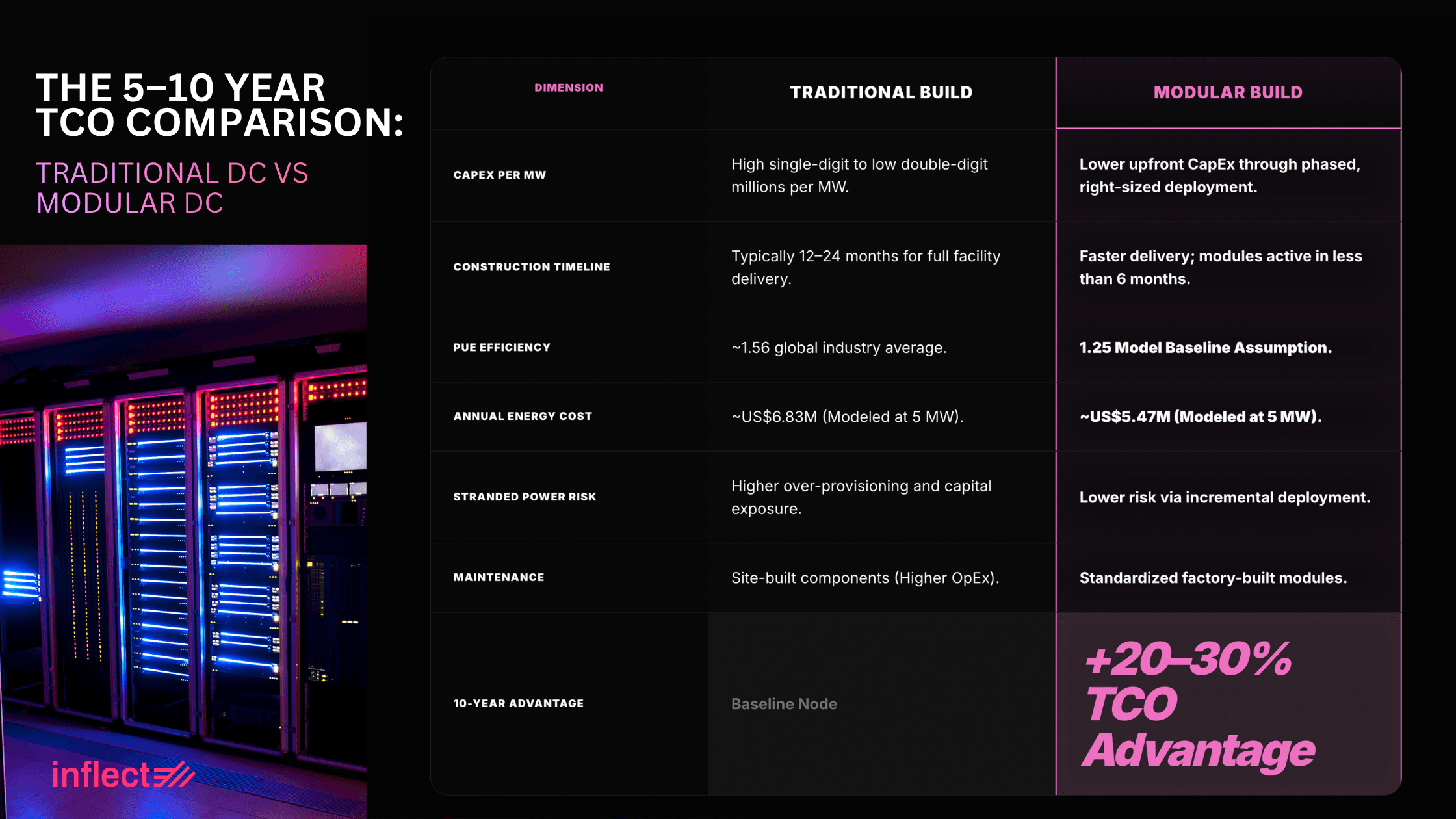
The following framework captures the key inputs for a TCO comparison between a modular and traditional build for a representative 5 MW enterprise data center deployment. Actual figures vary by region, specification, power cost, and financing structure. CapEx benchmarks are drawn from CBRE (traditional) and industry-cited modular cost reduction percentages (modular). PUE figures are from Uptime Institute 2024. Energy cost uses $0.10/kWh as a representative mid-range assumption per EIA 2024 commercial data. All figures should be treated as directional estimates and validated against specific vendor quotes and local conditions before use in formal investment cases.
TCO Dimension | Traditional Build (5 MW, Tier III) | Modular Build (5 MW, Incremental) |
|---|---|---|
CapEx per MW | High single-digit to low double-digit millions per MW, market dependent. | Lower upfront CapEx through phased deployment and right-sizing. |
Construction timeline | Often 12–24 months for full delivery. | Faster initial capacity delivery; phased modules can come online sooner. |
PUE | ~1.56 industry average at large legacy sites. | Often materially lower in newer modular deployments; 1.25 is a reasonable model assumption. |
Annual energy cost | ~US$6.83M modeled at 5 MW, PUE 1.56, $0.10/kWh. | ~US$5.47M modeled at 5 MW, PUE 1.25, $0.10/kWh. |
Over-provisioning risk | Higher, due to upfront capacity commitment. | Lower, due to incremental deployment. |
Maintenance cost | Potentially higher due to more custom, site-built components. | Potentially lower due to standardized, factory-tested modules. |
10-year TCO advantage | Baseline | Roughly 20–30% in some studies, depending on assumptions. |
The $15M to $30M+ modeled range reflects the combined effect of lower CapEx, earlier time to revenue, better operational PUE, lower maintenance costs, and reduced over-provisioning exposure, applied to the 5 MW illustrative scenario using the benchmarks cited above. This is a modeled directional estimate, not a third-party audited figure. The range is intentionally wide because power cost, colocation rate, capacity utilization curve, financing cost, and the specific modular configuration chosen all vary significantly between deployments.
When Traditional Builds Still Win Modular Data Centers on TCO
Modular and prefabricated facilities are not the optimal choice in every scenario. Traditional stick-built construction retains TCO advantages under specific conditions:
Very large scale with stable long-term demand. At hyperscale (50 MW and above) with a well-established demand anchor, traditional construction allows custom design optimization at a scale that can produce lower per-MW costs than modular approaches. Hyperscalers building out known, committed capacity on 10 to 20 year planning horizons can justify the upfront investment and longer timeline.
Sites with existing civil infrastructure. Where substantial civil works are already complete from a prior build, the cost of traditional construction is materially lower because the site preparation cost is already sunk. Modular's civil cost advantage over traditional partially disappears in brownfield scenarios.
Regulatory or specification requirements that preclude standard prefab configurations. Defense, government, and certain financial services environments may require a fully customized solution with physical security, certification, or integration requirements that standard shipping containers or off-the-shelf modular formats cannot satisfy. In these specific use cases, custom construction remains appropriate.
For all other scenarios including enterprise capacity expansion, multi-site distributed deployments, edge computing infrastructure, AI workload capacity additions, and greenfield builds with uncertain demand growth curves, the modular TCO case is strong and compounding.
Questions a CFO Will Ask About Modular TCO
Before committing to either approach, finance and infrastructure leadership should be able to answer:
What is the fully-loaded cost per MW, including site prep, utility connection, commissioning, and financing? The modular unit cost advantage is real, but ensuring the full scope is in the comparison prevents post-approval surprises.
What is our actual demand curve, and how much capital are we committing against speculative future load? The over-provisioning question is where traditional builds carry the most hidden TCO risk.
What does 12 months of earlier capacity actually generate or save for our organization? Quantifying time-to-revenue or avoided external spend in dollar terms is the single most persuasive element of the modular TCO case.
What are electrical power costs at this location, and what PUE can each approach achieve in years one through three? Energy cost is a long-tail TCO driver that compounds significantly over a 10-year horizon. For sites with access to renewable energy sources, the PUE efficiency of modular infrastructure amplifies the carbon and cost benefits of clean power procurement.
What are the financing terms for each approach, and how does the draw schedule affect NPV? Modular's incremental capital deployment profile is financially advantageous, but only if the financing structure reflects the actual timing of capital outlays.
What is the decommission or repurposing value at end of life? Modular units and prefabricated components can often be relocated to remote sites or redeployed for new workloads. Traditional facilities carry higher end-of-life stranded asset risk, particularly for critical loads tied to aging MEP infrastructure.
The Bottom Line
The total cost of ownership case for modular data center solutions over traditional data centers is compelling across most deployment scenarios when the full 5 to 10 year financial picture is evaluated. Data centers typically built on traditional construction models commit capital against uncertain future demand in a way that modular architectures structurally avoid. Lower CapEx per MW, significantly earlier time to productive capacity, better operational PUE during partial-loading phases, incremental capital deployment that reduces over-provisioning risk, and lower maintenance costs through standardized infrastructure all contribute to a TCO advantage that the illustrative model in this post estimates at $15 million to $30 million or more over a decade for a 5 MW deployment, based on CBRE CapEx benchmarks, Uptime Institute PUE data, and EIA electricity rate data. This is a modeled estimate; see the TCO framework section for full assumptions and caveats.
The traditional build retains its place for very large scale deployments with stable long-term demand and established civil infrastructure. For the majority of enterprise, edge, and distributed workload scenarios, the financial math consistently favors the modular approach when TCO rather than unit CapEx is the evaluation framework.
The modular data center market's 17.4% annual growth rate, rising from $29.04 billion in 2024 toward $75.77 billion by 2030, reflects an industry that has done the calculation. (Grand View Research, 2024) The question for any organization evaluating data center capacity is not whether modular can match traditional build quality. It is whether committing $10 to $12 million per MW (CBRE, 2025) and 18 to 24 months of data center construction (Omdia, 2024) is the right financial decision when a prefab data center path to the same capacity, including space-saving mini data centers for lower-density workloads, exists at an estimated $7 to $9 million per MW and six to twelve months.
Explore Modular Data Center Solutions
Factory-built, pre-tested modular data center systems deployable in months. Scalable from 0.5 MW to 20 MW and beyond. Standardized designs for enterprise, edge, remote locations, and branch offices. Integrated power distribution, cooling units, and monitoring. TCO modeling and site assessment available.
About the Author

Chanyu Kuo
Director of Marketing at Inflect
Chanyu is a creative and data-driven marketing leader with over 10 years of experience, especially in the tech and cloud industry, helping businesses establish strong digital presence, drive growth, and stand out from the competition. Chanyu holds an MS in Marketing from the University of Strathclyde and specializes in effective content marketing, lead generation, and strategic digital growth in the digital infrastructure space.
Contact:
Email: