11 mins
Streaming Colocation Pricing: What OTT and VOD Buyers Need to Know Before Requesting a Quote
The number on your first streaming colocation quote is not the number you will pay.
That is not a negotiating tactic or a criticism of the providers sending it. It is the structural outcome of a pricing process built around the inputs buyers typically provide, which almost never reflect the actual demands of a streaming workload. Providers quote against what they receive. When a spec sheet lists rack count and power without egress volume, traffic pattern, or CDN interconnection requirements, the quote is necessarily incomplete. Real usage then triggers overages, re-rating at higher tiers, and add-on line items that were always in the contract but never in the conversation.

This matters more for OTT and VOD operators than for any other colocation buyer category because the cost drivers are nonstandard and the workloads are not small. Video streaming accounts for more than 65% of all global internet traffic by volume (Source: Sandvine, 2024). Enterprise colocation pricing is dominated by power and space. Video streaming data center costs are dominated by bandwidth billing models, high-density power envelopes for transcoding and encoding infrastructure, and IX peering costs that vary sharply by market. A buyer who arrives with enterprise assumptions will receive an enterprise-style quote that will not survive contact with a live event or a catalog delivery spike.
This post explains the cost model, the six inputs required to get a real quote, how to interpret one once it arrives, and how to structure an RFQ that forces providers to price against your actual workload.
Why Streaming Colocation Pricing Differs from Standard Enterprise Colo
Colocation for streaming media differs from standard enterprise colo across three specific cost dimensions: bandwidth billing models that price egress as a variable rather than a fixed input, power density requirements that exceed standard cabinet specifications for transcoding and encoding hardware, and CDN interconnection costs that become a primary budget line rather than an incidental fee.
Bandwidth Billing Models That Catch Streaming Buyers Off Guard
OTT and VOD buyers encounter three bandwidth billing models in colocation contracts: 95th percentile billing, committed data transfer, and burstable bandwidth. Each prices the same underlying egress differently, and selecting the wrong model for your traffic profile is one of the most common sources of invoice surprise in streaming infrastructure procurement.
Under 95th percentile billing, providers measure bandwidth usage every five minutes across the month, discard the top five percent of readings, and bill against the remaining peak. Metered plans, often called committed data transfer, price egress as a monthly volume at a fixed rate with overage charges above the committed floor, billed against actual consumption rather than a modeled peak. Burstable pricing allows egress above a contracted baseline at a higher per-Mbps rate and can appear attractive on paper, but compounds quickly under event-driven patterns.
The practical synthesis: 95th percentile billing rewards steady usage but punishes spikes; a single two-hour live event can set the billing tier for the entire month. Burstable looks flexible but becomes expensive under repeated peaks. Committed transfer is cheapest when your floor is high and predictable. Matching the billing model to your traffic shape is as consequential as negotiating the rate itself.
Power Density Requirements for Transcoding and Encoding Infrastructure
Standard enterprise colocation facilities are designed around average rack power densities of 5 kW per cabinet, with the industry average rising toward 8 kW as high-density deployments proliferate, though the majority of general-purpose facilities remain well below that threshold (Source: Uptime Institute, 2024). Transcoding and encoding hardware regularly draws 8 to 20 kW per rack or higher for GPU-accelerated pipelines, placing streaming infrastructure well outside the design assumptions of general-purpose colocation space.
The consequence is not simply higher monthly power costs. Facilities that cannot support high-density draw will cap per-cabinet consumption at their breaker limits, forcing operators into more cabinets to distribute the load, or into purpose-built high-density zones that carry a premium over standard colo pricing. Overage charges for exceeding contracted per-cabinet power thresholds are real and routinely absent from initial quote conversations. Before signing any colocation contract for transcoding infrastructure, confirm three things: the per-cabinet power cap, the per-kW overage rate above that cap, and whether the facility has power capacity available for high-density zones at the contracted rate.
Why CDN Interconnection and IX Proximity Change the Total Cost
CDN interconnection costs in colocation are driven by two factors: the number of cross-connects required to reach CDN and network providers, and the internet exchange access available at the facility. Each cross-connect carries a one-time non-recurring charge (NRC) and a monthly recurring charge (MRC). A streaming operator connecting to multiple CDN providers and carriers can accumulate cross-connect fees that match or exceed base colocation MRC, particularly in high-density delivery environments.
Facilities with direct access to internet exchange points reduce transit dependency and lower per-unit egress costs. A facility in Ashburn with access to Equinix Internet Exchange, or in Amsterdam with access to AMS-IX, can materially reduce CDN delivery costs compared to a secondary-market facility where transit pricing applies. For OTT and VOD buyers, IX peering costs are a colocation cost, not a separate networking cost, and must appear in the same comparison model.
The Streaming Colocation Cost Model
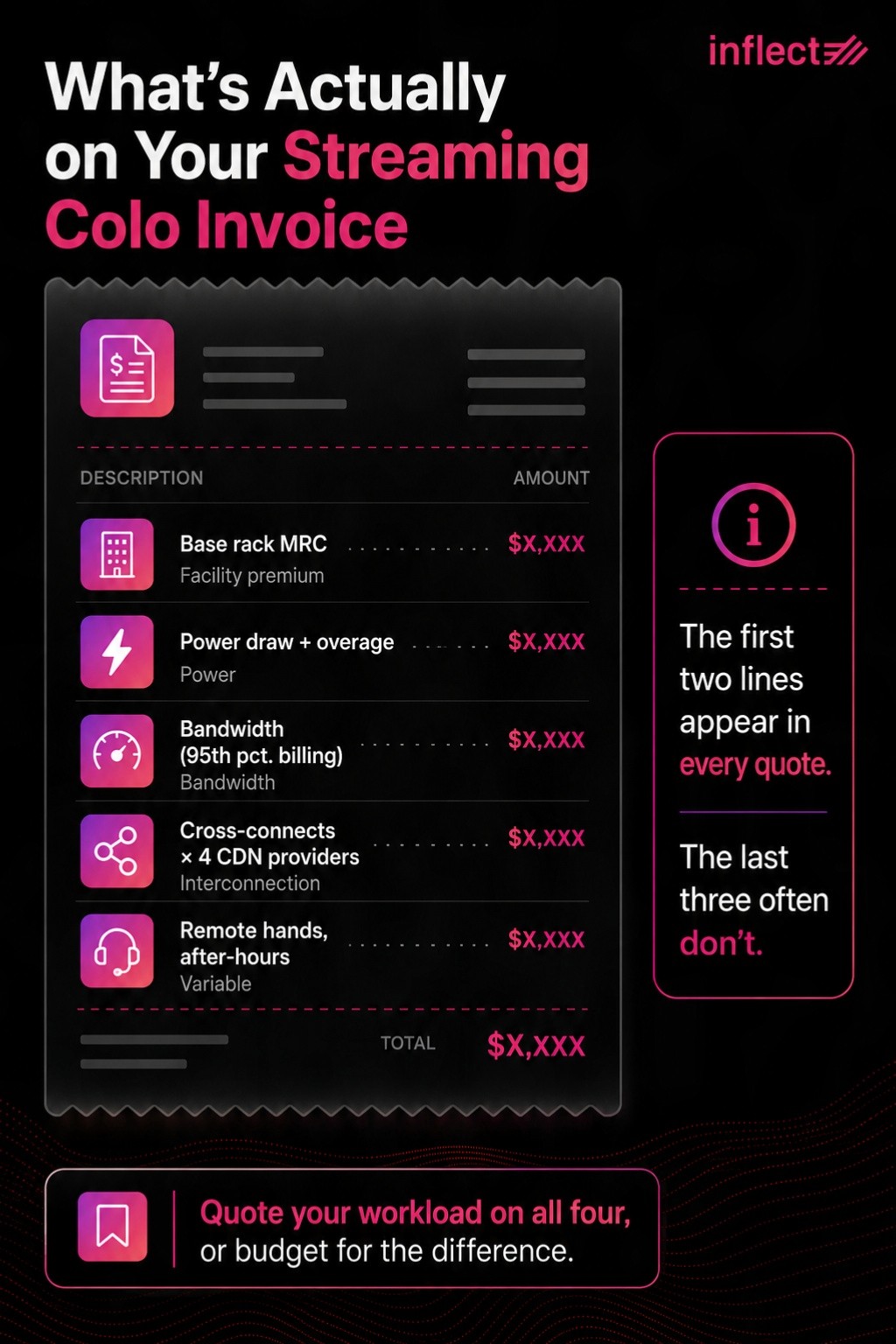
Total streaming colocation cost = power (kW demand at contracted density per cabinet) + bandwidth (billing model applied to egress profile) + interconnection (cross-connects, IX access, CDN peering fees) + facility premium (market, redundancy tier, contract length).
Most buyers model power. Some partially model bandwidth. Very few map their full cost structure across interconnection and facility premium before requesting a quote. The two largest sources of quote-to-invoice variance sit in the columns buyers leave blank.
The Six Inputs OTT and VOD Buyers Must Quantify Before Requesting a Quote
Six inputs determine whether a streaming colocation quote reflects actual costs: peak and average throughput, egress profile by region and CDN target, traffic pattern shape, rack count and per-cabinet power draw, redundancy tier, and contract length with commitment structure. Omitting any one of these forces providers to estimate, and providers estimate conservatively.
Peak and Average Throughput (and Why Providers Care About Both)
Peak throughput determines bandwidth billing exposure under 95th percentile and burstable models. Average throughput determines committed data transfer sizing. Providing only one number forces providers to assume the other, and they will assume against your worst case, which means pricing for a scenario that may never occur for a VOD-heavy operator.
Quantify both before engaging any provider. Express peak in Gbps and average in TB per month. If your operation has seasonal variation (Q4 catalog demand, summer sports schedules), provide the highest monthly peak rather than an annual average.
Egress Profile by Region or CDN Target
Total throughput is insufficient for multi-region deployments or global streaming operations. Providers need to know where traffic is going: which regions, which CDN endpoints, and what percentage of total egress flows through each facility. This determines which cross-connects are required at each site, whether IX access is relevant to your delivery model, and whether the facility's network infrastructure can support the egress profile you need.
A 10 Gbps requirement serving North American viewers from a single US East Coast facility is a fundamentally different procurement from a 10 Gbps requirement split across US East, EU, and APAC. The cross-connect and IX requirements change, the market selection changes, and the total cost changes.
Traffic Pattern Shape: Steady VOD Delivery vs. Live Event Spikes
A flat VOD egress curve and a live sports spike profile produce completely different billing outcomes under the same contract. Under 95th percentile billing, a four-hour live event that drives egress to three times your normal level can set the billing tier for the entire month, regardless of how flat the remaining 27 days are. Under burstable pricing, that same event triggers burst charges that may not appear until the following invoice.
Characterize your traffic shape before issuing an RFQ. Describe the ratio of scheduled live events to on-demand delivery, the duration and frequency of peak events, and the expected egress delta between peak and baseline. Providers who understand your pattern can recommend the billing model that minimizes total cost. Providers who don't will default to the model that minimizes their exposure.
Rack Count, Footprint, and Power Draw Per Cabinet
Specify rack count, usable U space requirements, and per-cabinet power draw in kW rather than total facility power. Whether you need full racks, private cages, or shared cage configurations affects both pricing and availability at specific colocation facilities. Total power can be distributed across many low-density cabinets or concentrated in fewer high-density ones, and the pricing, availability, and contract terms differ significantly between configurations.
For transcoding infrastructure specifically, confirm that the facility can support your per-cabinet power requirement within a contiguous footprint. Distributed high-density deployments across a standard colo floor add operational complexity and can increase remote hands costs, particularly during incident response on live events where urgency, not hourly rate, determines what you spend.
Redundancy Requirements: What N+1 vs. 2N Means for the Quote
N+1 redundancy (one backup system per failure domain) and 2N redundancy (fully duplicated systems) represent meaningfully different cost tiers in colocation pricing, with 2N configurations typically carrying a 15 to 30 percent MRC premium over N+1 at equivalent capacity. (Illustrative estimate based on industry-standard Tier III vs. Tier IV pricing differentials; actual variance depends on provider, market, and capacity level.) For streaming operations with SLA obligations on live delivery, 2N redundant power and cooling is often non-negotiable. For VOD-only workloads with retry tolerance, N+1 may be sufficient and represents a real cost lever.
Contract Length, Commitment Levels, and the Cost of Flexibility
Colocation pricing scales inversely with commitment length and volume. One-year terms typically carry a 10 to 20 percent premium over three-year terms at equivalent capacity, and month-to-month availability, where it exists, can double the effective per-kW and per-Mbps cost relative to a committed term. (Illustrative estimate; actual variance depends on provider, market, and contracted capacity.) For established streaming operations with predictable infrastructure requirements, longer terms are a straightforward cost lever. For operators scaling rapidly or entering a new market, flexibility carries a real value that warrants the premium, but that premium must be quantified and included in the cost model before comparing quotes across providers.
How to Read a Streaming Colocation Quote Without Getting Surprised at Invoice
Every line item in a streaming colocation quote maps to one of four variables: power, bandwidth, interconnection, or facility. Start there before reading anything else. Cross-connect fees map to interconnection. Bandwidth overage charges map to the billing model applied to your egress profile. Power overage fees map to per-cabinet density thresholds in the contract. Line items that don't cleanly map to one of those four variables warrant the closest scrutiny before signing.
What Line Items Are Always Negotiable in a Streaming Colo Contract
Cross-connect NRC fees, remote hands rates, power overage thresholds, and bandwidth commit floor levels are negotiable in almost every colocation agreement. Base MRC in high-demand markets is the least flexible line item. Bandwidth billing model selection (95th percentile vs. committed transfer), contract length thresholds for pricing tiers, and cross-connect NRC are all points where providers have room to move, particularly if you are committing volume across multiple sites or multiple years.
Remote hands rates deserve specific attention for streaming operators with live events. The rate per hour matters less than the minimum billing increment and after-hours premium. An operator running a midnight live event who needs 15 minutes of remote hands support billed at a one-hour minimum, at a 2x after-hours premium, pays materially more than the rate card implies. Negotiate minimum increments and after-hours terms before signing, not during an incident.
What "All-In" Pricing Rarely Includes for High-Bandwidth Workloads
All-in colocation pricing for streaming workloads almost universally excludes cross-connect NRC fees, bandwidth overage charges, power overage charges for cabinets exceeding contracted per-kW limits, setup fees for initial installation of your own equipment, remote hands services beyond basic hands-and-eyes support, and smart hands for cabling or configuration. Each appears as a separate line item once the facility is live.
For a streaming operator, cross-connect accumulation and bandwidth overage represent the largest gap between quoted and actual cost. Request an itemized breakdown of all potential variable charges before signing, and model your worst-case bandwidth month against the overage rate, not the base rate.
How to Compare Quotes Across Providers When Unit Costs Don't Match
Comparing high bandwidth colocation pricing across providers is a total cost of ownership exercise, not a rate comparison. It requires normalizing billing models, mapping each provider's pricing structure to the same egress and power inputs, and accounting for market-specific interconnection costs.
Build a single comparison model: apply each provider's billing model to your actual egress profile, add their cross-connect and IX costs, add their power rate at your contracted density, and apply their redundancy tier premium. That number is the real monthly cost. The provider with the lowest MRC quote rarely wins that comparison.
Which Colocation Markets Matter for OTT and VOD Delivery
Geographic location is the first pricing variable buyers encounter after power and bandwidth, and the three market tiers that matter for OTT and VOD delivery are Tier 1 interconnection hubs, secondary regional markets, and international markets in APAC and LATAM, each offering a distinct tradeoff between IX density, rack cost per kW, transit pricing, and backhaul complexity.
Tier 1 Markets (Ashburn, Los Angeles, Chicago, Amsterdam): Higher IX Density, Higher Rack $/kW
Tier 1 colocation markets command a significant pricing premium over secondary markets, with average asking rates for wholesale colocation in primary US markets reaching $196.25 per kW per month in H2 2025, up from $174.06 per kW per month in H1 2024, a 13 percent increase in 18 months driven by constrained supply and AI-fueled demand (Source: CBRE, 2025). Secondary and frontier markets with more available power and land offer meaningfully lower per-kW rates for operators willing to accept reduced IX density. In exchange for the Tier 1 premium, operators get direct access to the highest-density IX and CDN peering ecosystems available anywhere. Ashburn carries more internet traffic than any other single market in North America. Amsterdam is the primary IX hub for European delivery.
For OTT and VOD operators, the trade is direct: pay the rack premium, reduce transit and CDN delivery costs. Whether that trade is net positive depends on egress volume. At sustained high throughput, IX density savings outweigh the rack premium. At lower volumes, secondary markets with transit access may produce a lower total monthly cost.
Secondary Markets: Lower $/kW, Higher Backhaul and Latency Tradeoffs
Secondary markets including Atlanta, Dallas, Phoenix, Frankfurt, and Milan offer lower rack costs and lower power pricing than Tier 1 hubs, with the tradeoff being reduced IX density. Lower IX density means greater reliance on transit providers for CDN delivery and higher backhaul costs to reach Tier 1 interconnection points for content that must traverse them.
For VOD workloads with latency tolerance, secondary markets represent a real cost savings opportunity. A catalog delivery operation that does not require sub-20ms end-user delivery can reduce colocation costs materially by deploying outside Tier 1 markets, accepting the transit overhead, and managing backhaul through CDN configuration rather than physical IX proximity. Low latency colocation for video streaming serving live, interactive, or near-real-time workloads does not have that flexibility.
APAC and LATAM: Higher Cross-Border Transit and Fewer IX Options
APAC and LATAM colocation markets carry specific pricing characteristics for global streaming operators: fewer IX options mean greater reliance on transit pricing, cross-border peering agreements add line items absent from North American and European quotes, and network sovereignty requirements in some markets (India, Brazil, Indonesia) introduce compliance overhead that affects facility selection.
Singapore and Tokyo are the primary IX hubs in APAC. São Paulo and Mexico City anchor LATAM streaming infrastructure. Rack pricing in Singapore and Tokyo is comparable to or above US Tier 1 markets. Transit pricing is higher across most APAC markets than equivalent North American locations. Buyers entering these markets for the first time consistently underestimate interconnection costs as a share of total colocation spend.
How to Build an RFQ That Gets Real Streaming Colocation Pricing
A colocation RFQ for streaming workloads that produces usable pricing contains six specification inputs, a defined billing model preference, a market list with priority ranking, a contract term range, and a response timeline. An RFQ without those elements generates placeholder quotes that providers revise after the first discovery call, adding three to six weeks to the procurement cycle.
The Minimum Specification Set Every Streaming Colocation RFQ Needs
Every streaming colocation RFQ must specify: peak throughput in Gbps; average monthly data transfer in TB; egress destination regions and CDN targets; traffic pattern characterization (steady VOD, event-driven live, or mixed); rack count and per-cabinet power draw in kW; redundancy tier (N+1 or 2N); preferred bandwidth billing model or an explicit request for multiple billing model quotes; contract term range; and target markets in priority order.
RFQs that omit peak throughput, per-cabinet power density, or egress destinations will receive incomplete pricing that cannot be compared across providers without a follow-up discovery process. That process adds time, resets the negotiation, and frequently produces higher pricing than an RFQ that was complete from the start.
How to Structure Quote Comparison When Providers Use Different Billing Models
Comparing colocation RFQ responses for streaming workloads requires a normalization step most buyers skip. Apply each provider's billing model to your actual egress inputs, add cross-connect and IX costs specific to each market, apply power pricing at your contracted per-cabinet density, and sum the total monthly recurring cost. That number, not the headline MRC, is the basis for comparison.
Structure the comparison with four columns: provider name; total monthly recurring cost at your egress and power profile; total non-recurring costs in year one; and effective monthly cost over the contract term with NRC amortized. Providers that appear cheaper at the MRC level frequently look more expensive once overage exposure and NRC are included.
If you want to skip the manual RFQ process entirely and get instant pricing across providers already sized for streaming workloads, a marketplace compresses that cycle from weeks to hours.
How Inflect Helps OTT and VOD Buyers Source Streaming Colocation Pricing Without a Sales Call
Inflect is a digital infrastructure marketplace where OTT and VOD buyers can search, compare, and receive instant pricing from colocation providers across 6,000+ facilities in 100+ countries, without a sales call or an RFQ form. For streaming operators, that means accessing pricing from providers with the IX density, high-density power capacity, and CDN interconnection footprint their workloads require, searchable by market and capacity, with results that reflect actual provider availability rather than lead generation placeholders.
Buyers who arrive with the six inputs described in this post can use Inflect to compare providers across Tier 1 and secondary markets simultaneously, evaluate bandwidth pricing structures side by side, and identify which facilities offer direct IX access in their target delivery markets. Providers available on Inflect include Equinix, Digital Realty, NTT, QTS, CyrusOne, CoreSite, TierPoint, Flexential, and hundreds of others across every major streaming market globally.
For buyers who need guidance before selecting a market or finalizing their spec, Inflect's free expert advisory connects operators with infrastructure specialists who have sourced colocation for streaming workloads across live event, VOD, and hybrid delivery architectures. Buyers who arrive at Inflect with a complete spec typically compress the RFQ-to-shortlist timeline from three to six weeks to under 24 hours.
Get Streaming Colocation Pricing That Reflects Your Actual Workload
Search instant pricing across Tier 1 and secondary markets with bandwidth and power inputs already applied:
Compare 95th percentile, committed transfer, and burstable quotes from providers side by side
Identify facilities with direct IX access and CDN interconnection in your target delivery markets
Access free expert advisory from infrastructure specialists with streaming workload experience
About the Author

Haley Rogers
Content & Social Media Specialist
Haley Rogers is the Content & Social Media Specialist at Inflect, bringing over two years of experience in social media, marketing, and content strategy — including time at a fast-paced tech company before joining the Inflect team. She specializes in translating complex digital infrastructure topics into clear, engaging content, with a particular focus on blog writing and brand storytelling across channels.
Contact: