13 mins
SD-WAN + DIA: How to Build a Hybrid WAN That Doesn't Sacrifice Performance
SD-WAN controls how traffic is routed across a network, dynamically routing traffic to the best path for each application based on real-time network conditions. It does not control the performance characteristics of the transport underneath that routing decision. When the underlying circuit is best-effort broadband internet service, latency, jitter, and packet loss stay variable no matter how intelligent the overlay is, and the real-time applications enterprises deployed SD-WAN to optimize are the first ones to suffer.

This is where the transport conversation usually splits into two camps. SD-WAN running over broadband is flexible and inexpensive, but performance is inconsistent from one peak hour to the next. Traditional MPLS networks are predictable because the carrier engineers the path end to end, but they are expensive, slow to provision, and not built for direct access to the public internet and SaaS platforms enterprises now depend on. Dedicated internet access is the middle path: it gives SD-WAN an uncontended, SLA-backed underlay for network connectivity without the cost structure or provisioning timelines of MPLS.
The stakes are not theoretical. More than half of enterprises that experienced a significant, serious, or severe outage in 2024 reported a cost above $100,000, and one in five reported a cost above $1 million (Source: Uptime Institute, 2025). A WAN architecture that cannot guarantee transport quality carries that exposure every time a broadband circuit degrades during a video call, a point-of-sale transaction, or a cloud ERP session, creating measurable business disruption.
This post lays out why broadband-only SD-WAN cannot guarantee performance, three architecture patterns for pairing SD-WAN with DIA, the use cases where that pairing is non-negotiable, and the evaluation criteria and cost tradeoffs enterprise buyers need to procure it correctly.
Why SD-WAN Deployments Sacrifice Performance Without a Dedicated Internet Underlay
SD-WAN controls how traffic is routed across the network, but it does not control the performance characteristics of the underlying transport. When that transport is best-effort broadband, latency, jitter, and packet loss remain inherently variable regardless of how intelligent the overlay's path selection logic is. Dedicated internet access closes that gap by providing uncontended, SLA-backed bandwidth with predictable performance characteristics that the SD-WAN overlay can then route across with confidence.
SD-WAN Overlay vs. Underlay: Why Transport Quality Still Matters
The SD-WAN overlay is the software layer that gives network administrators centralized control over how network traffic is routed, policed, and steered across whatever transport is available; the underlay is the physical and contractual transport itself, whether that is broadband, DIA, MPLS, or LTE and 5G. An overlay can only route traffic as well as the underlay performs, so a traditional SD-WAN deployment running entirely over contended broadband inherits every limitation of that broadband no matter how sophisticated its path selection logic is.
Enterprises evaluating SD-WAN vs MPLS performance often frame the decision as an either-or choice between two competing technologies. The more accurate framing treats it as overlay versus underlay: SD-WAN is the overlay, and MPLS, DIA, and broadband are underlay options an architect chooses from, alone or in combination, based on what each site's traffic actually needs.
The Technical Mechanisms Behind the Broadband Bottleneck
Broadband underperforms for SD-WAN traffic for four specific reasons: the absence of enforceable quality of service across the ISP's core network, high oversubscription ratios that let providers oversell shared capacity, last-mile contention with other subscribers on the same segment, and asymmetric routing that amplifies jitter for latency-sensitive traffic flows.
A broadband circuit provisioned at a typical 20:1 to 50:1 contention ratio can see latency spike well beyond its idle baseline during peak usage windows, as network congestion builds and data packets queue and drop unpredictably. That range is an illustrative estimate consistent with how contended access networks behave under load, not a warranted figure from any single provider, and it is exactly the kind of variability an SLA-backed DIA circuit is engineered to avoid.
Why Consumer-Grade Circuits Break SLAs for Voice, Video, and Real-Time Applications
Consumer-grade and best-effort business broadband circuits often fail to meet the needs of real-time applications because they were not engineered for the latency, jitter, and packet-loss ceilings those workloads require. In practice, that means voice, video, and other interactive traffic can become unstable even when bandwidth looks sufficient. This is why broadband alone can undermine application SLAs, especially where consistency matters more than peak throughput (Source: ITU, 2023).
Real-time voice and video are especially sensitive to jitter, and even moderate variation in packet delay can make calls sound choppy or video feel unstable. WatchGuard’s SD-WAN monitoring guidance says jitter under 20 ms is “Good,” 20–50 ms is “Performance Impacted,” 50–100 ms is “Performance Significantly Impacted,” and anything above 100 ms is “Effectively Down,” which is why these issues usually show up first on interactive traffic (Source: WatchGuard, 2026).
What Dedicated Internet Access Fixes at the Transport Layer
Dedicated internet access, sometimes called direct internet access, fixes the transport-layer problem broadband cannot solve by providing a committed, 1:1 bandwidth ratio instead of a shared and oversubscribed circuit, along with an SLA that guarantees latency, packet loss, and jitter rather than leaving them best-effort.
DIA differs from broadband on contention and SLA enforcement, and it differs from MPLS on reachability and cost structure. MPLS delivers predictable performance across a private, carrier-engineered path, but it is not natively optimized for internet and SaaS access and often requires traffic to backhaul through a corporate data center before reaching the public internet. DIA delivers SLA-backed performance directly to the public internet, which aligns better with cloud-first and SaaS-heavy architectures than MPLS backhaul does.
How to Architect a Hybrid SD-WAN and DIA Network for Zero-Compromise Performance
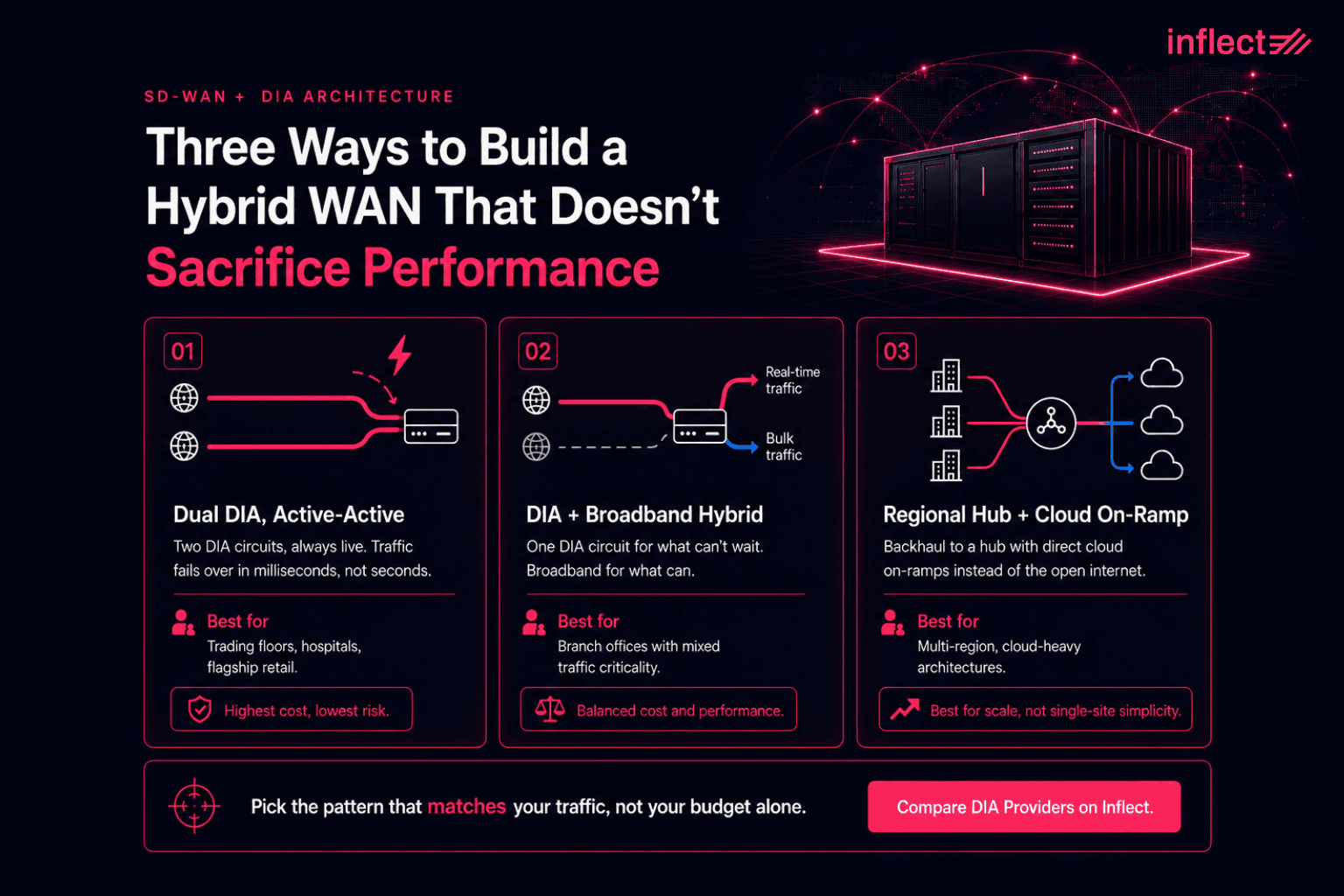
Enterprises architect hybrid SD-WAN and DIA networks using three recurring patterns: dual DIA circuits in an active-active configuration at the edge, a DIA and broadband hybrid for cost-tiered sites, and a regional hub with cloud on-ramps backhauled over DIA, each reflecting a different SD-WAN architecture decision about where to place DIA relative to broadband and MPLS.
Pattern 1: Dual DIA + SD-WAN Edge for Active-Active Failover
Pattern 1 pairs multiple internet connections, typically two independent DIA circuits from different last-mile providers, with an SD-WAN edge device running both DIA links as primary connections in an active-active configuration so traffic fails over in milliseconds rather than the seconds a single-link active-passive design requires. This pattern is best for latency-sensitive branches with high uptime requirements, such as trading floors, hospital sites, or flagship retail locations, where even a brief failover gap has a measurable cost.
Pattern 2: DIA + Broadband Hybrid for Cost-Optimized Tiering
Pattern 2 combines one DIA circuit for latency-sensitive and business-critical traffic with a lower-cost broadband connection for bulk or best-effort traffic, using the SD-WAN overlay's application-aware routing for traffic prioritization and steering each traffic class to the appropriate underlay. This pattern is best for cost-constrained sites with mixed traffic criticality, such as branch offices where email and web browsing can tolerate broadband but VoIP and ERP traffic cannot.
Pattern 3: Regional Hub and Cloud On-Ramp With DIA Backhaul
Pattern 3 routes branch traffic through a regional hub or colocation facility with a DIA connection and direct cloud on-ramps for consistent cloud connectivity, backhauling traffic over DIA rather than the public internet's best-effort path to reach AWS, Azure, Google Cloud, or SaaS platforms. This pattern is best for multi-region or cloud-heavy architectures where data center connectivity and performance to multiple cloud providers matter more than minimizing circuits per branch.
Sizing DIA Bandwidth Against SD-WAN Traffic Classes
Sizing a DIA circuit for SD-WAN starts with classifying traffic into at least three tiers: real-time (voice and video conferencing), business-critical (ERP, CRM, transactional SaaS), and best-effort (web browsing, software updates), then provisioning enough committed bandwidth to cover peak concurrent usage in the top two tiers without contention. Undersizing the DIA circuit reintroduces the same contention problem broadband has, just at a smaller scale and a higher price per site.
SD-WAN + DIA Use Cases Where Performance Cannot Be Compromised
Four categories of enterprise traffic make SD-WAN plus DIA a requirement rather than a preference: real-time voice, video, and UCaaS; multi-cloud and SaaS applications that need consistently low latency connectivity; regulated and transaction-heavy branch environments in retail, healthcare, and financial services; and a narrow set of edge cases, such as high-frequency trading, where even DIA is not enough.
Real-Time Voice, Video, and UCaaS Over Hybrid WAN
UCaaS platforms require the network to hold latency, jitter, and packet loss within the ITU-T G.114 bands cited earlier for every call, on every path, at every hour, which best-effort broadband cannot guarantee during peak usage windows. Pairing the SD-WAN overlay's application-aware routing with a DIA underlay lets the network meet those bands consistently rather than only when contention happens to be low.
For technical teams: configure the SD-WAN policy engine to mark UCaaS traffic for the DIA path by default for both branch offices and remote users connecting over VPN, and use the broadband link only as a failover path for non-real-time classes, rather than load-balancing real-time traffic across both links.
Multi-Cloud and SaaS Performance Requirements
Multi-cloud and SaaS-heavy enterprises need consistent performance to more than one hyperscaler and dozens of cloud applications at once, a driver, alongside cloud adoption and remote work, behind SD-WAN adoption growing from roughly $5.3 billion in 2023 toward more than $8 billion by 2026 (Source: Gartner, 2025). DIA backhaul to cloud on-ramps, covered in Pattern 3 above, gives that internet traffic a predictable path instead of routing it across the public internet's best-effort default.
Retail, Healthcare, and Financial Branch Connectivity
Retail point-of-sale systems, healthcare clinical applications, and financial branch transactions across remote locations all depend on low-latency, low-packet-loss connectivity that cannot tolerate the multi-second stalls broadband contention can introduce during peak hours. A DIA underlay gives these regulated and transaction-heavy environments the same SLA-backed performance floor regardless of how many other subscribers share the local access network.
For technical teams: financial branch and healthcare deployments should pair DIA with encrypted overlay tunnels and application-aware segmentation so compliance-sensitive traffic classes never fall back silently to an unencrypted or unmonitored broadband path.
When SD-WAN + DIA Is Not Enough
SD-WAN plus DIA is not sufficient for three narrow categories of traffic: high-frequency trading and other sub-millisecond use cases, workloads bound by regulatory or deterministic routing requirements that mandate a specific physical path, and ultra-low-latency edge computing scenarios where even a well-engineered internet path introduces too much variability. These cases still depend on private point-to-point circuits, dedicated dark fiber, or edge compute placement rather than an internet-based underlay, and recognizing that boundary early prevents an architecture team from over-promising what DIA can deliver.
How to Evaluate SD-WAN and DIA Providers for a Hybrid WAN Build
Evaluating SD-WAN and DIA providers for a hybrid WAN build comes down to four criteria: the specific SLA metrics and thresholds a provider will commit to in writing, whether the DIA circuit is on-net or off-net at each site, the procurement timeline and cost structure across multiple locations, and how directly comparable the SLAs are across providers bidding on the same build, since inconsistent SLA terms make ongoing network management harder once the circuits are live.
Key SLA Metrics and Minimum Acceptable Thresholds for DIA Providers
Enterprise buyers should require DIA providers to commit to four SLA metrics in writing: uptime, latency, packet loss, and jitter. Commonly used enterprise benchmarks, not universal guarantees, are uptime at 99.9 percent or higher, latency at or below 30 to 50 milliseconds for intra-region traffic, packet loss at or below 0.1 percent, and jitter at or below 5 to 10 milliseconds for real-time traffic classes. Buyers should treat these as a starting point for negotiation and confirm the specific numbers a provider is willing to guarantee rather than assume they match another provider's circuit in a different market.
On-Net vs. Off-Net DIA: What It Means for Your Build
On-net DIA means the provider owns and operates the physical last-mile connection into the building, while off-net DIA means the provider leases that last mile from another carrier and resells it under its own SLA. On-net circuits typically install faster and give the provider direct control over repair times, while off-net circuits can extend reach into markets the primary provider does not build into, at the cost of an extra layer between the buyer and the SLA that actually matters.
Procurement Timelines and Cost Considerations for Multi-Site DIA
Procuring DIA across multi-site networks introduces three recurring friction points: collecting comparable quotes from multiple providers across every site, validating on-net availability at each address before committing to a timeline, and reconciling SLA language that is not written the same way from one provider to the next. On-net DIA installs typically take four to twelve weeks depending on the market and whether new construction is required, while off-net or difficult-access sites can extend well beyond that window.
Building the Business Case for SD-WAN + DIA Investment
The business case for pairing SD-WAN with DIA rests on two figures finance stakeholders care about: the total cost of the hybrid build relative to MPLS, and the cost of the outages and performance degradation the hybrid build is designed to prevent.
SD-WAN + DIA Total Cost of Ownership vs. MPLS
SD-WAN paired with DIA can deliver lower WAN total cost than MPLS because organizations can use more affordable internet transport while still adding software-defined control and routing flexibility. APNIC’s 2023 TCO analysis found that a remote hybrid network cost 38% less than a baseline MPLS network, though the exact savings vary by site count, geography, access costs, and service mix. Whether SD-WAN should replace MPLS entirely or run alongside it depends on each enterprise’s cost goals and risk tolerance, so buyers should model savings against their own WAN invoices rather than relying on a generic percentage (Source: APNIC, 2023).
Quantifying the Cost of Downtime and Performance Degradation
The cost of getting WAN performance wrong is well documented: more than half of enterprises that experienced a significant, serious, or severe outage in 2024 reported a cost above $100,000, and one in five reported a cost above $1 million, a four percentage point increase year over year (Source: Uptime Institute, 2025). A hybrid WAN that eliminates broadband contention as a single point of failure directly reduces exposure to that cost category for critical business traffic, even though most published outage figures are reported at the data center level rather than isolated to branch WAN incidents specifically.
SD-WAN + DIA: The Hybrid WAN Standard for Performance-Critical Networks
SD-WAN was never designed to fix the performance ceiling of the transport underneath it, and broadband alone cannot hold the latency, jitter, and packet loss bands that voice, video, and SaaS traffic require during peak hours. Pairing SD-WAN with DIA closes that gap: it gives network architects software-defined routing control over an underlay that is contractually obligated to perform, using the active-active, hybrid-tiered, or cloud on-ramp patterns covered above depending on a site's traffic mix and budget, whether that site is a flagship location or one of dozens of remote branches. The SD-WAN benefits and capabilities that get the most attention, application-aware routing, centralized control, rapid failover, only hold up when the underlay backs them up, which is what DIA provides and broadband cannot. For most enterprise branches, that combination, not broadband alone and not MPLS alone, is now the practical standard for hybrid WAN architecture built for performance-critical applications, because modern businesses depend on consistent application performance more than they depend on any single transport type.
Sourcing SD-WAN and DIA Circuits on Inflect
The friction described in the evaluation section above, comparing quotes across providers, confirming on-net availability, and reconciling inconsistent SLA language, is exactly what slows down most multi-site DIA procurement. Inflect is a digital infrastructure marketplace where enterprise buyers can search, compare, and receive instant pricing on dedicated internet access, colocation, bare metal, and private networking across 6,000+ data centers and facilities in 100+ countries, without submitting a form or waiting on a sales call to see a price. Buyers can compare DIA availability and SLA terms from providers including Lumen, GTT, Colt, Zayo, Megaport, and Telehouse side by side for a given address, validate on-net coverage before committing to a build timeline, and get free expert advisory on which underlay pattern fits a given site's traffic profile at no cost. Whether the build is a single-site DIA upgrade or a network infrastructure refresh across dozens of branches, that combination of instant, comparable pricing and specific-market availability search is the difference between a multi-site DIA procurement that takes weeks of back-and-forth and one that starts with a shortlist the same day.
Ready to Build a Hybrid WAN That Doesn't Sacrifice Performance?
Compare DIA pricing and SLA terms from dozens of providers, side by side, with no sales call required
Validate on-net availability at every branch before you commit to a procurement timeline
Get free expert advisory on which SD-WAN and DIA architecture pattern fits your traffic mix
Search specific capacity and DIA availability by address across markets worldwide
Search DIA availability and pricing for your locations on Inflect today.
About the Author

Haley Rogers
Content & Social Media Specialist
Haley Rogers is the Content & Social Media Specialist at Inflect, bringing over two years of experience in social media, marketing, and content strategy — including time at a fast-paced tech company before joining the Inflect team. She specializes in translating complex digital infrastructure topics into clear, engaging content, with a particular focus on blog writing and brand storytelling across channels.
Contact: