10 mins
Prefabricated Data Center Solutions for Edge AI: Features, Costs, and Use Cases
Prefabricated modular data centers are factory-built, self-contained infrastructure units that integrate power, cooling, and IT systems into deployable containers or purpose-built structures, used by enterprises and operators to run edge AI workloads at distributed sites where traditional construction timelines and colocation supply constraints make conventional procurement paths unworkable. The primary drivers for this approach are rack density requirements of 50–150+ kW per rack, deployment timelines measured in months rather than years, and the need to position compute at or near the point of data generation rather than routing inference traffic to a distant region.
Your infrastructure team has confirmed the use case: real-time inference at the plant floor of a manufacturing facility in a secondary market, where latency and compliance requirements rule out both hyperscale cloud and shared colocation. You go to market anyway. Two of the three colocation providers you approach have no AI-ready inventory in that region. The third has limited high-density space, requires a deposit equivalent to six to twelve months of fees upfront, and cannot guarantee availability beyond the initial term. At 35ms round-trip, the cloud option is simply too far from the sensors regardless.
The problem is not budget. It is that the infrastructure options built for this moment, high-density, low-latency, at-the-edge compute, are either unavailable, locked behind restrictive terms, or in the wrong place. Prefabricated modular data centers exist to close this gap. This post covers how they work, what they cost, how they compare to the alternatives, and how to source capacity without a six-week RFQ.
What Are Prefabricated Modular Data Centers for Edge AI?
Prefabricated modular data centers (PMDCs) are factory-assembled, self-contained infrastructure units that integrate power distribution, mechanical cooling, fire suppression, physical security, and IT rack space into a single deployable structure, sized from a single shipping container to multi-megawatt campus blocks. For edge AI specifically, these modular data center solutions are engineered to support the GPU-dense workloads that local inference, computer vision, and real-time model execution require: workloads that most standard enterprise server rooms and conventional colocation facilities were not built to handle.
Recommend reading: Edge Colocation for AI Agents: Why Low-Latency Infrastructure Matters
The distinction between a general-purpose modular unit and one optimized for edge AI is primarily thermal and electrical. A containerized data center designed for traditional enterprise IT might support 10–15 kW per rack. An edge AI deployment using current-generation GPU accelerators can require 50–100 kW per rack, and dense Blackwell-class configurations can exceed 130 kW today, with future systems pushing higher (Uptime Institute, 2025). The factory-built approach allows cooling and power architecture to be designed around these specifications from the beginning, rather than retrofitting a facility built for a different era of compute.
Modular units are also ruggedized for deployment outside purpose-built data center campuses. Environmental hardening covers operating temperature ranges from -40°C to +55°C, dust and ingress protection to IP55 or higher, vibration resistance, and corrosion protection for coastal or industrial sites. These characteristics matter when the deployment location is a port facility, a manufacturing floor, an offshore platform, or an energy extraction site rather than a suburban campus with controlled access and stable utilities.
For technical teams: containerized units typically ship on standard 20ft or 40ft ISO frames for logistics compatibility. Purpose-built prefabricated buildings follow a similar factory-assembly model but are not container-constrained, allowing more flexible floor plan configurations and higher per-unit power capacity. Both approaches share the core advantage of factory commissioning: systems are tested before leaving the manufacturing facility, reducing on-site integration risk significantly. The modular approach also makes it practical to deploy a prefab data center at a site where traditional construction would never be approved or logistically viable.
Prefabricated vs. Colocation vs. Greenfield: The Real Deployment Decision for Edge AI
The three procurement paths available to an enterprise deploying edge AI infrastructure (prefabricated modular, colocation in an established data center, and greenfield traditional construction) differ across six dimensions that drive the actual sourcing decision: deployment timeline, rack density ceiling, capacity availability, contract terms, geographic flexibility, and upfront cost structure.
Decision factor | Prefabricated modular | Colocation (established DC) | Greenfield traditional build |
|---|---|---|---|
Deployment timeline | 6–12 months from order | 30–90 days if capacity exists | 24–36 months |
Rack density ceiling | 50–150+ kW, engineered to spec | Typically 10–20 kW; AI-ready space severely constrained | Designed to spec, but timeline cost is prohibitive |
Capacity availability | Made to order; no inventory constraint | Constrained in most AI-demand markets; waitlists common | No constraint, but construction starts from zero |
Contract terms | Purchase or lease; no operator deposit | Large upfront deposits for AI-ready space; 3–5 year minimums standard | Full capital outlay; no operator dependency |
Geographic flexibility | Deployable at any site with power access | Limited to existing facility footprints | Any site; timeline is the binding constraint |
Upfront cost structure | Higher hardware CapEx; lower civil and construction cost | Lower CapEx entry; higher long-term OpEx and lock-in risk | Highest total CapEx; highest construction schedule risk |
The colocation option is worth examining closely because it is typically presented as the fast path. It can be, when capacity exists. In most markets with active AI demand, it does not. Established data center operators have absorbed hyperscaler and NeoCloud pre-leases across multiple consecutive years, leaving limited AI-ready inventory available to enterprise buyers. When high-density space does appear, operators are increasingly requiring significant deposits upfront and minimum terms of three to five years to secure it. For a buyer that needs to move on a defined AI rollout schedule and retain some degree of flexibility, these terms introduce meaningful procurement friction.
Beyond terms, there is a structural density problem. The majority of installed colocation inventory was engineered for 10–15 kW per rack. Retrofitting an existing hall for 80 kW per rack average density requires cooling system replacement, power infrastructure upgrades, and structural assessment: work that takes time and that operators are not universally willing to undertake for a single tenant. Buyers sometimes discover that the AI-ready colocation space that exists on paper does not exist at the density, location, or timeline their deployment actually requires.
The greenfield option solves the density and control problem but introduces a timeline that most AI programs cannot absorb. A 2 MW prefabricated facility delivers in approximately 12 months. A comparable traditional build takes 24–36 months. (Introl, 2026)) If your AI roadmap is measured in quarters, a 30-month data center construction cycle is not a viable path.
Prefabricated modular sits between these two options for most edge AI buyers: faster deployment than greenfield, locationally flexible and density-capable in ways that established colocation currently cannot reliably match. When rapid deployment and density are both hard requirements, it is the only path that satisfies both (Soeteck, 2025).
Power and Cooling Systems Engineered for 50–150+ kW Rack Densities
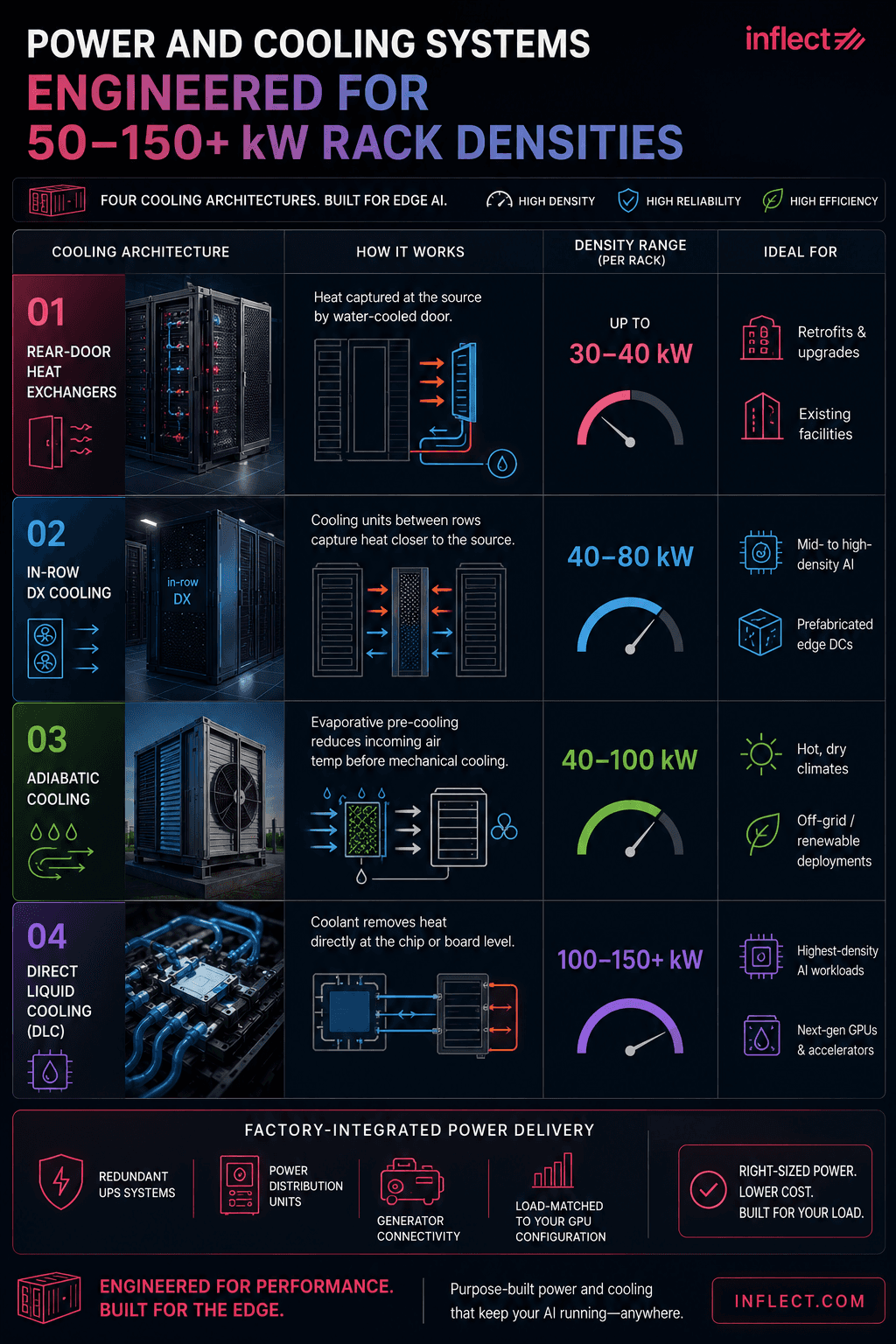
Prefabricated edge AI data centers are built around four primary cooling architectures: rear-door heat exchangers, in-row direct expansion (DX) cooling, adiabatic systems, and direct liquid cooling, each suited to a different operating environment and density range.
Rear-door heat exchangers
Rear-door heat exchangers replace standard rack doors with water-cooled panels that capture heat at the source before it enters the room air. They are effective at up to approximately 30–40 kW per rack and integrate into existing air-cooled room architectures. They are the common entry point for buyers transitioning existing infrastructure rather than deploying net-new.
In-row DX cooling
In-row DX cooling positions cooling units between rack rows, reducing the distance hot air must travel before capture. This approach supports higher densities than perimeter cooling alone and is a standard configuration in prefabricated builds targeting the 40–80 kW range.
Adiabatic cooling
Adiabatic cooling uses evaporative pre-cooling to reduce incoming air temperature before it enters the mechanical cooling loop. It is highly efficient in dry climates and reduces mechanical cooling load by 30–60% in suitable environments. (Source: ASHRAE, "Evaporative and Adiabatic Cooling for Data Centers," 2022. ashrae.org) For remote or off-grid edge deployments, reduced cooling energy draw directly reduces generator sizing requirements and ongoing fuel cost, and the efficiency profile pairs particularly well with renewable energy sources where grid power is unavailable or expensive.
Direct liquid cooling (DLC)
Direct liquid cooling (DLC) routes coolant to heat-generating components at the chip or board level and is the only architecture that reliably supports configurations above 100 kW per rack. It is increasingly standard in any prefabricated unit designed for current-generation AI accelerators. Cold plate configurations, where coolant contacts a plate attached directly to the processor, are the most common form in containerized AI deployments. Immersion cooling, where compute hardware is submerged in dielectric fluid, is gaining adoption for the highest-density configurations and for deployments where air management at the site level is particularly constrained.
Power delivery in prefabricated edge AI units is factory-integrated with redundant UPS systems, power distribution units, and generator connectivity for remote sites. These purpose-engineered modules allow power and cooling to be load-matched to the specific GPU configuration procured, which avoids the overprovisioning that typically inflates cost in traditional builds designed around theoretical peak loads.
Prefabricated Edge AI Data Center Costs: CapEx, OpEx, and Total Cost of Ownership
Modular data center cost for an edge AI deployment breaks down across four components: hardware and factory fabrication, site preparation, ongoing power and cooling operations, and financing or lease cost where the unit is not purchased outright.
Hardware and fabrication
Hardware and fabrication is the largest upfront item. A fully integrated containerized unit in the 500 kW to 1 MW range, including cooling, power infrastructure, and rack systems but excluding IT hardware, typically falls in the multi-million-dollar range, depending on density specification, cooling architecture, and site hardening requirements. (Global Newswire, 2024) Treat any published figure as directional: pricing is sensitive to GPU supply chain dynamics and commodity costs that have moved significantly in recent years.
Site preparation
Site preparation is where the prefabricated approach delivers its most material cost advantage. On-site labor for a prefabricated deployment is reduced by up to 70% compared to traditional construction, with remaining work covering utility connections, foundation or pad preparation, and commissioning. (Introl, 2026) For remote sites, this directly reduces the cost of mobilizing construction crews and reduces schedule exposure to weather, permitting delays, and regional labor availability.
Ongoing OpEx
Ongoing OpEx is dominated by power cost, which at edge sites is often higher per kWh than at centralized data center campuses, a factor buyers frequently underweight in initial TCO models. A 1 MW facility operating at a PUE of 1.3 and paying $0.10/kWh spends approximately $1.1 million per year on power. Cooling architecture selection has a direct impact on this number: adiabatic and liquid cooling approaches reduce PUE meaningfully at the density levels edge AI requires.
For buyers evaluating a three-to-five-year horizon, the cost efficiency of a purchased prefabricated unit at a controlled site typically compares favorably to colocation once deposit requirements, escalation clauses, and the current premium pricing for AI-ready space are factored into the colocation model. The capital deploys earlier, but the ongoing cost structure is more predictable and not subject to operator repricing at lease renewal.
Edge AI Use Cases That Drive Prefabricated Deployments: Industrial, Energy, Smart Cities, and Phased Scale
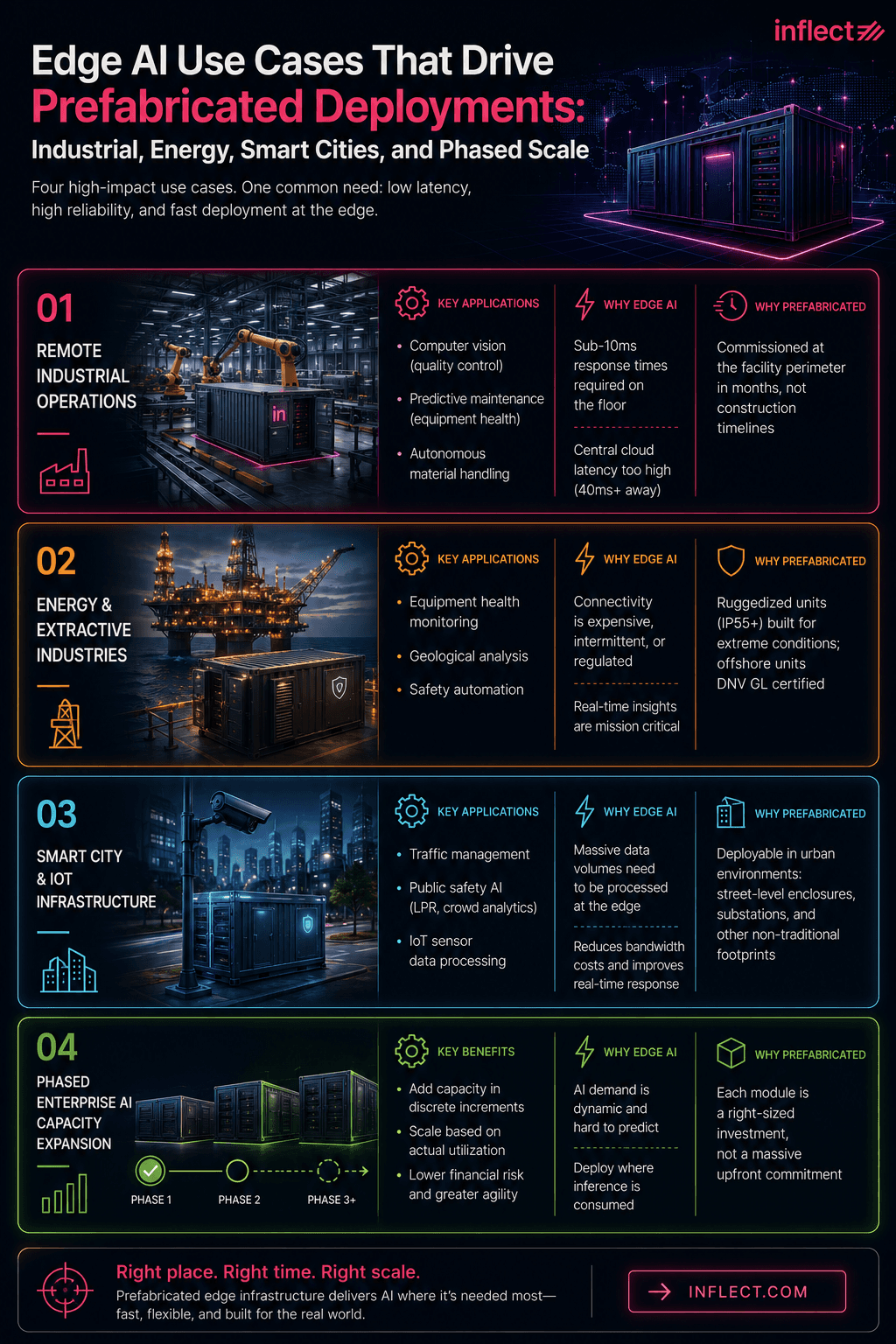
The four use cases that account for the majority of prefabricated edge AI deployments are remote industrial operations, energy and extractive industries, smart city and IoT infrastructure, and phased enterprise AI capacity expansion, each defined by a combination of location constraint, latency requirement, and density need that rules out centralized alternatives.
Remote industrial operations
Manufacturing, logistics, and processing facilities in secondary or tertiary markets need AI inference running on the floor, not 40ms away in a regional cloud hub. Computer vision for quality control, predictive maintenance on heavy equipment, and autonomous material handling all require low latency, sub-10ms response times. Prefabricated units can be commissioned at the facility perimeter on a timeline that aligns with the AI project deployment schedule rather than a construction calendar.
Energy and extractive industries
Offshore platforms, mining operations, and pipeline monitoring sites run AI workloads for equipment health monitoring, geological analysis, and safety automation in remote areas where connectivity to a central cloud is expensive, intermittent, or regulated out of acceptable use. Ruggedized containerized units rated to IP55 or higher are standard for these deployments; offshore configurations typically carry DNV GL certification for marine environments.
Smart city and IoT infrastructure
Traffic management systems, public safety AI applications including license plate recognition and crowd analytics, and Internet of Things sensor networks generate data that must be processed at the network edge to be useful. Municipal operators need edge data centers positioned within urban areas, often in facilities with no resemblance to a traditional data center. Prefabricated units in street-level enclosures or substation configurations are an established deployment pattern in this segment.
Phased enterprise AI capacity expansion
Enterprises that need AI capacity now but cannot forecast their three-year compute requirement accurately can add compute capacity in discrete increments rather than overbuild a permanent facility against an uncertain demand curve. The scalability this model provides means each additional module is a capital decision made with real utilization data from the prior unit, a materially lower-risk approach than a single large greenfield commitment. For organizations scaling AI across multiple sites, this scalable infrastructure model is the primary argument for modular over any fixed-build alternative.
How to Source Edge AI Data Center Capacity on Inflect
Inflect is a digital infrastructure marketplace and wholesale infrastructure expert, helping enterprises and NeoClouds source colocation, GPU servers, and network connectivity from 500kW to multi-megawatt scale, with deep advisory across financing, fit-out, connectivity, and offtake. For buyers evaluating edge AI infrastructure, whether the right answer turns out to be prefabricated modular, established colocation in a global market, or a combination of the two. Inflect provides instant pricing and side-by-side comparison across 6,000+ data centers and facilities in 100+ countries, with no sales call required to start.
The sourcing decision for edge AI infrastructure is rarely as clean as it looks at the start. A buyer who begins with a prefabricated modular requirement may find colocation capacity exists closer to their target site than expected, or that the optimal architecture pairs owned modular compute at the edge with established colocation for overflow or backup capacity. Inflect's free expert advisory covers the full infrastructure decision: site selection, density requirement validation, connectivity sourcing, and provider comparison, at no charge to the buyer.
Winston, Inflect's AI agent, is trained on Inflect's own marketplace data and the inventory and specifications of tremendous providers across the full ecosystem. For buyers navigating a complex infrastructure problem (multiple deployment sites, mixed workload types, uncertain capacity requirements, or a comparison between modular and colocation options they have not been able to price side by side), Winston is built specifically to model those options and connect buyers with advisors who have closed comparable deals.
Whether your requirement is a quote for a specific colocation facility with AI-ready density, a wholesale infrastructure process for a large-scale edge deployment, or a search for the right infrastructure path before you have committed to a direction, Inflect is the place to start without the friction of long wait time on quotes or a weeks-long sales process.
Find the right edge AI infrastructure on Inflect. No sales call required.
Search 6,000+ data centers across 100+ countries for AI-ready colocation capacity, with instant pricing and side-by-side comparison
Get free expert advisory on your edge AI deployment: site selection, density requirements, connectivity, and provider evaluation
Ask Winston to model your infrastructure options before you commit to a path, whether that is prefabricated modular, established colocation, or a hybrid approach
About the Author

Chanyu Kuo
Director of Marketing at Inflect
Chanyu is a creative and data-driven marketing leader with over 10 years of experience, especially in the tech and cloud industry, helping businesses establish strong digital presence, drive growth, and stand out from the competition. Chanyu holds an MS in Marketing from the University of Strathclyde and specializes in effective content marketing, lead generation, and strategic digital growth in the digital infrastructure space.
Contact:
Email: