13 mins
Multi-Tenant vs. Dedicated GPU Clusters: A Security and Performance Comparison
GPU cloud providers market multi-tenant instances as delivering near-bare-metal performance with enterprise-grade tenant isolation. In practice, teams running production workloads such as training and inference jobs on shared GPU infrastructure report throughput that varies by double digits between identical runs, and security researchers have identified side-channel exposure as a real isolation risk in certain multi-tenant configurations, not a universal condition of every shared GPU deployment.

That gap exists because multi-tenancy is a scheduling and resource-arbitration problem before it is a marketing claim: a GPU, its memory controller, and its interconnect fabric are physical resources shared through a hypervisor, orchestrator, or partitioning scheme, and each mechanism introduces contention, timing variance, or a boundary a motivated attacker can probe.
This post compares multi-tenant and dedicated GPU clusters across the two dimensions that drive sourcing decisions: security posture and performance consistency. It also maps specific workload types to the architecture that fits them, so AI infrastructure and ML platform leads can build a sourcing decision on evidence rather than vendor claims.
What Is the Difference Between Multi-Tenant and Dedicated GPU Clusters?
Multi-tenant GPU clusters allocate shared physical GPU hardware across multiple customers or workloads using a hypervisor, container orchestrator, or hardware partitioning layer, while dedicated GPU clusters allocate entire GPUs, servers, or racks to a single customer with no hardware, network, or scheduling layer shared with any other tenant. Every security and performance difference in this post traces back to whether a physical GPU is divided among strangers or reserved for one organization.
Definition of Multi-Tenant GPU Clusters
A multi-tenant GPU cluster is a pool of physical GPU servers that a provider divides among multiple customers at the virtual machine, container, or GPU-partition level, using a hypervisor, Kubernetes, or NVIDIA's Multi-Instance GPU (MIG) technology, which partitions supported GPUs into as many as seven isolated instances with dedicated compute and memory paths (Source: NVIDIA, 2026). Customers typically pay for the fraction of the GPU they consume, not the full unit.
Definition of Dedicated GPU Cluster Hosting
A dedicated GPU cluster is a set of physical GPU servers, network fabric, and storage provisioned exclusively for one customer, with no other tenant sharing the same hardware, hypervisor instance, or top-of-rack switch. It is typically billed by reserved capacity or contract term, and the customer controls scheduling policy across the full allocation.
Key Architectural Differences (Shared vs. Isolated Hardware)
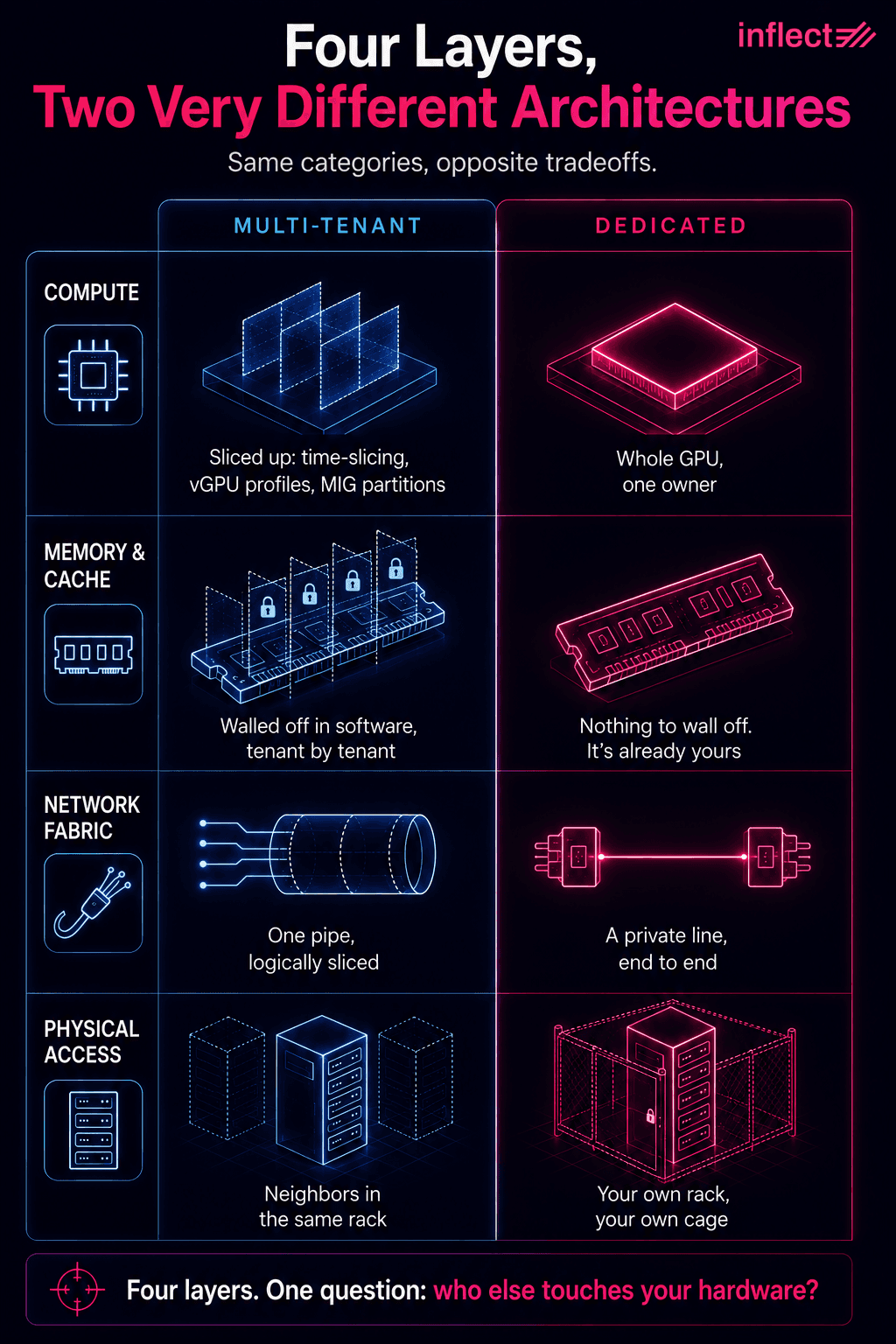
Multi-tenant and dedicated GPU clusters differ across four architectural layers: compute allocation, memory and cache isolation, network fabric, and physical hardware access. Multi-tenant clusters divide compute through time-slicing, virtual GPU profiles, or MIG partitions, rely on software or hardware boundaries to keep tenants' data apart in memory and cache, share a network fabric with logical segmentation, and house multiple customers in the same rack. Dedicated clusters assign whole GPUs to one workload, have no other tenant to isolate against in memory, run a private InfiniBand or Ethernet fabric end to end, and can be contracted with rack- or cage-level physical separation.
Role of Schedulers and Hypervisors
Schedulers and hypervisors are the software layer that makes multi-tenancy possible, translating shared physical hardware into isolated logical units by allocating time slices, memory ranges, or partitions to each tenant. This resource allocation policy, whether fair-share, priority queuing, or hard quotas, directly determines how much contention one tenant can create for another, a root cause that resurfaces in both the security and performance sections below.
How Multi-Tenant and Dedicated GPU Clusters Work
Multi-tenant and dedicated GPU clusters rely on six distinct mechanisms to allocate hardware: VM-based isolation through hypervisors, container isolation and orchestration through Kubernetes and Slurm, NVIDIA Multi-Instance GPU (MIG) and virtual GPU (vGPU) partitioning, bare-metal allocation, single-tenant networking and fabric isolation, and physical rack and node-level isolation.
VM-Based Isolation and Hypervisors
VM-based isolation assigns a GPU or fractional GPU profile to a virtual machine through a hypervisor such as KVM, Xen, or VMware ESXi, which mediates access between the physical device and guest operating system. Passthrough configurations are generally able to deliver performance close to native, non-virtualized execution because the hypervisor grants near-exclusive device access, but this approach does not enable fine-grained multi-tenancy within a single GPU.
Container Isolation and Orchestration (Kubernetes, Slurm, Scheduling Policies)
Container isolation shares GPU resources across multiple tenants' workloads using an orchestrator such as Kubernetes, often deployed alongside the NVIDIA GPU Operator to manage drivers and device plugins, or a workload manager such as Slurm, both of which expose GPUs as schedulable resources under fair-share, priority, or quota-based policies enforced at the pod or job level. These policies directly produce or prevent noisy-neighbor contention: a quota caps how much of a shared resource one tenant can consume, while a loosely enforced fair-share policy can let one workload's burst degrade another's throughput. This pattern is how most Kubernetes GPU clusters divide capacity across data science teams.
NVIDIA MIG and vGPU Partitioning
NVIDIA MIG and vGPU partitioning divide a single physical GPU into multiple isolated instances at the hardware or driver level rather than through the hypervisor alone, improving GPU utilization by letting multiple workloads share otherwise idle capacity. With MIG, each partition has separate, isolated paths through the memory system, including dedicated L2 cache banks, memory controllers, and DRAM address buses, giving each instance predictable performance and fault isolation so it cannot interfere with another's scheduling (Source: NVIDIA, 2026). This is materially stronger hardware-level GPU isolation than software-only time-slicing.
Bare-Metal Allocation in Dedicated Clusters
Bare-metal allocation provisions physical GPU servers directly to a single customer with no hypervisor layer between the operating system and hardware. This gives full control over GPU driver versions and kernel parameters through direct GPU access, removing virtualization overhead entirely, which matters for teams running custom CUDA kernels or other latency-sensitive AI workloads.
Single-Tenant Networking and Fabric Isolation
Single-tenant networking dedicates high-speed interconnects, whether InfiniBand or Ethernet fabric, exclusively to one customer's traffic rather than sharing them with logical segmentation. This eliminates network-level noisy-neighbor effects and gives deterministic latency for distributed training jobs.
Physical Rack and Node-Level Isolation
Physical rack and node-level isolation places a customer's dedicated GPU nodes in a rack or cage with no other tenant's equipment present, supporting physical security and simplified compliance scoping. Shared racks without individual access controls introduce compliance complications that dedicated isolation avoids by design.
Security Comparison: Multi-Tenant vs. Dedicated GPU Infrastructure
Multi-tenant and dedicated GPU clusters differ across six security dimensions: shared attack surface, side-channel risk in GPU and memory subsystems, GPU memory residue and data remanence, hypervisor and orchestration layer vulnerabilities, compliance implications, and auditability of tenant boundaries. Unlike CPUs, which have decades of mature multi-tenant isolation features, GPUs were originally designed for single-user graphics workloads, which is part of why isolation guarantees still vary so much by provider and technology.
Shared Attack Surface in Multi-Tenant Environments
Multi-tenant GPU environments expand the attack surface to include every other tenant sharing the same physical hardware, an attack path that does not exist in a dedicated cluster. Researchers demonstrated covert and side-channel attacks against NVIDIA's multi-GPU interconnect that succeed across virtual machines on public cloud providers without requiring the attacker's workload to be co-located on the same physical GPU as the victim, instead monitoring communication traffic across the interconnect from a remote instance (Source: NVIDIA, 2025). This matters for GPU multi-tenancy risks because it shows exposure can extend beyond the immediate physical neighbor to the broader shared interconnect fabric. This risk is most relevant on public cloud instances, where tenants typically have no visibility into who else shares the underlying hardware.
Side-Channel Risks in GPU and Memory Subsystems
Side-channel risk in multi-tenant GPU infrastructure arises when one tenant's workload can infer information about another's by observing shared hardware behavior such as interconnect traffic or memory timing, without directly accessing the other tenant's data. The same NVBleed research also demonstrated intra-VM side-channel attacks capable of fingerprinting applications and identifying content processed by a co-located workload using only unprivileged, user-level access (Source: NVIDIA, 2025). This risk class is real in any GPU cluster side-channel attacks assessment, but it applies to configurations with insufficient isolation, not every deployment; strong partitioning such as MIG, when properly configured, substantially reduces it compared to software-only time-slicing.
GPU Memory Residue and Data Remanence
GPU memory residue occurs in cloud environments when data such as model weights or training data from one tenant's workload remains in memory after that workload ends and is not fully cleared before the next tenant is allocated to the same space. Mitigation varies by provider: some implement mandatory memory zeroing between allocations by default, while others leave it configurable, so buyers evaluating secure GPU cloud infrastructure for sensitive AI workloads should confirm a provider's specific policy rather than assume it is universal. Some providers are also beginning to offer confidential computing capabilities that encrypt GPU memory in use, though support is still limited to specific hardware generations and provider stacks.
Hypervisor and Orchestration Layer Vulnerabilities
Hypervisor and orchestration layer vulnerabilities create a path for a compromised tenant workload to escape its isolation boundary and affect the host or other tenants, a risk that exists at the hypervisor, container runtime, and orchestrator layer alike. Because this class targets the software enforcing separation rather than the GPU hardware, patch management matters as much to multi-tenant GPU infrastructure security as the partitioning technology in use.
Compliance Implications of Shared vs. Isolated Hardware
GPU cluster compliance requirements differ significantly depending on whether infrastructure is shared, with HIPAA, PCI DSS, FedRAMP, and SOC 2 Type II each imposing conditions more straightforward to satisfy on dedicated hardware. HIPAA's Security Rule requires covered entities and business associates to implement physical, administrative, and technical safeguards wherever electronic protected health information is created, received, or maintained, obligations that extend to business associates through a signed business associate agreement. PCI DSS v4.0.1 continues to apply additional requirements to multi-tenant and shared hosting service providers, requiring that each customer's environment be logically separated so no shared component, including the hypervisor, provides an access path between tenants (Source: PCI Security Standards Council, 2024). Dedicated clusters simplify these assessments because there is no other tenant's environment to segment against.
Auditability and Tenant Boundary Guarantees
Auditability in multi-tenant environments depends on a provider's ability to demonstrate, not just assert, that tenant boundaries hold under testing. PCI DSS v4.0.1 requires providers relying on network segmentation to reduce assessment scope to regularly penetration test that segmentation, and if segmentation cannot be verified, the entire shared environment falls into scope for every customer's compliance assessment (Source: PCI Security Standards Council, 2024). Dedicated clusters remove this dependency entirely. The stakes are not abstract: the global average cost of a data breach reached 4.44 million dollars in 2025, the first year-over-year decline in five years, driven largely by faster breach containment through AI-assisted detection (Source: IBM Security and Ponemon Institute, 2025).
Performance Comparison: Multi-Tenant vs. Dedicated GPU Clusters
Multi-tenant and dedicated GPU clusters differ across six performance dimensions: throughput variability from noisy-neighbor effects, latency consistency under shared load, GPU virtualization overhead, PCIe, NVLink, and memory bandwidth contention, interconnect topology control, and scaling efficiency for distributed training.
Throughput Variability and Noisy-Neighbor Effects
Noisy-neighbor GPU performance effects occur when one tenant's workload consumes enough shared compute, bandwidth, or cache capacity to cause measurable performance degradation in another tenant's workload on the same hardware. This follows directly from the scheduling policies discussed earlier: clusters enforcing hard partitioning through MIG or dedicated hardware largely eliminate it, while clusters relying on software time-slicing or loose fair-share scheduling remain exposed.
Latency Consistency Under Shared Load
Latency consistency matters most for inference workloads with strict response-time requirements, and multi-tenant environments introduce unpredictable latency when a request lands behind another tenant's burst of activity on the same GPU or interconnect segment. Dedicated clusters eliminate this performance inconsistency because no other tenant's traffic competes for the same scheduling slot or network path.
GPU Virtualization Overhead
GPU virtualization performance overhead comes from two sources often conflated: compute overhead from the virtualization layer itself, which is typically minimal when hardware partitioning such as MIG is used, and contention-driven degradation from sharing hardware with other active tenants, which is often the larger factor in practice. The gap between the two can be substantial: a workload that shows almost no measurable overhead when it has a GPU to itself can slow down considerably once a second, unrelated workload is scheduled onto the same physical GPU. For technical teams: ask a provider whether its overhead figures reflect isolated compute overhead or overhead measured under realistic concurrent-tenant load, since the two can differ by an order of magnitude.
PCIe, NVLink, and Memory Bandwidth Contention
PCIe, NVLink, and memory bandwidth contention occurs when tenants compete for the same physical interconnect or memory controller bandwidth, regardless of how well compute cycles are partitioned. Even with MIG-level compute isolation, tenants sharing a node can still contend for PCIe lanes, shared memory access, or system memory bandwidth unless the architecture reserves those paths per partition.
Interconnect Topology Control (InfiniBand, NVLink Fabrics)
Interconnect topology control determines how much bandwidth is available for GPU-to-GPU communication during distributed training, and dedicated clusters give the customer exclusive control over that topology. NVIDIA's current-generation Blackwell GPUs pair high-bandwidth memory with 1,800 GB/s of NVLink bandwidth per GPU, with the newest Rubin platform doubling that to 3,600 GB/s per GPU and enabling 260 TB/s of aggregate bandwidth across a 72-GPU NVLink Switch domain, far ahead of older GPU generations that relied on PCIe alone for GPU-to-GPU communication (Source: NVIDIA, 2026). On a multi-tenant cluster, this fabric is typically shared with logical partitioning, which can limit effective bandwidth during another tenant's peak usage.
Scaling Efficiency for Distributed Training
Scaling efficiency measures how close a multi-GPU training job comes to linear speedup as GPU count increases, and it degrades faster on multi-tenant infrastructure because inconsistent per-GPU throughput and shared bandwidth compound at scale. One team's training job that loses even a few percentage points of throughput per GPU to contention sees that loss multiply across dozens or hundreds of GPUs, which is why large distributed training workloads favor dedicated or high-isolation infrastructure.
Choosing the Right Model for Your Workloads
Six workload categories determine whether multi-tenant or dedicated GPU infrastructure is the better fit: variable-demand inference, development and experimentation, short-cycle fine-tuning and batch jobs, large-scale model training, regulated and sensitive data workloads, and high-utilization or SLA-bound workloads.
Inference Workloads With Variable Demand
Cloud GPU instances serving inference workloads with unpredictable or spiky traffic generally favor multi-tenant infrastructure, letting teams scale capacity up and down without paying for idle dedicated hardware between spikes. This changes for latency-sensitive, real-time inference under strict enterprise SLAs, where latency spikes from shared infrastructure can degrade inference performance and violate response-time commitments, often justifying dedicated capacity even at lower utilization.
Development, Testing, and Experimentation
Development and experimentation workloads suit multi-tenant infrastructure well because they are typically short-lived, tolerant of performance variability, and benefit most from the low cost and fast provisioning shared capacity provides.
Short-Cycle Fine-Tuning and Batch Jobs
Short-cycle fine-tuning and batch jobs that run for hours rather than weeks generally fit multi-tenant infrastructure, since the cost efficiency of shared capacity typically outweighs the modest throughput variance for jobs of this length.
Large-Scale Model Training
AI training on dedicated GPU clusters is the standard for large-scale foundation model training because sustained multi-week runs at high GPU counts are exactly where noisy-neighbor variance, interconnect contention, and scaling inefficiency compound into real cost and schedule risk. Teams training at scale typically find the premium for dedicated capacity smaller than the throughput loss of running the same job on shared infrastructure.
Regulated and Sensitive Data Workloads
Regulated and sensitive data workloads, including those governed by HIPAA, PCI DSS, or FedRAMP, generally require dedicated or strongly isolated infrastructure because auditors expect verifiable tenant boundaries, not a provider's assurance alone. Organizations training or fine-tuning models on protected health information, cardholder data, or government data should treat dedicated hardware and single-tenant networking as close to a default rather than an optional upgrade.
High-Utilization and SLA-Bound Workloads
High-utilization workloads that keep GPUs busy most of the time, and workloads bound by contractual SLA guarantees on latency or throughput, both favor dedicated GPU vs. shared GPU performance economics: the cost advantage of shared infrastructure shrinks as utilization rises, while the isolation advantage of dedicated infrastructure grows as SLA exposure increases.
Sourcing GPU Clusters: What Inflect Buyers Should Know
Choosing between multi-tenant and dedicated GPU infrastructure comes down to the evaluation criteria covered throughout this post: isolation guarantees, interconnect topology, enterprise GPU cloud pricing models, and SLA transparency. Inflect is a digital infrastructure marketplace where buyers can search, compare, and receive instant pricing across 6,000-plus data centers and facilities in more than 100 countries, spanning colocation, bare metal, GPU cloud, dedicated internet access, and private networking, all without a sales call.
For buyers weighing multi-tenant GPU infrastructure against dedicated GPU cluster hosting, Inflect surfaces specific capacity, whether a MIG-partitioned instance for bursty inference or a fully dedicated, single-tenant GPU rack for a regulated training pipeline, searchable by region and availability rather than a request for quote. Providers offering GPU capacity on the platform include Equinix, Digital Realty, CoreSite, and CyrusOne, alongside specialized bare-metal and GPU cloud providers. Free expert advisory is available at no cost to help buyers match the tradeoffs in this post to their own workload, compliance, and infrastructure cost requirements.
On Inflect, you can:
Compare instant pricing across multi-tenant and dedicated GPU providers side by side, with no RFP or sales call required
Search specific GPU capacity, from fractional MIG instances to fully dedicated racks, by region and availability
Evaluate providers against the isolation, compliance, and interconnect criteria covered in this post before you commit
Get free expert advisory to match your workload's security and performance requirements to the right architecture
Start your search on Inflect to compare multi-tenant and dedicated GPU cluster providers and get instant pricing today.
About the Author

Haley Rogers
Content & Social Media Specialist
Haley Rogers is the Content & Social Media Specialist at Inflect, bringing over two years of experience in social media, marketing, and content strategy — including time at a fast-paced tech company before joining the Inflect team. She specializes in translating complex digital infrastructure topics into clear, engaging content, with a particular focus on blog writing and brand storytelling across channels.
Contact: