12 mins
Modular Data Center Deployment Timeline: From Quote to Go-Live
The three vendors gave you three different numbers, and none of them explained why. One quoted fourteen weeks. Another said nine months. The third sent a spreadsheet with seventeen variables and no total.

The modular data center deployment timeline is not a fixed number: it is the sum of four distinct phases, each with its own lead times, decision points, and compounding risks. What follows is a phase-by-phase breakdown of the full project schedule, from quote to commissioning, with realistic week ranges, the decisions that compress or extend each phase, and the failure modes that push go-live past your board date.
What Is a Modular Data Center and How Does Deployment Differ From Traditional Build?
A modular data center is a pre-engineered, factory-built infrastructure unit that delivers compute, power, and cooling as a deployable module, with the majority of integration work occurring off-site before the unit reaches its operating location. The global modular data center market reached $29.04 billion in 2024 and is projected to reach $75.77 billion by 2030, growing at a 17.4% CAGR. (Source: Grand View Research, 2024)
How Long Does It Take to Deploy a Modular Data Center?
A modular data center deployment typically takes between six and eighteen months from signed contract to operational go-live, with the most common range for a standard mid-scale prefabricated deployment falling between nine and twelve months. Heavily customized builds, complex permitting jurisdictions, or long utility interconnect queues can push that modular data center lead time to fourteen to twenty months; fully standardized containerized units with prepared sites can complete in as little as four to six months.
Modular Data Center Types: Containerized, Prefabricated, and Campus
The three primary modular archetypes carry materially different deployment timelines: containerized edge units can be operational within four to ten weeks of on-site delivery, prefabricated room-scale modules typically take twelve to twenty-four weeks from contract to installation complete, and scalable campus builds with multiple interconnected modules generally require nine to eighteen months. Containerized units ship as self-contained environments requiring minimal on-site integration; campus-scale deployments introduce phased delivery schedules, more complex permitting, and utility infrastructure requirements that align their data center construction timeline with the longer end of the modular range.
What Components Are Actually Prefabricated vs. Site-Built
In a modular data center deployment, the factory-built scope typically includes the structural enclosure, power distribution units, cooling systems, rack infrastructure, cable management, fire suppression, and control systems; the site-built scope covers the foundation, upstream utility connections, fuel storage, and MEP tie-in between the module and site services. Buyers who assume modular means "everything arrives finished" consistently underestimate Phase 3, because site-built scope represents four to twelve weeks of independent work that must complete before or alongside delivery.
Modular vs. Traditional Build: Why Speed-to-Power Is Not the Whole Story
Modular data center build time is shorter than traditional construction on a like-for-like basis, with ground-up traditional data center construction typically requiring twenty-four to thirty-six months compared to nine to eighteen months for modular, but the speed advantage narrows when site preparation, utility infrastructure, and permitting requirements are equivalent across both approaches. (Source: Uptime Institute, 2023) The relevant question is not "is modular faster?" but "what is the critical path for this site?"
Primary Use Cases That Drive Modular Deployment Decisions
Organizations select modular data center deployment for five primary reasons: rapid deployment of additional data center capacity where a traditional build timeline is incompatible with business requirements, edge computing in remote locations where permanent construction is impractical, disaster recovery infrastructure deployable on short notice artificial intelligence (AI) and HPC workload hosting requiring dense power and cooling configurations unavailable in existing facilities, and operations in markets with scarce construction labor. Each carries different timeline expectations and tolerances for customization.
Key Variables That Drive Modular Deployment Timelines
The four variables with the greatest impact on total modular data center deployment time are customization level, permitting jurisdiction, equipment supply chain conditions at time of order, and site readiness at delivery. Customization level determines manufacturing lead time; permitting jurisdiction determines whether the project spends four weeks or four months in approval; supply chain conditions at time of order determine lead times for switchgear, transformers, and generators; and site readiness at delivery determines whether installation begins on arrival or waits weeks for incomplete civil work.
Phase 1: Quote, Scope Definition, and Contract Execution (Weeks 1–8)
Phase 1 covers initial vendor engagement through signed contract, and the quality of decisions made here determines whether the downstream schedule is realistic or aspirational.
What Vendors Need to Generate an Accurate Modular Data Center Quote
An accurate modular data center quote requires site address and geotechnical data, available utility power capacity and voltage, target IT load in kilowatts or megawatts, redundancy tier requirement, cooling preference, regulatory constraints affecting design, and the target go-live date. Quotes generated without this information are directional estimates, not project-grade commitments, and the resulting gaps resurface as change orders after contract execution.
Site Assessment Requirements and Who Conducts Them
A pre-contract site assessment typically covers structural ground conditions, available utility service, access route dimensions for delivery and craning, and local AHJ requirements, and is conducted by the vendor's engineering team or a third-party civil engineer over one to three weeks. Findings regularly produce scope adjustments: restricted crane access may require a different module configuration, and inadequate utility capacity may require upstream infrastructure investment before manufacturing can begin.
Contract Terms That Protect Your Deployment Schedule
A modular data center contract that protects your schedule should include a manufacturing start date tied to contract execution, a delivery window with defined tolerance, liquidated damages for vendor-caused delays, and a change order freeze period after engineering lock. The change order freeze is particularly important: scope changes after engineering lock trigger re-engineering cycles that add four to eight weeks to the manufacturing timeline and reset supplier lead time commitments.
Common Causes of Phase 1 Delay and How to Avoid Them
Phase 1 slips for four primary reasons: incomplete site data at time of quote, multi-stakeholder internal approval processes, scope expansion during design review, and financing conditions that gate contract signature. The mitigation for each is achievable before vendor engagement begins: prepare a site data package in advance, identify all internal approvers, define a scope ceiling before design review, and confirm capital approval status beforehand.
Shortening the Quote-to-Contract Cycle Without Increasing Risk
The quote-to-contract cycle can be reduced from six to eight weeks to three to four weeks by providing a complete site data package at initial engagement, running legal review in parallel with technical scoping rather than sequentially, and pre-authorizing a scope envelope so minor design adjustments do not require executive re-approval. None of these actions require accepting additional commercial risk.
Phase 2: Engineering, Permitting & Manufacturing (Weeks 8–24)
Phase 2 is the longest and most opaque phase, and the primary source of schedule slippage on projects that started Phase 1 cleanly.
Custom Module Designs and Hidden Lead Time Risks
Standard modular configurations leave the factory in ten to sixteen weeks from engineering lock; custom configurations typically take sixteen to twenty-four weeks, and each engineering revision cycle requested after initial design approval adds two to four weeks to that modular data center manufacturing lead time. Buyers who treat the engineering review as an opportunity to refine requirements rather than confirm them generate the majority of manufacturing delays on custom builds.
Permitting Timelines for Modular Data Center Installations
Modular data center permitting timelines range from three to four weeks in jurisdictions with established modular construction precedent to sixteen to twenty weeks in jurisdictions with no prior approvals, with AHJ familiarity being the single largest variable. Permitting can be parallel-pathed with manufacturing in most cases, but utility interconnect approval is the exception: in some markets it carries queue times of eight to twenty weeks regardless of when the application is submitted.
Factory Manufacturing: The Build Sequence and Quality Milestone Schedule
Factory manufacturing of modular units in a controlled environment follows a defined sequence: structural fabrication, power system integration, cooling system installation, cable management, quality control, control system commissioning, and factory acceptance testing (FAT), with total elapsed time between ten and twenty weeks. Buyers should attend both the mid-build inspection and the FAT: deficiencies found at FAT are far less expensive to resolve than those discovered after delivery.
Supply Chain Risks That Extend Modular Lead Times
The components with the longest and most variable lead times in modular data center manufacturing are medium-voltage switchgear, power transformers, backup generators, and precision liquid cooling units, with switchgear and transformer lead times often stretching from months to more than a year during periods of heavy data center buildout (Source: CMIC Global, 2026). Vendors who build standard configurations typically pre-order these components in anticipation of demand, which is a meaningful differentiator worth asking about at the quote stage.
Buyer Visibility: What You Can Track During Manufacturing
Buyers should expect weekly status reports covering milestone completion, component receipt, and schedule risks, plus access to two formal hold-point inspections during manufacturing. Track three metrics through Phase 2: scheduled versus actual milestone dates, long-lead component receipt versus plan, and open engineering queries. An unresolved query late in the manufacturing cycle requires escalation, not a follow-up email.
Reducing Engineering and Manufacturing Lead Time
The three levers buyers control to reduce modular data center manufacturing lead time are selecting a standard configuration, confirming that long-lead components are pre-ordered by the vendor rather than procured at contract execution, and parallel-pathing permitting with manufacturing. Selecting a standard configuration alone saves four to eight weeks, and parallel permitting eliminates the scenario where a delivered unit has no legal authorization to install.
Phase 3: Site Preparation, Delivery & Installation (Weeks 24–40)
Phase 3 covers ground preparation through MEP tie-in, and is the phase most frequently affected by conditions outside the vendor's direct control.
Civil Works and Site Readiness: What Must Be Complete Before Delivery
Before a modular data center unit can be delivered and placed, four site conditions must be satisfied: the foundation must be complete and cured, the grounding grid must be installed, utility service must be terminated at the delivery point, and the access route and crane pad must be cleared and rated for the delivery load. Taking delivery before these conditions are confirmed is the most common source of Phase 3 delay, generating demurrage charges and compressing the MEP tie-in schedule.
Modular Unit Transport, Craning, and Placement: What to Plan For
Modular data center delivery involves oversized load permitting, route survey, crane mobilization, and a placement window of one to three days for a single module, with oversized load permits taking two to six weeks to obtain and the application needing to be initiated at least four to six weeks before the planned delivery date. Placement tolerance is typically within one inch of the engineered position, requiring the crane operator and vendor installation team to be on site together, not sequentially.
Mechanical, Electrical & Plumbing Tie-In: The Most Variable Installation Phase
On-site MEP tie-in connects the modular unit to site utility services and typically takes three to eight weeks depending on upstream infrastructure complexity and local labor availability. Qualified electricians and mechanical contractors are a genuine constraint in many secondary markets where data center demand has outpaced local trades capacity; sourcing them during Phase 2 rather than at the start of Phase 3 avoids being in queue when installation begins.
The Four Scenarios That Push Go-Live Back at Installation
The four most common causes of go-live delay in Phase 3 are: the site is not ready when the unit is delivered, utility interconnect approval is pending when installation is otherwise complete, qualified MEP contractors are unavailable in the required timeframe, and a design discrepancy between the manufactured unit and site conditions is discovered on arrival. The first and fourth are preventable with a pre-delivery inspection cross-referenced against as-built manufacturing drawings; the second requires utility engagement early in Phase 2, not at the start of Phase 3.
Pre-Delivery Site Readiness Checklist and Ownership Model
A pre-delivery readiness check should be completed no later than two weeks before the scheduled delivery date, with a named internal owner assigned to each item: foundation status (civil contractor), grounding grid (electrical contractor), utility termination at delivery point (electrical contractor), access route clearance and crane pad (site manager), and oversized load permit receipt (logistics coordinator). A checklist with no named owner is a list of assumptions, not a verification, and assumptions are what produce Phase 3 delays.
Phase 4: Commissioning, Testing, and Go-Live (Weeks 40–52+)
Phase 4 covers installation complete through formal acceptance and handover, and buyers who treat go-live as synonymous with delivery consistently underestimate it by four to six weeks.
Integrated Systems Testing: What Gets Tested and in What Order
Modular data center commissioning follows a defined four-stage sequence: point-to-point verification, functional testing of each system in isolation, integrated systems testing under realistic conditions, and load bank testing at rated capacity. Point-to-point verification alone takes three to five days for a room-scale module; integrated systems testing and load bank testing adds one to three weeks more and cannot be abbreviated without increasing operational risk.
Acceptance Testing and Handover Documentation Requirements
Formal acceptance should be conditioned on receipt of a complete handover package including as-built drawings, equipment serial numbers and warranty registration, commissioning reports for all major systems, O&M manuals, and signed confirmation that all punchlist items are resolved. Accepting the facility without this documentation creates operational risk for the facility's entire service life, including maintenance planning and future capacity expansion.
Commissioning Acceleration Strategies Without Cutting Validation
Commissioning time can be reduced by two to four weeks by beginning pre-commissioning activities before installation is complete, specifically completing point-to-point documentation review in parallel with MEP tie-in, and scheduling load bank equipment delivery to coincide with commissioning kick-off rather than ordering it after installation completes. The commissioning test protocol should also be agreed at contract execution: when undefined at the start of Phase 4, drafting and approval can consume two to three weeks of testing time.
What Go-Live Actually Means: Operational Readiness Criteria
Go-live is not the same as power-on: operational readiness requires five conditions beyond systems commissioning, specifically network connectivity tested to the IT environment, physical security operational and monitored, environmental monitoring integrated into the DCIM or BMS, maintenance contracts in place, and operations staff trained on the facility's configuration. Projects that define go-live as the date the generator runs are typically not ready for production workloads for another two to four weeks.
Modular Data Center Deployment Timelines: Three Paths to Go-Live
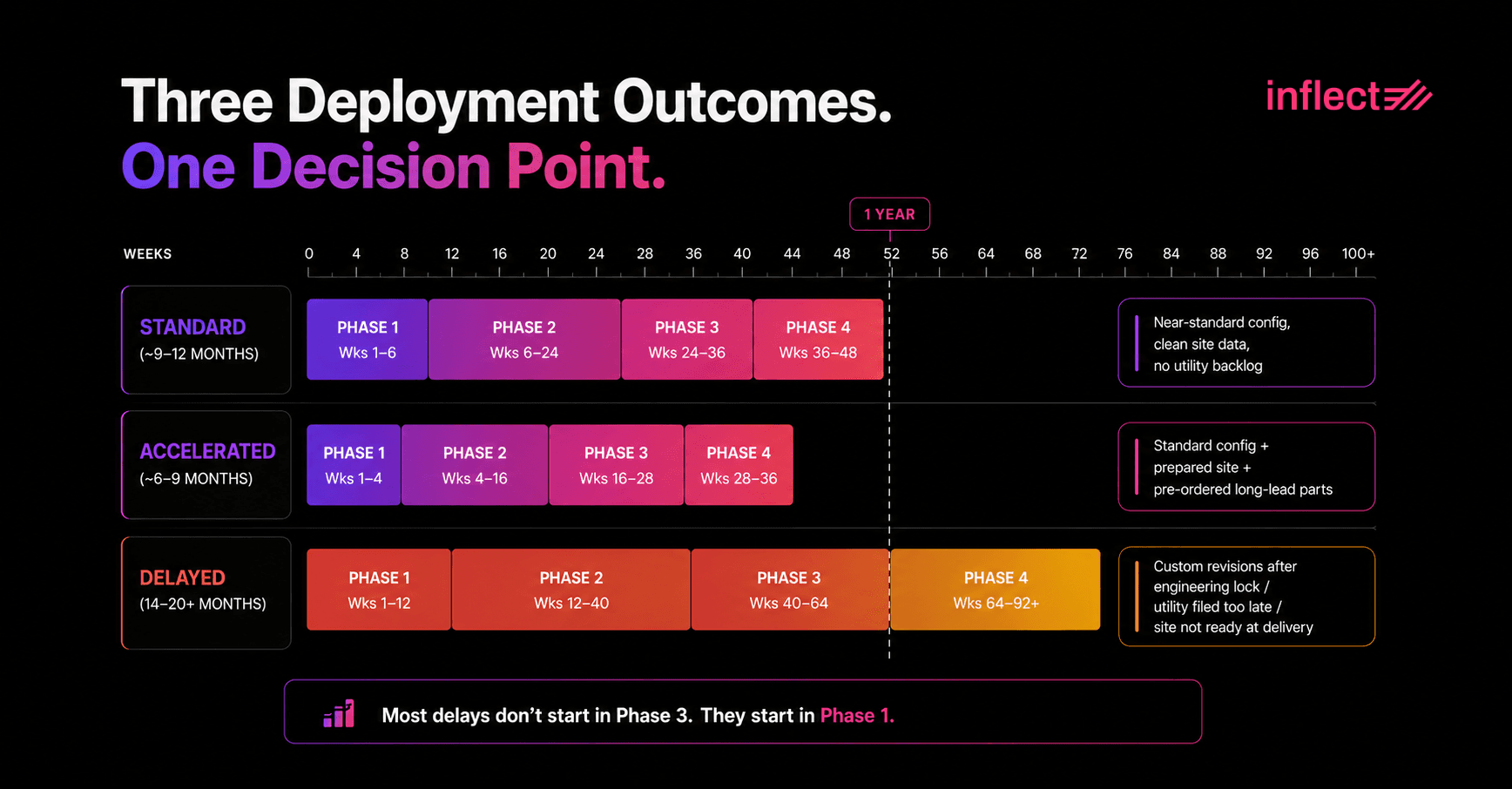
The full modular data center project timeline follows one of three paths depending on Phase 1 decisions and the site, supply chain, and permitting conditions governing the phases that follow.
The standard path covers a mid-scale prefabricated module with a near-standard configuration, single-AHJ permitting, no utility interconnect queue, and a prepared site. It completes in nine to twelve months: Phase 1 takes four to six weeks, Phase 2 takes fourteen to eighteen weeks with permitting parallel-pathed, Phase 3 takes eight to twelve weeks, and Phase 4 takes four to six weeks.
The accelerated path requires a standard configuration, a complete site data package at engagement, live utility service on site, and a jurisdiction with established modular construction precedent. When all four align, total deployment compresses to six to nine months.
The delayed path is not a planning scenario but a pattern: an underspecified Phase 1 contract, revision cycles in Phase 2, late utility engagement, an unready site, and commissioning treated as an afterthought. Projects on this path reach go-live at fourteen to twenty months, with delays compounding because early decisions left no margin for the variability that always follows.
What This Means If Your Timeline Is Already at Risk
If Phase 2 has slipped due to switchgear or transformer lead times, or Phase 3 is stalled while utility interconnect clears, you have a measurable gap between your original go-live date and your revised one. Colocation is a viable bridge. Inflect gives IT directors and procurement teams instant pricing across 6,000+ data centers in 100+ countries, including providers such as Equinix, Digital Realty, Iron Mountain, QTS, and CyrusOne, without a sales call or RFQ. If your modular deployment timeline has slipped by three to six months, a short-term colocation commitment can carry your production workloads without a multiyear contract.
Search available capacity, compare providers, and receive instant pricing at inflect.com, or speak with an Inflect advisor at no cost to scope a bridge solution for your timeline and load requirements.
About the Author

Haley Rogers
Content & Social Media Specialist
Haley Rogers is the Content & Social Media Specialist at Inflect, bringing over two years of experience in social media, marketing, and content strategy — including time at a fast-paced tech company before joining the Inflect team. She specializes in translating complex digital infrastructure topics into clear, engaging content, with a particular focus on blog writing and brand storytelling across channels.
Contact: