12 mins
Manufacturing Colocation Pricing: What Buyers Need to Know Before Requesting a Quote
Most procurement leads and infrastructure directors in manufacturing run into the same problem: the first colocation quote comes in higher than budgeted, and explaining the gap to a CFO is harder than expected.
The line items are unfamiliar, the power charges look like they might be duplicated, and the connectivity fees weren't in the model. That information asymmetry is structural, not accidental.

Colocation providers price manufacturing workloads differently because those workloads behave differently: higher power draw, stricter uptime requirements, more complex connectivity needs, and in defense and aerospace manufacturing, compliance requirements that carry a real cost.
This post covers why manufacturing colocation costs more than a standard enterprise deployment, what a quote actually includes, where buyers most often misread the numbers, what location and compliance variables shift the price, and how to put competing quotes on a common basis before making a decision.
What Makes Manufacturing Colocation Pricing Structurally Different
Industrial colocation costs are structurally higher than standard enterprise pricing for four reasons: power density requirements that exceed standard cabinet specs, uptime mandates tied to production continuity, OT/IT convergence that multiplies connectivity costs, and proximity requirements that limit the available pool of qualifying facilities.
Power Density Requirements and How Providers Price Them
Manufacturing colocation pricing often differs from standard enterprise pricing because the cost structure is shaped by space, power, connectivity, and services, and manufacturing workloads can add higher power-density and IT/OT integration requirements that affect the quote (Source: CoreSite, 2026). Industrial compute, SCADA support systems, and edge processing nodes often require 10 to 20 kW or more per cabinet, which can drive advanced cooling needs and push the deployment into a different pricing tier at many providers. Buyers who do not specify cabinet power capacity and expected draw upfront often receive standard-density estimates that understate the real cost.
Uptime Tier Requirements and the Real Cost of Overbuying
Colocation pricing can vary significantly by Uptime Institute tier: Tier III facilities are generally associated with 99.982% availability and N+1 redundancy (concurrently maintainable with redundant distribution paths), while Tier IV facilities are associated with 99.995% availability and fault-tolerant infrastructure with multiple independent distribution paths (Source: Uptime Institute, 2018). Because Tier IV requires more redundant infrastructure, it typically carries a higher cost than Tier III. For many manufacturing IT workloads, including ERP systems, historian servers, and manufacturing execution systems, Tier III is often sufficient when the goal is to balance resilience with cost. Matching the tier requirement to actual workload criticality is one of the most effective ways to control industrial colocation spend.
OT/IT Convergence and Its Impact on Connectivity Costs
OT/IT convergence increases colocation connectivity costs because manufacturing environments typically require multiple discrete network paths: one for corporate IT, one for operational technology, and often one or more for industrial control system (ICS) traffic that must remain isolated. Each path requires a cross-connect or dedicated circuit, and cross-connect fees are charged per connection, per month. A standard enterprise deployment might require one or two cross-connects; a manufacturing environment with converged OT and IT infrastructure can require five to ten.
When Edge Colocation Reduces Costs and When It Increases Them
Edge colocation for manufacturing reduces costs when the workload requires low latency to plant floor systems; it increases costs when the buyer pays a proximity premium for a smaller, less competitive facility with fewer providers and less negotiating leverage. Core facilities in primary markets offer more competition, more connectivity options, and competitive rates that edge locations rarely match. Edge facilities near industrial corridors offer proximity but often at a premium and with fewer alternatives. The right answer depends on which workloads genuinely require plant-floor proximity and which can be served by a hybrid infrastructure model combining edge and core deployments.
What a Manufacturing Colocation Quote Actually Includes
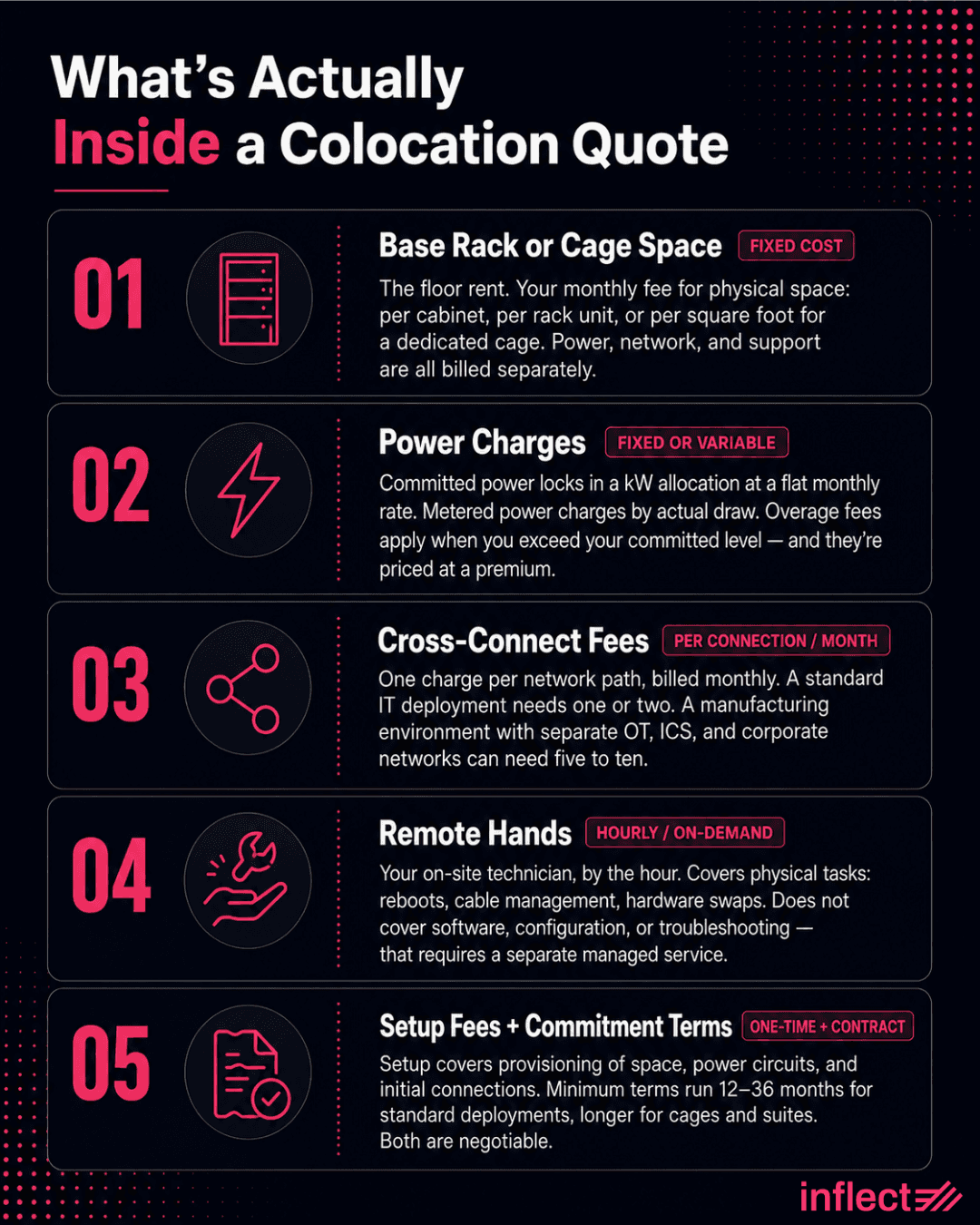
A manufacturing colocation quote typically includes five components: base rack or cage pricing, power charges, cross-connect and network fees, remote hands and on-site support rates, and setup fees plus minimum commitment terms. Knowing what each covers before the quote arrives allows buyers to verify completeness, identify missing line items, and ask informed questions.
Base Rack or Cabinet Pricing
Base rack pricing is the monthly fee for rack space or colocation space in the facility, quoted per cabinet or per rack unit, and does not include power, connectivity, or support services. Two quotes with identical base rack pricing can have total monthly costs that differ by 40 percent or more depending on how power, connectivity, and support are structured. Base rack rate is a starting point, not a comparison basis.
Power Charges: Committed, Metered, and Overage
Power charges in a colocation quote appear in three forms: committed power (a flat rate plan charging a fixed monthly fee for a reserved kW allocation regardless of actual usage, offering predictable monthly costs), metered power (a variable charge based on actual usage and power consumption), and overage fees (a penalty rate applied when usage exceeds the committed allocation). Manufacturing environments with steady-state compute tend to favor committed power to keep power costs stable; environments with variable loads may find metered power more economical. Overage fees are almost always priced at a significant premium, so underestimating the committed allocation is a common and avoidable cost.
Cross-Connect and Network Fees
Cross-connect fees are monthly charges for each physical or virtual connection between a tenant’s equipment and a network provider, another tenant, or a cloud on-ramp within a facility, and in manufacturing environments these costs can add up quickly when OT and IT networks are segmented. Dgtl Infra’s 2024 industry guide reports that cross-connect monthly recurring charges typically range from $100 to $300 per connection, and it derives an implied average price of $341 per interconnection per month in the Americas from Equinix’s reported interconnection revenue (Source: Dgtl Infra, 2023). One-time installation fees also apply per connection, which can make the total cost meaningfully higher in heavily segmented environments. Because these charges often appear in contract detail rather than summary pricing, buyers should always request a fully itemized list before comparing quotes.
Remote Hands and On-Site Support Rates
Remote hands support at a data center refers to the labor charges for technician time when on-site physical support services are required, typically billed hourly with a one- to two-hour minimum; published rate cards from US colocation providers indicate a typical range of $100 to $300 per hour at standard facilities, with emergency and after-hours rates running higher (illustrative range based on publicly available provider rate schedules). For manufacturing environments where IT staff are not co-located with the data center, remote hands support covers equipment reboots, cable management, hardware swaps, and escorting third-party vendors. Buyers should request the full rate card, including after-hours and emergency rates, before signing.
Setup Fees and Minimum Commitment Terms
Setup fees cover the one-time cost of provisioning the physical space, power circuits, and initial cross-connects, while minimum commitment terms define the shortest contract length the provider will accept, typically 12 to 36 months for retail colocation and 36 to 60 months for cage and suite deployments. Both are more negotiable than buyers typically assume: setup fees are frequently reduced or waived for larger deployments, and minimum terms can sometimes be shortened in exchange for a higher monthly rate.
Where Manufacturing Buyers Most Often Misread a Quote
The four areas where manufacturing buyers most frequently misread a colocation quote are cross-connect costs in OT/IT environments, committed vs. metered power billing mechanics, the total cost difference between cage and cabinet deployments, and the scope limitations of remote hands services.
Why Cross-Connect Costs Multiply in OT/IT Environments
Cross-connect fees in colocation multiply in manufacturing environments because each network segment required for OT/IT separation, ICS isolation, or redundant carrier paths generates its own monthly charge. Before requesting a quote, map every network path the deployment requires: corporate IT, OT, ICS, internet, cloud on-ramp, and any inter-site private circuits. The total cross-connect count should be explicitly stated in the RFQ.
The Difference Between Committed and Metered Power Billing
Committed vs. metered power colocation billing affects total monthly cost significantly: committed power charges for reserved capacity regardless of usage, metered power charges for actual consumption, and mismatching the billing model to the workload profile is one of the most consistent sources of cost variance in manufacturing deployments. For environments running consistent compute loads, committed power provides better cost control; for environments with significant variability, metered power is worth modeling carefully before committing.
Cage vs. Cabinet: When Dedicated Space Changes the Total Cost
Private cages cost more than individual cabinets on a per-unit basis, but for manufacturing environments with strict physical security requirements or multiple racks, a cage can produce a lower total cost than an equivalent number of cabinets with security add-ons applied. Buyers with four or more cabinets should model both options side by side, including the cost of any physical security controls required for a cabinet deployment, before assuming cabinets are the lower-cost path.
What Remote Hands Rates Actually Cover
Remote hands services at a colocation facility cover physical tasks performed by facility technicians, including equipment reboots, cable management, hardware swaps, and escorting authorized third parties, but they do not cover troubleshooting, configuration changes, or any work requiring system-level access. Remote hands is physical labor billed by the hour, not a managed service. Backup and recovery services, configuration management, and software-level troubleshooting all fall outside the remote hands scope and require a separate managed service agreement or contracted resource.
Location and Compliance Variables That Shift the Price
The location and compliance variables that most significantly affect manufacturing colocation pricing are regional market rates in industrial corridors, local power grid costs, ITAR facility certification requirements, and CMMC scoping and security surcharges. These variables sit outside the base quote structure but can shift total cost by 30 percent or more.
Typical Price Ranges in Industrial vs. Tier 1 Markets
Industrial corridor markets offer a measurable cost advantage over primary coastal hubs: CBRE's North America Data Center Trends H1 2025 report shows Chicago asking rates at $155 to $165 per kW per month, compared to the primary market average of $196.25 per kW per month, a discount of approximately 16 to 21 percent (Source: CBRE, 2025). For manufacturing buyers whose workloads do not require proximity to a coastal hub, industrial corridor markets offer a meaningful cost advantage, though facility selection is more limited and not all providers with required certifications operate in every corridor.
How Regional Power Grid Costs Affect Your Monthly Bill
Regional power grid costs directly affect industrial colocation costs because providers pass through or embed local electricity rates into their power pricing, and markets with low-cost grid power and strong energy efficiency profiles, including parts of the Pacific Northwest, Texas, and the upper Midwest, consistently produce lower power costs than high-cost markets like New England or California. For buyers with location flexibility and high power density requirements, grid cost by market is worth modeling before shortlisting facilities.
ITAR-Compliant Facilities and What They Cost
ITAR-compliant data center costs are often higher than standard colocation because facilities must implement physical access controls, personnel screening, audit trails, and security procedures that satisfy International Traffic in Arms Regulations requirements, and those controls add both capital and operating costs. For buyers that need ITAR compliance, the pool of qualifying facilities is narrower, competition is more limited, and providers may charge a premium to cover the cost of implementing and maintaining those controls. As a reference point, Google Cloud’s ITAR-compliant Assured Workloads offering includes a 20% surcharge over standard pricing because the ITAR control package is included in the Premium tier of Assured Workloads, which incurs a 20% additional charge (Source: Google Cloud, 2026). For physical colocation, however, the premium varies by provider and should be confirmed directly in the RFQ process. Confirming ITAR requirements before engaging providers helps avoid spending time on facilities that cannot qualify.
CMMC Scoping, Provider Certification, and Security Surcharges
CMMC data center requirements pricing applies to defense contractors subject to the Cybersecurity Maturity Model Certification framework, where the facility must meet specific physical and logical security standards, and the cost premium reflects both the capital investment in certified controls and the ongoing audit overhead providers maintain to support tenant compliance. For manufacturing organizations in the defense industrial base, CMMC Level 2 or Level 3 requirements may impose obligations on the physical facility including access logging, visitor management, and personnel vetting. Buyers should request explicit documentation of the provider's CMMC scope before treating any facility as compliant.
How to Normalize and Compare Manufacturing Colocation Quotes
Normalizing colocation quotes for manufacturing environments requires standardizing five variables across every quote received: total power cost on a consistent kW basis, connectivity costs including all cross-connect fees, contract term converted to a total commitment value, setup and one-time fees amortized across the contract term, and compliance certification scope. Without normalization, comparing quotes on headline rack rate produces a misleading ranking that rarely reflects actual total cost.
The Five Variables You Must Standardize Before Comparing Pricing
The five variables that must be standardized when applying a colocation cost comparison framework are: power cost per kW per month under the proposed billing model, all connectivity costs including every cross-connect, total contract commitment value, amortized one-time fees, and confirmation that compliance scope is equivalent across compared facilities. Providers structure quotes differently by design: some lead with low rack rates and high power charges, others bundle connectivity into the base rate. The only reliable comparison basis is a single model populated from contract documents, not summary pricing pages.
A Simple Framework for Evaluating Total Cost, Not Just Rack Rate
A reliable total cost framework for data center pricing comparison includes four components: monthly recurring charges at steady state covering all power, connectivity, and support; one-time fees amortized over the contract term; expected remote hands costs based on a realistic incident frequency estimate; and any compliance premium applied by ITAR- or CMMC-certified facilities, plus disaster recovery services if scoped to the deployment. This framework surfaces deals that appear cheap on rack rate but are costly in aggregate, and gives procurement teams a defensible number to present internally.
Five Questions to Ask Before Submitting an RFQ
The five questions every manufacturing buyer should answer before submitting an RFQ for data center colocation are:
What is the total kW draw per cabinet at peak load?
What uptime tier is required and what production consequence justifies it?
How many cross-connects are required and what network segments do they serve?
Is ITAR or CMMC compliance required and at what scope level?
What is the minimum acceptable contract term?
Providers who receive an RFQ with clear answers to these questions return more accurate first quotes and compress the procurement timeline significantly.
Using a Marketplace to Price Before You Quote
A digital infrastructure marketplace allows manufacturing buyers to search, compare, and receive colocation pricing across thousands of facilities before submitting a formal RFQ, providing a market-calibrated baseline before entering commercial negotiation. Inflect provides instant pricing across more than 6,000 data centers in over 100 countries, including facilities from providers such as Equinix, Iron Mountain, QTS, TierPoint, and Flexential, without requiring a sales call. For manufacturing buyers evaluating industrial corridor markets or comparing colocation solutions across regions, searching available options before shortlisting provides the negotiating context that a single-provider engagement does not, and helps identify reliable colocation services at competitive rates. Free expert advisory is available for buyers who need help scoping a deployment before going to market.
What Manufacturing Buyers Should Take Into Any Colocation Negotiation
Manufacturing colocation pricing is structurally different from standard enterprise pricing, and the buyers who get the most accurate quotes arrive with a clear spec rather than a general inquiry.
The cost drivers that matter most are power density, uptime tier selection, OT/IT connectivity requirements, and for defense and aerospace manufacturers, ITAR and CMMC compliance obligations. The line items that most often produce budget surprises are cross-connect fees in converged OT/IT environments, committed vs. metered power billing mismatches, and remote hands rates not modeled at a realistic incident frequency. Location matters: industrial corridor markets typically offer lower pricing than Tier 1 markets, and regional power grid costs can move the monthly bill independently of any other variable.
Buyers who enter the market with a defined power spec, a justified uptime tier, a mapped cross-connect list, and an honest compliance scope will spend less time in revision cycles and more time making a well-informed IT infrastructure decision.
About the Author

Haley Rogers
Content & Social Media Specialist
Haley Rogers is the Content & Social Media Specialist at Inflect, bringing over two years of experience in social media, marketing, and content strategy — including time at a fast-paced tech company before joining the Inflect team. She specializes in translating complex digital infrastructure topics into clear, engaging content, with a particular focus on blog writing and brand storytelling across channels.
Contact: