14 mins
Last-Mile DIA Options: Fiber, Fixed Wireless, and When Each Is the Right Call
Most procurement teams assume fiber is the default and fixed wireless internet is the consolation prize. The reality on the ground looks different: a site three blocks from a carrier's fiber ring can wait six months for service, while a site with clear line of sight to a rooftop antenna can be live in under two weeks.

That gap is not random. Fiber and fixed wireless are built on fundamentally different economics: one requires physical construction along a fixed path, the other requires spectrum and a clear signal path through the air. Those economics determine everything else that follows, from what a circuit costs to how fast it can go live to how it fails when something goes wrong.
This post breaks down what each option actually delivers and gives you a framework for choosing between them based on four variables that matter to any procurement decision: cost, install timeline, reliability and SLA terms, and long-term scalability.
What Is Last-Mile DIA (and Why It Varies by Location)
Last-mile DIA is the final physical segment of a dedicated internet access circuit that connects a specific building to a carrier's core network, and it is the single largest source of cost and timeline variability in any DIA order. Dedicated internet access has become the fastest-growing Ethernet service category in the United States by both ports and revenue, driven by demand for the guaranteed bandwidth and low latency connections that AI workloads, cloud services, remote access, and hybrid work require (Source: Vertical Systems Group, 2025). Nearly all of that demand runs into the same bottleneck: getting a dedicated circuit from the carrier's network to the customer's door.
How Last-Mile Connectivity Fits Into a DIA Circuit
A DIA circuit has three segments: the customer premises equipment inside the building, the last-mile connection between the building and the nearest carrier point of presence, and the core network that carries network traffic from that point of presence to the public internet. Core network performance is largely standardized across major carriers. Last-mile performance is not, because it depends entirely on what physical or wireless infrastructure already exists between the building and the network edge.
On-Net, Near-Net, and Off-Net: What They Actually Mean for Your Timeline and Cost
On-net, near-net, and off-net are the three classifications carriers use to describe how much construction a building requires before service can activate. An on-net building already has the carrier's fiber inside it or immediately adjacent, meaning little or no construction is needed and service can often activate in days to a few weeks. A near-net building sits close to existing carrier infrastructure but requires a short extension, commonly a lateral run from the street into the building, which typically adds light construction and weeks to the timeline. An off-net building has no nearby carrier presence at all, which means a full extension build, permitting, and potentially months of lead time before the circuit goes live.
Why Carrier Coverage Maps Overstate True Availability
Carrier coverage maps show network reach at the neighborhood or district level, not availability at a specific address, which is why two buildings on the same block can face completely different install timelines. A map showing fiber "in the area" often means the carrier has a route running down the street, not that the building itself is on-net. The only way to know true availability, and the actual on-net, near-net, or off-net status of a specific address, is to run an address-level qualification with the carrier or a sourcing partner before assuming a timeline.
Fiber Last-Mile DIA: Capabilities, Costs, and Build Timelines
Fiber last-mile DIA, often called fiber internet in enterprise sourcing conversations, delivers a private, high-speed internet connection with symmetrical bandwidth from roughly 10 Mbps to 100 Gbps over dedicated glass, consistent speeds, and the lowest and most consistent latency, jitter, and packet loss of any last-mile option, backed by carrier-grade SLAs. For workloads sensitive to consistency rather than just peak speed, such as real-time replication, video conferencing, VoIP trunking, or steady-state data transfer, fiber's advantage is not top-line speed but how little that speed varies over the life of the contract.
What Fiber DIA Delivers in Bandwidth, Symmetry, and SLA Terms
Fiber DIA circuits deliver a dedicated internet connection with symmetrical upload and download speeds, sub-5-millisecond latency to the nearest point of presence in most metro markets, and packet loss typically held under 0.1% under carrier service level agreements (SLAs). Because the wired connection runs over dedicated glass rather than shared spectrum, a fiber SLA can commit to specific, enforceable numbers rather than best-effort ranges: uptime, latency ceilings, jitter maximums, and packet loss thresholds, each carrying financial remedies when missed. Unlike broadband, that enforceability is what separates a carrier-grade fiber SLA from a best-effort shared internet agreement, and it is the reason procurement and legal teams treat fiber DIA contracts as auditable commitments rather than marketing language.
What Drives Fiber Construction Costs and Lead Times
Fiber construction costs are driven primarily by labor, materials, permitting, and make-ready work, the last of which involves preparing utility poles or conduit before new fiber optic cables can be installed. Median fiber deployment costs in 2025 reached $18 per foot for underground builds and $8 per foot for aerial builds, meaning a one-mile underground extension can run into six figures before a single customer is connected (Source: Fiber Broadband Association, 2025). Permitting alone can take eight weeks to six months depending on the jurisdiction, and make-ready work in dense urban corridors, where utility poles must be adjusted to make room for new fiber cables, commonly adds several more months on top of that (Source: Light Reading, 2026). None of this applies to a building that is already on-net, which is why the same fiber order can be a two-week activation in one location and a nine-month build in another.
How to Estimate Whether Your Site Will Require New Construction
Three signals reliably predict whether a fiber order will require new construction: distance from the building to the nearest splice point or carrier-lit building, the presence of existing conduit laterals running from the street into the property, and whether the building's telco room and entry facilities are already provisioned for a new carrier. A short distance to an existing splice point with usable conduit already in place points toward a near-net timeline measured in weeks. A building with no nearby splice point, no existing conduit, and a telco room that has never hosted the carrier in question points toward an off-net build measured in months. Asking a carrier or sourcing partner to confirm these three signals before signing an order is the single most useful step a buyer can take to avoid a timeline surprise on a new internet connection.
Fixed Wireless Last-Mile DIA: Capabilities, Costs, and Deployment Speed
Fixed wireless last-mile DIA delivers a dedicated connection over a point-to-point or point-to-multipoint link, using radio signals to transmit data instead of buried or aerial cable, which removes construction from the critical path entirely and lets qualified sites activate in days rather than months. That speed comes with a different risk profile than fiber: wireless connectivity depends on line of sight, weather, and available spectrum rather than the condition of buried glass.
What Fixed Wireless DIA Delivers in Bandwidth, Latency, Jitter, and SLA Terms
Business-grade fixed wireless DIA typically delivers bandwidth from 25 Mbps to 1 Gbps with latency in the 10 to 30 millisecond range, though performance varies by spectrum band and link distance. Public benchmark data on consumer and SMB-grade 5G fixed wireless offers a useful proxy for the variability buyers should expect: median download speeds across the three major U.S. carriers ranged from 104.63 Mbps to 209.06 Mbps in Q3 2025, with median latency ranging from 50 to 67 milliseconds (Source: Ookla Speedtest Intelligence data, 2025). Dedicated point-to-point business circuits from specialized wireless ISPs generally contract to tighter latency and jitter figures than consumer 5G home internet, but the underlying variable, contention for shared spectrum, is the same. Jitter and packet loss under load are the two metrics worth scrutinizing most closely, since a link can post an attractive average speed while still introducing enough variability to disrupt latency-sensitive applications.
What Determines Fixed Wireless Reliability: Line of Sight, Weather, and Spectrum
Fixed wireless reliability is determined by three physical factors: unobstructed line of sight between the customer antenna and the provider's tower or rooftop node, weather conditions that can attenuate the signal, and the amount of licensed or lightly licensed spectrum available on that link. Seasonal foliage growth is a documented cause of measurable speed degradation on fixed wireless links, particularly those using higher-frequency spectrum such as millimeter wave, which is more sensitive to physical obstruction than lower-band spectrum (Source: Fierce Network, 2025). Network congestion matters just as much as weather: a wireless network that performs well when a tower is lightly loaded can degrade as more connected devices share the same sector, which is why enterprise buyers should ask providers directly about sector loading and available capacity headroom rather than relying on a single point-in-time speed test.
Why Fixed Wireless Deploys in Days Instead of Months
Fixed wireless deploys faster than fiber because activation requires mounting an antenna and aligning a radio link rather than trenching, permitting, and make-ready construction. Once a site has confirmed line of sight to a provider's tower or rooftop node, installation is typically a single-day site visit, and the circuit can be provisioned and tested within one to two weeks of order. That timeline advantage is the primary reason fixed wireless has become a serious primary option, not just a backup, for buyers facing hard deployment deadlines that a fiber build cannot meet.
Fiber vs. Fixed Wireless: Comparing the Decision Criteria That Matter
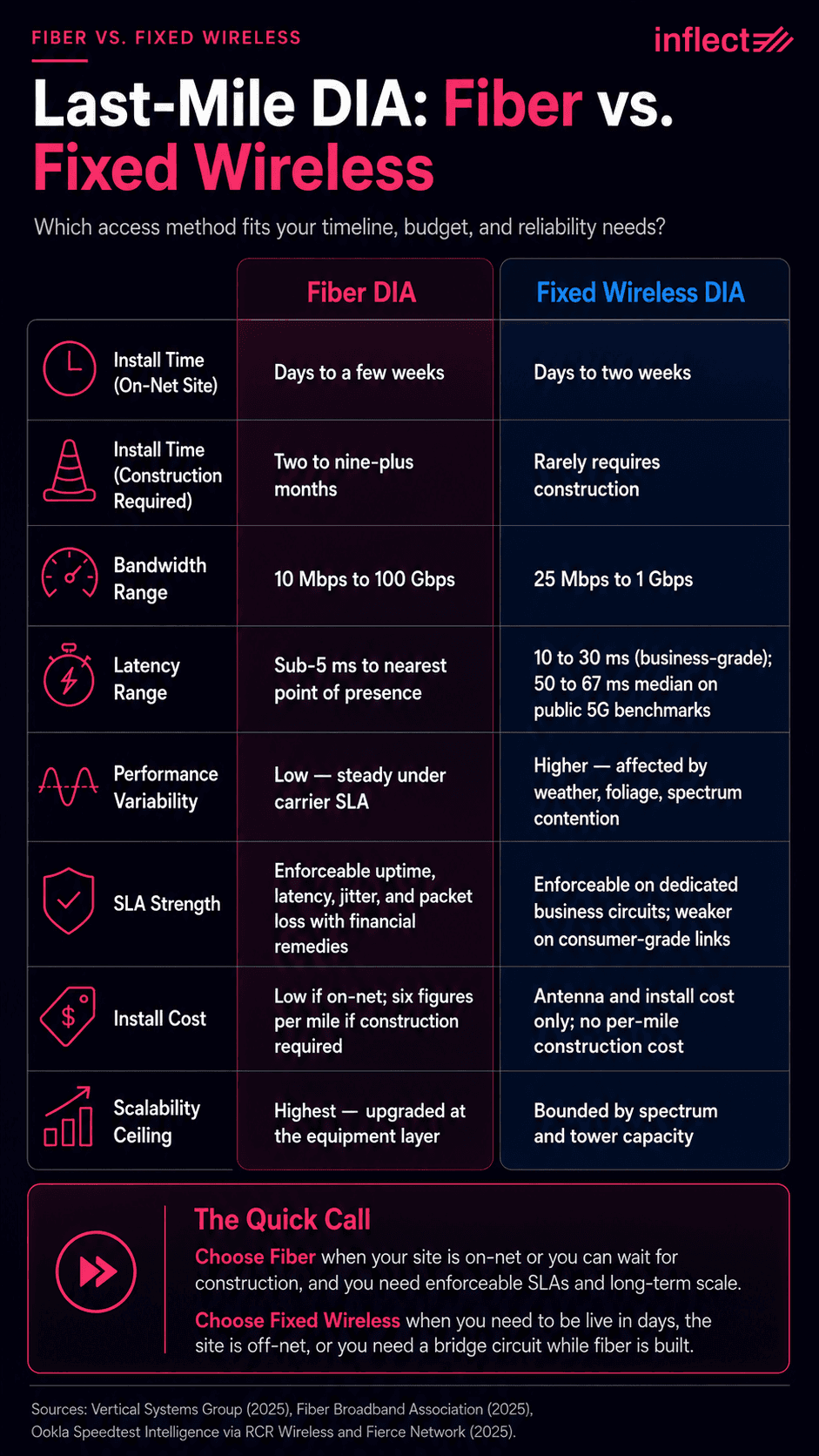
Source: Vertical Systems Group, 2025; Fiber Broadband Association, 2025; RCR Wireless News, 2025; and Fierce Network, 2025. Ranges reflect typical business-grade deployments and cited industry benchmarks; actual figures vary by provider, market, and contract terms.
Cost Comparison: Installation, Monthly Recurring, and Total Cost of Ownership
Fiber installation costs and fixed wireless costs diverge most sharply when construction is required: an on-net fiber order costs little more to install than a fixed wireless link, but an off-net fiber order can carry a construction bill running into six figures per mile that the customer, the carrier, or both must absorb (Source: Fiber Broadband Association, 2025). Monthly recurring cost tends to favor fiber at higher bandwidth tiers, since fixed wireless pricing per Mbps often rises faster as bandwidth requirements climb toward the top of a provider's available spectrum capacity. Total cost of ownership should always be modeled over the full contract term, not just the first invoice, because a fixed wireless circuit with a lower install cost can cost more than a fiber circuit over a three-year term once bandwidth needs grow.
Timeline Comparison: Fiber Build Times vs. Fixed Wireless Activation
Fixed wireless wins on timeline whenever construction is required for fiber, activating in days to two weeks against a fiber build that can stretch from two to nine months once permitting and make-ready work are included (Source: Light Reading, 2026). That advantage disappears when the site is already on-net for fiber, since an on-net fiber order can activate on a timeline comparable to fixed wireless. The deciding question is never "which technology is faster" in the abstract; it is "what is this specific building's on-net, near-net, or off-net status today."
Reliability and SLA Comparison: MTTR, Fault Domains, and Carrier vs. WISP Enforcement
Reliability comparisons between fiber and fixed wireless come down to fault domain exposure and how tightly the provider enforces its SLA. A dedicated fiber strand riding on wired infrastructure is a single point of failure for that customer alone, while a fixed wireless sector is shared infrastructure serving multiple users, meaning a tower outage or capacity event can affect the entire network of customers on that sector simultaneously rather than just one building. Mean time to repair also differs by failure type: a fiber cut typically requires a physical dispatch and splice, while a weather- or interference-driven wireless outage often resolves once conditions clear, though a hardware failure on either technology requires a truck roll. Enforcement quality varies more by provider type than by technology: a national carrier's fiber SLA and a licensed wireless ISP's business-grade SLA can both carry real financial remedies under strict service level agreements, while a best-effort consumer wireless plan typically carries none.
Scalability Comparison as Bandwidth Needs Grow
Fiber scales further than fixed wireless because capacity upgrades happen at the equipment layer, meaning a customer can typically move from 1 Gbps to 10 Gbps or beyond on the same physical strand by upgrading optics rather than rebuilding the last mile. Fixed wireless operates within a fixed bandwidth ceiling set by the spectrum available on that specific link and the capacity headroom on the tower or node serving it, which means a site approaching the top of its available tier may need to migrate to fiber, add a second wireless link, or accept a ceiling on future growth. Buyers with a clear multi-year bandwidth growth curve should weight scalability heavily; buyers with a stable, predictable bandwidth need may find fixed wireless's ceiling irrelevant to their actual requirement.
When Each Option Is the Right Call
When Fiber Is the Right Call
Fiber is the right call when the site needs high SLA enforceability, sustained low-latency performance, and room to scale bandwidth well beyond current requirements, and when the building is already on-net or the buyer has enough lead time to absorb a construction timeline. Enterprise data centers, financial trading operations, and any workload where jitter and packet loss consistency matter more than headline speed should default to a fiber connection for consistent performance whenever one is available on a workable timeline.
When Fixed Wireless Is the Right Call
Fixed wireless is the right call when the deployment deadline is measured in days or weeks rather than months, the building is off-net with no near-term fiber path, or the bandwidth requirement fits comfortably within what a business-grade wireless link can deliver. New retail locations, temporary or pop-up sites, and buildings in rural areas or markets where fiber construction economics do not pencil out are strong candidates for wireless solutions as a primary, not secondary, circuit.
When to Use Fixed Wireless as a Bridge Circuit While Fiber Is Being Built
Fixed wireless functions as an effective bridge circuit when a site has already committed to fiber but the construction timeline leaves a gap the business cannot tolerate, allowing operations to go live on a secondary connection while the permanent fiber build proceeds in parallel. This approach converts a months-long fiber build from a blocking dependency into a background process, since the business already has backup connectivity in place to ensure reliable internet connectivity by the time fiber activates.
When a Hybrid, Dual-Circuit Approach Makes Sense
A hybrid, dual-circuit approach combining fiber and fixed wireless makes sense whenever a site's uptime requirement exceeds what any single access method can guarantee on its own, since the two technologies fail from different causes and rarely fail at the same time. Because a fiber cut and a fixed wireless weather event are unrelated failure modes, pairing the two as primary and failover circuits in hybrid networks delivers meaningfully higher effective uptime and a more reliable connection than either technology alone, which is why this pairing has become a standard architecture for high-performance connectivity at sites where downtime carries a direct revenue or compliance cost.
How to Evaluate DIA Providers Across Fiber and Fixed Wireless
Evaluating DIA services across fiber and fixed wireless requires comparing carriers, wireless internet service providers, and aggregators on address-level availability, SLA enforcement terms, and pricing rather than relying on a single service provider's coverage claims. A carrier's own sales team confirms availability on their own fiber networks but has no incentive to flag a competing internet service provider that can deliver the same circuit faster or cheaper at that address. A marketplace approach solves that by pulling live, address-level pricing across multiple providers at once, the only way to see the true on-net, near-net, and off-net picture before committing to an order.
Inflect gives buyers exactly that view for sourcing dedicated internet access services. The platform provides instant, side-by-side pricing across 6,000+ data centers and facilities in more than 100 countries, spanning fiber carriers and fixed wireless internet providers, without requiring a sales call to get a quote. Buyers evaluating providers including Lumen, GTT, Colt, Zayo, and Megaport alongside regional fiber and fixed wireless specialists can compare address-level availability and pricing side by side, then get free expert advisory to sanity-check construction estimates and SLA terms before signing.
Matching Last-Mile Access to Your Timeline, Budget, and Risk Tolerance
The right last-mile DIA option is rarely a technology preference; it is a direct function of a specific building's on-net status, a specific project's deadline, and a specific workload's tolerance for latency variability. Fiber remains the stronger long-term choice wherever it is available on a workable timeline, because it wins decisively on SLA enforceability and scalability. Fixed wireless has earned a legitimate place as a primary option, not just a fallback, wherever deployment speed matters more than the last few milliseconds of latency consistency, and it is an increasingly common partner to fiber in network designs built for resilience.
Buyers who qualify a building's true on-net, near-net, or off-net status before comparing quotes, and who model total cost of ownership rather than install price alone, consistently make faster and cheaper last-mile decisions that match reliable internet connectivity to actual business needs, rather than starting from a carrier's coverage map.
Ready to compare fiber and fixed wireless DIA options for your site?
Get instant, side-by-side pricing on high-speed connectivity across fiber and fixed wireless providers for your specific address
Confirm on-net, near-net, or off-net status before you commit to a timeline
Talk to Inflect's free advisory team about construction estimates, SLA terms, or hybrid architecture options
Search DIA providers on Inflect to see what is available at your address today.
About the Author

Haley Rogers
Content & Social Media Specialist
Haley Rogers is the Content & Social Media Specialist at Inflect, bringing over two years of experience in social media, marketing, and content strategy — including time at a fast-paced tech company before joining the Inflect team. She specializes in translating complex digital infrastructure topics into clear, engaging content, with a particular focus on blog writing and brand storytelling across channels.
Contact: