11 mins
How to Negotiate a DIA Contract: What Buyers Get Wrong and How to Fix It
A network procurement lead at a regional financial services firm signs a three-year dedicated internet access contract with their incumbent provider. The price looks competitive. The SLA guarantees 99.9% uptime. Six months in, the circuit fails on a Friday evening and comes back online the following morning after 14 hours of downtime. The team files for SLA credits. The provider denies the claim: the outage crosses midnight and splits across two calendar months. Neither individual monthly period exceeds the downtime threshold written into the agreement. The contract is legally compliant. The credits were never coming.
That scenario repeats consistently across enterprise network procurement. The problem is not the provider acting in bad faith. The problem is a contract negotiated entirely on the provider's standard terms, which are optimized for the provider.
At scale, the financial exposure is substantial. ITIC's 2023 Reliability and Hourly Downtime Cost Survey found that 91% of mid-size and large enterprises report that one hour of unplanned downtime costs over $300,000. (Source: ITIC, 2023) Uptime Institute's Annual Outage Analysis 2025 found that outages from IT and networking issues accounted for 23% of all impactful incidents tracked in 2024, a share that has grown as enterprises rely more heavily on third-party connectivity and cloud providers. (Source: Uptime Institute, 2025) A dedicated internet access circuit that goes dark during business hours is rarely a minor inconvenience. It is a direct business cost that standard DIA service level agreement credit structures do not come close to covering.
This post covers the five areas where enterprise buyers consistently leave value on the table: what the contract actually scopes and where misreads become expensive, the SLA clauses that determine whether your protections are enforceable, the commercial terms that lock you in, why market pricing visibility changes what you can negotiate, and the verification checklist you need before you sign.
What a DIA Contract Actually Covers and Where Misunderstandings Get Expensive
A dedicated internet access contract governs four cost-bearing elements that are commonly misread at signing: bandwidth type and billing methodology, charges beyond the headline rate, the access technology and what "dedicated" means under each, and delivery timelines with the contractual protections available when providers miss them.
CIR vs. Burstable Bandwidth: Billing Methodology and Cost Per Mbps
The committed information rate (CIR) and burstable bandwidth represent two distinct commercial models in a dedicated internet access contract that produce different effective costs per Mbps depending on billing methodology. A CIR contract provides guaranteed bandwidth in a fixed dedicated bandwidth allocation at all times, billed at a flat monthly rate regardless of usage. A burstable arrangement sets a lower guaranteed floor with the ability to consume additional bandwidth on demand, typically billed using 95th percentile methodology: the provider measures network traffic in five-minute intervals across the billing period, discards the top 5% of peak demand samples, and bills against the highest remaining interval.
For predictable, high-utilization or data-intensive applications, CIR at a competitive flat rate is often more cost-efficient. For organizations with variable traffic patterns and significant off-peak periods, 95th percentile billing bandwidth can reduce the effective cost per Mbps. Understanding which bandwidth tier and billing model applies to your usage profile before entering negotiations determines whether you are optimizing against the right baseline. Both the CIR value and the billing methodology should appear explicitly in the contract, not by reference to a service schedule that can change.
DIA Hidden Fees: Port, Loop, and Cross-Connect Costs
The true cost of a DIA circuit includes port fees, local loop charges, and cross-connect fees that are routinely absent from headline quotes. Port fees cover the physical connection to the provider's network at the point of presence. Loop charges cover the local access circuit from the provider's POP to your facility, billed as a separate monthly recurring charge. Cross-connect fees apply when you are colocated in a data center and connecting to the provider's equipment within that facility.
In practice, these line items can add 20 to 40% to the total contract value relative to the headline bandwidth price per Mbps. (Source: modeled estimate based on itemized enterprise DIA quote comparisons.) Requesting a fully itemized quote before comparing offers is a foundational step that many buyers skip, which makes accurate price comparisons across providers difficult and leaves cost reduction opportunities unaddressed.
What 'Dedicated' Means Across Fiber, Ethernet, and Wavelength
The term "dedicated" applies to fiber Ethernet, wavelength, and fixed wireless access services in different ways, with direct implications for capacity, pricing leverage, and the availability of competitive alternatives at renewal. Unlike standard broadband or shared internet connections, all three models deliver symmetric bandwidth with equal guaranteed upload speeds and download speeds, though the degree of isolation and consistent performance varies significantly between them. Business fiber Ethernet circuits delivered over shared physical infrastructure with a guaranteed CIR are dedicated at the logical layer. Wavelength services allocate a specific portion of physical fiber capacity to your circuit, providing stronger isolation and more consistent performance under load. Fixed wireless circuits may carry a "dedicated" designation but are more variable under network congestion conditions, making them better suited as backup connectivity than as a primary enterprise connection.
At renewal, the access technology determines how many competing providers can realistically serve your location and on what timeline. Business fiber providers in dense metro markets typically offer multiple DIA services, giving buyers more competitive leverage. Wavelength and dark fiber services are available from providers with a more limited fiber footprint and take longer to provision, which reduces the leverage a competing quote provides when your incumbent knows the alternatives are constrained.
RFS Dates and Delivery Credits as Negotiating Levers
Installation timelines for dedicated internet access circuits, particularly new fiber construction to locations not previously on a provider's network, commonly run 60 to 120 days and can extend further in constrained markets. Most provider standard agreements do not include contractual consequences for missing the committed ready-for-service (RFS) date. That omission is negotiable. Buyers should request a defined RFS date in the contract, a service delivery credit structure that applies if the provider misses it, and the right to terminate without penalty if delivery exceeds a stated threshold beyond the RFS date. These provisions are standard in well-negotiated enterprise telecommunications agreements and are rarely offered without being asked for.
The SLA Clauses That Determine Whether Your DIA Contract Actually Protects You
The four dedicated internet access SLA metrics that determine whether your contract provides enforceable protection are uptime calculation methodology, MTTR commitment structure, credit caps relative to actual outage cost, and performance thresholds for latency, jitter, and packet loss. EMA Research's 2024 IT Outages: Costs and Containment study, based on independent enterprise field research, found that networking and connectivity issues are now the single largest cause of IT service outages, cited by 31% of respondents, with unplanned downtime averaging $14,056 per minute across all enterprise sizes. (Source: Enterprise Management Associates, 2024) When network connectivity is the leading cause of outages and the financial exposure runs to five figures per minute, the precision of SLA language is not a legal formality. It is the primary mechanism through which financial risk is allocated between buyer and provider.
99.9% vs. 99.99% Uptime: 8.76 Hours of Permitted Downtime
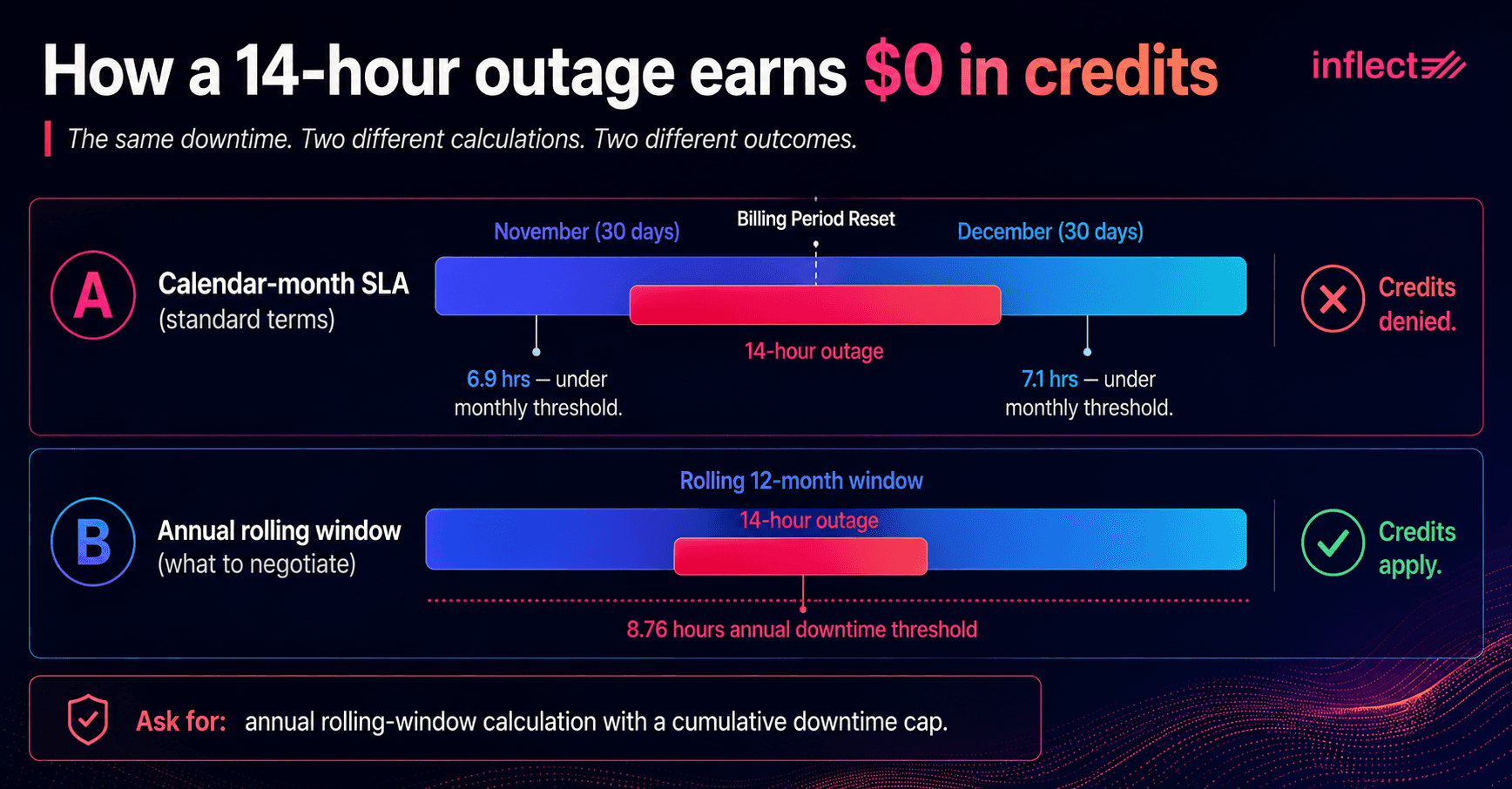
A 99.9% uptime commitment permits approximately 8.76 hours of downtime annually; a 99.99% commitment permits approximately 0.88 hours. The difference between the two is roughly 7.9 hours per year, but the more consequential variable is aggregation method. A provider using calendar-month uptime calculation resets the downtime clock at the start of each month. At 99.9% monthly, that permits approximately 43 minutes of downtime per billing period without triggering a credit. A 14-hour outage that splits across two months, as in the scenario above, breaches neither monthly threshold while consuming far more downtime than an annual 99.9% commitment would allow as a single event. Buyers focused only on the uptime percentage often miss the aggregation mechanic that determines whether any credit is ever paid.
Ask for: an annual rolling-window calculation with a cumulative downtime cap, rather than monthly resets that allow the provider to absorb large single-event outages across billing periods.
MTTR Commitments vs. Best-Effort Language in DIA SLAs
Mean time to repair (MTTR) in a telecom SLA exists in two forms: a contractually binding commitment with defined credit consequences for breach, and a best-effort response window that carries no financial obligation. The distinction is not always apparent in contract language. Phrases like "our team will work to restore service within four hours" describe aspiration. Phrases like "provider shall restore service within four hours of ticket open, failing which customer shall receive a credit equal to X" describe an obligation. Reviewing the precise language in the SLA agreement rather than the sales summary is the only reliable way to determine which applies.
Ask for: a binding MTTR commitment of four hours or less, with specific service credits tied to each breach. Best-effort language in a DIA service level agreement provides no enforceable protection and should be redlined before signing.
Why Standard Credit Caps Don't Cover the Cost of an Actual Outage
Standard DIA service level agreement credits are typically capped at one month's monthly recurring charge for a given billing period, regardless of outage duration or business impact. At $3,000 per month for a circuit, the maximum financial consequence to the provider for a multi-day outage is $3,000, against a business downtime cost that may be orders of magnitude higher. (Source: ITIC, 2023) Uptime Institute's 2024 Annual Outage Analysis found that 54% of organizations reported their most recent significant outage cost more than $100,000, with 20% reporting costs exceeding $1 million. (Source: Uptime Institute, 2024) Against a standard credit cap of one month's MRC, the gap between what the provider owes and what the outage actually costs the business is rarely close. The credit structure as commonly written does not function as a meaningful financial consequence for the provider; it functions as a liability cap.
Ask for: credit exposure that scales beyond a single MRC, with uncapped or multi-month credits for extended outages. Not all providers will accept this language, but requesting it opens a negotiation about credit mechanics rather than defaulting to the provider's standard terms without challenge.
Latency, Jitter, and Packet Loss Thresholds for Real-Time Workloads
Dedicated internet access SLA metrics for latency, jitter, and packet loss are material to any organization running voice over IP, video conferencing, real-time trading platforms, cloud-based applications, or other critical business applications that require low latency connectivity. Standard DIA agreements often omit these metrics entirely or include thresholds broad enough to be unenforceable in practice. For most enterprise real-time workloads, a latency commitment under 10ms within a metro market, jitter under 5ms, and packet loss below 0.1% represent reasonable performance metrics to negotiate into the SLA. These network performance metrics vary by application and geography, but the principle holds: if the SLA does not define a measurable threshold with a credit consequence attached, the performance guarantee is aspirational.
Contract Term Traps That Favor the Provider
The four commercial term structures in DIA contracts that most frequently disadvantage enterprise buyers are auto-renewal windows, annual rate escalation clauses, early termination fee structures, and co-term agreements across multi-site deployments.
Auto-Renewal Notice Windows and the Financial Consequence of Missing Them
Standard dedicated internet access contracts include an auto-renewal clause that extends the full contract term, typically one to three years, unless the buyer provides written notice of non-renewal within a defined window, commonly 30 to 90 days before expiration. Buyers who miss this window are committed to another full term at existing rates, eliminating the pricing leverage that contract renewal naturally creates. Building the renewal notice deadline into your enterprise network procurement calendar 120 to 150 days before contract end provides the time needed to run a market comparison, generate competing quotes, and negotiate from a position of genuine optionality rather than reacting to an auto-renewal that has already triggered.
Annual Rate Escalation Clauses and How to Cap Them at Signing
Telecom rate escalation clauses in DIA contracts allow providers to increase the monthly recurring charge annually, typically by a fixed percentage or by reference to a consumer price index. Escalators of 3 to 5% annually are common in provider standard terms and add meaningful cost over a three- or five-year term. The negotiating target is a cap of 0 to 3% annually, with any CPI-linked escalation subject to a stated ceiling, for example CPI plus 1%, not to exceed 3% in any single year. Providers will often accept a ceiling in exchange for securing the contract term. The ceiling is the commercial leverage point, not the formula itself.
Early Termination Fees and How to Negotiate a Declining-Schedule Exit Ramp
Early termination fees in enterprise internet contracts typically equal the remaining monthly recurring charges for the full contract period. A buyer who exits a three-year contract at month 18 may owe 18 months of MRC. A declining-schedule ETF, where the financial obligation reduces proportionally as the contract progresses, is a more equitable structure and is achievable with most providers through direct negotiation. A reasonable declining schedule for a three-year term might run 100% of remaining MRC in year one, 75% in year two, and 50% in year three. The specific percentages matter less than establishing proportional reduction in principle, rather than full remaining-term liability regardless of how far into the contract you are.
Co-Term Agreements: Why Multi-Site Contracts Compress Your Leverage
Enterprise network procurement strategy for organizations with multiple locations often involves co-termination: aligning all circuits to the same renewal date to simplify contract administration. The commercial consequence is that it eliminates the natural leverage of having individual circuits renew at different points in the calendar. When all circuits renew simultaneously, the provider knows your ability to migrate any single location on short notice is limited by operational constraints, and can price the renewal package accordingly. Staggered renewal dates across sites, or negotiating co-term agreements with explicit volume pricing tied to the full estate, preserves more commercial leverage at renewal than synchronized termination alone.
Why You're Negotiating Blind Without Market Pricing Visibility
Enterprise buyers who negotiate DIA pricing without a current market reference are negotiating against the provider's internal targets, not against the actual cost of alternative internet connectivity. The three steps that change this are understanding why incumbent pricing diverges from market, running parallel quotes as a pre-negotiation action, and comparing offers across total value rather than headline bandwidth price.
Why Incumbents Quote Above Market Without Competition
Incumbent providers have no commercial incentive to open a dedicated internet access contract renewal at competitive market pricing when there is no evidence the buyer has explored alternatives. The renewal figure in a standard agreement typically reflects premium pricing from the provider's starting position against an anchored buyer, not the market clearing price. Buyers who accept or negotiate incrementally from that opening are working from the wrong reference point. The correct reference point is what multiple providers would charge for the same service at the same location, which is only available through a parallel pricing process.
Using Parallel Quotes as Leverage Before Your Term Ends
Running simultaneous pricing requests across multiple DIA providers is most effective when initiated 90 to 120 days before the existing contract's renewal notice deadline, giving enough time to receive and evaluate offers before the auto-renewal window closes. A competing quote does not need to be an offer you intend to accept. Its function is to establish a market reference that your incumbent must respond to. In markets with multiple fiber providers, the existence of a competing quote at a materially lower price typically produces more downward movement than extended direct negotiation against the incumbent's initial offer. Compare DIA providers pricing before any negotiation begins, not as a final escalation tactic.
What Comparing DIA Providers Reveals Beyond Bandwidth Price
Comparing DIA providers across a full quote scope, rather than headline bandwidth price alone, surfaces meaningful differences in port pricing, installation fees, SLA terms, MTTR commitments, telecom rate escalation language, and contract flexibility that change the total value of competing offers. Two providers quoting the same monthly bandwidth price may differ by 20% or more in total three-year cost once installation charges, port fees, and annual escalators are modeled against the full contract term. (Source: modeled estimate based on itemized enterprise DIA quote comparisons.) The buyer who evaluates only the monthly recurring bandwidth charge is comparing a fraction of the total pricing structure for dedicated internet access and may select the contract with the higher total exposure.
DIA Contract Negotiation Checklist
The four verification areas that prevent the most common and costly failures in dedicated internet access contract negotiations are bandwidth definition and billing methodology, SLA calculation mechanics, commercial lock-in provisions, and total cost of ownership including timing misalignments.
Confirm How Bandwidth Is Defined, Measured, and Billed in the Agreement
The bandwidth terms that require explicit contract confirmation before signing are the committed information rate or burstable arrangement type, the billing methodology (flat rate or 95th percentile), and how overage usage is priced. Both the CIR value and billing methodology should appear in the contract body, not by reference to a product addendum or service schedule that can be updated without notice. If the agreement references a separate service description for billing definitions, read that document in full before executing the main agreement.
Verify Uptime Calculation, Downtime Aggregation, and Credit Structure
The SLA terms that require verification before signing are uptime calculation method (calendar-month or annual rolling-window), downtime aggregation approach (monthly resets or cumulative annual tracking), the binding MTTR commitment and the credit consequence attached to any breach, and whether credit exposure can scale beyond a single month's MRC for extended outages. The scenario described in the introduction, a 14-hour outage that escapes credit eligibility entirely, is a direct result of failing to verify the aggregation method before signing. Confirm how downtime aggregation is defined in the agreement, not in the sales presentation.
Check Every Commercial Term That Extends or Locks the Contract
The commercial terms that most commonly constrain enterprise buyers at renewal are the auto-renewal notice window (enter the deadline in your procurement calendar at signing), the rate escalation formula and ceiling (negotiate a cap before executing the agreement, not at renewal), the early termination fee structure (request a declining schedule if the agreement imposes full remaining-term liability), and the co-term implications if the agreement covers multiple sites. Each of these terms is negotiable before signing. None of them are meaningfully negotiable after.
Request a Full TCO Breakdown Including Term vs. Billing Start Date
The dedicated internet access cost items that must be requested before comparing offers are installation charges, port fees, local loop costs, cross-connect fees where applicable, equipment costs, and provisioning timeline in writing. Beyond the cost line items, confirm that the contract term start date and billing start date are aligned. Misalignment between the two is a common and costly oversight: a buyer whose billing begins at provisioning but whose contract term began at signing may find they have been billed for months of service against a contract term that was already running before the circuit was live.
What Buyers With Favorable DIA Contracts Do Differently
Buyers who consistently secure favorable dedicated internet access contracts do three things differently from those who don't.
They validate pricing against the market before negotiating. Not as a final escalation, but as a pre-negotiation step initiated 90 to 120 days before the renewal notice window closes. A market reference changes the opening position of the entire conversation.
They negotiate SLA math, not just uptime percentages. The difference between 99.9% and 99.99% matters less than how downtime is aggregated, whether MTTR is binding, and whether credit exposure has any real financial consequence for the provider. Buyers who focus on the percentage and ignore the mechanics sign agreements that look protective and aren't.
They structure exit optionality before signing. A declining ETF schedule, a capped rate escalator, a clearly defined auto-renewal notice window: none of these are available to negotiate once the agreement is executed. Each is a standard ask on the front end of any enterprise internet contract negotiation.
The market comparison is where to start. It establishes what the circuit should cost, what SLA terms are available from competing providers, and what leverage actually exists before a single word is negotiated with an incumbent.
Find Market Pricing Before You Negotiate
Inflect is a digital infrastructure marketplace where enterprise buyers can search and compare transparent, instant pricing from DIA providers including Lumen, GTT, Colt, Zayo, and Megaport, across 6,000+ facilities in 100+ countries, without a sales call. The parallel quoting process described above, initiated 90 to 120 days before contract renewal, is executable directly on the platform. Buyers see dedicated internet access pricing side by side across providers, including port and access options by location, which produces the market reference that changes negotiating outcomes with incumbents. Free expert advisory is available for buyers who need guidance on SLA language, contract structure, or provider selection for enterprise connectivity at a specific location or use case.
About the Author

Haley Rogers
Content & Social Media Specialist
Haley Rogers is the Content & Social Media Specialist at Inflect, bringing over two years of experience in social media, marketing, and content strategy — including time at a fast-paced tech company before joining the Inflect team. She specializes in translating complex digital infrastructure topics into clear, engaging content, with a particular focus on blog writing and brand storytelling across channels.
Contact: