13 mins
How to Deploy AI Workloads on Bare Metal Without Slowing Time to Market
An ML infrastructure team with a model pipeline ready to migrate off cloud GPUs faces a specific kind of decision pressure: the migration either happens on the product timeline or it does not happen at all. The cost of delay is concrete: every additional week on cloud GPU infrastructure at sustained training utilization compounds against the budget case for moving.
The assumption driving most hesitation around bare metal for AI is that dedicated infrastructure takes longer than cloud. That assumption is mostly wrong, and wrong in a specific and correctable way. Bare metal is not slow. Unstructured decision-making is. The teams that move fastest are the ones who treat deployment as a sequence of discrete decisions, each of which can be made once, correctly, before the clock starts.
This post covers why AI workloads outgrow cloud GPU infrastructure, where teams actually lose time on bare metal deployments, how to specify hardware correctly the first time, how to execute fast once the spec is locked, and what running AI in production on dedicated hardware looks like over time.
Why AI Workloads Outgrow Cloud GPU Infrastructure
AI workloads migrate from cloud to bare metal for three reasons: the cost structure of sustained GPU utilization breaks down at scale, shared infrastructure introduces performance variability that affects training reproducibility, and cloud GPU hosting gives teams less control over the hardware and network configuration that high-performance AI infrastructure requires.
The Cost Structure That Breaks Down When GPU Utilization Is Sustained
Cloud GPU costs become economically unviable for AI teams when GPU utilization is high and sustained, because cloud pricing is designed for variable workloads and charges a significant premium for the flexibility that AI training does not need. A 2022 analysis by Andreessen Horowitz found that cloud infrastructure costs can represent 50 to 80 percent of revenue at infrastructure-intensive companies, and that teams running predictable, high-utilization workloads are systematically overpaying for flexibility they do not use (Source: Andreessen Horowitz, 2021). For AI training on dedicated servers, where a single H100 instance on a major cloud provider runs at $25 to $30 per hour on-demand, the economics of bare metal GPU hosting become compelling at any training schedule exceeding a few hundred hours per month.
Egress compounds the problem. Moving large datasets, model checkpoints, and inference outputs in and out of cloud environments adds a per-gigabyte cost that grows with model size and that bare metal AI infrastructure eliminates entirely.
Noisy Neighbor Performance and Why It Matters for Model Training
Noisy neighbor effects on shared cloud GPU infrastructure introduce performance variability that affects training reproducibility, with co-tenant workload spikes causing measurable throughput degradation on multi-GPU bare metal training runs that teams have migrated for exactly this reason. For teams running experiments that depend on consistent performance and predictable inter-GPU communication latency, shared infrastructure introduces a source of variance that is difficult to control or measure accurately.
What Dedicated Hardware Gives AI Teams That Shared Cloud Cannot
Bare metal AI infrastructure gives teams three capabilities that cloud GPU alternatives do not: full control over hardware configuration and dedicated resources, direct access to high-speed interconnects between GPUs, and the ability to optimize the software stack for raw performance without the constraints of a managed environment. On cloud GPU instances, teams operate within a virtualization layer that limits direct hardware access and often precludes configurations required for maximum GPU utilization optimization on dedicated servers.
Where Teams Actually Lose Time on Bare Metal Deployments
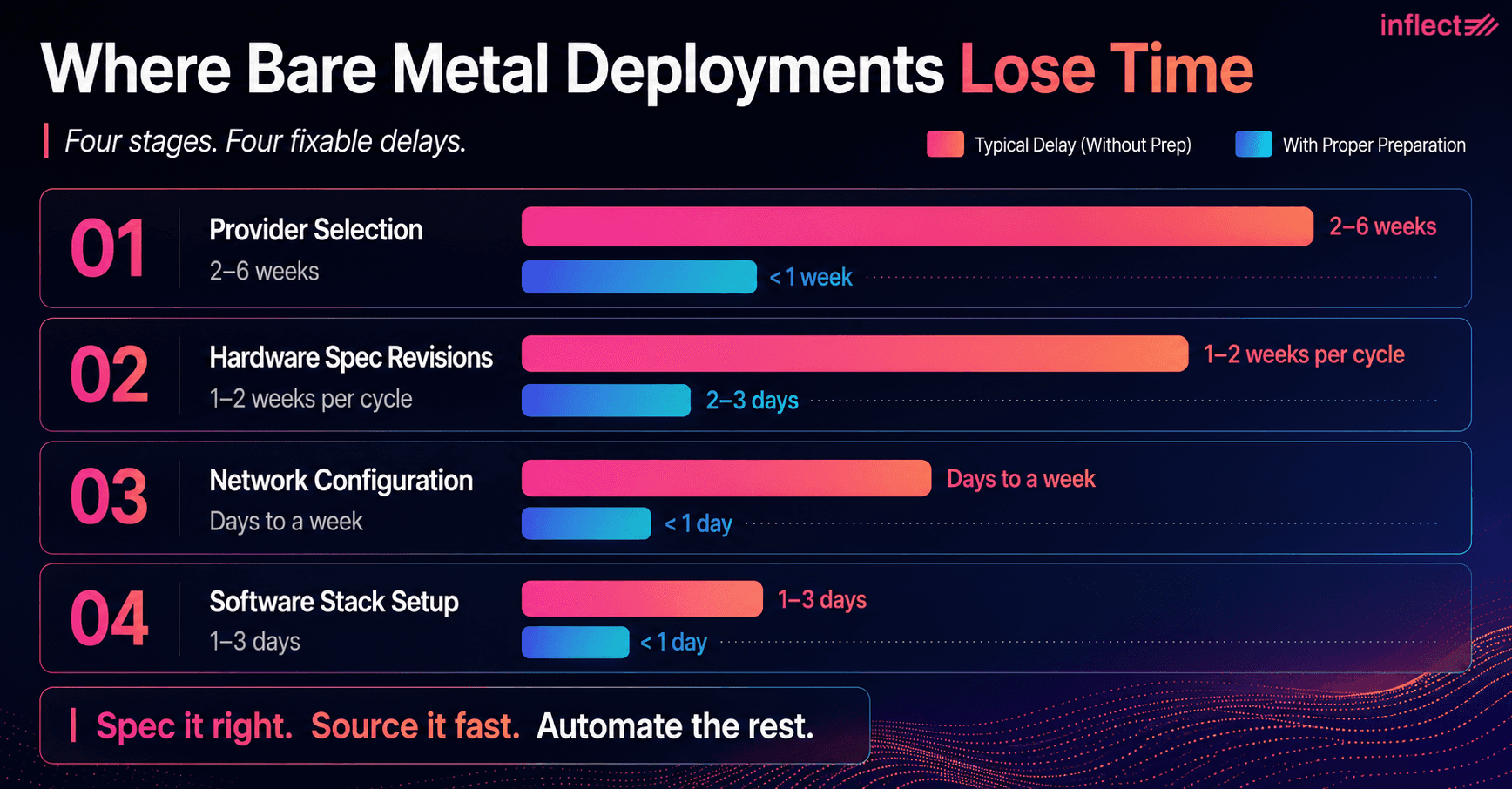
The four stages where AI teams lose the most time on bare metal deployments are provider selection and RFQ cycles, hardware specification revisions caused by underspecified initial requirements, network configuration complexity in multi-GPU environments, and software stack setup that cloud infrastructure previously abstracted away.
Provider Selection and RFQ Cycles: How Long They Actually Take
Provider selection for bare metal GPU hosting typically takes two to six weeks when approached through traditional RFQ processes: one to two weeks to identify qualifying providers, one to two weeks for quote turnaround, and additional time for negotiation and contract execution. For teams with a fixed launch deadline, that cycle represents the longest single delay in the AI deployment time to market and the one most amenable to compression through preparation.
Underspecified Hardware Requirements and the Revision Loop They Create
Underspecified hardware requirements in an AI infrastructure request create revision cycles that add weeks to deployment timelines, because providers quote against the spec they receive and changes to GPU type, memory configuration, or storage after the initial quote require re-scoping, re-pricing, and sometimes re-routing to a different facility. The most common errors are GPU memory capacity (choosing a GPU sized for development rather than production batch sizes), NVMe SSD storage throughput (underestimating I/O requirements for large dataset loading), and network bandwidth between nodes (omitting InfiniBand or high-speed Ethernet requirements for distributed training).
Network Configuration Complexity in Multi-GPU Deployments
Multi-GPU bare metal deployment introduces network configuration requirements that single-node cloud GPU instances do not, and teams that have not scoped these requirements before engaging a provider encounter delays at provisioning time that are difficult to compress. For distributed AI training across multiple physical servers, the network fabric between nodes is as important as the compute configuration: a cluster using standard 10 GbE switching for inter-node communication will bottleneck on gradient synchronization in ways that misrepresent the hardware's actual training throughput. InfiniBand AI training setups address this directly, and teams that specify InfiniBand or high-bandwidth RoCE upfront avoid the most common network-related deployment delay.
The Software Setup Gap That Cloud Abstracts Away
Cloud GPU instances ship with managed driver stacks, pre-configured CUDA environments, and container runtimes that teams accept by default. Bare metal GPU servers ship with an OS, and everything above that is the team's responsibility. For teams making the transition for the first time, the gap between "server is provisioned" and "first training job runs" can be one to three days of driver installation, CUDA configuration, container runtime setup, and cluster orchestration work. That gap is predictable and compressible through preparation and automation, but teams that do not account for it in their machine learning infrastructure setup timeline will miss it.
Make the Right Decisions Once: Hardware Specification for AI
A complete bare metal AI hardware specification covers four elements: GPU selection matched to workload type, CPU and memory and storage configuration matched to pipeline requirements, network fabric matched to cluster size and communication patterns, and tenancy model matched to security and performance isolation requirements. Getting these four decisions right before engaging a provider eliminates the revision cycles that create the most common deployment delays.
GPU Selection for Training vs. Inference Workloads
GPU selection for AI workloads depends on whether the primary use case is training or inference, with the two use cases having materially different requirements for memory capacity, compute throughput, and cost profile. Training workloads, including deep learning models for computer vision, natural language processing, and high-performance computing applications, require high GPU memory to hold model weights, gradients, and optimizer states, making high-memory configurations like the H100 or A100 the standard choice for production training. Inference workloads on bare metal prioritize high throughput and low latency over memory capacity and in many cases can be served efficiently on lower-cost GPUs that would not be appropriate for training.
CPU, Memory, and NVMe Storage Requirements for AI Pipelines
AI pipeline infrastructure requirements beyond the GPU include CPU core count for data preprocessing, system memory for dataset caching, and NVMe SSD storage throughput for training data loading from large datasets. A common bottleneck in machine learning infrastructure setup is a GPU-rich, storage-poor configuration where the GPU sits idle waiting for data to load from an undersized or slow storage layer. For production AI training, NVMe SSD storage attached directly to the physical machine rather than shared network storage delivers the high throughput needed to keep GPU acceleration running at capacity.
High-Speed Networking and InfiniBand for Distributed Training
Distributed AI training across multiple servers requires high-bandwidth, low-latency connections between nodes so gradients and other training data can be synchronized efficiently. In practice, InfiniBand setups are often used for these workloads because they are designed to provide very high throughput and very low latency at scale, including 200Gb/s HDR configurations with latency under 600 nanoseconds (Source: NVIDIA, 2019). For large GPU clusters spanning two to eight nodes, InfiniBand or converged Ethernet with RDMA over Converged Ethernet (RoCE) is the standard choice to accelerate training and eliminate the gradient synchronization bottleneck that limits throughput on standard switching.
Single-Tenant vs. Multi-Tenant Bare Metal for AI Workloads
Single-tenant bare metal AI deployment gives teams a dedicated physical server with no co-tenant workloads, providing dedicated performance, full access to all hardware resources, and the ability to configure the machine at the BIOS and firmware level. For AI/ML teams handling sensitive data or regulated workloads, single-tenant configurations also satisfy isolation requirements that multi-tenant environments cannot meet. Multi-tenant bare metal shares physical hardware at the hypervisor level and sacrifices the performance isolation that makes bare metal the preferred choice for high-performance AI infrastructure.
Execute Those Decisions Quickly: From Signed Contract to Live
Executing a bare metal AI deployment quickly requires four things: a repeatable OS and driver setup process, a pre-defined container orchestration and MLOps tooling stack, infrastructure-as-code automation that eliminates manual configuration steps, and a provider selection approach that does not restart the RFQ process from scratch every time.
OS and GPU Driver Setup for Production AI Workloads
OS and GPU driver setup for bare metal AI infrastructure is the first software layer and the one most likely to introduce unexpected delays when done manually and differently each time. For production deployments, the baseline covers OS selection (Ubuntu LTS is most widely supported), GPU driver version matched to the required CUDA version, and container runtime installation. Teams that document this baseline and maintain it as a provisioning script reduce per-server setup time from a day of manual work to an hour of automated execution. Version pinning matters: driver and CUDA version mismatches are the most common cause of GPU utilization issues in freshly provisioned environments.
Container Orchestration and MLOps Tooling on Bare Metal
Container orchestration on bare metal AI infrastructure enables teams to manage training jobs, resource allocation, and experiment tracking with the same tooling discipline that cloud environments provide through managed services. Kubernetes with GPU device plugin support is the standard choice for multi-GPU bare metal deployment, providing workload scheduling, resource isolation, and horizontal scaling without requiring cloud-specific APIs. MLOps tooling for experiment tracking, model versioning, and pipeline orchestration runs identically on bare metal as on cloud, with tools like MLflow, Weights and Biases, and Kubeflow all supporting self-hosted deployments.
Automating Infrastructure Configuration with IaC
Infrastructure-as-code automation compresses bare metal AI deployment timelines by making server configuration deterministic, repeatable, and auditable, giving teams cloud-like provisioning speed on dedicated hardware. Tools like Ansible, Terraform, or cloud-agnostic provisioning frameworks can automate OS configuration, driver installation, network setup, and software stack deployment from a single command. For multi-node GPU cluster deployment, IaC automation is the difference between a two-day manual exercise and a two-hour automated run.
How to Accelerate Provider Selection Without Sacrificing Coverage
Provider selection is the deployment stage most amenable to external compression, because the bottleneck is information access rather than technical work: teams need to know which providers have the right GPU configuration available, at what price, in which location, before they can issue a contract. Approaches include using a digital infrastructure marketplace to surface pricing across multiple providers simultaneously, engaging a broker with pre-existing provider relationships, and issuing a standardized RFQ template that allows multiple providers to respond in parallel.
Running AI Workloads in Production on Bare Metal
Running AI workloads in production on bare metal requires operational discipline in four areas: GPU utilization monitoring, capacity scaling, hybrid cloud integration for variable workloads, and total cost management over a multi-month horizon.
Monitoring GPU Utilization and Training Pipeline Performance
GPU utilization optimization and resource utilization monitoring on bare metal requires active instrumentation because, unlike cloud environments, there is no managed service surfacing these metrics by default. Gartner predicts 40 percent of organizations deploying AI will implement dedicated observability tools to monitor model performance by 2028 (Source: Gartner, 2026). On bare metal, the standard monitoring layer is NVIDIA's Data Center GPU Manager (DCGM), which exposes GPU utilization, memory bandwidth, temperature, and error rates to Prometheus or other metrics collectors. Low GPU utilization is almost always a software or configuration problem: data loading bottlenecks, suboptimal batch sizing, or synchronization overhead in distributed training.
Scaling Bare Metal Capacity Without Starting Over
Scaling bare metal AI infrastructure does not require re-provisioning the entire environment from scratch if the initial deployment was built with IaC automation and a modular hardware specification. The constraint on bare metal scaling is provider availability: unlike cloud, bare metal requires the provider to have the required GPU configuration in stock at the required location. Teams that communicate future capacity needs to their provider in advance avoid the availability delays that make reactive scaling difficult.
When a Hybrid Bare Metal and Cloud Approach Makes Sense
Hybrid cloud and bare metal AI infrastructure makes sense when usage patterns include both a sustained baseline of steady workloads and continuous training runs appropriate for bare metal, and variable workloads or demand spikes that benefit from cloud burst. A common pattern is to anchor base training and inference serving on bare metal in a colocation or on-premises data center, and route overflow to cloud GPU instances when queues exceed a threshold. This captures the cost savings of dedicated hardware at sustained utilization while preserving cloud elasticity for variable demand.
Total Cost of Ownership Over a 12-Month AI Infrastructure Horizon
AI infrastructure cost optimization over a 12-month horizon on bare metal requires modeling four components: hardware cost, power and cooling for colocation deployments, network connectivity, and engineering time to manage the infrastructure. Cloud GPU alternatives price all four into a single per-hour rate that obscures the margin embedded in that rate. For teams with predictable training schedules and stable inference workloads, a 12-month bare metal commitment typically produces meaningful cost savings and more predictable pricing relative to on-demand cloud GPU alternatives, with the breakeven point depending on GPU type, resource usage patterns, and cloud pricing tier.
A Four-Step Framework for Bare Metal AI Deployment
Bare metal is not slow. Teams that move fastest treat deployment as four discrete stages, each of which can be executed once and reused.
Step 1: Lock the specification. Define GPU type, memory, storage, network fabric, and tenancy model before engaging any provider. Every revision after first contact adds time. The hardware specification guide is the single document that determines how fast everything else moves.
Step 2: Eliminate provider friction. Use a marketplace, advisory service, or parallel RFQ process to compress provider selection from weeks to days. Inflect provides instant pricing across more than 6,000 data centers in over 100 countries, including bare metal GPU configurations from providers such as Equinix, Iron Mountain, and Flexential, without requiring a sales call. Free expert advisory is available for teams that need help scoping a deployment before going to market.
Step 3: Standardize software setup. Document OS, driver, and container configuration as a repeatable provisioning script before the first server is delivered. The first run takes time; every run after takes an hour.
Step 4: Automate everything repeatable. IaC automation for server configuration, MLOps tooling for experiment management, and DCGM for GPU monitoring are the operational foundations that make bare metal AI infrastructure manageable at scale without cloud-level abstraction.
Teams that follow this framework go from budget approval to live workloads in weeks. The infrastructure decision that felt like a risk becomes the one that put the model in production on time.
If you are at Step 2, Inflect is the fastest way to get market-calibrated pricing before committing to a provider. Search bare metal GPU configurations, compare providers side by side, and get instant pricing.
About the Author

Haley Rogers
Content & Social Media Specialist
Haley Rogers is the Content & Social Media Specialist at Inflect, bringing over two years of experience in social media, marketing, and content strategy — including time at a fast-paced tech company before joining the Inflect team. She specializes in translating complex digital infrastructure topics into clear, engaging content, with a particular focus on blog writing and brand storytelling across channels.
Contact: