14 mins
How to Choose a Colocation Facility for Manufacturing IT and OT Environments
At 2:47 a.m., a stamping line at a Tier 1 automotive supplier's Ohio plant stalls mid-cycle. Diagnostics don't point to a worn die or a failed press. They trace back to a firmware update pushed to the plant network the night before, one that quietly severed the connection between the manufacturing execution system and the programmable logic controllers running the line.

That kind of incident used to be an IT problem with an IT timeline: a ticket, a rollback, an apology email. It is now a production problem with a production price tag. A large manufacturing operation loses close to $260,000 for every hour a critical line sits idle, and automotive plants lose closer to $2.3 million an hour, a figure that has more than doubled since 2019. Unscheduled downtime now drains an estimated $1.4 trillion, or 11 percent of annual revenue, from the world's 500 largest companies (Source: Siemens, 2024).
The reason IT incidents now carry OT-scale consequences is convergence. Systems that once sat in isolated plant environments are increasingly connected to corporate IT, cloud platforms, and each other, which is what makes real-time visibility and predictive maintenance possible and what makes the data center hosting them a production-critical decision. This post lays out how manufacturing IT and operations leaders should evaluate a colocation facility once IT and OT are no longer separate infrastructure decisions.
Why IT/OT Convergence Has Turned Data Center Decisions Into Operational Risk Decisions
IT/OT convergence has turned data center site selection into an operational risk decision, because a network, power, or security failure in the facility hosting MES, SCADA, or historian systems can now stop physical production.
What Colocation Means for Manufacturing IT and OT Environments
Colocation for manufacturing means the ability to rent space, power, cooling, and network connectivity inside a third-party data center to host the servers and network equipment running both IT applications and OT systems such as MES, SCADA, and historian platforms, while the provider supplies the building, power infrastructure, and physical security. Unlike a hyperscale cloud region built for general-purpose compute, a colocation facility lets manufacturers control the hardware, network segmentation, and compliance posture of systems plant operations depend on directly.
How Colocation for Manufacturing Differs From On-Premises and Public Cloud
Colocation differs from on-premises hosting by moving physical infrastructure into a facility built for enterprise-grade power redundancy, cooling, and security, and it differs from cloud service providers by keeping manufacturers in control of hardware, network architecture, and data residency rather than a shared public cloud compute layer. That middle position matters because OT systems often need deterministic performance and direct network paths to plant equipment that public cloud regions were not designed to provide.
Typical Colocation Use Cases in Manufacturing IT and OT Architectures
Manufacturers typically use colocation for four purposes: hosting MES and ERP systems close to plant networks, running SCADA and historian platforms over dedicated low-latency links to the factory floor, centralizing edge aggregation nodes that collect IIoT sensor data before it reaches cloud hosting environments, and maintaining disaster recovery for production-critical applications.
Downtime Cost and Operational Risk in Continuous Production Environments
Downtime cost is the clearest reason IT/OT convergence has become a board-level concern, since large manufacturers lose an average of $260,000 for every hour a critical line is down, and automotive losses run closer to $2.3 million an hour (Source: Siemens, 2024).
How IT-Originated Failures Cascade Into OT System Failures
IT-originated failures cascade into OT system failures when a network outage, a failed patch, or a misconfigured firewall disrupts the connectivity that MES, SCADA, and historian systems depend on to reach controllers and sensors on the floor. Because converged architectures link IT and OT by design, a fault that once stayed contained in a back-office system can now reach the production environment.
Why On-Premises Server Rooms Fall Short for Manufacturing Uptime and Compliance Needs
On-premises server rooms fall short for manufacturers running their own data centers, because most rely on aging infrastructure and legacy systems built decades before IT/OT convergence, leaving them without the power redundancy, security, and compliance controls modern ICS standards now require.
Power and Cooling Limitations in Plant Server Rooms
Plant server rooms typically run on the facility's general electrical infrastructure rather than the redundant uninterruptible power supplies and generator-backed cooling systems standard in a purpose-built data center, exposing IT, OT, and networking equipment to the same outages and cooling failures that affect the rest of the plant. A single HVAC failure in a converted closet or mezzanine server room can take down MES and SCADA connectivity while production equipment is still running.
Lack of Redundancy and Failover Capabilities
Most plant server rooms running privately owned servers lack the redundant network paths, backup power, and failover systems that let a colocation facility keep critical applications running through a hardware failure or utility outage. A single point of failure in a private data center or server room becomes a single point of failure for the systems coordinating the production line.
Physical Security Gaps in Industrial Environments
Plant floors are designed for equipment access and worker throughput, not for the layered security systems, biometric access control, fire suppression and safety systems, and monitored perimeters a colocation facility applies to the physical space hosting sensitive IT and OT systems, a gap that creates exposure to insider risk and physical tampering.
Compliance Limitations for Regulated Manufacturing Sectors
Manufacturers in regulated sectors such as automotive, aerospace, and medical devices face audit requirements and compliance certifications, from IATF 16949 to FDA quality system regulations, that plant server rooms were never designed to support, while colocation facilities can provide the access logs and audit trails those frameworks require.
Scalability Constraints for IIoT and AI-Driven Workloads
Plant server rooms have fixed power and cooling capacity that cannot absorb the compute density IIoT sensor networks and AI-driven quality inspection and predictive maintenance workloads now require, a constraint that becomes more acute as global edge computing spend, increasingly tied to hybrid cloud environments, grows at a 13.8 percent compound annual rate, reaching an estimated $380 billion by 2028 (Source: IDC, 2025).
Operational Burden on Internal IT Teams Managing Plant Infrastructure
Internal IT teams managing in-house servers absorb the full burden of power monitoring, physical maintenance, asset management, and after-hours incident response, pulling skilled staff away from projects like MES rollouts and predictive maintenance that actually move the business forward.
Key Criteria for Choosing a Colocation Facility for Manufacturing IT and OT Environments
Manufacturers evaluating colocation for industrial environments should apply six criteria: power redundancy, network segmentation and latency for industrial control systems, physical security, proximity to plant locations, environmental and density support for industrial equipment, and scalability for edge and AI-driven workloads. Demand across many data centers is accelerating as data center operators compete for manufacturing workloads: the global colocation data center market is projected to reach $99.2 billion in 2026, growing at a 9.3 percent compound annual rate through 2033 (Source: Grand View Research, 2026).
Power Redundancy and Uptime SLAs for Continuous Production Operations
Power redundancy is the first criterion because continuous production cannot tolerate outages in power infrastructure that a single-utility-feed facility risks. Manufacturers should require N+1 or 2N power architecture, multiple backup generators, and a manufacturing uptime data center SLA with financial remedies tied to production-linked downtime, not just general application availability.
Network Segmentation and Latency Requirements for Industrial Control Systems
Industrial control systems require network segmentation that keeps OT traffic isolated from IT traffic while still allowing controlled data exchange, and they require latency low enough to support real-time control loops, consistent performance, and network performance across low-latency industrial networks.
For technical teams: evaluate whether the facility supports dedicated VLANs or physically separate network paths for OT traffic, sub-10-millisecond latency to plant locations where real-time control matters, and cross-connect options that avoid routing OT data through shared public internet paths.
Physical Security and Access Control for Facilities Hosting OT Data
Facilities hosting OT data need physical security controls, including biometric access, multi-factor authentication, physical access logging, mantraps, 24/7 monitoring, and visitor logging, matching the sensitivity of systems that can affect physical production equipment if compromised, a meaningfully higher bar than a standard IT data closet.
Proximity and Interconnection to Plant Locations and Industrial Networks
Proximity to plant locations reduces the latency of connecting a colocation facility to SCADA and MES systems, and strong interconnection options, including fiber routes, cloud on-ramps, and carrier-neutral cross-connects, give manufacturers cloud connectivity to link multiple plants without routing OT data through the public internet.
Environmental and Density Requirements for Industrial and Edge Equipment
Industrial and edge computing hardware often runs at higher power density than standard IT gear, so manufacturers should confirm a facility's rack power capacity and supporting infrastructure for the ruggedized hardware some OT applications require.
Scalability for Edge Computing, IIoT, and AI-Driven Manufacturing Workloads
A colocation facility must scale as IIoT deployments grow, which is why rapid provisioning matters as much as raw density, since manufacturing is already one of the largest contributors to a global edge computing market projected to reach $380 billion by 2028 (Source: IDC, 2025).
Security and Compliance Requirements for OT Data in a Shared Colocation Facility
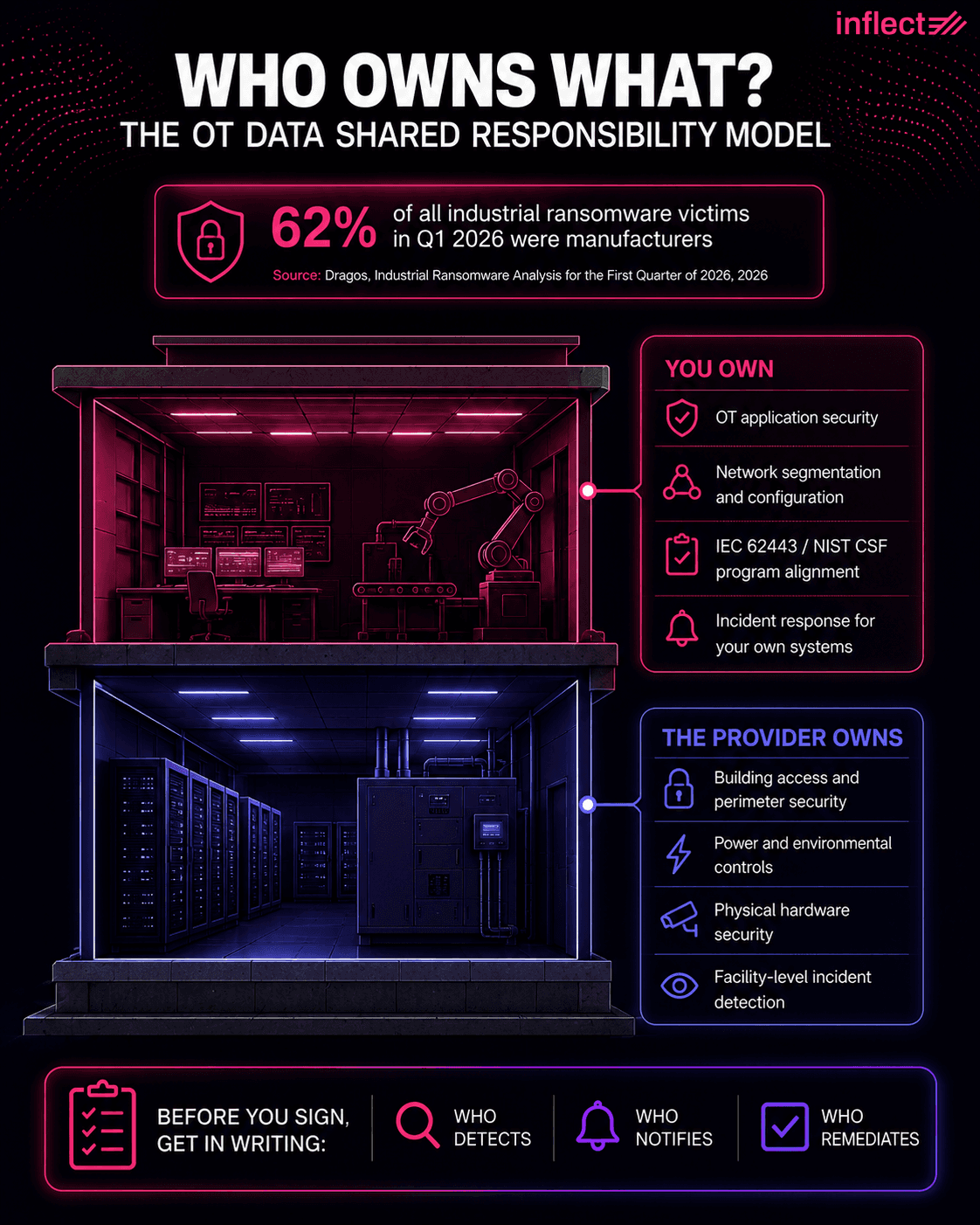
OT data center requirements for a shared colocation facility come down to four things: alignment with IEC 62443 for industrial control system security, alignment with the NIST Cybersecurity Framework for broader risk management, clear data segregation between IT and OT networks, and defined incident response responsibilities between manufacturer and provider.
IEC 62443 and Industrial Control System Security Expectations for Colocation Providers
IEC 62443 is the international standard for securing industrial automation and control systems, and colocation providers hosting OT infrastructure should support the zone-and-conduit segmentation the standard defines, even though it is typically applied by the manufacturer rather than certified at the facility level (Source: International Electrotechnical Commission, 2024).
For technical teams: most industrial controllers target Security Level 2 under IEC 62443, requiring unique device credentials, certificate-based authentication, role-based access control, secure boot, and TLS on cross-zone communication, all of which depend on the facility's network architecture supporting proper zone separation.
NIST Cybersecurity Framework Alignment for Manufacturing Data Environments
The NIST Cybersecurity Framework organizes risk management into six functions, Govern, Identify, Protect, Detect, Respond, and Recover, and manufacturers should confirm a provider's controls map cleanly to the Protect and Detect functions their OT security program relies on (Source: National Institute of Standards and Technology, 2024).
Data Segregation Between IT and OT Networks in a Multi-Tenant Facility
Data segregation in a multi-tenant facility means confirming a manufacturer's OT traffic is logically, and where required physically, isolated from other tenants and from its own IT traffic, so a breach elsewhere in the facility cannot reach production systems.
Audit, Logging, and Monitoring Requirements for OT Data in Shared Facilities
OT data hosted in a shared facility requires audit logging and network monitoring that captures physical access events, network anomalies, and configuration changes in enough detail to support both internal review and external compliance audits.
Physical vs. Cybersecurity Responsibility in Colocation Environments
Physical security in a colocation environment, covering building access, environmental controls, and hardware security, is the provider's responsibility, while cybersecurity of the OT applications and data running on the provider's infrastructure remains the manufacturer's. That division should be documented in the contract rather than assumed.
Incident Response and Shared Responsibility Models in OT Contexts
Incident response in a colocation environment depends on a documented shared responsibility model specifying who detects, notifies, and remediates depending on whether an incident originates in the facility or in the manufacturer's own OT applications. That gap matters because manufacturing ransomware activity keeps rising: manufacturing accounted for 62 percent of all industrial ransomware victims tracked in the first quarter of 2026 (Source: Dragos, 2026).
Questions Manufacturing IT and Operations Leaders Should Ask Before Signing a Colocation Contract
Manufacturing IT and operations leaders should ask four categories of questions before signing a colocation contract to protect critical infrastructure: how disaster recovery is handled for production-critical systems, what SLA and support model applies to 24/7 operations, how total cost of ownership compares to staying on-premises, and what happens at contract end regarding vendor lock-in.
Disaster Recovery and Business Continuity for Production-Critical Systems
Buyers evaluating manufacturing disaster recovery solutions should ask whether a provider offers geographically separate secondary sites, what recovery time objectives it will commit to contractually, and how failover is tested for OT-specific applications rather than general IT workloads.
SLA and Support Model Requirements for 24/7 Manufacturing Operations
Because production runs around the clock, manufacturers should confirm the provider's service level agreements include 24/7 on-site technical staff, response time commitments specific to production-linked incidents, and an escalation path that does not require the manufacturer's own team to be physically present to resolve a facility-side issue.
Total Cost of Ownership: Colocation vs. On-Premises Data Center for Manufacturers
Total cost of ownership for colocation vs. on-premises manufacturing infrastructure should account for the capital cost of building and maintaining redundant power and cooling in-house, the staffing cost of round-the-clock data center management, ongoing maintenance costs, and facility costs, weighed against the more predictable costs and downtime savings of infrastructure built for continuous, cost-effective operations.
Vendor Lock-In, Exit Strategy, and Contract Terms for Scaling IT/OT Capacity
Manufacturers should review contract terms covering minimum capacity commitments, the cost and process of scaling up as IIoT and AI workloads grow, and the exit terms, including data migration support and notice periods, that determine how difficult it would be to move to a different colo provider or facility later.
Which Colocation Model Fits Your Manufacturing Environment?
Choosing the right colocation model for a manufacturing IT and OT environment depends on how a manufacturer answers five questions, and Inflect's advisory team uses this framework, informed by data across thousands of facilities, to point manufacturers toward one of three practical paths.
First, how production-critical are the systems being hosted? A failure that would stop a line within minutes points toward N+1 or 2N power and sub-10-millisecond proximity to the plant, not a lowest-cost regional option.
Second, what does current infrastructure look like? Manufacturers still running plant server rooms with no redundant power path are usually better served by a phased migration that moves the highest-risk systems, typically MES and SCADA connectivity, first.
Third, what compliance obligations apply? Regulated manufacturers need to confirm audit logging, access control, and IEC 62443 or NIST CSF alignment before selecting a facility, which can narrow the shortlist considerably.
Fourth, how fast is IIoT and edge deployment growing? Manufacturers scaling sensor networks and AI-driven inspection quickly should weight facilities on power density and expansion capacity over pure proximity.
Fifth, how much can internal IT absorb? Lean IT teams typically choose a specialized provider offering fully managed services and managed colocation with 24/7 on-site support, rather than a bare-bones space-and-power arrangement that still requires in-house management for the systems inside it.
Most manufacturers land in one of three models: a hybrid IT/OT infrastructure that keeps time-sensitive control at the plant while hosting MES and disaster recovery in colocation, a full migration of plant systems into a purpose-built facility, or a phased convergence that moves systems in stages as compliance needs increase. A conversation with Inflect's advisory team, at no cost, is the fastest way to find out which fits a specific plant network.
Choosing a colocation facility for manufacturing IT and OT environments now carries the same weight as choosing a production equipment vendor, because a facility that cannot deliver redundant power, ICS-aware network segmentation, and documented security responsibility will eventually become a production risk rather than an IT convenience. The criteria that matter most, uptime SLAs backed by real financial remedies, network architecture built for OT traffic, and a security posture that maps to IEC 62443 and NIST CSF, are the same criteria that separate a facility built for IT/OT convergence from one designed only for general enterprise IT. Manufacturers who treat this as a core piece of manufacturing data center strategy, rather than a line item in an IT budget, are the ones best positioned for operational continuity across data center operations as IIoT and AI workloads keep growing.
Why Manufacturers Use Inflect to Source Colocation for IT and OT Environments
Manufacturers evaluating scalable infrastructure for IIoT workloads can search Inflect's marketplace for retail colocation, wholesale colocation, or private suites, filtering by specific power density, redundancy tier, and regional proximity, and get instant, side-by-side pricing across colocation services and data center services without a sales call, an advantage when a plant network spans multiple regions with different latency and compliance needs. Inflect's platform enables organizations to compare data center colocation pricing across more than 6,000 data centers and facilities in over 100 countries, including providers such as Equinix, Digital Realty, CoreSite, and Flexential that support the power density manufacturing IT infrastructure demands. Manufacturers weighing the total cost of ownership questions above can compare pricing across each data center facility directly on the platform, and Inflect's advisory team provides free guidance, including whether managed services or self-managed colocation fits better, and matches a facility's compliance posture to a plant's requirements for secure colocation for OT data, before any contract is signed.
Start comparing colocation options built for manufacturing IT and OT:
Search Inflect's marketplace for colocation facilities with the power density, redundancy tier, and proximity your plant network requires
Get instant, side-by-side pricing from multiple providers without a sales call
Talk to Inflect's advisory team, at no cost, about matching a facility to your IEC 62443 or NIST CSF compliance requirements
Compare colocation against your current on-premises total cost of ownership before your next contract renewal
Start your search on Inflect to find the right colocation facility for your manufacturing IT and OT environment.
About the Author

Haley Rogers
Content & Social Media Specialist
Haley Rogers is the Content & Social Media Specialist at Inflect, bringing over two years of experience in social media, marketing, and content strategy — including time at a fast-paced tech company before joining the Inflect team. She specializes in translating complex digital infrastructure topics into clear, engaging content, with a particular focus on blog writing and brand storytelling across channels.
Contact: