9 mins
How Manufacturers Can Use Colocation for ERP, MES, and Supply Chain Systems
At 2:14 on a Tuesday afternoon, a cooling failure in a plant-adjacent server room takes down the ERP instance managing production scheduling across three lines. The MES loses its connection to the shop floor. Work orders queue. Line supervisors fall back on paper. By the time the system recovers four hours later, the plant has missed two shift targets and carries a backlog that will take two days to clear.
This is not an edge case. It is a pattern that repeats across manufacturing environments where IT infrastructure was built incrementally, often inside the same building it serves, without the redundancy, physical separation, or carrier diversity that production-critical systems actually require.
The financial stakes are measurable. Siemens’ 2024 analysis found that Fortune Global 500 companies lose about $1.4 trillion annually to unplanned downtime, or roughly 11% of revenue (Source: Siemens, 2024). For a plant running two shifts, even a four-hour outage can quickly become a seven-figure event, before you factor in missed production, labor inefficiency, expedited recovery work, and downstream supply chain disruptions.
The infrastructure decision that determines whether that scenario repeats is not which ERP platform to license or which MES vendor to standardize on. It is where those systems live, who is responsible for keeping them running, and how they connect to the rest of the operation. That decision is what this post covers: a framework for manufacturing IT leaders evaluating colocation as a hosting model for ERP, MES, and supply chain platforms, with the specificity the decision actually requires.
Why Manufacturers Are Moving ERP, MES, and Supply Chain Systems to Colocation
Manufacturers are moving ERP, MES, and supply chain systems to colocation for three converging reasons: the accelerating cost and risk of on-premises infrastructure ownership, the connectivity demands that OT/IT convergence has introduced, and the rising rack density requirements that AI and GPU workloads are beginning to impose on production environments. Each of these pressures existed independently a decade ago. Together, they are making on-premises hosting of production-critical systems a progressively more difficult position to sustain.
The Hidden Cost of Running ERP and MES on On-Premises Hardware
On-premises hosting of ERP and MES systems generates three categories of cost that rarely appear together in a single budget line: hardware refresh CapEx, end-of-life OEM support exposure, and the operational burden of running an in-house data center facility that was never purpose-built for production-critical IT systems.
Hardware refresh cycles for production-grade servers typically run three to five years. When an ERP platform such as SAP S/4HANA or Oracle EBS reaches a refresh point simultaneously with MES server infrastructure, the capital requirement spikes in ways that are difficult to absorb within a single fiscal year. Colocation converts that spike into a predictable monthly OpEx commitment that maps cleanly to operational budgets and removes the internal capital allocation contest between IT and production equipment.
End-of-life OEM support risk compounds the CapEx problem. Extended support contracts for out-of-cycle hardware carry significant premium pricing, and the operational risk of running unsupported hardware in a production-critical environment is not theoretical for manufacturing IT teams who have managed a hardware failure mid-production run. Moving systems to colocation facilities that operate standardized, current-generation infrastructure removes that exposure entirely while shifting responsibility for physical infrastructure continuity to a provider whose core business is exactly that.
How OT/IT Convergence Is Creating Connectivity Demands On-Premises Cannot Meet
OT/IT convergence in manufacturing environments is generating east-west traffic between operational technology systems and enterprise IT platforms at volumes that on-premises server rooms were not designed to carry. As plant floor sensors, SCADA systems, historian databases, and process control networks increasingly integrate with ERP and MES platforms, the network paths between those systems become production-critical infrastructure in their own right.
On-premises server rooms typically lack the carrier diversity and cross-connect density to support this traffic at the latency and reliability levels production environments require. A colocation facility with multiple on-net carriers and direct interconnection to cloud environments provides the low-latency, deterministic connectivity that OT/IT convergence architectures depend on. This is the connectivity gap that is moving manufacturing infrastructure conversations from "should we consider colocation" to "which facility fits our architecture."
Which Manufacturing Workloads Belong in Colocation
Manufacturing workloads suited to colocation are those requiring high uptime, carrier-grade connectivity, and physical separation from the production floor: ERP platforms, manufacturing execution systems, and supply chain applications. Not every manufacturing workload belongs in colocation. Latency-sensitive control systems, PLC-adjacent workloads, and real-time edge processing tied directly to machine inputs typically remain on-site or at the edge, where round-trip latency to a remote facility would introduce unacceptable delay in control loop response.
ERP Systems (SAP, Oracle, Microsoft Dynamics) in Colocation
SAP, Oracle, and Microsoft Dynamics ERP systems are well suited to colocation because they depend on stable performance, dense integration, and dependable connections to cloud-based analytics and disaster recovery environments. SAP’s 2026 HANA Cloud documentation still reflects the memory- and I/O-intensive profile of these deployments, which makes current-generation colocation infrastructure a better fit than aging on-premises server rooms on a deferred refresh cycle. In practice, these systems benefit from redundant power, stronger cooling, better network interconnection, and easier access to hybrid architectures that keep core transactional workloads close while extending analytics and backup functions into the cloud. For manufacturers, that combination improves resilience without forcing every workload into a public-cloud model (Source: SAP, 2026).
Proximity to cloud environments is a practical consideration for ERP in colocation. Most enterprise ERP deployments use cloud-based analytics, business intelligence layers, or disaster recovery tiers to minimize data loss and meet recovery time targets, and a carrier-neutral facility with AWS Direct Connect or Azure ExpressRoute on-ramps provides lower-latency, more cost-efficient paths to those environments than internet-routed cloud connectivity from an on-premises location.
Manufacturing Execution Systems and Deterministic Production Data
MES platforms hosted in colocation require low-latency, deterministic connectivity between the data center and the production floor, with single-digit millisecond round-trip times achievable where plant-to-facility distances are within a reasonable geographic range. For manufacturers with multiple plants in a region, a well-connected colocation facility can serve as a central MES host for several sites simultaneously, consolidating infrastructure while maintaining the performance thresholds each plant requires.
MES data volumes from sensor-dense production environments are growing as manufacturers add instrumentation for quality management, OEE tracking, and predictive maintenance programs. Colocation facilities with scalable power and cooling capacity accommodate that growth without the internal capital planning cycles that on-premises expansion requires.
Supply Chain and Logistics Platforms in Colocation
Supply chain and logistics platforms benefit from colocation through improved API integration performance, lower EDI transaction latency, and multi-region redundancy for manufacturers operating across global supplier networks. A carrier-neutral colocation facility with direct interconnection to trading partner networks reduces latency on EDI and API traffic compared to internet-routed connections from an on-premises environment, which matters in just-in-time manufacturing models where supply chain platform availability directly affects production scheduling.
For manufacturers operating global supply chains, multi-region colocation deployments provide active-active or active-passive redundancy across geographies, ensuring that a regional infrastructure event does not halt supply chain visibility or partner transaction processing across the broader operation.
Colocation Requirements for Manufacturing Environments
Manufacturing colocation providers must satisfy five categories of requirement that distinguish them from general-purpose hosting environments: physical infrastructure specifications, SLA structure and MTTR commitments, regulatory compliance, physical security controls, and network architecture. A provider meeting generic data center standards but unable to demonstrate compliance-specific capabilities or carrier density sufficient for OT/IT workloads is not a suitable choice for production-critical manufacturing systems.
Power, Cooling, and Uptime Standards for Production-Critical Systems
Manufacturing colocation deployments require Tier III or Tier IV facilities, providing N+1 or 2N redundancy across power and cooling infrastructure, including redundant power sources, backup generators, and uninterrupted power supplies, with provider SLAs that address power uptime, network uptime, and cross-connect availability as separate commitments rather than a single blended figure. A provider offering a 99.999% power uptime SLA with no corresponding network or cross-connect SLA is not providing meaningful protection for a workload where connectivity loss is as disruptive as power loss.
Mean time to repair is as important as uptime percentage for manufacturing workloads. A facility with a 99.999% uptime commitment and an MTTR of eight hours carries a materially different risk profile than one with the same uptime figure and a documented MTTR under 90 minutes. Manufacturing IT teams should request MTTR data by incident category during provider evaluation, not accept uptime percentage as the only availability metric on the table.
Compliance Requirements: ITAR, CMMC, and Data Sovereignty for Manufacturers
ITAR-compliant colocation providers must demonstrate that physical access to all spaces where controlled technical data may reside is restricted to US persons, with documented access control procedures, visitor management protocols, and audit logging that satisfies ITAR Part 120 requirements. Manufacturers in defense, aerospace, and advanced manufacturing who handle sensitive data under export-controlled classifications cannot rely on a general-purpose colocation facility without verifying these controls explicitly and in writing before data migration begins.
CMMC Level 2 and Level 3 compliance, required for manufacturers in the US defense industrial base, imposes physical access requirements including biometric access controls, video surveillance, fire suppression systems, 24/7 monitoring, and incident documentation that many standard colocation providers do not maintain as a default configuration. Data residency requirements for multinational manufacturers add a further dimension: where data is physically stored, which legal jurisdictions govern it, and whether the provider can contractually guarantee residency within specified geographic boundaries are all evaluation criteria that must be resolved before contract execution, not after.
Network Architecture Requirements for Manufacturing Colocation
Carrier-neutral colocation facilities suitable for manufacturing workloads should provide access to a minimum of 10 on-net carriers, offering redundant path options and competitive pricing for bandwidth-intensive workloads including MES data replication, supply chain platform synchronization, and growing OT/IT integration traffic. Single-carrier or limited-carrier facilities introduce concentration risk that directly undermines the redundancy argument for moving systems to colocation in the first place.
Internet exchange presence enables direct peering and interconnection services with trading partners, cloud providers, and content networks, reducing transit hops and improving latency for supply chain API traffic. Cloud on-ramps including AWS Direct Connect, Azure ExpressRoute, and Google Cloud Interconnect allow manufacturers to connect ERP and MES colocation environments to cloud analytics and DR tiers at private-network performance levels rather than public internet latency, which is a meaningful operational difference for data-intensive hybrid architectures.
Colocation vs. Public Cloud for Manufacturing Workloads
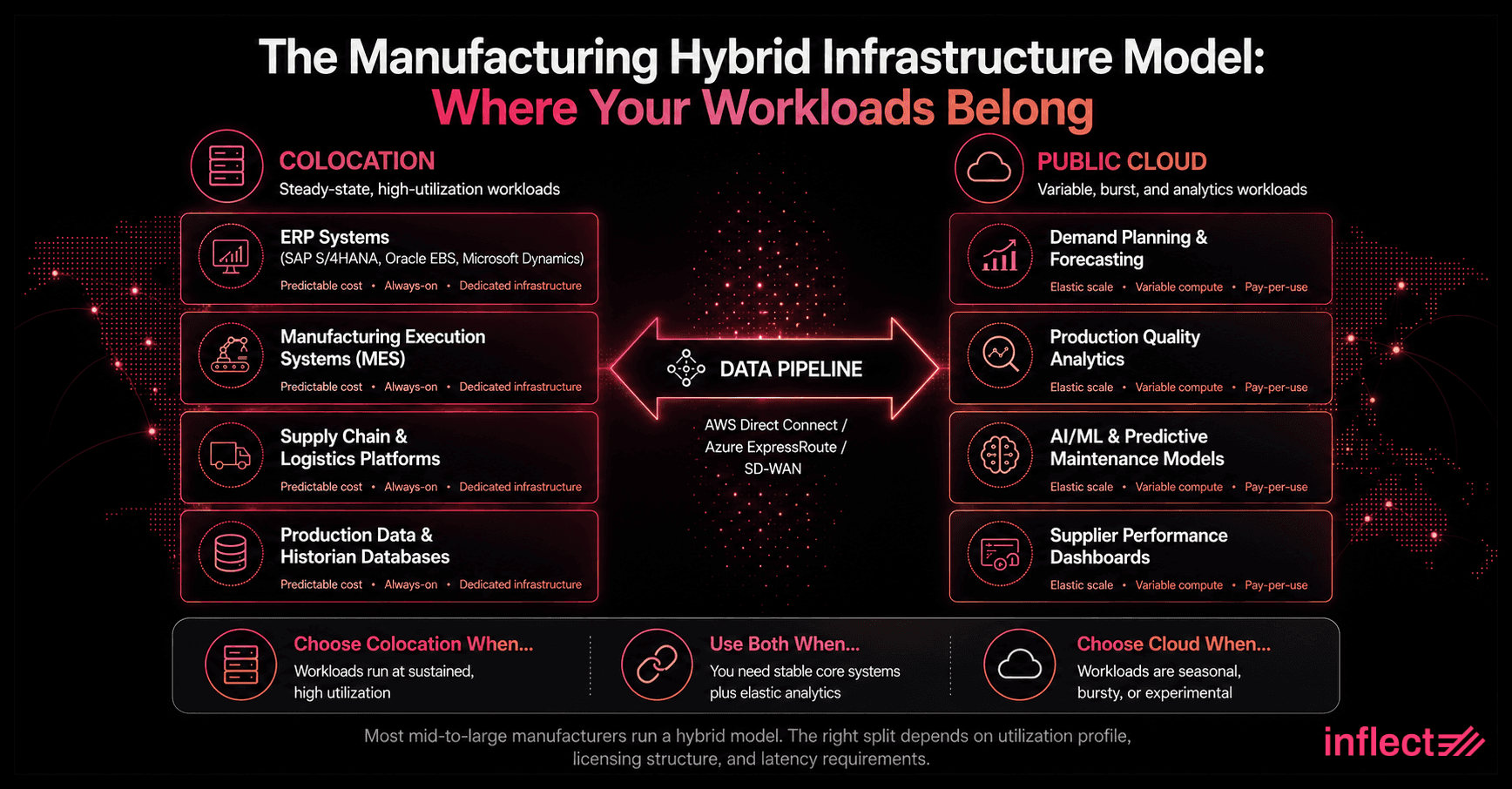
Colocation and public cloud serve different functions in a manufacturing infrastructure architecture: colocation is the better fit for steady-state, high-utilization workloads requiring predictable performance and cost, while public cloud is better suited to variable, analytics-heavy, or burst-demand workloads. Neither model is universally superior for manufacturing environments, and the most effective architectures use both deliberately, with workloads distributed based on utilization profile and performance requirements.
When Colocation Beats Public Cloud for ERP and MES
Colocation outperforms public cloud for steady-state, high-utilization manufacturing workloads, specifically ERP platforms, MES systems, and always-on production data infrastructure, for three reasons: cost predictability, licensing economics, and performance consistency.
Cloud pricing for compute-intensive workloads compounds quickly over a three-to-five-year horizon, especially when compute, storage, and data-transfer charges stack on top of one another. Current cloud cost-management guidance continues to emphasize that recurring usage charges and egress fees are common drivers of budget overruns, particularly for predictable, high-utilization applications. Colocation pricing is typically fixed once contracted, so manufacturers running steady SAP HANA workloads can often see a meaningful cost advantage by year three while also removing cloud bill variability (Source: Splunk, 2025).
Oracle and SAP licensing structures add a further constraint specific to manufacturing ERP environments. Both vendors price enterprise licenses in ways that are less favorable when deployed on public cloud virtual machines than on dedicated hardware, and the licensing terms for cloud deployments can introduce cost variability that dedicated colocation infrastructure removes. Manufacturers holding perpetual or enterprise agreement licenses for ERP platforms frequently find colocation the more economical execution environment when total cost of ownership across a five-year horizon is modeled against cloud alternatives.
Building a Hybrid Model: Colocation Plus Cloud for Manufacturing
The most common architecture for mid-to-large manufacturers pairs colocation for ERP and MES core systems with public cloud for analytics, AI, and demand forecasting. Recent manufacturing infrastructure guidance continues to emphasize this hybrid pattern because steady-state production workloads tend to perform better on dedicated infrastructure, while cloud resources remain useful for variable or compute-heavy workloads. In practice, that approach preserves the cost and performance advantages of colocation for core operational systems while keeping elasticity available for forecasting, experimentation, and other cyclical demand spikes (Source: Digital Realty, 2026).
In practice, the workload split follows a clear logic: ERP transaction processing, MES production data, and supply chain platform hosting run in colocation on predictable, dedicated infrastructure. Demand planning models, production quality analytics, supplier performance dashboards, and AI-driven maintenance forecasting run in cloud environments that can scale with analytical workload cycles without carrying the cost of dedicated hardware at base load.
The data pipeline between colocation and cloud environments is a design decision that must be addressed before facility selection. Manufacturers need either direct cloud on-ramp connectivity from their colocation provider or a software-defined WAN architecture connecting the environments with consistent, low-latency performance. A facility without cloud on-ramp availability forces internet-routed connectivity between colocation and cloud tiers, which introduces latency and cost that undermine the hybrid model's performance case at scale.
How to Source Colocation for Manufacturing Systems Using Inflect
For most manufacturing IT teams, sourcing colocation has historically meant contacting providers directly, waiting for proposals, and comparing options without a shared framework or transparent pricing. The process routinely runs four to eight weeks before a meaningful shortlist emerges, which is a significant friction cost on a decision that is already infrastructure-complex.
The practical starting point for this buyer is defining three parameters before engaging any provider: the power density requirement for ERP and MES infrastructure (typically 4 to 10 kW per cabinet for standard deployments, higher for SAP HANA configurations), the geographic location of the facility relative to the primary plant or regional headquarters for OT/IT latency management, and the compliance requirement (ITAR, CMMC, SOC 2 Type II, or ISO 27001 depending on the manufacturer's regulatory context).
Inflect is a digital infrastructure marketplace where manufacturers can search, compare, and receive instant pricing from colocation data center providers across 6,000+ facilities in 100+ countries. Providers on the platform with manufacturing-relevant capabilities include Equinix, Digital Realty, Iron Mountain, QTS, CoreSite, TierPoint, and Flexential, among hundreds of others.
Ready to find colocation for your ERP, MES, or supply chain systems?
Get instant, comparable pricing from colocation providers with no sales call required
Filter by compliance certification, power density, and geographic market to reach a shortlist in one session rather than weeks of sequential vendor outreach
Access carrier-neutral interconnection services, cloud on-ramps, and colocation data center space from a single sourcing platform
Work with a free Inflect advisor on requirements scoping, provider shortlisting, and RFP preparation
Start your search at inflect.com.
About the Author

Haley Rogers
Content & Social Media Specialist
Haley Rogers is the Content & Social Media Specialist at Inflect, bringing over two years of experience in social media, marketing, and content strategy — including time at a fast-paced tech company before joining the Inflect team. She specializes in translating complex digital infrastructure topics into clear, engaging content, with a particular focus on blog writing and brand storytelling across channels.
Contact: