13 mins
High-Performance Bare Metal for Game Developers and Online Gaming Platforms
A season launch spikes concurrent players 10x in twenty minutes. Matchmaking queues back up, ping times climb past playable thresholds, and the autoscaling group that was supposed to absorb the surge is still provisioning instances by the time players start abandoning sessions.
This repeats every content drop, battle pass reset, and tournament weekend. The instances eventually catch up. The players who quit mid-match over a lag spike, and the ones who see a five-minute queue and close the client instead, do not come back for that session, and a meaningful share do not come back at all.

That gap between "traffic spiked" and "infrastructure responded" is a retention and revenue problem, not an engineering inconvenience, and the stakes are only rising as the global video game market grows toward a projected $351.6 billion in 2026 (Source: Grand View Research, 2025). It shows up in churn dashboards, refund requests, and the Discord threads that shape a game's community and reputation in its first critical week, and it is why infrastructure leads are re-evaluating whether public cloud is the right foundation for persistent world servers, matchmaking, and anything holding a strict latency budget under load or attack.
This is where bare metal changes the equation, delivering the low latency, DDoS protection, and cost predictability public cloud struggles to guarantee at scale. The rest of this guide covers what latency costs a game, where cloud breaks down under real multiplayer game server infrastructure, which workloads belong on dedicated hardware, what DDoS protection a gaming platform should require, and how to evaluate and source bare metal capacity across regions.
Why Latency Determines Player Retention in Online Games
Latency directly shapes the gaming experience, determining whether a multiplayer game feels responsive or broken, at thresholds far tighter than most web or mobile applications have to meet. A controlled 2023 study out of the University of Regensburg found that players performed significantly worse at 150 milliseconds of added latency than at a 0-millisecond baseline, hitting fewer targets, needing more time to complete actions, and reporting reduced ease of control, immersion, and enjoyment (Source: ACM Digital Library, 2023). Notably, the same study found that in-game perspective (first-person, third-person, or top-down) did not change how much latency hurt performance, undercutting the older assumption that genre alone predicts a game's latency sensitivity (Source: ACM Digital Library, 2023). A player on 20 milliseconds and an opponent on 150 are not playing the same game: the second player's inputs register later, and their reactions land after the moment has passed.
Latency Thresholds by Game Genre
Industry practice still uses genre as a practical shorthand even though perspective alone does not fully predict sensitivity: fast-paced first-person shooters and fighting games are built to a round-trip target under 50 milliseconds because individual frames and inputs carry competitive weight, while slower-paced strategy and persistent-world titles tolerate more, up to the roughly 150-millisecond threshold at which the 2023 Regensburg study measured a significant, broad-based drop in both performance and player experience (Source: ACM Digital Library, 2023). Game server latency optimization starts with treating that threshold as an outer limit rather than a target: fighting games are the tightest case in practice, since some frame-perfect inputs execute in windows as short as 16 milliseconds.
How Server Location Impacts Matchmaking Fairness and Queue Times
Server location determines both how long a player waits in matchmaking and whether the match they land in is fair, because matchmaking server infrastructure has to balance skill matching against geographic distance to keep everyone inside an acceptable latency band. A player pool served from a single distant data center forces a tradeoff: queue times grow while the system waits for a close match, or the match proceeds with an uneven latency distribution favoring whichever players sit closer to the server. Regional points of presence placed near concentrated player populations shrink both problems at once, which is why matchmaking architecture and server placement have to be designed together.
Where Cloud Infrastructure Breaks Down for Online Games
Public cloud infrastructure breaks down for online games in three specific ways: autoscaling cannot provision fast enough to absorb the traffic curves launches and live events actually produce, bandwidth-heavy workloads like patch delivery accumulate egress costs that scale with a game's success rather than its revenue, and variable per-hour billing makes forecasting difficult for infrastructure that needs to run at predictable capacity around the clock. This is the core of the cloud vs bare metal gaming decision most infrastructure leads eventually face.
Autoscaling Lag and Overprovisioning During Launches
Autoscaling groups react to load after it has already arrived, and the provisioning lag between a traffic spike and a new instance becoming ready to serve players is exactly the window in which matchmaking queues back up and session drops happen. These game server autoscaling issues push studios toward one of two costly responses: overprovision ahead of a known launch, paying for idle capacity for days or weeks around the event, or accept degraded performance during the moments when player attention matters most. Neither solves the underlying problem, because the constraint is not compute availability, it is the time a virtualized environment takes to spin up and start absorbing production traffic.
Egress and Patch Delivery Economics
Game server bandwidth and egress costs accumulate every time a client downloads a patch, texture pack, or live-service update, and that cost scales with player count and file size rather than revenue. The major hyperscalers waived a portion of egress fees for customers migrating off their platforms in 2024, but standard egress pricing for content delivered to players remains in place and compounds as concurrent player counts and asset sizes both grow. For a title pushing multi-gigabyte updates to a player base in the millions, bandwidth is one of the largest recurring infrastructure line items, and dedicated hosting with predictable or bundled bandwidth pricing handles it more reliably than usage-based cloud billing.
Cost Predictability vs. Player Concurrency Volatility
Cloud pricing assumes workloads are variable, but core game infrastructure, persistent world servers, matchmaking backends, and always-on live-service systems, runs at sustained utilization around the clock. Running a steady workload on infrastructure priced for burst flexibility means paying a premium for elasticity it rarely uses. Dedicated infrastructure with fixed monthly costs converts an unpredictable bill into a known number finance teams can plan against, which matters to a CFO evaluating unit economics as much as to the team running the infrastructure.
Which Game Workloads Require Bare Metal Infrastructure
Three categories of game infrastructure require bare metal rather than shared virtualized cloud instances: persistent world and matchmaking servers needing consistent tick rates without noisy-neighbor interference, GPU-intensive workloads like anti-cheat processing, AI-driven NPC behavior, and procedural generation needing sustained compute at predictable cost, and any system where a single dropped frame is visible to every player in the match. All three depend on direct access to high performance hardware, not a virtualized slice of it.
Persistent Worlds and Matchmaking Stability
Persistent world servers and matchmaking backends run continuously and hold state that cannot tolerate interruption, a poor fit for shared virtualized infrastructure where another tenant's workload can compete for the same physical CPU cache or network interface. Bare metal gives the studio full control over hardware resources, removing that contention entirely, keeping tick rates stable, and delivering the consistent performance shared hypervisor environments can't guarantee under load.
GPU Workloads for Anti-Cheat, AI NPCs, and Procedural Generation
GPU bare metal for gaming workloads, including real-time anti-cheat analysis, machine-learning-driven NPC behavior, and procedural world generation, runs most efficiently on dedicated GPU servers because these workloads need sustained, predictable compute access rather than the shared, time-sliced GPU allocation common in some cloud instance types. Anti-cheat systems benefit most from this isolation, since kernel-level detection runs without the added variability of a hypervisor layer between the workload and the hardware.
Tick-Rate Consistency and Noisy Neighbor Avoidance
Game servers running at a fixed tick rate, whether 20, 64, or 128 ticks per second, need that interval to stay consistent, since every deviation shows up to players as stutter, rubber-banding, lag spikes, or missed hit registration. On shared cloud infrastructure, a "noisy neighbor," another tenant's workload spiking CPU or I/O on the same host, can introduce that inconsistency without any change on the studio's side. Dedicated hardware eliminates the neighbor entirely, making tick-rate-sensitive code one of the clearest cases for bare metal over shared compute.
DDoS Protection Requirements for Game Servers and Online Gaming Platforms
Online gaming platforms and game server providers require anti-DDoS protection that combines high-capacity network-layer scrubbing with application-layer filtering, because gaming remains one of the most heavily targeted industries for both volumetric attacks and competitive griefing attacks aimed at individual matches or player connections.
Why Gaming Remains a Top Target for DDoS Attacks
Gaming accounted for 19% of all DDoS attacks in the first half of 2025, the second-largest share of any industry after technology overtook it at 30%, down from a 34% share in the second half of 2024 (Source: Gcore, 2025). Total DDoS attack volume grew 41% year over year over the same period, and Cloudflare's Q4 2025 threat report separately recorded a record-setting 31.4 Tbps attack and ranked gaming among the top four most-attacked industries globally that quarter (Source: Cloudflare, 2026). Much of this volume is not generic: it includes competitors and disgruntled players hiring booter services to knock opponents offline mid-match, making the gaming industry's attack profile structurally different from most other targeted sectors.
What a DDoS Mitigation SLA Should Guarantee for Game Hosting
Effective DDoS mitigation for game servers should guarantee sub-10-second detection and mitigation initiation, Tbps-scale scrubbing capacity across multiple regions, always-on protection rather than on-demand activation, and no material added latency to legitimate player traffic during an active attack. Buyers should treat these as non-negotiable RFP line items, not marketing language: the gap between "we offer DDoS protection" and "we guarantee sub-10-second mitigation with regional scrubbing capacity" is the gap between a platform that survives a launch-week attack and one that suffers costly downtime during it.
Layer 3/4 vs. Layer 7 Protection for Game Traffic
Game traffic needs both network-layer (Layer 3/4) protection against volumetric floods aimed at saturating bandwidth or connection tables, and application-layer (Layer 7) protection against attacks that mimic legitimate client traffic to exhaust server-side game logic or matchmaking APIs. Layer 3/4 mitigation handles the brute-force scenario: a flood of traffic aimed at open UDP ports and SYN floods against connection tables before traffic reaches the game server. Granular firewall rules and source IP filtering reduce the attack surface further and keep the deployment secure, restricting port exposure and connection configuration to only what the game client needs. Layer 7 protection handles the more targeted scenario increasingly common in gaming: traffic that mimics real matchmaking requests but is designed to exhaust CPU cycles or database connections. Gaming platforms need both layers active at once, since an attacker blocked at one will often pivot to the other.
Bare Metal Deployment Models and Evaluation Criteria for Game Hosting
The right bare metal deployment model and the game hosting provider evaluation criteria that go with it depend on a game's genre, its player distribution, and how volatile its traffic patterns are, so both have to be assessed together rather than in isolation.
Battle Royale and FPS: Regional PoPs and Stateless Match Servers
Game server hosting for battle royale and competitive FPS titles needs dense regional PoP game server hosting paired with stateless match servers that spin up and tear down per match, since matchmaking fairness depends on placing players close to the server handling their match. If a game looks like this, the model is regional bare metal distributed across the markets where the player base concentrates, not one large deployment in a single region.
MMO and Persistent World Games: Clustered, Stateful Infrastructure and Data Locality
MMO server hosting infrastructure needs clustered, stateful environments where world state, inventory, and player data stay close to the compute processing them, since these games maintain continuous state that cannot be rebuilt per session. If a game looks like this, the model is a smaller number of high-capacity, tightly clustered bare metal environments prioritizing data locality and cluster stability over wide geographic spread.
Cloud Gaming and Streaming Platforms: GPU Bare Metal and Edge Delivery
Cloud gaming infrastructure GPU servers pair GPU bare metal with edge delivery, since rendering happens server-side and every frame has to reach the player's screen inside a strict latency budget, with measurable, significant performance and experience degradation once added latency reaches the 150-millisecond range identified in current network gaming research (Source: ACM Digital Library, 2023). If a game looks like this, the model is GPU-equipped bare metal placed at the network edge, close to major population centers, because the render-to-display budget leaves little room for backbone transit time.
Esports Tournament and Broadcast Infrastructure
Esports server hosting solutions for tournaments and broadcasts need dedicated bare metal capacity that guarantees zero-contention performance for the duration of a live event, since a dropped frame during a broadcast match is visible to every viewer and directly affects sponsorship value. If an event looks like this, the model is short-term, high-priority bare metal reserved around the tournament window, with support SLAs matching the stakes of a live broadcast.
Network and Peering Criteria That Affect In-Game Latency
Once the deployment model is set, the next question is whether a provider can deliver it, starting with network and peering: the number and quality of internet exchange points a provider connects to as part of its global presence, transit diversity across various regions, and how many hops separate the server from the major ISPs serving the player base. Technical specifications matter just as much: clock speed, core count, and NVMe storage all affect tick-rate stability and load times independent of network path. Dense regional peering can reduce latency by meaningful margins compared to longer transit paths, and that difference is exactly what shows up as ping in the client.
Contract Flexibility and Support SLAs for Launch-Driven Traffic
Contract terms need to match how gaming traffic behaves: flexible capacity commitments that allow scaling around launches and tournament windows without long lead times, punitive overage terms, or hidden setup fees, and support SLAs fast enough to matter during a live incident rather than a standard multi-hour ticket queue. A provider that cannot commit to sub-hour response during a launch weekend is not built for gaming workloads, regardless of how competitive its base pricing looks.
Choosing the Right Bare Metal Deployment Model for Your Game
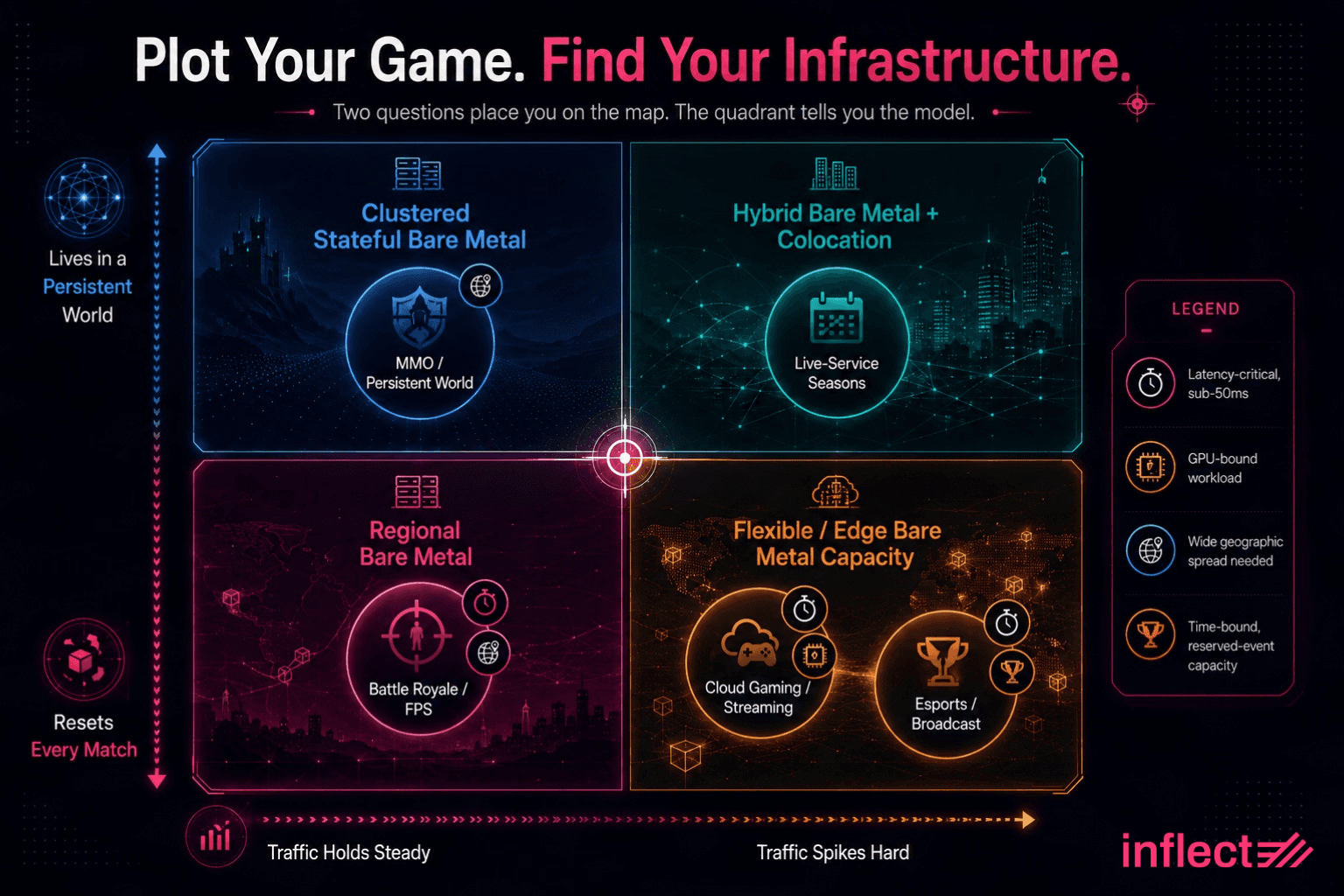
Matching a game to the right bare metal deployment comes down to five questions, and Inflect's advisory team uses this same framework, informed by provider data across its marketplace, to help studios land on the right starting point before running an RFP: how latency-sensitive the game is, with competitive play breaking above 50 milliseconds pointing to regional bare metal close to the player base; how the player base is distributed geographically, since concentrated populations support fewer, denser deployments while a global base needs wider regional PoP coverage; whether the game maintains persistent session state, since stateful games point toward clustered bare metal with strong data locality while stateless match-based games support a distributed, spin-up-and-tear-down model; whether it carries sustained GPU workloads such as anti-cheat, AI NPCs, procedural generation, or server-side streaming, which point toward GPU bare metal over general-purpose compute; and how volatile its traffic pattern is, since sharp, predictable launch spikes need flexible capacity and fast provisioning while a steady population supports fixed-capacity deployment.
These answers map directly onto genre and traffic pattern. Battle royale and FPS titles typically land on regional bare metal with stateless match servers, MMO and persistent-world games on clustered, stateful bare metal with data locality, cloud gaming and streaming on GPU bare metal at the edge, and esports and broadcast on reserved, zero-contention capacity around event windows. Steady, predictable concurrency supports fixed-capacity bare metal sized to sustained peak, while sharp, event-driven spikes need flexible capacity commitments with fast provisioning built into the contract: a single major launch calls for a temporary capacity reservation, while a live-service title with recurring seasons calls for a standing flexible-capacity agreement. Studios balancing steady core infrastructure against launch volatility often land on a hybrid model instead, pairing bare metal for core workloads with colocation capacity held in reserve.
Sourcing Bare Metal Infrastructure for Game Hosting on Inflect
Game studios evaluating bare metal providers face the same sourcing problem regardless of genre: comparing regional coverage, DDoS mitigation terms, and GPU availability across providers usually means several sales calls and RFP cycles before a price is on the table. Inflect is a digital infrastructure marketplace where studios can search, compare, and receive instant pricing on bare metal, colocation, GPU cloud, and private networking across a global network of 6,000+ data centers and facilities in 100+ countries, with no sales call required. Providers on Inflect relevant to gaming include Equinix, Digital Realty, CoreSite, Flexential, and Megaport, among hundreds of others spanning the regional and edge markets gaming depends on, and Inflect's team provides free expert advisory to help studios apply the deployment framework above to their title, at no cost to the buyer.
Matching infrastructure to a game's genre, concurrency pattern, and launch cadence is the difference between a launch that scales cleanly and one that trends for the wrong reasons.
Search and compare bare metal, GPU, and colocation capacity by region with instant pricing, no sales call required
Evaluate DDoS mitigation SLAs and network peering across providers side by side before committing
Get free expert advisory on which deployment model fits your game's latency, concurrency, and workload profile
Source flexible capacity ahead of a launch window or lock in standing capacity for a live-service title
Compare bare metal and GPU hosting providers for gaming on Inflect to get pricing and start scoping your next launch.
About the Author

Haley Rogers
Content & Social Media Specialist
Haley Rogers is the Content & Social Media Specialist at Inflect, bringing over two years of experience in social media, marketing, and content strategy — including time at a fast-paced tech company before joining the Inflect team. She specializes in translating complex digital infrastructure topics into clear, engaging content, with a particular focus on blog writing and brand storytelling across channels.
Contact: