9 mins
High-Performance Bare Metal for AI Model Training and Inference
Your cloud GPU bill arrived for the quarter. Three months of H100 instance reservations, plus egress on the training datasets, plus storage for model checkpoints. The number is not a surprise, exactly. But when your infrastructure lead runs the annualized projection against what it would cost to own or lease dedicated GPU servers, the gap is wide enough to bring to the CFO.
This is the moment most AI infrastructure decisions actually begin. Not during the proof-of-concept, when cloud flexibility is genuinely useful, and not during early fine-tuning runs when reserved instances make reasonable sense. The inflection point arrives when training runs are sustained, inference is serving production traffic, and GPU utilization is no longer bursty. At that point, the economic model underlying public cloud GPU pricing stops working in your favor.
Global spending on AI infrastructure is projected to exceed $200 billion by 2028 as organizations scale model training and inference across industries, according to IDC’s Worldwide Semiannual Artificial Intelligence Infrastructure Tracker (Source: FutureIoT, 2025). The organizations driving that spending are increasingly evaluating dedicated bare metal GPU servers as an alternative to on-demand cloud compute, particularly for high-performance computing workloads where utilization is predictable and consistent performance is non-negotiable.
This guide covers the core decision criteria: when bare metal outperforms cloud for AI, how to evaluate hardware configurations and providers, and how to source dedicated GPU servers without spending weeks in vendor sales cycles.
Why AI Workloads Break the Economics of Shared Cloud Infrastructure
AI training and inference workloads break cloud cost models because they run at sustained, predictable GPU utilization rates that eliminate the variable-demand assumptions underlying cloud pricing.
Cloud infrastructure is priced for GPU workloads that spike, idle, and scale dynamically, based on usage patterns that assume significant idle time between bursts. A web application that handles 10x traffic on Monday and near-zero traffic on Saturday benefits from elastic compute. An LLM pre-training run that saturates GPU memory for 90 consecutive days does not. The pricing model designed for the former systematically overcharges for the latter.
GPU Utilization Rates That Make Cloud Cost Models Unworkable
Dedicated bare metal GPU servers become cost-effective when GPU utilization exceeds roughly 60 to 70 percent sustained over a billing period, a threshold that AI training workloads routinely exceed. Production LLM training runs typically sustain 80 to 95 percent GPU utilization across multi-node clusters for weeks or months at a time. At that utilization rate, the on-demand and reserved instance pricing structures offered by major cloud providers carry a significant premium over the cost of dedicated hardware, whether owned outright or leased from a managed bare metal provider.
The economics are starker for inference. A production inference endpoint serving a high-QPS model needs dedicated compute to maintain latency SLAs. Autoscaled cloud instances introduce cold-start latency, shared-tenancy noise, and per-second billing that adds up faster than a fixed monthly cost for a dedicated bare metal inference server.
Egress and Storage Costs at AI Data Volumes
AI teams using cloud infrastructure for training pay three times: for compute, for storage, and for egress when moving data between services or out of the cloud entirely. Training a large language model requires moving multi-terabyte datasets repeatedly across storage and compute boundaries, and checkpoint storage for a large model can run into hundreds of gigabytes per save. Cloud egress fees, typically $0.08 to $0.09 per GB for major providers, compound quickly at the data volumes AI pipelines generate (Source: Cast AI, 2025). Bare metal infrastructure hosted in a colocation facility eliminates egress fees between compute and storage within the same facility and reduces the surface area where transfer costs accumulate.
Bare Metal vs. Cloud GPU Instances for AI: A Direct Comparison
Bare metal GPU servers outperform cloud GPU instances on cost per training run, latency consistency, and hardware configurability for sustained AI workloads, while cloud retains an advantage for short, variable, or experimental workloads.
Neither model is universally correct. The comparison that matters is built on your actual workload profile: training run duration, inference QPS requirements, team size, and how far along your model is in its development lifecycle.
Training Workloads: Where Bare Metal Has a Structural Advantage
Bare metal delivers a structural advantage for AI model training infrastructure through four factors: dedicated GPU memory with no noisy-neighbor interference, direct hardware access for custom CUDA kernel optimization, deterministic interconnect bandwidth between nodes, and the ability to configure the exact GPU-to-CPU-to-NVMe ratio the model architecture requires. Shared cloud GPU instances, even the largest reserved configurations, introduce performance variance from virtualization overhead, since virtual machines on hosts shared across multiple users cannot guarantee the deterministic GPU throughput that multi-week training runs require. For a training run measured in weeks, even small amounts of variance in throughput compound into meaningful differences in total run time and cost.
Inference at Scale: Latency, SLAs, and Dedicated Compute
Bare metal inference servers deliver consistent performance and predictable p99 latency that shared infrastructure cannot match, because the compute, memory, and network resources are not shared with other tenants. For production LLM inference workloads with latency SLAs in the 50 to 200 millisecond range, shared cloud infrastructure introduces tail latency spikes that are difficult to engineer around without significant over-provisioning. Achieving minimal latency at scale requires dedicated hardware with full GPU resources allocated to a single workload. A dedicated bare metal inference server running a quantized 70B parameter model at high QPS will consistently outperform an equivalently specced cloud instance on p99 AI inference latency because there is no hypervisor layer and no competing workload consuming cache or memory bandwidth.
Hardware Configurations That Matter for AI Bare Metal
The hardware configurations that determine performance for AI bare metal workloads are GPU generation and memory capacity, host CPU and system RAM, NVMe storage tier, and the interconnect fabric connecting nodes in a multi-GPU cluster.
Procuring the wrong configuration is the most common mistake AI teams make when moving to dedicated GPU servers. Each use case has specific workload requirements, and a server specced for inference will sacrifice raw performance on pre-training tasks, and vice versa.
GPU Options: H100, A100, L40S, and When Each Makes Sense
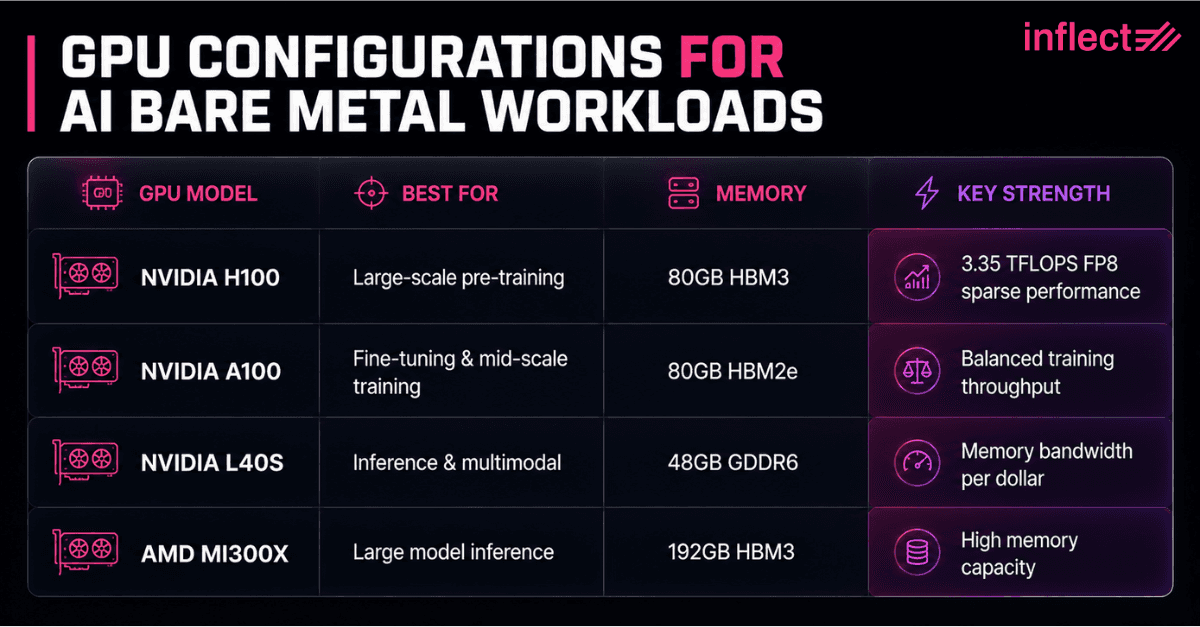
The four GPU configurations most commonly deployed for AI bare metal workloads are the NVIDIA H100 for large-scale pre-training, the NVIDIA A100 for fine-tuning and mid-scale training, the NVIDIA L40S for inference and multimodal workloads, and the AMD MI300X as an emerging alternative for large model inference at high memory capacity. The H100 SXM5 delivers 3.35 teraflops of FP8 sparse performance and 80GB of HBM3 memory per GPU, making it the current standard for frontier model training (Source: NVIDIA, 2023). The L40S, with 48GB of GDDR6 memory and strong INT8 throughput, is better suited to inference serving where memory bandwidth per dollar matters more than raw training throughput.
For technical teams: when evaluating a provider's GPU bare metal hosting inventory, confirm the specific GPU SKU, including whether it is SXM or PCIe form factor, since SXM enables NVLink connectivity between GPUs within the node. Also confirm the number of GPUs per node and whether the server supports NVSwitch for all-to-all GPU communication.
CPU, Memory, and Storage Requirements for AI Pipelines
AI bare metal servers for deep learning require a host CPU with sufficient PCIe bandwidth to feed data to GPUs without creating a bottleneck, memory configurations of at least 1.5 to 2× the total GPU memory in the node, and NVMe storage fast enough to sustain large datasets during training. For a node with 8× H100 80GB GPUs (640GB total GPU memory), a minimum of 1TB of system RAM is recommended for large model fine‑tuning and inference; NVIDIA’s DGX H100 system uses 2TB of system memory (32 DIMMs) to support these workloads and includes 30TB of NVMe SSD storage for high‑speed performance (Source: NVIDIA, 2022). Slower storage creates a bottleneck during data loading between training steps, reducing effective GPU utilization even on otherwise well-specced hardware.
Networking: InfiniBand vs. Ethernet for Multi-Node Training
Multi-node AI training clusters require either InfiniBand or high-speed Ethernet as the inter-node fabric. InfiniBand NDR delivers 400Gbps per port with ultra-low latency, making it ideal for all-reduce operations in distributed training, while 400GbE with RoCE (RDMA over Converged Ethernet) provides a cost-effective alternative for clusters where RDMA over Ethernet is sufficient. InfiniBand remains the standard for frontier model pre-training at scale because its latency characteristics allow gradient synchronization across hundreds of nodes without the fabric becoming the bottleneck in the training loop (Source: NVIDIA, 2026). For bare metal machine learning inference clusters or smaller training runs under 64 GPUs, 100GbE or 400GbE with RoCE support is typically sufficient and reduces infrastructure cost considerably.
Colocation vs. Managed Bare Metal for AI Teams
AI teams sourcing dedicated GPU infrastructure can choose between owning hardware deployed in a colocation facility and leasing dedicated servers from a managed bare metal provider, with colocation offering hardware ownership and customization at the cost of capital expenditure and operational responsibility, and managed bare metal offering faster deployment and predictable monthly costs without upfront hardware investment.
The right model depends on team size, capital availability, timeline to first training run, and how long the organization expects to run the specific hardware generation before needing to upgrade. For organizations in regulated industries handling sensitive data, colocation also addresses data sovereignty and security requirements that shared cloud infrastructure cannot satisfy. Managed bare metal offers quick deployment for teams that need GPU infrastructure running within days rather than the weeks required to procure and rack physical hardware.
Power Density Requirements for GPU Clusters
GPU clusters for AI workloads require colocation facilities capable of supporting 30 to 100 kilowatts per rack or more, far exceeding the 8 to 12 kilowatts per rack that standard colocation facilities are designed to support. A single 8× H100 SXM5 server draws approximately 10 to 14 kilowatts under full training load (the DGX H100 system has a maximum power consumption of 14 kW ). A 16-node cluster at that density requires a facility capable of delivering 160 to 224 kilowatts in a footprint of 16 to 32 rack units, plus cooling infrastructure rated for that heat load (Source: NVIDIA, 2022). Organizations evaluating GPU server colocation must confirm per-rack power availability, redundant power feeds, and liquid cooling or high-density air cooling capability before signing a contract.
How to Evaluate a Bare Metal Provider's AI Readiness
A bare metal provider is ready for production AI workloads if it can demonstrate GPU inventory with confirmed availability in your required configuration, provisioning timelines under 24 hours for standard builds, support for your choice of operating system with root access and complete control via IPMI or BMC, network fabric options including InfiniBand or high-speed RoCE, and SLA terms covering hardware replacement and uptime at the node level. Provisioning speed matters more than most buyers expect. A managed bare metal provider that requires 72 hours to provision a new node adds friction to every training run iteration, and that friction compounds across a team running multiple experiments in parallel.
Five Questions to Determine Whether Bare Metal Is Right for Your AI Stage
The five questions that determine whether bare metal is the right infrastructure model for your AI workload are: What is your average GPU utilization rate over the past 90 days? How long are your longest training runs? Do you have a production inference endpoint with latency SLAs? Does your team have the operational capacity to manage physical infrastructure or a colocation relationship? And what is your timeline to the next hardware generation change? If your GPU utilization is above 60 percent sustained, your training runs exceed two weeks, and you have production inference traffic, bare metal will almost certainly reduce your total infrastructure cost compared to equivalent cloud GPU reservations. If you are still in the experimental phase with variable compute needs and a small team, cloud remains the more operationally practical option.
How to Source Bare Metal for AI Workloads on Inflect
Inflect is a digital infrastructure marketplace and bare metal hosting provider where AI teams can search, compare, and receive instant pricing on bare metal GPU servers, high performance hardware, GPU cloud, and colocation for AI workloads from providers across more than 6,000 data centers in over 100 countries, without a sales call or RFQ process.
For AI infrastructure buyers, the sourcing process has traditionally meant contacting each provider individually, waiting for a sales response, and comparing proposals built on different assumptions. Inflect replaces that process with instant pricing and side-by-side comparison across providers including Equinix, Digital Realty, CoreSite, and NTT, among hundreds of others on the platform.
Buyers sourcing bare metal AI cloud infrastructure on Inflect can filter by GPU type, geographic region, power density capability, and network connectivity options. For teams that need guidance on configuration or provider selection, Inflect's expert advisory service is available at no charge. Winston, Inflect's AI agent, can help buyers narrow options based on workload requirements before connecting with a human advisor. Where other websites require a form submission or phone call to obtain pricing or operate on an RFQ model with no instant results, Inflect returns pricing immediately.
Ready to source bare metal GPU servers for your AI workloads?
On Inflect, you can:
Search dedicated GPU servers by GPU type, including H100, A100, and L40S configurations, across providers in your target region
Compare instant pricing from multiple bare metal and colocation providers without a sales call or RFQ
Access free expert advisory to match your training and inference requirements to the right hardware configuration and provider
Evaluate colocation facilities with confirmed high-density power availability for GPU clusters
Search bare metal for AI on Inflect.
About the Author

Haley Rogers
Content & Social Media Specialist
Haley Rogers is the Content & Social Media Specialist at Inflect, bringing over two years of experience in social media, marketing, and content strategy — including time at a fast-paced tech company before joining the Inflect team. She specializes in translating complex digital infrastructure topics into clear, engaging content, with a particular focus on blog writing and brand storytelling across channels.
Contact: