10 mins
France AI Data Center Investment: Inside the Nebius, Azur Datacenters and Inflect 240MW Deal
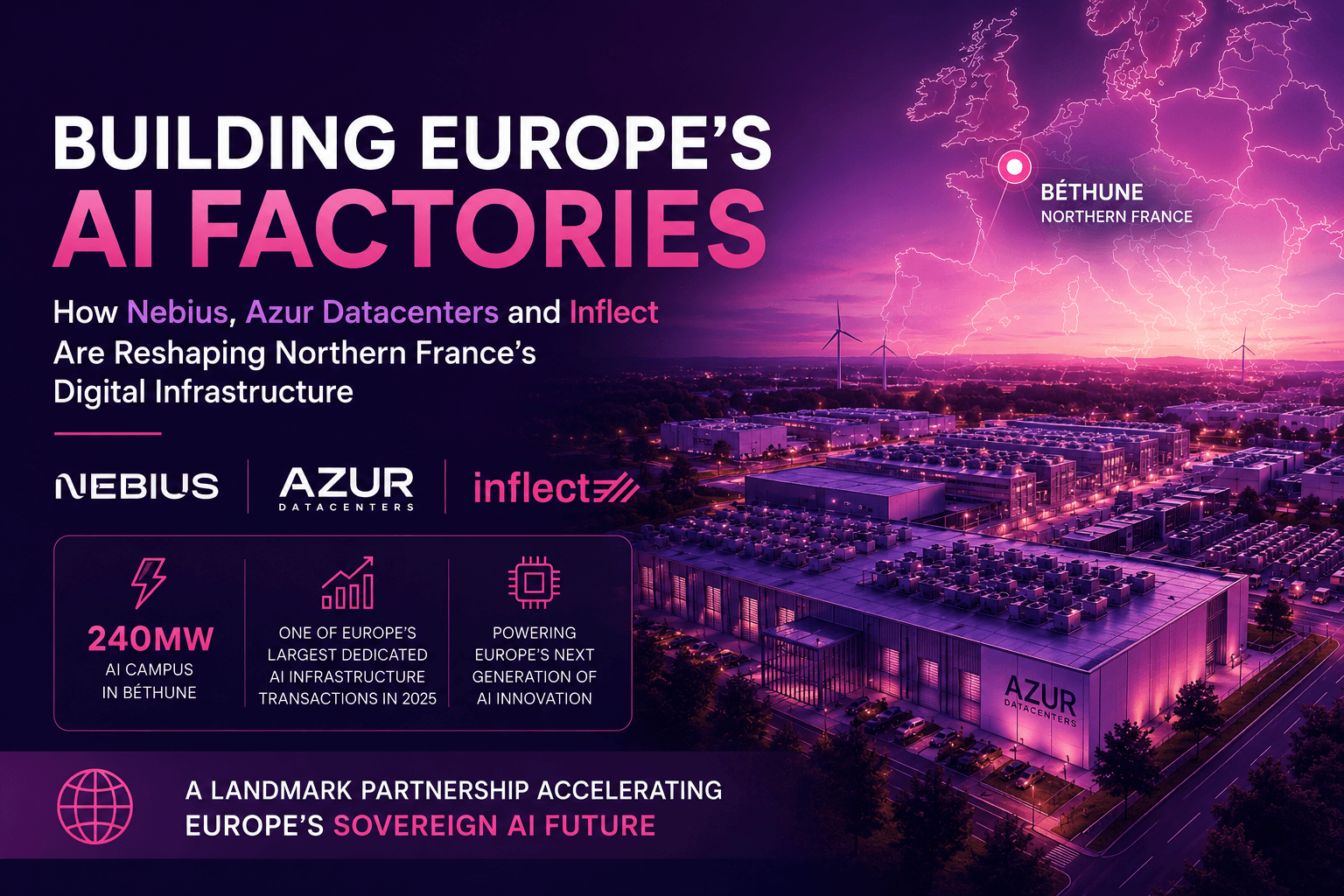
The 240MW wholesale colocation agreement between Nebius and Azur Datacenters, facilitated by Inflect in late 2025, is one of the largest dedicated AI data center transactions completed in Europe to date, covering a purpose-built AI campus in Béthune, Northern France.

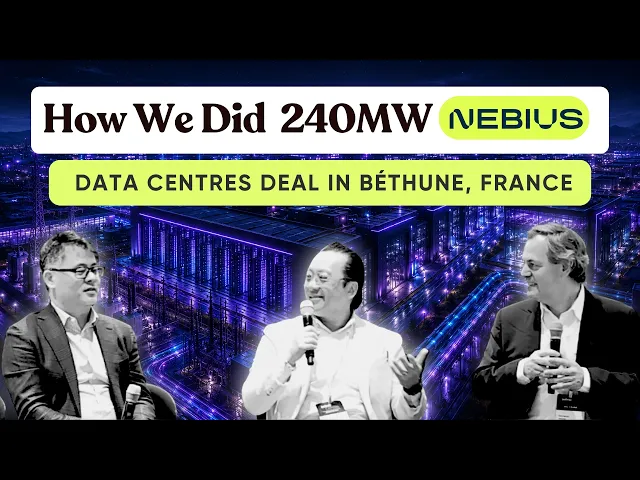
At the infra/CAPITAL Summit 2026 in Paris, Philbert Shih of Structure Research sat down with two of the people who made this deal happen: Emmanuel Vannier, Founder, CEO and CTO of Azur Datacenters, and Mike Nguyen, CEO of Inflect. The conversation covered territory that most industry panels avoid: why the majority of AI infrastructure requests in 2025 never closed, what it actually costs to build an AI factory rather than a conventional data center, and how operators with serious capital requirements can identify providers who are genuinely ready to move.
For AI compute operators, neoclouds, and infrastructure buyers engaged in capacity planning at scale, the Béthune transaction offers a concrete reference point. France's position in the European AI data center market is no accident; it reflects deliberate structural advantages that most neighbouring markets cannot match. Azur Datacenters' ability to deliver the first phase of a 240MW project in under eight months reflects a build methodology that is almost entirely different from how conventional colocation facilities are designed and constructed. And Inflect's role in the transaction reflects a sourcing model built for global capacity sourcing at a time when most announced projects are not what they appear.
This post covers the key findings from that panel discussion. The full 24-minute interview is available at the bottom of this page, and it is worth watching in full.
Why Most of AI Infrastructure Deals Fail and How to Identify the Real Ones
Inflect identifies viable global datacenter capacity opportunities through a two-sided marketplace model that provides visibility into both buyer requirements and provider capacity simultaneously, a structural advantage over traditional single-sided brokers in global capacity sourcing.
Unlike conventional brokers who represent one party in a transaction, Inflect connects AI compute operators, neocloud providers, hyperscalers and enterprise customers with data center capacity across markets ranging from 10kW to 1GW+. Because Inflect also works with neocloud operators selling services through its marketplace, the firm carries real-time intelligence on which customers are buying, at what scale and in which markets. That data directly informs how Inflect qualifies providers and how providers assess the credibility of incoming demand.
The practical result: Inflect processed a high volume of AI infrastructure requests throughout 2025 and developed early signals for which ones had the elements to progress. Nguyen was direct about what the failure rate looked like from the inside.
"Half of them, maybe two-thirds, turned out to be, shall we say, less than real deals, for fundamental reasons," he said. "Power availability is often talked about, but how 'fundable' a project is became a primary driver on why projects failed. There are a multitude of reasons why a project fails or becomes successful. We just have to be ready to move quickly and with conviction to help fill in the gaps."
The qualification framework Inflect applies comes from operating both sides of the market at the same time. As Nguyen explained: "We built a marketplace, complemented with our infrastructure advisory. Many of the neoclouds that we represent also sell services in our marketplace. That helps us understand who is buying from them, which gives us insight into what capacity they need and where. It also helps us sell their story to the datacenter providers, and their capital partners. In this market, a customer has to compete with other qualified parties to even get a chance at winning capacity."
Nebius cleared that bar. Inflect identified Azur Datacenters as the right match for Nebius's requirements: the right power, the right location, and a provider with the build capability to deliver on a timeline that most operators in France could not meet.
"When it comes to the go-to-market side of this industry, you see a lot of people. But really, deals come down to the right provider, the right power, and a good story for the project to be fundable." — Mike Nguyen, CEO, Inflect
Inside the Nebius 240MW Deal: How Azur Datacenters Closed Before Christmas 2025
Azur Datacenters entered the AI factory era carrying a decade of edge data center operations and high-performance computing liquid cooling work for major European operators, a background that positioned the company differently from greenfield developers encountering AI-grade engineering requirements for the first time.
"We have been in the small edge datacenters for a decade," Vannier said. "We started doing HPC liquid cooling for the largest European operators. Then came the AI factory era, in 2024."
The path to the Nebius agreement was not linear. Vannier described the evaluation process across 2025 as exhaustive: extensive conversations with potential customers, most of which stalled well before reaching a signed deal.
"Half of them, maybe more, were not real deals; they never went to agreement," he said. "But we did a real one with Nebius." Negotiations concluded just before Christmas 2025.
Site selection was the critical variable. Rather than committing to a new-build facility, Azur identified an existing building in Béthune with power infrastructure and a grid connection already operational. That decision removed the most time-intensive phases of a conventional development program and gave Nebius the timeline certainty it needed.
"Everything was live when we decided to go," Vannier said. The only regulatory requirement was a permit for external cooling equipment, a process that cleared in five weeks. Total delivery timeline from commitment to first-phase availability: under eight months.
"Usually, we propose to our customers six, seven or eight months for the first delivery, with two months early access," Vannier said. The Béthune campus is structured across three phases, with the first tranche operational in July.
AI Data Center vs. Traditional Colocation: Engineering Differences That Determine Capability
AI data centers differ from conventional colocation facilities across power architecture, cooling systems, supply chain sourcing and structural load requirements, according to Vannier, whose team has designed and built for both markets.
The gap starts at the power level. "If you look at the power side, the medium voltage, the high voltage infrastructure, it is different," Vannier said. "If you look at the cooling, the piping, it is vastly different."
Cooling is where most of the industry's attention has concentrated, specifically on liquid cooling for high-density compute. Vannier's point is that air-cooled network components represent an equally significant engineering challenge that receives far less discussion.
"Everybody is talking about liquid cooling density," he said. "But there may be 160kW air cooling racks just for the switches. That is probably more challenging than bringing liquid cooling to the compute."
At the supply chain level, the scale of the Béthune facility pushed Azur outside conventional data center procurement entirely. Cooling systems at the site are industrial equipment sourced from manufacturers serving the oil and gas sector, not standard data center vendor products.
"We are buying from the factories, manufacturers, not from the data center equipment vendors," Vannier said. "My coolers are 2,500 square metres on the ground, twelve metres high."
"It is a real factory." — Emmanuel Vannier, Founder, CEO and CTO, Azur Datacenters
For operators conducting capacity planning for AI workloads, this distinction carries direct implications. A facility designed for conventional enterprise or cloud workloads is not the same asset as one built from the ground up for AI compute density. The engineering, the supply chain and the operational profile belong to different categories entirely.
AI Data Center Capacity Planning for Next-Generation GPU Infrastructure
AI infrastructure must be designed for hardware that does not yet exist at the time of build, a capacity planning challenge that separates operators building ahead of the market from those engineering to catch up.
Vannier was specific about where most of the industry currently stands. "My feeling is that most designers are not really understanding what they need to deliver for the next generation of Nvidia hardware," he said. "They are preparing to just catch up. We are preparing for the future."
The timeline reality is concrete: operators ordering infrastructure today are specifying for mid-2027 delivery, targeting operational status at end-2027 or mid-2028. The hardware that will run in those facilities has not been formally announced. AI data center capacity planning now requires designing for requirements that will only become explicit after construction has already begun.
"Maybe they do not know today, but next year they will ask for the next generation," Vannier said. "Before you need it, I know what you need: liquid cooling, air cooling, density, heavy racks, medium voltage close to the data hall, battery storage. They just do not know it yet."
Requirements continue to shift even within a single build cycle. "The requirements change all the time," Vannier said. "You have to be constantly available for the changes."
Nguyen framed the same challenge from the market side. "Perhaps that they are building to today's standards," he said. "But what about tomorrow's?"
For global capacity sourcing at scale, that forward-planning question is a practical due diligence criterion when evaluating operators. A provider building to current specifications carries a different risk profile from one designing ahead of the hardware curve.
Watch the Full Panel: Nebius, Azur Datacenters and Inflect at infra/CAPITAL Summit 2026
The written summary above covers the structural findings from the panel discussion. The full interview goes further.
Vannier walks through Azur's financing model and the specific approach to absorbing customer risk that made the Nebius deal structure possible. Nguyen discusses how Inflect evaluates deal credibility at volume, what separates a customer who will close from one who will not, and what the go-to-market reality of AI infrastructure sourcing looks like from inside the market.
Watch the full 24-minute panel here:
If you are evaluating global datacenter capacity in Europe, conducting capacity planning for AI-grade infrastructure, or tracking how neocloud operators like Nebius are sourcing and structuring large-scale deployments, the full conversation is worth the time.
Source Global Datacenter Capacity Through Inflect
Search and compare global datacenter capacity across France, Europe and worldwide
Access instant pricing from qualified providers, no sales call required
Work with Inflect's advisory team on AI-grade capacity sourcing, site selection and power procurement
Get matched with operators building ahead of the hardware curve, not catching up to it
About the Author

Chanyu Kuo
Director of Marketing at Inflect
Chanyu is a creative and data-driven marketing leader with over 10 years of experience, especially in the tech and cloud industry, helping businesses establish strong digital presence, drive growth, and stand out from the competition. Chanyu holds an MS in Marketing from the University of Strathclyde and specializes in effective content marketing, lead generation, and strategic digital growth in the digital infrastructure space.
Contact:
Email: