10 mins
Duos Edge AI Hits 20MW Contracted Deployment in 2026 with Columbus, Georgia Colocation Expansion
Duos Edge AI's Columbus, Georgia campus has reached 20 MW of contracted critical IT-load capacity following a new five-year, 10 MW hyperscaler colocation agreement valued at more than $111 million (Source: Duos Technologies Group, 2026). The milestone reflects hyperscaler demand for artificial intelligence (AI) and high performance computing colocation capacity, edge deployment strategy, and a broader shift of data center locations toward secondary markets outside traditional Tier 1 hubs, a trend increasingly visible across the data center industry.

Two years ago, Duos Edge AI was a modestly sized data center operator building small-footprint edge data centers for schools, hospitals, and rural utilities in Tier 3 and Tier 4 markets. Its pitch was proximity, not scale: edge computing facilities designed to sit within roughly 12 miles of end users, with rapid deployment timelines of around 90 days and no expectation of hyperscale-sized contracts (Source: Duos Edge AI, 2026).
That positioning changed fast in 2026. In July alone, Duos Edge AI signed a Master Services Agreement with Nistar for up to 2 MW of capacity to support a planned 1,024 NVIDIA B200 GPU installation, opened a new edge facility in Abilene, Texas, and then signed a five-year, 10 MW colocation agreement with an unnamed investment-grade hyperscaler at its Columbus, Georgia campus (Source: Data Center Dynamics, 2026; Duos Technologies Group, Inc., 2026). That hyperscaler deal pushed the Columbus campus, on its own, to 20 MW of contracted critical IT-load capacity by the end of the fourth quarter of 2026.
The pace of that build-out matters beyond one company's earnings story. It is a data point in a larger data center industry trend: hyperscale data centers and AI workload demand are showing up in secondary markets that most buyers still associate with regional or edge-tier data center providers, not gigawatt-scale colocation contracts. This post breaks down what the Columbus deal actually includes, how Duos Edge AI got to 20 MW, why hyperscalers are increasingly willing to sign in markets like Columbus, and what it means for buyers evaluating data center infrastructure outside the traditional primary hubs.
What Is the Duos Edge AI Columbus, Georgia Deal?
Duos Edge AI's Columbus, Georgia deal is a five-year colocation agreement to provide 10 MW of critical IT-load capacity to an investment-grade hyperscaler, valued at more than $111 million in contracted revenue over the term. The new capacity is expected to become available in the fourth quarter of 2026, layering on top of the campus's previously announced initial 10 MW deployment, which is expected to begin generating revenue in August 2026 (Source: Duos Technologies Group, Inc., 2026). Combined, the two deployments bring the Columbus campus to 20 MW of contracted critical IT-load capacity, which is the basis for Duos Edge AI's claim of 20 MW in total contracted 2026 deployment and a meaningful data center expansion for a company that started as a niche edge computing player.
The hyperscaler counterparty was not named in the announcement, which is typical for agreements of this size and term. Duos Technologies Group CEO Doug Recker framed the deal as validation of the company's owned-infrastructure model: "This agreement shows how we are investing in infrastructure in key markets so we can quickly add capacity for our customers. The Columbus campus gives us the ability to rapidly deploy high-density AI infrastructure while generating durable recurring revenue" (Source: Duos Technologies Group, Inc., 2026).
Key Terms in the Deal: Capacity, Timeline, and Hyperscaler Commitments
The Duos Edge AI Columbus agreement includes four defining terms: 10 MW of new critical IT-load capacity, a five-year contract term, contracted revenue in excess of $111 million, and a phased availability timeline running from August 2026 (initial 10 MW) through the fourth quarter of 2026 (additional 10 MW) (Source: Duos Technologies Group, Inc., 2026). For technical teams: the agreement covers critical IT-load capacity specifically, meaning the contracted 10 MW figure reflects usable compute and equipment power at the rack level rather than total facility power draw, which is the standard unit hyperscalers and large colocation tenants use when evaluating capacity commitments and capacity planning across a data center portfolio.
How Duos Edge AI Reached 20 MW of Contracted Deployment in 2026
Duos Edge AI reached 20 MW of contracted deployment in 2026 through two capacity phases at a single site, the Columbus, Georgia campus, not by summing unrelated deals across markets. The first 10 MW came from a previously announced deployment expected to begin generating revenue in August 2026. The second 10 MW came from the new five-year hyperscaler agreement announced July 16, 2026, expected to be available by the end of the fourth quarter (Source: Duos Technologies Group, Inc., 2026).
That Columbus data center development sat alongside, but separate from, several other announcements the company made in the same stretch of 2026. Earlier in July, Duos Edge AI signed a Master Services Agreement with Nistar for up to 2 MW of Tier III-equivalent, N+1 capacity at the same Columbus campus, supporting a planned installation of 1,024 NVIDIA B200 GPUs for compute-intensive AI and high performance computing workloads (Source: Data Center Dynamics, 2026). Days before that, the company opened a new edge facility in Abilene, Texas, expanding its edge footprint into a different market entirely (Source: Duos Technologies Group, Inc., 2026; Duos Technologies Group, Inc., 2026). These deals demonstrate broader momentum across the company's data center projects, but the 20 MW figure itself is specific to Columbus.
What Is Duos Edge AI's $55 Million Capital Raise Funding?
Duos Edge AI's $55 million capital raise is funding the acquisition of the Columbus, Georgia facility and the infrastructure buildout needed to fulfill contracted customer deployments and expand the campus (Source: Duos Technologies Group, Inc., 2026). The stated strategic intent behind the raise is to convert deployed capital into long-term contracted recurring revenue by owning the underlying real estate rather than leasing it, a model that lets Duos own data centers outright and changes the economics of the business from a services model to something closer to an infrastructure landlord model. That distinction matters for buyers evaluating the provider's staying power: owning the site removes lease renewal risk and gives Duos Edge AI direct control over power procurement, energy demands, and expansion timing, both of which are common failure points for smaller colocation operators trying to scale quickly and drive operational efficiency.
Why Hyperscalers Are Signing Colocation Deals in Secondary Markets Like Columbus, Georgia
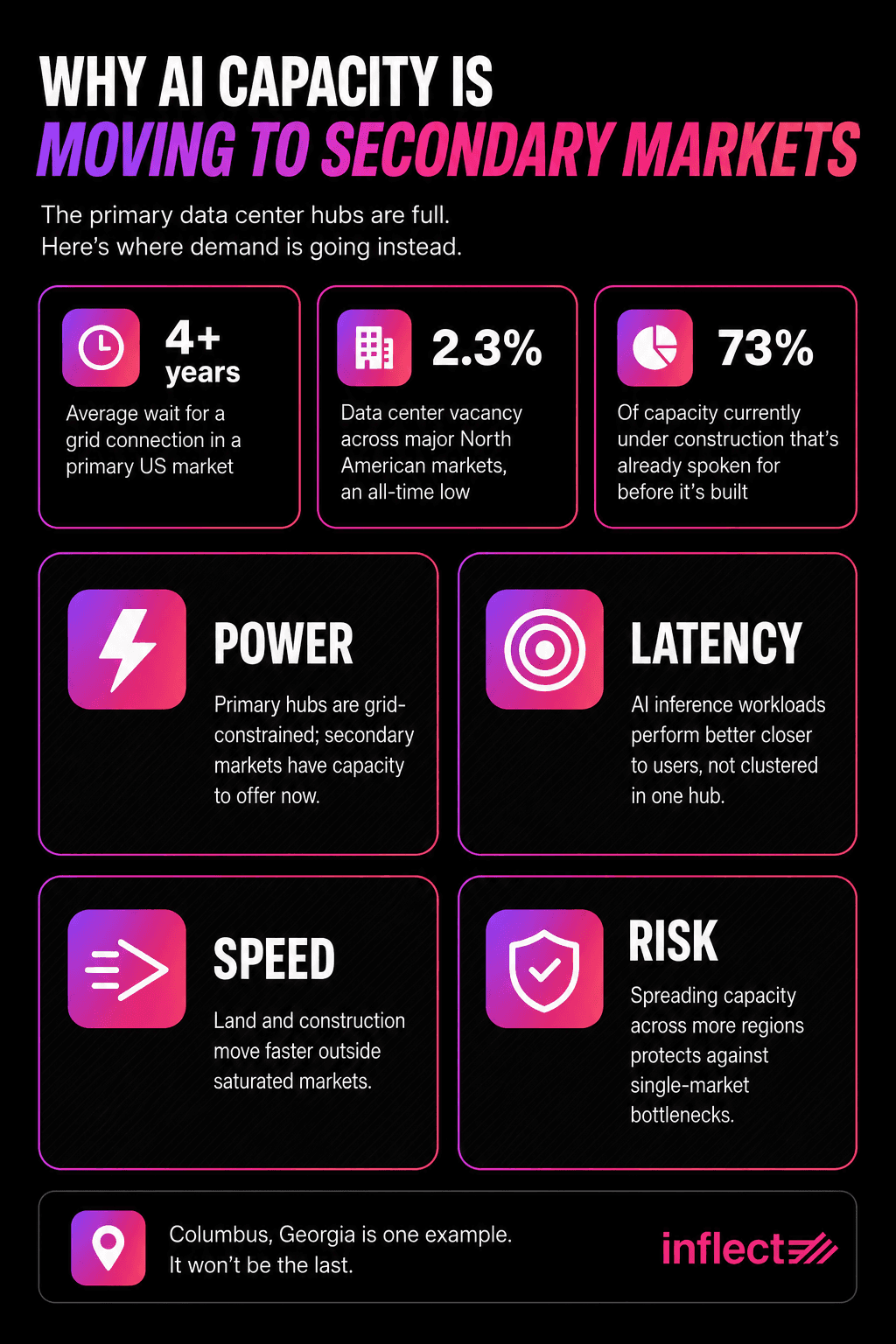
Hyperscalers are signing colocation deals in secondary markets like Columbus, Georgia for four structural reasons: grid constraints and power availability in Tier 1 hubs, the latency and decentralization requirements of AI inference workloads, faster land, permitting, and construction costs outside saturated markets, and a deliberate regionalization strategy that spreads capacity risk across a wider geographical distribution of sites. None of these reasons are specific to Duos Edge AI; they explain the increasing demand that leads a hyperscaler to choose a 10 MW block in Columbus over waiting for capacity in a market it might otherwise prefer.
The clearest driver is power. Site selection for new data center capacity is increasingly decided by power availability rather than location or cost, since the average wait time for a grid connection in primary US data center markets now exceeds four years (Source: JLL, 2026). Northern Virginia alone holds 5.6 GW of data center capacity, more than triple the 1.5 GW in Dallas-Fort Worth, the second-largest US market, and cloud providers and technology companies already account for 65 percent of all data center leasing activity nationally. Vacancy across major North American markets fell to 2.3 percent in the first half of 2025, with 73 percent of the capacity currently under construction already preleased (Source: JLL, 2025). When primary hubs are this constrained on grid capacity, hyperscalers with near-term AI capacity needs increasingly look at markets where power and land are available now rather than years out, and some are turning to renewable energy sources, natural gas, and nuclear energy as longer-term answers to rising energy demands and power consumption at scale, though JLL notes widespread nuclear deployment for data centers may still be a decade away (Source: JLL, 2026).
AI workload decentralization compounds the pressure. AI represented roughly a quarter of all data center workloads in 2025, with training driving most of that demand, but JLL projects inference workloads will overtake training as the dominant AI requirement by 2027, and inference benefits far more from proximity to users and lower network latency than training does (Source: JLL, 2026). For technical teams: a 10 MW block dedicated to inference or GPU-based high performance computing does not require the same interconnection density as a hyperscale training campus, which is part of why a site like Columbus, with Tier III-equivalent, N+1 infrastructure and its own cooling systems and networking equipment, can support a meaningful AI deployment such as the Nistar MSA's planned 1,024 NVIDIA B200 GPUs without needing primary-hub-level fiber density (Source: Data Center Dynamics, 2026). AI is also pushing rack densities toward 100 kW with liquid cooling becoming a standard requirement for new builds, a power density profile close to the 100 kW+ per cabinet Duos Edge AI already advertises for its edge facilities (Source: JLL, 2026).
Land, construction pipeline, and market economics round out the picture. Phoenix, Chicago, and Atlanta together lead the US data center construction pipeline outside Northern Virginia, at 1.3 GW, 1.18 GW, and 1.11 GW respectively, evidence that developers are actively building capacity in secondary and adjacent markets rather than only in the traditional primary hubs (Source: JLL, 2025). Secondary markets that can offer available power, buildable land, and local government support are increasingly viable alternatives, not fallback options, for hyperscalers that need capacity sooner than the multiyear waits now common in saturated primary hubs, and building data centers in these markets is often the only realistic way to meet growing demand on schedule.
What This Means for Buyers Evaluating Edge Colocation Capacity
Buyers evaluating edge colocation capacity should weigh three factors when a deal like this shows up in a market they hadn't previously considered: whether the workload actually fits a secondary-market profile, what signals indicate the provider can execute at scale, and what risks are specific to newer or smaller operators expanding quickly.
The first question is workload fit. Secondary markets make sense for inference workloads, regional disaster recovery, and any application where latency to a specific user population matters more than proximity to a dense interconnection hub. Tier 1 markets still make sense for training clusters and workloads that depend on the network density only a handful of hubs currently offer. Your team should map the workload to the market, not the other way around.
The second question is whether the provider is actually positioned to scale. Signals worth checking include a track record of executing multi-megawatt hyperscaler or enterprise contracts, ownership of the underlying real estate rather than a leased or subleased position, and a phased deployment plan with dates that have already been hit rather than only promised. Duos Edge AI's Columbus buildout, moving from a 10 MW initial deployment expected to bill in August 2026 to an additional 10 MW by year-end, is the kind of documented, dated sequence that buyers should look for from any data center provider claiming rapid growth in the data center sector.
The third question is risk. Power availability, grid constraints, and utility interconnection timing remain the single biggest variable in whether a secondary-market provider can deliver data center space on schedule. Network density and fiber redundancy matter more in markets that have not yet built out the carrier diversity of a primary hub. And vendor financial maturity, including how a provider is funding its expansion, whether through equity raises, debt, or existing cash flow, is a legitimate diligence question for any multi-year colocation commitment, not just for smaller or newer data center operators managing rapid capacity planning.
Tools for Comparing Emerging Colocation Capacity in Secondary Markets
Buyers watching hyperscaler activity move into markets like Columbus need a practical way to compare emerging colocation data centers against established ones without waiting weeks for quotes. Inflect is a digital infrastructure marketplace covering more than 6,000 data centers and facilities across 100+ countries, giving buyers the ability to search and compare specific capacity and scalable infrastructure, including in growing secondary and Tier 3/4 markets, alongside established global data center hubs. The platform provides instant pricing without a sales call, which matters most precisely in scenarios like this one: when a buyer wants to evaluate a provider that just signed a major hyperscaler deal against known quantities like Equinix, Digital Realty, NTT Global Data Centers, Aligned Data Centers, Vantage Data Centers, CyrusOne, or TierPoint, without a multi-week RFP cycle for either side.
Inflect's free expert advisory is available to help buyers translate a provider's growth story, capacity claims, power access, and financial backing into a workload-fit decision, rather than relying solely on press releases. For a buyer trying to determine whether a secondary-market deployment makes sense for a specific inference or high performance computing workload, that combination of instant, side-by-side capacity data across the global market and advisory support is the difference between reacting to headlines and making a sourced colocation services decision.
Get Ahead of the Secondary Market Capacity Shift
Hyperscaler colocation deals in markets like Columbus, Georgia are a leading indicator of growing demand, not a one-off. If your organization is evaluating edge or regional colocation data centers for AI, HPC, or latency-sensitive workloads, here's how to act on it:
Search live scalable capacity across primary and secondary markets side by side, with instant pricing and no sales call required
Compare colocation providers on power access, ownership structure, and deployment track record, not just advertised megawatts
Get free expert advisory to stress-test whether a secondary-market deployment actually fits your workload
Move on a timeline measured in weeks, not the multi-year waits now common in constrained Tier 1 hubs
Start comparing colocation and edge capacity on Inflect today.
About the Author

Haley Rogers
Content & Social Media Specialist
Haley Rogers is the Content & Social Media Specialist at Inflect, bringing over two years of experience in social media, marketing, and content strategy — including time at a fast-paced tech company before joining the Inflect team. She specializes in translating complex digital infrastructure topics into clear, engaging content, with a particular focus on blog writing and brand storytelling across channels.
Contact: