13 mins
DIA SLA Demystified: What Uptime Guarantees Actually Mean in Practice
A newly hired VP of Infrastructure asks the team to document the organization's current network SLA coverage as part of a broader resilience review. Nobody can answer with confidence. The DIA contract is located, the SLA section is found, and the 99.99% uptime figure is easy to cite. But when the VP asks what that means in practice, what exclusions apply, and what the company can actually collect if the provider misses it, the answers are not in the document in any usable form.

That gap is not unusual. Enterprise teams routinely sign DIA contracts with headline uptime commitments they understand at a high level but have never stress-tested against the specific language that determines whether those commitments are enforceable. Most service level agreements are written to define what a provider owes a customer. Many are also written, by the same legal teams, to limit how much of that obligation a buyer can actually collect.
Network downtime is expensive regardless of what a provider eventually credits. ITIC's 2024 Hourly Cost of Downtime Survey found that over 90% of mid-size and large enterprises report a single hour of downtime costs more than $300,000, with 44% placing that figure above $1 million (Source: ITIC, 2024). Uptime Institute's Annual Outage Analysis 2024 identifies network-related issues as the largest single cause of IT service outages, attributing the pattern to rising IT and network complexity and configuration errors (Source: Uptime Institute, 2024). A credit capped at one month's service fees on a $5,000-per-month circuit is not a business continuity instrument. It is a liability management tool for the provider.
This post works through every layer of a dedicated internet access SLA: what uptime percentages allow in practice, how providers narrow the definition of "availability" to limit valid claims, which performance metrics actually predict circuit reliability, how credits work and where they fall short, and what a procurement team must nail down in a contract before signing.
What Uptime Percentages Actually Mean: How Measurement Changes the Outcome
Uptime percentages in a DIA SLA define the maximum allowable network unavailability over a given period, expressed as a fraction of total time, but the financial and operational consequences of each tier depend as much on measurement methodology as on the percentage itself.
The Annual Downtime Math Behind Each Uptime Tier
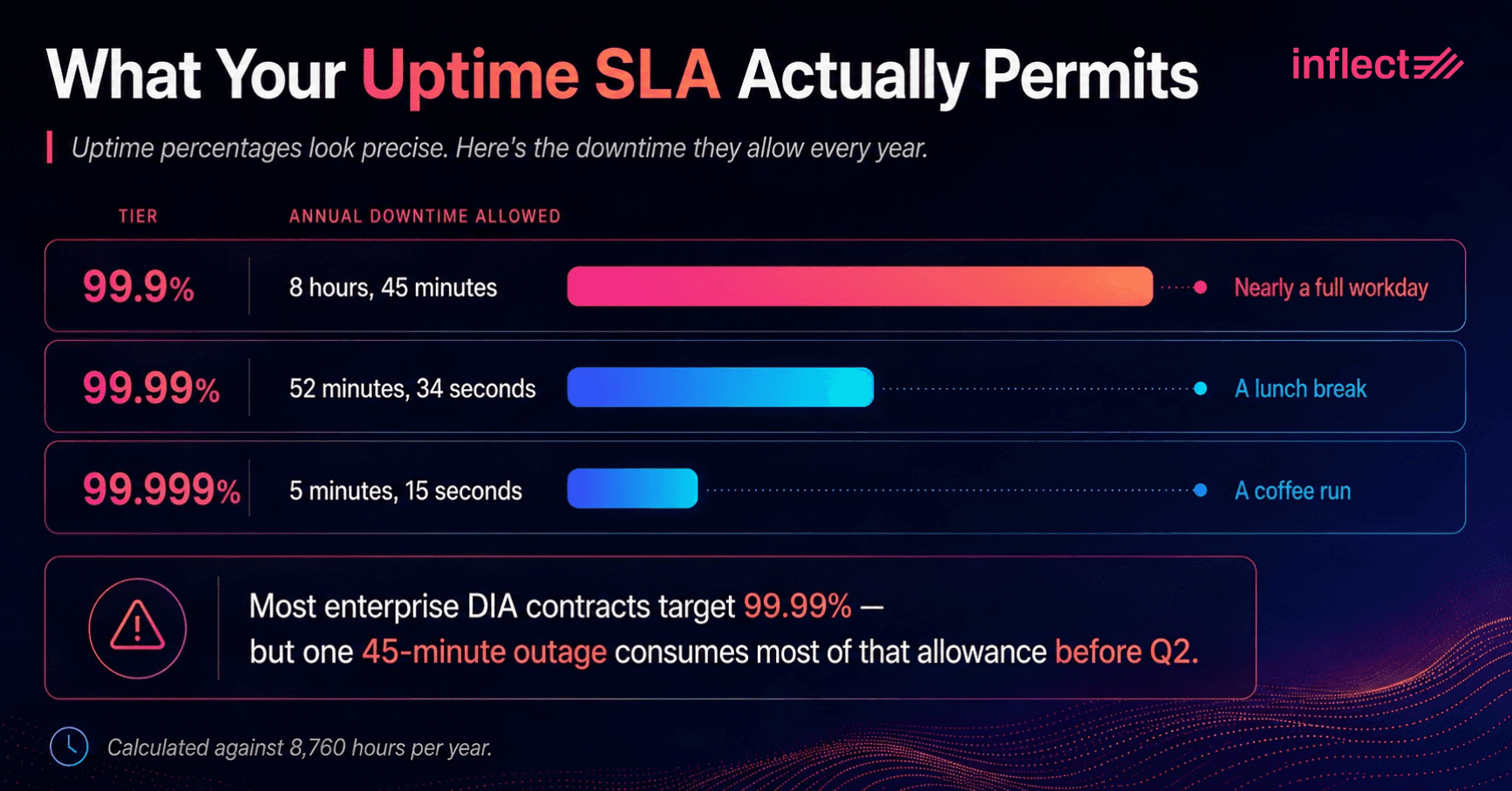
The three tiers buyers encounter most often in enterprise DIA SLAs translate to the following maximum annual downtime allowances, calculated against 8,760 hours per year:
99.9% uptime: 8 hours 45 minutes of allowed downtime per year
99.99% uptime: 52 minutes 34 seconds of allowed downtime per year
99.999% uptime: 5 minutes 15 seconds of allowed downtime per year
The difference between 99.9% and 99.99% is significant for most enterprise workloads. The difference between 99.99% and 99.999% matters operationally only for applications where any single incident lasting more than a few minutes creates compliance, safety, or direct revenue consequences. For most enterprise internet circuits, 99.99% is the standard procurement target.
Why 99.99% Uptime Allows More Disruption Than Most Buyers Realize
A 99.99% uptime SLA does not mean a circuit will experience less than 53 minutes of total downtime in a given year. It means the provider is contractually permitted to deliver up to 53 minutes of unavailability before the buyer has any claim at all. That ceiling does not distribute evenly across the year. A provider who experiences one 45-minute outage in January has consumed most of their annual allowance before Q2, with no requirement to perform above threshold for the remainder of the year.
The percentages also assume a static workload tolerance. An organization running latency-sensitive unified communications or real-time analytics over that circuit may find that even a 20-minute outage carries costs that dwarf any available SLA credit.
How Measurement Windows Change What Providers Actually Owe You
Monthly measurement windows favor buyers because outage impact is evaluated in shorter intervals, meaning a single bad calendar month triggers a credit regardless of annual aggregate performance. Annual measurement windows favor providers because strong performance later in the year can absorb an early outage without triggering any credit at all. Before signing any enterprise DIA contract, buyers should confirm whether availability is calculated monthly or annually. If the SLA document is silent on this point, request written clarification before execution. This single clause can determine whether a significant outage produces a credit or disappears into aggregate performance.
How Providers Define "Availability": Why That Definition Limits Your Claims
DIA providers define "availability" in their SLA documents in ways that typically exclude scheduled maintenance, planned downtime, force majeure events, and third-party network failures from the availability calculation, meaning the headline uptime percentage applies to a narrower set of network availability scenarios than buyers generally assume.
Scheduled Maintenance Exclusions and How They Reduce Your Uptime Guarantee
Most DIA SLAs include a scheduled maintenance exclusion that removes planned downtime from the availability calculation entirely. A provider who takes a circuit down for four hours at 2am for a firmware upgrade does not count that window against the uptime commitment if the work was scheduled within a defined notice period, typically 24 to 72 hours in advance. Providers with aggressive maintenance schedules can consume hours of downtime each year without any SLA consequence. Buyers should request the provider's historical maintenance frequency and average duration during procurement, and push for contractual caps on scheduled maintenance hours per month.
The Force Majeure and Third-Party Carve-outs That Void Most Outage Claims
Force majeure clauses in telecom SLA contracts routinely extend beyond natural disasters to include power failures at third-party facilities, upstream network provider outages, fiber cuts caused by construction activity, and government or regulatory actions. In a multi-provider circuit architecture where a DIA provider is purchasing capacity from underlying carriers or third party providers, a significant share of real-world outages may originate in a portion of the network the provider classifies as outside their control. The practical effect is that force majeure and third-party carve-outs can exempt a provider from SLA liability for outages that a buyer experiences as complete circuit failures.
Where SLA Language Diverges from Real-World Network Behavior
A circuit that is technically "available" by SLA definition may not be usable for the workloads it supports. Some SLA frameworks measure availability as the ability to pass any traffic at all, not the ability to pass traffic at contracted throughput levels. A circuit delivering 5 Mbps on a 1 Gbps dedicated port is "available" under many standard SLA definitions, even as service degradation of that magnitude renders it unusable for most enterprise workloads. This divergence between contractual availability and operational performance is one of the most significant gaps in standard DIA SLA language, and it is rarely addressed unless a buyer specifically negotiates throughput minimums into the contract.
Ping-Based vs. Traffic-Based Availability Measurement and What Each Means for Your Claims
Providers use two primary methods to measure circuit availability: ping-based monitoring, which tracks whether a handoff interface responds to ICMP requests, and traffic-based monitoring, which measures whether the circuit is carrying data at contracted levels. Ping-based measurement is the more common default and the more favorable to providers. A circuit that responds to pings but cannot route application traffic passes a ping-based availability test without triggering any SLA consequence. Buyers negotiating enterprise DIA contracts should request traffic-based availability measurement, or at minimum, confirm precisely how the provider defines the test it uses to calculate uptime before signing.
MTTR, Latency, Jitter, and Packet Loss: What Actually Determines Circuit Performance
A DIA SLA governs four SLA metrics that determine whether a circuit is usable for enterprise workloads: mean time to repair, latency, jitter, and packet loss, each of which is measured, committed, and remedied separately from the uptime availability percentage.
Why Uptime Guarantees Don't Reflect Incident Severity or Recovery Time
Uptime is an aggregate measure that says nothing about how long any individual outage lasts or how quickly a provider restores service after one. A provider can deliver 99.99% annual uptime while consistently taking six to eight hours to restore service after each incident, provided outage frequency remains low enough to keep the aggregate within threshold. For an organization whose operations require recovery within two hours, the aggregate uptime number is the wrong metric to evaluate. MTTR commitments define the provider's response time obligation at the incident level, which is where operational impact is actually felt.
What Mean Time to Repair Commitments Actually Promise
MTTR in a DIA SLA typically defines the maximum time from incident notification to service restoration, not from incident occurrence to restoration. If a provider's SLA commits to a four-hour MTTR after a trouble ticket is opened, and the buyer's team does not detect the outage for two hours, the provider's clock starts at hour two. Buyers should push for contracts that define MTTR from confirmed outage time, not from ticket submission, and should verify how the provider monitors the circuit proactively on their side. A provider with no independent monitoring capability is relying on customers to initiate the recovery clock.
Latency, Jitter, and Packet Loss Thresholds and Which Workloads Require What
Enterprise DIA buyers should treat latency and packet loss as core contractual performance metrics when comparing SLA terms, especially for real-time and latency-sensitive applications. A 2024 NetForecast report shows that these metrics are central to evaluating internet service quality and can vary materially across providers, which makes benchmarking and comparison essential during procurement. For mixed-workload environments, buyers should negotiate SLA targets against the most demanding application on the circuit rather than rely on an average across traffic types (Source: NetForecast, 2024).
How to Read a DIA Performance Matrix in a Provider SLA Document
A provider SLA performance matrix presents performance targets and corresponding credit tiers in a table, and buyers reviewing this section should confirm four things before accepting the terms: whether thresholds are measured continuously or sampled at defined intervals; what the measurement duration is for each metric; whether each metric carries its own independent credit or a single credit applies to all metrics collectively; and whether performance SLA credits are capped separately from availability credits or draw from the same pool. These four factors determine whether the performance matrix carries real contractual weight or functions primarily as a marketing commitment.
What SLA Credits Actually Compensate (and What They Don't Cover)
Service credits in DIA contracts are designed primarily to limit provider liability, not to compensate buyers for the actual business impact of downtime, and understanding that distinction is the starting point for any realistic assessment of what a credit-based SLA is worth to your organization.
How DIA Credit Caps Limit the Remedy You Can Actually Collect
Most enterprise DIA SLAs apply a liability cap on monthly service credits, typically set between one and two times the monthly recurring charge for the affected circuit, regardless of how many SLA thresholds the provider breached or how long the outage lasted. On a $5,000-per-month circuit, a liability cap of one MRC returns $5,000 against a downtime event that may have cost the organization several multiples of that in lost revenue, lost profits, staff time, and incident response. These liability caps typically appear alongside an exclusive remedies clause, which establishes service credits as the sole financial remedy available regardless of actual business impact. Buyers should treat credit caps not as a measure of what an SLA is worth, but as a baseline floor on provider accountability, and build redundancy strategies that reflect the actual cost of downtime to their operations.
The SLA Claims Process and Why Most Buyers Never Collect What They're Owed
Most DIA SLA claims processes are not automatic. Buyers are typically required to submit a written claim within a defined window, often five to ten business days after an incident, with supporting documentation that may include ticket numbers, timestamps, and traffic logs. Providers do not proactively issue credits when a carrier misses SLA thresholds, even when the failure is well-documented. Organizations without a dedicated network operations function or a structured incident tracking process frequently miss claims windows entirely, forfeiting credits they were contractually entitled to collect. A well-drafted contract should require the provider to notify the buyer when an SLA threshold breach has been detected, regardless of whether the buyer has submitted a claim.
Termination for Cause and Escalation Rights in Enterprise DIA Contracts
Enterprise DIA contracts should include termination for cause provisions, formal escalation rights, and explicit liability provisions that give buyers meaningful leverage beyond credit accumulation when providers chronically miss SLA thresholds. Without a termination for cause clause, a buyer locked into a three-year contract with a chronically underperforming provider has no practical exit. A standard termination trigger allows the buyer to exit without early termination fees if the provider misses availability or performance thresholds for a defined number of consecutive months, typically two to three. Escalation rights, which specify the process for engaging senior provider management or a formal dispute resolution mechanism, should be written into the contract rather than left to informal relationship management.
How to Evaluate DIA SLAs: A Buyer's Checklist Before You Sign
Evaluating DIA SLA terms before contract execution requires confirming five specific clause categories: definition of availability, measurement methodology, exclusions and maintenance windows, credit structure and caps, and termination and escalation rights.
Five SLA Clauses Every DIA RFP Must Require
SLA provisions typically appear within a master service agreement, but these five clauses receive less scrutiny than the headline uptime figure. Every enterprise internet SLA checklist should require providers to define their position on each before a contract is executed:
Definition of availability: How is circuit availability measured, and does "available" mean the circuit is carrying traffic at contracted throughput, or simply responding to monitoring probes?
Measurement methodology: Is availability calculated monthly or annually, and is measurement ping-based or traffic-based?
Exclusions and maintenance windows: Which categories of downtime are excluded from the availability calculation, and is there a contractual cap on scheduled maintenance hours per month?
Credit structure and caps: What is the credit schedule for each SLA metric, and what is the maximum credit available per month or per incident?
Termination and escalation rights: Under what conditions can the buyer exit the contract without penalty, and what is the formal escalation process for persistent SLA failures?
Providers who cannot or will not answer these five questions during the RFP process are signaling that the fine print of their SLA is not designed to be evaluated. That is itself a useful data point in a DIA provider comparison.
Questions to Ask DIA Providers Before Committing to a Multi-Year Term
Before committing to a multi-year enterprise DIA contract, buyers should ask providers five questions directly: What was your average availability across your enterprise customer base last year, and can you provide a reference customer in a comparable geography? How do you measure circuit availability, and can I see a sample monitoring report? How do you notify customers when an SLA breach occurs? Are credits issued automatically or only upon customer claim? How many customers exercised termination for cause in the past 12 months? Also ask whether the provider offers quarterly reviews of SLA performance data. These questions are uncomfortable for providers to field, and informative precisely because of that.
Red Flags in DIA SLA Language That Signal Provider Risk
Four patterns in DIA SLA documents signal meaningful buyer risk: an availability definition that does not specify what "available" means technically; exclusion language broad enough to cover most real-world outage scenarios, including open-ended carve-outs for "third-party network events" without geographic or scope limits; credit caps below one month's MRC; and no specified MTTR commitment, which leaves recovery time entirely at the provider's discretion. Any one of these warrants negotiation before signing. All four together indicate an SLA that offers limited practical protection regardless of the headline uptime percentage.
How Inflect Helps Buyers Compare DIA Providers and SLA Terms Side by Side
Inflect is a digital infrastructure marketplace where enterprise buyers can search, compare, and receive instant pricing from DIA providers across 6,000+ facilities in 100+ countries, without a sales call or RFP process. For buyers evaluating business internet and dedicated internet access options, Inflect provides side-by-side comparison across providers including Lumen, GTT, Colt, Zayo, and Megaport, among hundreds of others on the platform.
The SLA evaluation framework in this post maps directly onto the DIA sourcing process on Inflect. Buyers who have identified the five contract clauses they require, the performance thresholds their workloads demand, and the red flags they need to screen for can use Inflect to compare providers and engage expert advisory at no cost. Inflect's advisory team works with buyers on RFP development, SLA negotiation posture, provider selection, and service quality benchmarking, drawing on active market data across the platform. No sales call required to start.
Ready to compare DIA providers on your terms?
Search instant pricing from DIA providers worldwide, no sales call required
Compare provider coverage, circuit types, and SLA structures side by side
Access free expert advisory for RFP development and SLA negotiation
Engage directly with providers through Inflect without a separate procurement process
About the Author

Haley Rogers
Content & Social Media Specialist
Haley Rogers is the Content & Social Media Specialist at Inflect, bringing over two years of experience in social media, marketing, and content strategy — including time at a fast-paced tech company before joining the Inflect team. She specializes in translating complex digital infrastructure topics into clear, engaging content, with a particular focus on blog writing and brand storytelling across channels.
Contact: