17 mins
Dedicated Internet Access for Multi-Site Enterprises: Connectivity Strategy for Distributed Teams
How does a multi-site enterprise guarantee the same level of network reliability at a 12-person regional office that it gets at headquarters, without paying MPLS-grade prices at every single address? The question shows up whether it is a medium sized business opening its fifth regional office or a global enterprise managing hundreds of branch offices, and it is harder to answer than it sounds because the easy paths both fail: standardizing every site on premium MPLS circuits is not affordable at scale, and standardizing every site on consumer broadband internet leaves the business exposed the moment one location goes down.

The stakes are higher than most infrastructure teams admit when they are budgeting circuits site by site. IT and networking issues account for 53% of the causes operators cite most often when an outage occurs, regardless of severity, and the underlying drivers are consistently the same: change management failures, third-party network provider failures, and hardware failures (Source: Uptime Institute, 2024). The cost of that risk is not abstract: more than 90% of mid-size and large enterprises now report that a single hour of downtime costs over $300,000, with several industries averaging more than $5 million per hour (Source: ITIC, 2024). A single underperforming site does not stay contained to that site; it becomes a support ticket queue, a missed SLA, and in some cases a full disruption to business operations that the rest of the network absorbs the cost of.
This post lays out a framework for building a DIA-based connectivity strategy that treats every location as a business-critical asset without over-engineering the smallest ones: how to tier sites, size bandwidth, design redundancy, choose a failover model, and source circuits consistently across every market a distributed team operates in.
What Is Dedicated Internet Access and Why It Matters for Multi-Site Enterprises
Dedicated Internet Access (DIA) is a business-grade internet circuit reserved exclusively for one customer that delivers symmetrical upload and download speeds, a committed information rate, and a service level agreement covering uptime, latency, and packet loss, in contrast to shared broadband internet connections that fluctuate with neighborhood demand and offer no enforceable performance guarantee. For a multi-site enterprise, that guarantee is the entire point: distributed teams need dedicated connections and consistent network infrastructure at every location, not just the flagship office.
Committed Information Rate vs. Best-Effort Bandwidth
Committed Information Rate (CIR) is the guaranteed bandwidth a DIA circuit delivers at all times, while best-effort broadband allocates bandwidth among multiple users on a shared, first-come basis with no protection against network congestion during peak usage times. That distinction matters most for the applications distributed teams depend on daily and that require high speed connectivity: video conferencing, VoIP, and cloud applications such as ERP and CRM platforms all degrade visibly the moment bandwidth becomes contested, and a branch office on shared broadband will see that degradation exactly when the rest of the building is also online. A CIR-backed circuit removes that variable entirely.
For technical teams: DIA circuits are typically provisioned with symmetrical speeds and CIR from 10 Mbps to 10 Gbps depending on site size, delivered over fiber internet, coax, or fixed wireless last mile, with the provider contractually obligated to maintain that guaranteed bandwidth independent of aggregate network utilization. Most enterprise DIA circuits also include static IP addresses, which matters for sites hosting servers, VPN endpoints, or inbound services that a dynamic IP cannot support.
DIA vs. MPLS vs. SD-WAN vs. Broadband: What's Different for Distributed Teams
DIA, Multiprotocol Label Switching (MPLS), Software-Defined WAN (SD-WAN), and broadband differ across three primary differences that matter to a multi-site buyer: whether bandwidth is dedicated or shared, whether traffic traverses a private network or public backbone, and how failover and redundancy get architected. DIA and MPLS both guarantee dedicated bandwidth, but MPLS routes traffic over a private network that is provider-managed while DIA typically routes over the public internet with a dedicated last mile. SD-WAN solutions are not a transport type at all; they are an overlay that manages traffic intelligently across whatever underlying circuits it sits on, commonly a mix of DIA and broadband. A full breakdown of how these four options compare on cost, redundancy, and reliability follows later in this post.
SLA Guarantees: Uptime, Latency, and Packet Loss
Enterprise DIA service level agreements typically guarantee three measurable outcomes that define high performance connections: guaranteed uptime commonly set between 99.9% and 99.99%, low latency connectivity with round-trip thresholds appropriate to the application mix, and maximum data packet loss commonly held under 0.1%, with defined service credits when the provider misses any of them. These figures vary by provider and market and should be treated as typical ranges rather than universal guarantees; the specific numbers belong in the contract, not in marketing copy. For a distributed team, the SLA is the enforcement mechanism: it is what turns "the internet should be fine" into a contractual obligation with a remedy attached.
The Core Connectivity Challenges Distributed Teams Face Across Multiple Sites
Multi-site enterprises face four network connectivity challenges that a single-location business rarely encounters: inconsistent performance across sites, redundancy gaps at smaller and remote sites, vendor sprawl from managing circuits across dozens of markets, and inconsistent security and compliance posture across the network. Each of these compounds as a company expands to multiple locations, and none of them show up clearly until a specific site fails.
Site-to-Site Performance Consistency
Distributed teams often discover that headquarters gets premium circuits while regional offices get whatever the local ISP offers, which means network performance for the same application varies depending on which office a user happens to sit in. That inconsistency undermines the entire premise of a distributed workforce: employees are supposed to be interchangeable across locations, but the network treats them differently. Standardizing on DIA at every site, sized appropriately rather than uniformly, is what delivers consistent performance across the whole footprint.
Circuit Diversity and Last-Mile Redundancy
A site with a single circuit from a single provider has a single point of failure no matter how reliable that circuit's SLA claims to be, because the SLA does not protect against a backhoe cutting the one fiber path into the building. Multi-site enterprises need last-mile diversity and true backup connectivity, meaning a second circuit that enters the facility through a physically different path, ideally over separate fiber connections or a different provider's infrastructure entirely, not just a second contract with the same underlying carrier.
Vendor Sprawl and Contract Complexity at Scale
Managing DIA circuits with multiple vendors, site by site and contract by contract, creates an operational burden that scales faster than the site count itself: renewal dates fall on different cycles, SLA terms are inconsistent from one service provider to the next, and no single team has visibility into total network spend or performance across the footprint. This is where many multi-site enterprises lose negotiating leverage they should otherwise have from their aggregate volume.
Security and Compliance Consistency Across Sites
A distributed network is only as strong as its weakest site from a security standpoint, and regulated industries handling sensitive data in particular cannot afford a branch office that falls outside the compliance boundary the rest of the network operates within. This is the direct extension of the "one weak link" security risks raised earlier: a site without consistent segmentation, encryption, or secure access controls becomes the entry point an attacker looks for, and it is also where zero trust architectures most commonly break down when they are layered onto SD-WAN without addressing the underlying circuit-level secure connectivity at every location.
How to Design a DIA Connectivity Strategy for Multi-Site Enterprises
Designing a multi-site DIA strategy requires five decisions made in sequence: tiering sites by business criticality, sizing bandwidth to each site's actual function, architecting circuit redundancy through diverse paths, selecting a failover model, and integrating DIA with SD-WAN for centralized policy control. Skipping any one of these steps tends to produce the two most common failure patterns in multi-site network design: uniform over-provisioning that wastes budget, or uniform under-provisioning that leaves critical sites exposed.
Tiering Sites by Business Criticality
Not every location carries the same business risk if its connectivity fails, and a tiering exercise should sort every site into a small number of criticality bands based on actual business needs before any bandwidth or redundancy decisions get made. A distribution center running mission critical applications like real-time inventory systems and a two-person sales office checking email do not belong in the same tier, even if they are the same square footage. Tiering is the step that lets an enterprise apply MPLS-equivalent reliability where it actually matters, without paying MPLS-level cost at every address on the list.
Bandwidth Sizing by Site Function
Bandwidth allocation should be sized to what a site actually does, not to a flat per-employee formula applied across the entire footprint. A call center site with heavy concurrent VoIP traffic has different internet needs than a warehouse running large data transfers for inventory syncs, a design studio handling large file uploads, or a regional office running standard SaaS applications, and sizing each site to its function avoids the two failure modes of flat allocation: paying for capacity that never gets used, or running a high-traffic site on a circuit that was sized for a much lighter workload.
Circuit Redundancy and Diverse-Path Design
Redundancy only works if the backup circuit fails independently of the primary one, which means diverse-path design has to account for physical routing, not just contractual duplication. That means verifying that the secondary circuit enters the building through a different conduit, terminates on different equipment, and ideally comes from a different carrier's physical infrastructure rather than a second circuit resold over the same underlying network. Tier-1 sites should carry full path diversity; lower tiers may reasonably accept a lighter-weight backup, which is exactly what the tiering exercise upstream is meant to determine.
Active-Active vs. Active-Passive Failover Models
Active-active failover runs both circuits simultaneously and load-balances traffic across them, while active-passive failover keeps the secondary circuit idle until the primary fails and then cuts over. Active-active delivers better bandwidth utilization and a faster, often imperceptible failover, but it requires SD-WAN or routing infrastructure with granular network control capable of managing two live paths at once. Active-passive is simpler to deploy and adequate for lower-tier sites where a brief failover delay during a rare outage is an acceptable tradeoff against cost. The choice between the two should follow directly from the criticality tier a site was assigned earlier, not from whichever model the local provider happens to offer.
Integrating DIA With SD-WAN and Private Networking
SD-WAN sits on top of DIA circuits and applies centralized policy across the whole footprint: which application gets which path, how failover triggers, and how traffic prioritization gets applied during congestion, a form of WAN optimization that MPLS handled natively and internet-based architectures have to build back in. This is the combination that gets an enterprise the closest to MPLS-level reliability without MPLS-level cost or contractual rigidity, because the underlying circuits are DIA (dedicated, SLA-backed, competitively priced) while the overlay handles the intelligent routing that MPLS used to provide from its own network core. For enterprises that also need a direct connection or private connection into cloud services, data centers, or cloud provider environments, DIA and SD-WAN can be paired with private networking to keep sensitive traffic off the public internet entirely for specific paths while still using internet-based DIA for general site connectivity.
DIA vs. Alternatives for Multi-Site Deployments
The key differences between DIA, MPLS, SD-WAN over broadband, and hybrid architectures come down to the criteria multi-site buyers weigh most heavily: cost at scale, SLA strength, bandwidth symmetry, and redundancy design, with DIA increasingly positioned as the technology enterprises use to replace MPLS without giving up reliability. Gartner has been direct about where this is heading as part of the broader digital transformation of enterprise networks: internet services are augmenting and often displacing MPLS across enterprise WANs, and by 2026, 45% of enterprise locations are expected to use only internet-based connectivity for their WAN (Source: Gartner, 2024). SD-WAN adoption is rising alongside broader cloud adoption, with 70% of enterprises expected to have implemented SD-WAN solutions by 2026, up from roughly 45% in 2021 (Source: Gartner, 2025).
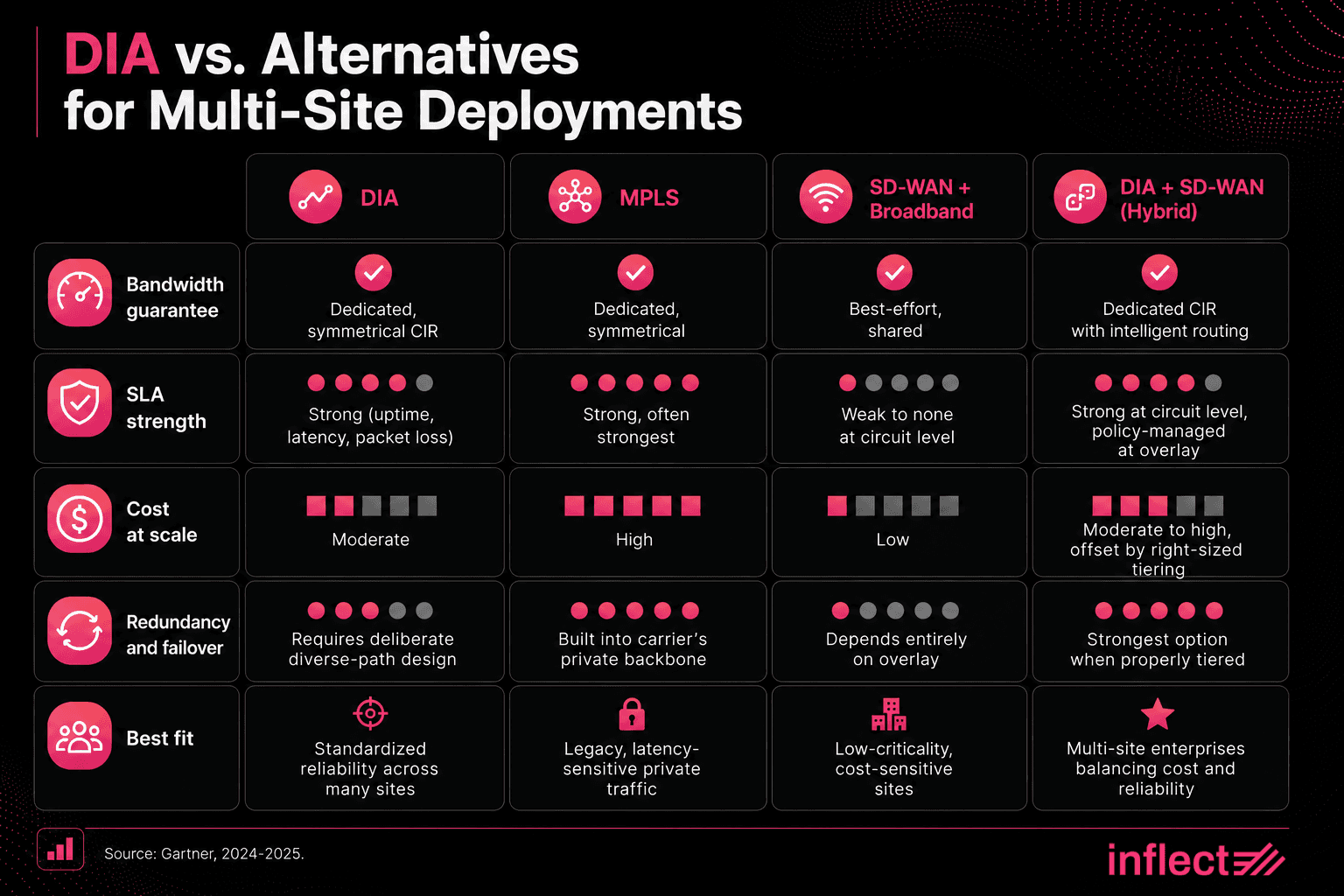
Table reflects standard enterprise WAN architecture characteristics as of 2024-2025 (Source: Gartner, 2024; Gartner, 2025).
DIA vs. MPLS for Multi-Site Reliability
DIA matches MPLS on the two guarantees that matter most to a distributed team, dedicated bandwidth and an enforceable SLA, while typically costing meaningfully less per site and avoiding the long-term contractual lock-in that has historically come with private MPLS backbones. The tradeoff is that MPLS traffic never touches the public internet, which still matters for a narrow set of latency-sensitive or highly regulated use cases. For the large majority of multi-site enterprises, that tradeoff no longer justifies MPLS pricing across an entire enterprise network, which is exactly why Gartner has said MPLS is headed for a slow decline as internet services mature, with niche use cases in legacy, high-security, and certain regional deployments the main reason it persists at all (Source: Gartner, 2024). This is the shift behind why so many infrastructure teams are actively evaluating how SD-WAN can replace MPLS rather than renewing it.
DIA + SD-WAN vs. Broadband-Based Architectures
Pure broadband-based SD-WAN architectures cut cost aggressively but inherit every limitation of shared, best-effort public internet connections at the circuit level, meaning the overlay can route network traffic around congestion but cannot guarantee a minimum performance floor the way a dedicated circuit can. Pairing SD-WAN with DIA instead of broadband keeps the intelligent routing and centralized policy control while restoring the bandwidth guarantee, which is the combination most multi-site enterprises land on once a tier-one site suffers a broadband-related outage during a period the business could least afford it.
When Hybrid Connectivity Models Make Sense
Hybrid models, meaning DIA for tier-one and tier-two sites paired with broadband-backed SD-WAN for the lowest-criticality locations, make sense whenever a footprint spans a wide range of site types rather than a uniform set of offices. A retail chain with a handful of distribution centers and hundreds of small storefronts handling in-person customer traffic is the clearest example: the distribution centers justify full DIA with diverse-path redundancy, while individual storefronts can run on a lighter-weight combination without meaningfully increasing business risk. Hybrid design is where the tiering exercise from the design section pays for itself directly.
Sourcing and Negotiating DIA Across Multiple Markets
Sourcing DIA across a distributed footprint introduces a problem that single-site buyers never face: the provider with the best circuit in one market may not operate in the next city on the list, which forces enterprises to choose between managing many vendor relationships or accepting weaker options in markets where their preferred carrier has no presence.
Evaluating DIA Providers Across Regions
Evaluating DIA providers market by market requires comparing last-mile infrastructure, not just headline pricing, because a provider's national brand recognition says nothing about whether they own or lease fiber to a specific building in a specific city. The practical evaluation criteria are consistent regardless of market: available bandwidth tiers ranging from standard offices up to high bandwidth circuits for data-intensive sites, last-mile technology (fiber, coax, or fixed wireless), typical install timelines, and whether the provider can support the redundancy design the enterprise settled on in the tiering exercise.
Standardizing SLA Terms Across a Multi-Site Contract
Multi-site enterprises lose leverage when they negotiate SLA terms site by site instead of standardizing uptime, latency, and packet loss commitments, along with service credit structures, across the entire footprint under a master agreement. Standardization does more than simplify contract management: it gives the enterprise a single, consistent performance bar to hold every provider to, which makes it far easier to identify and act on underperforming sites instead of discovering inconsistent SLA language only after an outage has already happened.
How Inflect Simplifies Multi-Site DIA Sourcing
Sourcing DIA across dozens or hundreds of locations is the exact problem Inflect's marketplace model was built to solve. Instead of running a separate sales process in every market a distributed team operates in, buyers can search, compare, and get instant pricing on DIA circuits across 6,000+ data centers and network facilities in 100+ countries, without a sales call gating access to pricing the way it does on lead-generation-based directories. That matters most for the multi-site enterprises this guide is written for, where the sourcing burden scales with every additional site added to the footprint.
Inflect's platform includes DIA and network connectivity availability from providers such as Lumen, GTT, Colt, Zayo, and Megaport, alongside hundreds of others, searchable by specific market and capacity rather than requiring a buyer to already know which provider covers which city. Free expert advisory is available at no cost to buyers who are working through the tiering and redundancy decisions this post covers, which is often the harder part of a multi-site DIA project than the pricing itself. Buyers get instant, comparable pricing across every market on their list at once, rather than negotiating market by market and losing the aggregate leverage a distributed footprint should otherwise provide.
A Tiered DIA Strategy Is the Foundation for Distributed Team Reliability
A multi-site connectivity strategy built around DIA works because it separates two decisions that most enterprises conflate: what technology to use, and how much of it each site actually needs. DIA gives every location the same dedicated, SLA-backed foundation that MPLS used to provide, at a cost structure that scales across a real-world footprint rather than penalizing every additional site. Tiering, sizing, redundancy design, and failover model selection are what turn that foundation into a strategy instead of a uniform default applied everywhere. The enterprises that get this right are not the ones spending the most on connectivity. They are the ones spending it in the right places, at the right sites, with SLA terms and sourcing consistency that hold up as the footprint keeps growing.
Multi-site connectivity decisions get harder to unwind the longer inconsistent circuits and contracts stay in place across a growing footprint. Inflect gives distributed enterprises a faster path to a standardized DIA strategy:
Compare instant DIA pricing across every market in your footprint, from a single search, without a separate sales call per site
Access DIA and network connectivity from providers including Lumen, GTT, Colt, Zayo, and Megaport
Get free expert advisory on site tiering, redundancy design, and failover model selection before committing to a sourcing strategy
Standardize SLA terms and pricing across your entire footprint instead of negotiating market by market
Start comparing DIA options for your locations on Inflect and bring your multi-site connectivity strategy under one consistent standard.
About the Author

Haley Rogers
Content & Social Media Specialist
Haley Rogers is the Content & Social Media Specialist at Inflect, bringing over two years of experience in social media, marketing, and content strategy — including time at a fast-paced tech company before joining the Inflect team. She specializes in translating complex digital infrastructure topics into clear, engaging content, with a particular focus on blog writing and brand storytelling across channels.
Contact: