12 mins
Dedicated Internet Access for Media and Entertainment Companies
In media and entertainment, the audience does not wait. A live stream that buffers loses viewers in seconds. A content upload that stalls delays a release. Network outages during major events become PR crises before the technical team has even finished diagnosing the cause. Every second of performance matters because the audience, and the revenue it represents, is always one bad experience away from leaving.
The scale of what is at stake is significant and growing. According to PwC's research, global entertainment and media revenues were just under US$3 trillion in 2024 and are projected to reach about US$3.5 trillion by 2029. The study also expects global OTT video revenues to surpass US$200 billion by the end of the decade, underlining how central streaming has become within the broader entertainment and media landscape. Behind every one of those numbers is a content delivery operation that depends on a fast, reliable internet connection performing consistently at the moment audiences choose to engage. (PwC, 2025)
Dedicated internet access (DIA) is a private, unshared dedicated internet connection with guaranteed bandwidth, symmetrical upload and download speeds, and contractual uptime backed by formal service level agreements (SLAs). For media and entertainment companies where the connection between content and audience is the product, it is the connectivity standard the work demands.
In media and entertainment, connectivity is not infrastructure. It is the delivery mechanism for everything the audience pays for.
What Makes Dedicated Internet Access Different for Media and Entertainment
Dedicated internet access is different from standard broadband internet because the bandwidth is private, guaranteed, and delivers consistent and reliable performance that does not fluctuate based on what other businesses or other users on the same shared network are doing. Standard broadband connections share capacity. During peak periods, when the most users are online simultaneously, internet speeds drop and latency increases. For a streaming platform, a broadcast operation, or a production studio, those peak periods are exactly when the connection needs to be most reliable. That is when audiences are largest and content delivery pressure is highest.
Unlike broadband, a dedicated internet connection gives a media company guaranteed bandwidth that does not change based on network conditions. Symmetrical upload and download speeds matter significantly for organizations sending large volumes of data in both directions: live stream ingest to CDN platforms, uploading large files of raw production footage, and continuous content synchronization across distributed teams all depend on sustained internet connectivity that shared broadband cannot reliably provide.
For media and entertainment companies where a single technical failure during a live event or major release can directly affect audience numbers, advertiser commitments, and subscription revenue, the difference is between a delivery infrastructure with dedicated bandwidth and consistent performance built for the work, and one that was not.
What Media and Entertainment Buyers Look for in a DIA Provider
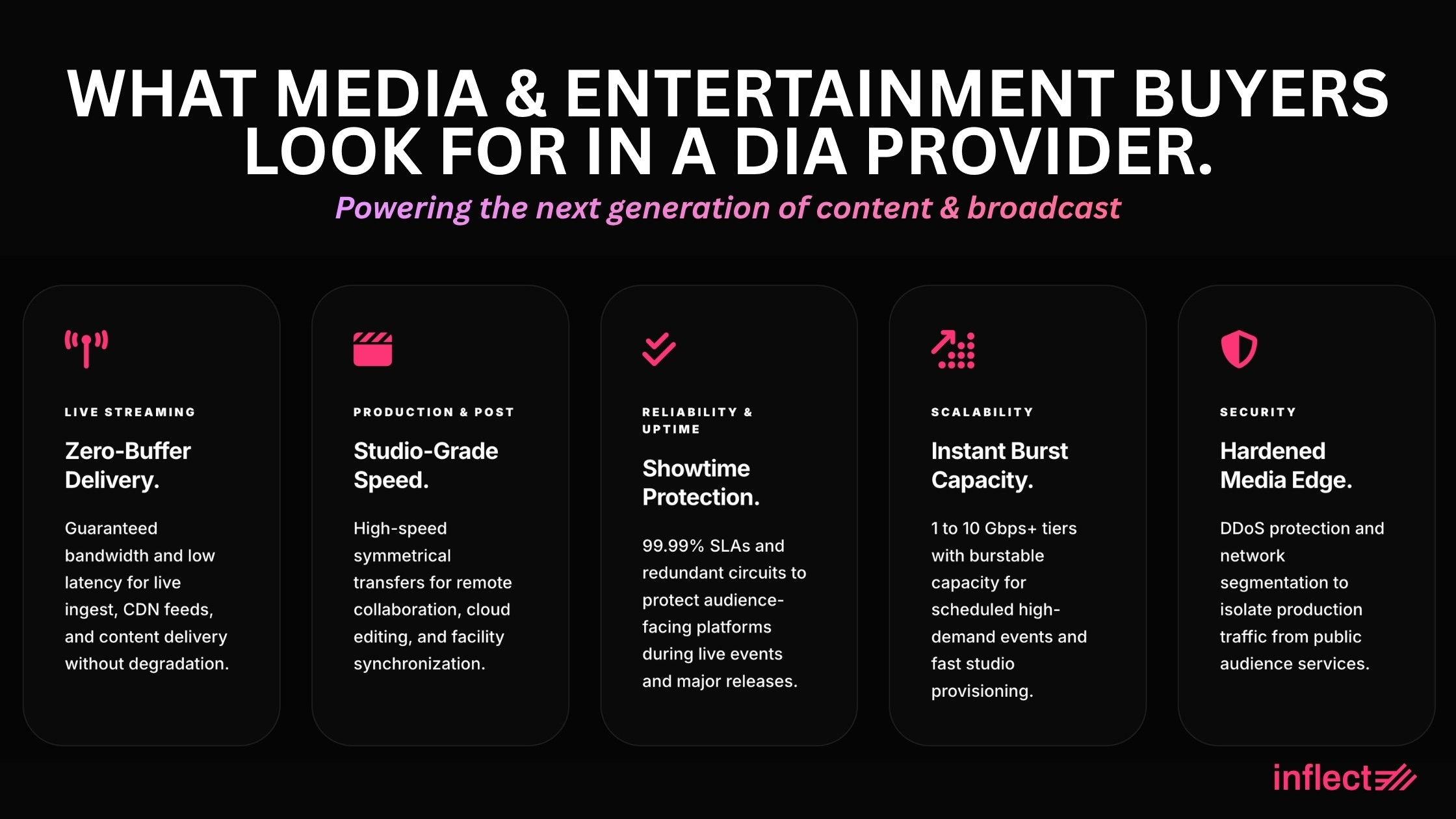
Media and entertainment companies evaluate dedicated internet providers across five core dimensions. The table below reflects what consistently drives connectivity decisions at streaming platforms, broadcasters, production studios, and content distributors.
Dimension | What Media and Entertainment Buyers Expect |
Live Streaming and Delivery | Guaranteed bandwidth and low latency for live stream ingest, CDN contribution feeds, and real-time content delivery without buffering or quality degradation. |
Production and Post-Production | High-speed symmetrical upload and download for large file transfers, remote collaboration, cloud editing workflows, and content synchronization across facilities. |
Reliability and Uptime | Uptime SLAs of 99.9 to 99.99 percent, fast mean time to repair, and redundant circuit options to protect audience-facing platforms during live events and major releases. |
Scalability | Bandwidth tiers from 1 to 10 Gbps and above, with burstable capacity for scheduled high-demand events and fast provisioning for new studios and production locations. |
Security | DDoS protection for public-facing streaming platforms and content portals, edge firewall, and network segmentation to isolate production traffic from audience-facing services. |
Where Media and Entertainment Companies Actually Use DIA
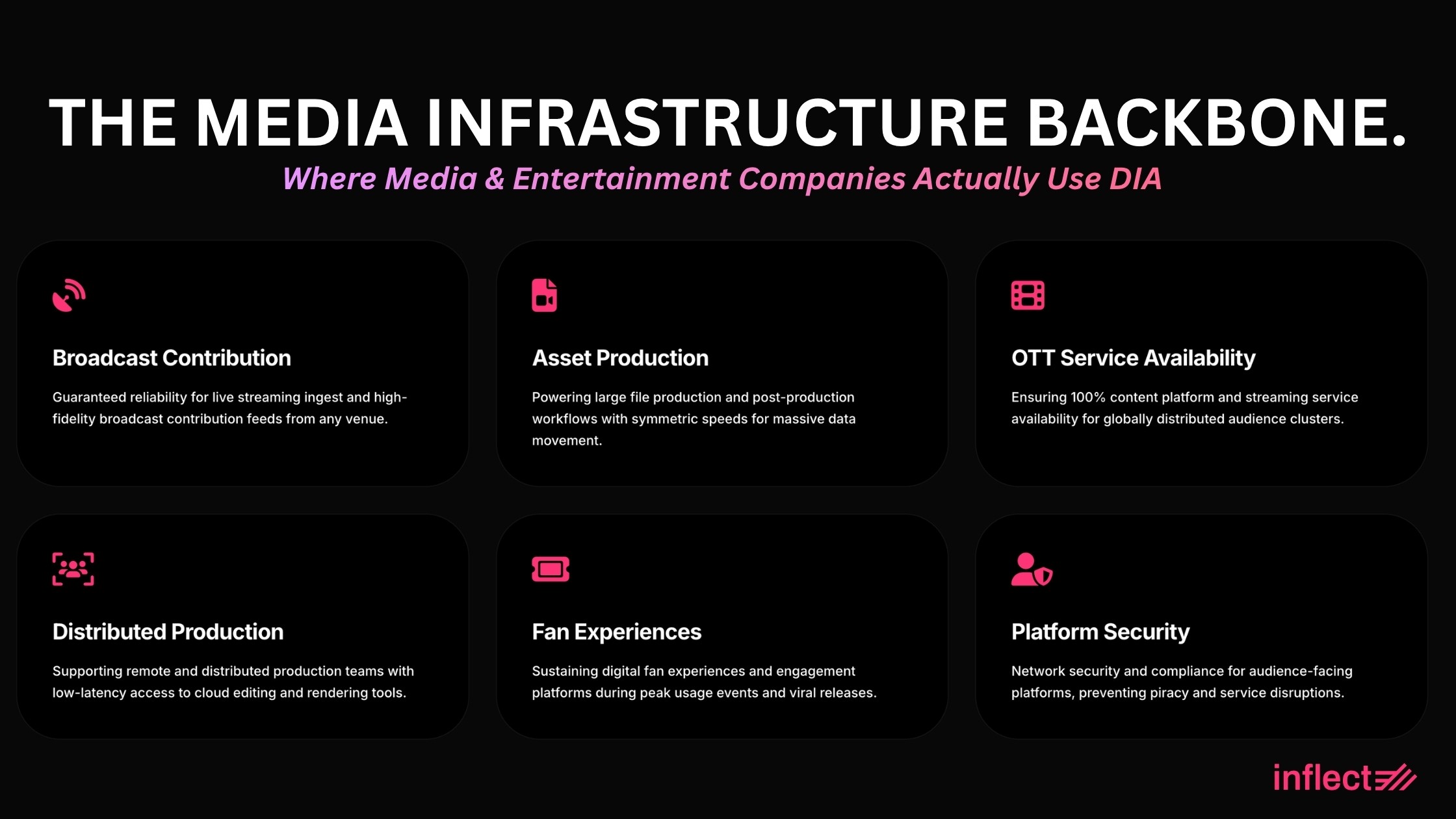
Media and entertainment companies use dedicated internet access across six core areas: live streaming and broadcast contribution, large file production and post-production workflows, content platform and streaming service availability, remote and distributed production, digital fan experiences and engagement platforms, and audience-facing platform security.
Live Streaming and Broadcast Contribution Feeds
Dedicated internet access supports reliable live streaming and broadcast contribution by providing the guaranteed, low-latency bandwidth that live video ingest requires, without the congestion or packet loss that causes a live stream to buffer, drop frames, or disconnect from a CDN mid-broadcast. Live streaming is now the dominant segment of the video streaming market. According to Grand View Research, live video streaming accounted for roughly 62.5 percent of global video streaming revenues in 2024, underscoring the scale of audience demand for real-time content across entertainment, sports, gaming, and live events. (Grand View Research, 2025)
For broadcasters and streaming platforms, a live event is a fixed window of audience attention that cannot be paused or rescheduled. A shared broadband connection with no uptime SLA introduces congestion risk at precisely the moments when audiences are largest. For broadcast operations where live delivery is core to business continuity, DIA provides maximum bandwidth on demand and committed performance that live workflows require.
For technical teams evaluating live production requirements: industry guidelines typically reference a minimum of 5 to 10 Mbps of upload capacity per HD stream as a starting floor, with 4K and multi-camera productions requiring significantly more. A dedicated fiber connection from an internet service provider with a contractual committed upload rate gives broadcast engineers a known, reliable number to plan encoder configurations around, rather than guessing based on shared broadband averages. Low latency and stable upload speeds are what make these protocols perform as designed in live production environments. Contribution protocols including RTMP, SRT, and RIST are all designed to work best over stable, low-jitter connections with predictable throughput, exactly what DIA provides.
Large File Transfers in Production and Post-Production
Dedicated internet access eliminates production workflow bottlenecks by providing the high-speed symmetrical upload and download capacity that media companies need to move large raw footage files, high-resolution masters, audio projects, and visual effects assets between studios, remote editors, cloud editing platforms, and distribution partners reliably and on schedule. A single 4K raw footage file can run to hundreds of gigabytes. A feature-length production generates terabytes of assets across its lifecycle. Moving those files over a shared broadband connection with unpredictable upload speeds turns every transfer into a scheduling risk. Many organizations have learned this the hard way when a critical delivery to a cloud service or distribution partner slips because the connection could not sustain the required speed.
With a dedicated internet connection, large file transfers happen at consistent speeds that teams can plan around. Remote editors receive footage when it is ready. Post-production deadlines stay intact. Cloud applications for editing, grading, and render farm workflows receive the assets they need without waiting on a congested shared line, delivering reliable performance that production schedules depend on. Accelerated uploads to OTT distribution partners, review platforms, and clients for approval become predictable rather than variable. For production companies managing multiple simultaneous projects across different teams and deadlines, that reliability compounds across every workflow running in parallel.
Keeping Content Platforms and Streaming Services Available
Dedicated internet access keeps audience-facing content platforms and streaming services available with guaranteed uptime and consistent performance, even during the traffic spikes that accompany new releases, live events, and promotional campaigns that drive large numbers of users online simultaneously. A streaming platform or VOD service that goes down during a major release moment does not just lose the viewing session. It loses subscriber trust that takes time and marketing spend to rebuild.
DIA provides the guaranteed bandwidth and SLA-backed uptime that content platform operators need to make commitments to audiences and advertisers about service availability. For platforms carrying advertising inventory, downtime and buffering directly affect application performance and revenue simultaneously: ad impressions that fail to deliver are revenue that cannot be recovered.
Digital Fan Experiences and High-Traffic Engagement Platforms
Dedicated internet access keeps high-traffic digital fan experiences and engagement platforms responsive during the peak demand moments that define their value, including major tournament streams, award show second-screen experiences, interactive AR and VR activations, and social publishing pipelines that clip and distribute content in real time during live events. These are not background workloads. They run at their highest demand exactly when the live event audience is largest, creating simultaneous spikes in inbound traffic from fans and outbound traffic from publishing and distribution workflows.
Sports rights holders, entertainment brands, and publishers running real-time social clipping and distribution pipelines need a dedicated internet connection that can handle both directions at full speed simultaneously. Equal upload and download capacity, guaranteed bandwidth that does not degrade under concurrent user load, and uptime SLAs that cover peak event windows are all requirements that shared broadband cannot satisfy reliably. DIA gives these platforms the consistent performance foundation that makes real-time fan engagement technically viable at scale. Proactive monitoring and network management from a provider with strong SLAs also gives operations teams the visibility to catch and resolve issues before audiences notice them.
Remote and Distributed Production Workflows
Dedicated internet access enables remote and distributed production workflows by providing the reliable, high-speed internet connection that editors, colorists, sound designers, and production teams working across multiple locations need to collaborate on shared assets in real time, access cloud-based production tools without latency, and participate in video conference reviews and approvals without quality degradation. Remote production has moved from a contingency model to a standard operating practice across the media industry. Studios and production companies now regularly run projects across teams in different cities and countries, relying on cloud services for editing, shared storage, and real-time collaboration tools that all depend on internet speed and consistency at every location.
A shared broadband connection introduces unpredictable latency and bandwidth variability that disrupts collaborative workflows. A dedicated internet connection at each production location gives remote teams the same reliable access to shared assets and cloud tools that an on-premise team would have. For technical teams, the ability to segment and prioritize live production traffic, contribution feeds and real-time review sessions, over general office internet usage using QoS policies is a meaningful operational advantage that DIA architecture supports where shared broadband does not.
Protecting Streaming Platforms and Content Portals from DDoS Attacks
Dedicated internet access with built-in DDoS protection and edge security defends audience-facing streaming platforms and content portals against volumetric attacks that can take services offline during peak demand periods, protecting both the audience experience and the advertising and subscription revenue that depends on platform availability. Public-facing streaming platforms are high-value targets for DDoS attacks, particularly during major live events. The combination of large audiences and time-sensitive content creates maximum disruption potential. Without mitigation at the network edge, a single sustained attack can overwhelm platform infrastructure and create an outage that coincides with the organization's highest-traffic moment.
Network security integration with content delivery networks, zero-trust frameworks, and network segmentation also protects the intellectual property that media companies depend on. Keeping production traffic off the public internet, with secure access controls at the edge, reduces the attack surface and limits the blast radius of any security incident on the broader operation.
Why Uptime SLAs Matter Differently in Media and Entertainment
Uptime SLAs matter differently for media and entertainment companies than they do for most other industries because the cost of downtime is not just operational: it is audience-facing, time-sensitive, and in the case of live events, irreversible. A hospital can document a network outage, restore internet connectivity, and resume operations after recovery. A live sports broadcast that goes dark for ten minutes during the final quarter cannot recover that audience or that moment.
For this reason, media and entertainment organizations evaluating DIA providers should look beyond headline uptime percentages and ask specifically about mean time to repair commitments, escalation paths during live events, and the provider's experience with scheduled maintenance windows around broadcast schedules. Providers that understand the operational context of media delivery treat a connectivity issue during a live stream differently from one that occurs at 3 a.m. on a Tuesday.
Redundancy is the other critical dimension. A primary DIA circuit paired with a secondary diverse-path circuit from a different carrier, or a primary circuit with automatic failover to a secondary connection, ensures that a single fiber cut or equipment failure does not become a broadcast outage. Some production workflows use one circuit for primary contribution and a second for backup monitoring and return feeds. For live event operations, major sports rights holders, and streaming platforms with large concurrent audiences, dual-circuit redundancy is not optional architecture.
Flexible, event-driven capacity is the third dimension that media companies evaluate differently from other industries. Major tournaments, award seasons, and big releases create predictable but time-limited demand spikes. A DIA provider that supports temporary bandwidth bursting around scheduled events, and that can provision temporary connections for pop-up venues and production sites on realistic timelines, gives media organizations more flexibility and a more cost effective approach to peak capacity without paying for it year-round.
Questions Worth Asking Before You Sign
Not all dedicated internet providers understand the specific demands of media and entertainment operations. Before committing, these are the questions that separate providers who can support the work from those who cannot:
What upload speeds can you guarantee, not just download? Media and entertainment companies push significant data outbound. Confirm the provider offers true symmetrical speeds and that the committed upload rate is contractual, not estimated.
What uptime SLA do you offer, and what does it cover? Ask specifically whether the SLA covers planned maintenance windows, what qualifies as an outage, and what the financial remedies are. For live event operations, also ask whether the provider offers enhanced support during scheduled broadcasts.
What is your mean time to repair? A four-hour MTTR (Mean Time to Repair) is different from an eight-hour MTTR when a platform is down during a live event. Get a specific commitment with escalation paths in writing.
Can you support burstable bandwidth for high-demand events? Major releases and live events create predictable traffic spikes. Ask whether the provider supports temporary bandwidth bursting above the committed rate and what the process for scheduling that capacity looks like.
Do you have on-net coverage at all of our studio and office locations? For production companies and broadcasters with multiple facilities, consistent DIA coverage at every location is essential. A provider that covers headquarters but not production studios creates the gaps you are trying to eliminate.
What DDoS protection and edge security options are available? For audience-facing platforms, DDoS mitigation at the network edge is a baseline requirement. Confirm what is included and what requires separate procurement.
Can you provision connections at venues and temporary production sites? Live events and remote productions often require connectivity at locations that are not permanent offices. Ask about the provider's experience with venue installs, typical lead times for fiber build or turn-up, and whether they can support shorter-term commitments for temporary production sites.
Do you offer 24/7 support with broadcast-aware escalation paths? A connectivity issue during a live broadcast is not the same as a routine outage. Confirm the provider has 24/7 NOC support and escalation paths that treat live event windows differently from standard business hours incidents.
The Bottom Line
Dedicated internet access for media and entertainment companies provides the reliable, high-capacity connectivity that live streaming, production workflows, content platforms, and distributed teams depend on to perform consistently when audiences are watching. The media industry's growth trajectory, with the global entertainment and media sector projected to reach about US$3.5 trillion by 2029 (PwC, 2025), makes the infrastructure decisions companies make today consequential for the operations they will need to run at scale tomorrow.
A shared broadband connection was never designed for the demands of professional media delivery. A dedicated internet service with guaranteed bandwidth, symmetrical speeds, contractual uptime, and edge security connecting studios, facilities, and data centers is not a premium option for media companies. It is the network services foundation the work is built on.
Source Dedicated Internet Access for Your Media Operation
Guaranteed bandwidth from 1 to 10 Gbps and above. Symmetrical upload and download speeds. 99.99% uptime SLAs with fast repair commitments. DDoS protection for audience-facing platforms. Built for live streaming, production workflows, and content delivery at scale.
→ Source Media and Entertainment DIA →
Let Media & Entertainment DIA Expert handpick the right solution for you
About the Author

Chanyu Kuo
Director of Marketing at Inflect
Chanyu is a creative and data-driven marketing leader with over 10 years of experience, especially in the tech and cloud industry, helping businesses establish strong digital presence, drive growth, and stand out from the competition. Chanyu holds an MS in Marketing from the University of Strathclyde and specializes in effective content marketing, lead generation, and strategic digital growth in the digital infrastructure space.
Contact:
Email: