10 mins
Dedicated Internet Access for Manufacturing Companies
When a production line stops, the cost starts immediately. Idle labor, wasted materials, missed shipments, and downstream supply chain disruption all compound by the hour. Network connectivity is rarely the first thing a plant manager thinks of as a production risk, but as factories become more digitally connected through IIoT (Industrial Internet of Things) sensors, cloud-hosted MES (Manufacturing Execution System) and ERP (Enterprise Resource Planning) systems, remote monitoring platforms, and automated production controls, the business internet connection between the plant and those systems has become as operationally critical as any piece of equipment on the floor, and the number of connected devices depending on it grows with every modernization project.
Whether downtime is caused by a machine failure, a cyberattack, or a connectivity disruption that takes cloud systems offline, the financial consequence is the same: production stops and costs accumulate. According to the research summarized by ABB and Aberdeen finds typical manufacturing downtime averaging around US$260,000 per hour, with some large plants losing up to US$2.3 million per hour when production stops.
Dedicated internet access (DIA) is a private, unshared business fiber internet connection with guaranteed bandwidth, symmetrical upload and download speeds, low latency, a static IP address for consistent remote access, and contractual uptime backed by formal service level agreements. It comes with professional installation and a dedicated support path, not a consumer helpdesk. For manufacturing operations running 24 hours a day, seven days a week, where connectivity underpins IIoT data flows, cloud application access, remote monitoring, and OT (Operational Technology) security, it is the internet infrastructure standard the work demands.
Dedicated internet access for manufacturing is not just a connectivity decision. It is an operational reliability decision that directly affects OEE (Overall Equipment Effectivenes), plant uptime, and the ability to scale smart factory investments.
What Makes Dedicated Internet Access Different for Manufacturing
Dedicated internet access is different from standard business internet plans because it uses fiber optic internet infrastructure that delivers private, guaranteed bandwidth with symmetrical upload speeds and download speeds that do not fluctuate based on congestion or what other businesses on the same shared line are doing. Standard broadband is a best-effort service. In an office environment that is a manageable tradeoff. In a manufacturing plant where IIoT sensors are streaming telemetry continuously, SCADA systems are monitoring production in real time, and cloud MES and ERP platforms are coordinating operations across shifts, best-effort connectivity is not an acceptable foundation.
Unlike broadband, a dedicated internet connection provides a committed information rate: the bandwidth your organization purchases is always available, in full, in both directions. For plants uploading high volumes of sensor and production data to cloud analytics platforms, that upload capacity matters as much as download speed. Equal upload and download speeds also support remote access sessions, video calls with engineering teams, transferring large files of production data, and the constant two-way data flows between OT systems on the shop floor and IT systems in cloud or central data centers.
For manufacturing IT and OT teams, the difference between DIA and broadband is also the difference between a connection they can build reliable IIoT and automation architectures on and one that introduces unpredictable variability into time-sensitive production workflows.
What Manufacturing Buyers Look for in a DIA Provider
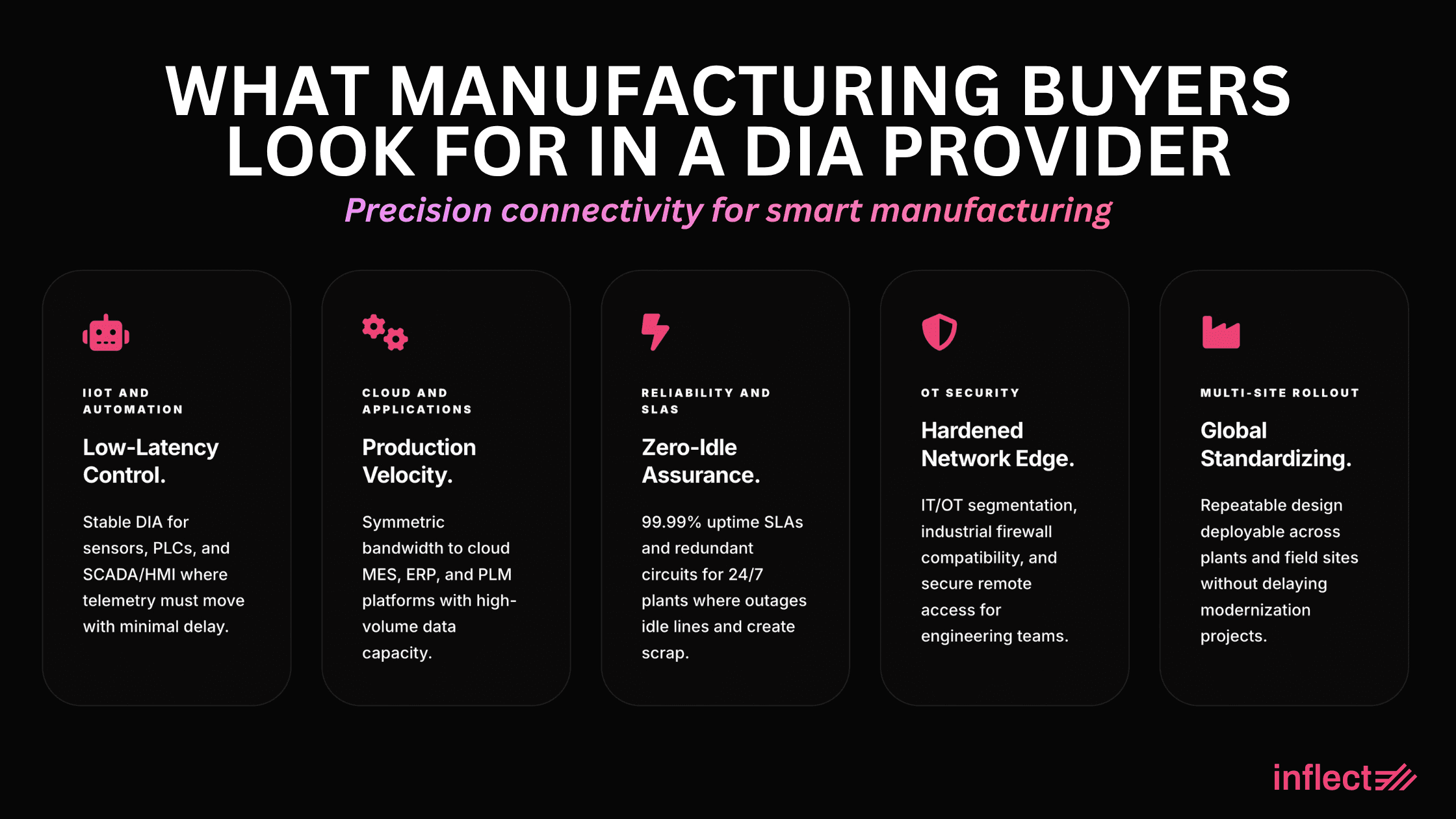
Manufacturing IT, OT, and network teams evaluate dedicated internet providers across five core dimensions. The table below reflects what consistently appears in manufacturing connectivity RFPs and procurement discussions.
Dimension | What Manufacturing Buyers Expect |
|---|---|
IIoT and Automation | Stable, low-latency DIA for sensors, PLCs, SCADA/HMI, historians, and automated production lines where control commands and telemetry must move with minimal delay. |
Cloud and Applications | Reliable symmetric bandwidth to cloud-hosted MES, ERP, PLM, quality systems, and analytics platforms, with high-volume data transfer capacity for production and sensor data. |
Reliability and SLAs | High uptime SLAs of 99.9 to 99.99 percent, fast mean time to repair, and redundant circuit options for 24/7 plants where even brief outages idle lines and create scrap. |
OT Security | Segmentation support between IT and OT networks, industrial firewall and IPS compatibility, secure remote access for engineers and vendors, and monitoring at the internet edge. |
Multi-Site Rollout | Repeatable design and consistent SLA standards deployable across multiple plants, warehouses, and field sites, with clear installation timelines that do not delay greenfield or modernization projects. |
Where Manufacturing Companies Actually Use DIA
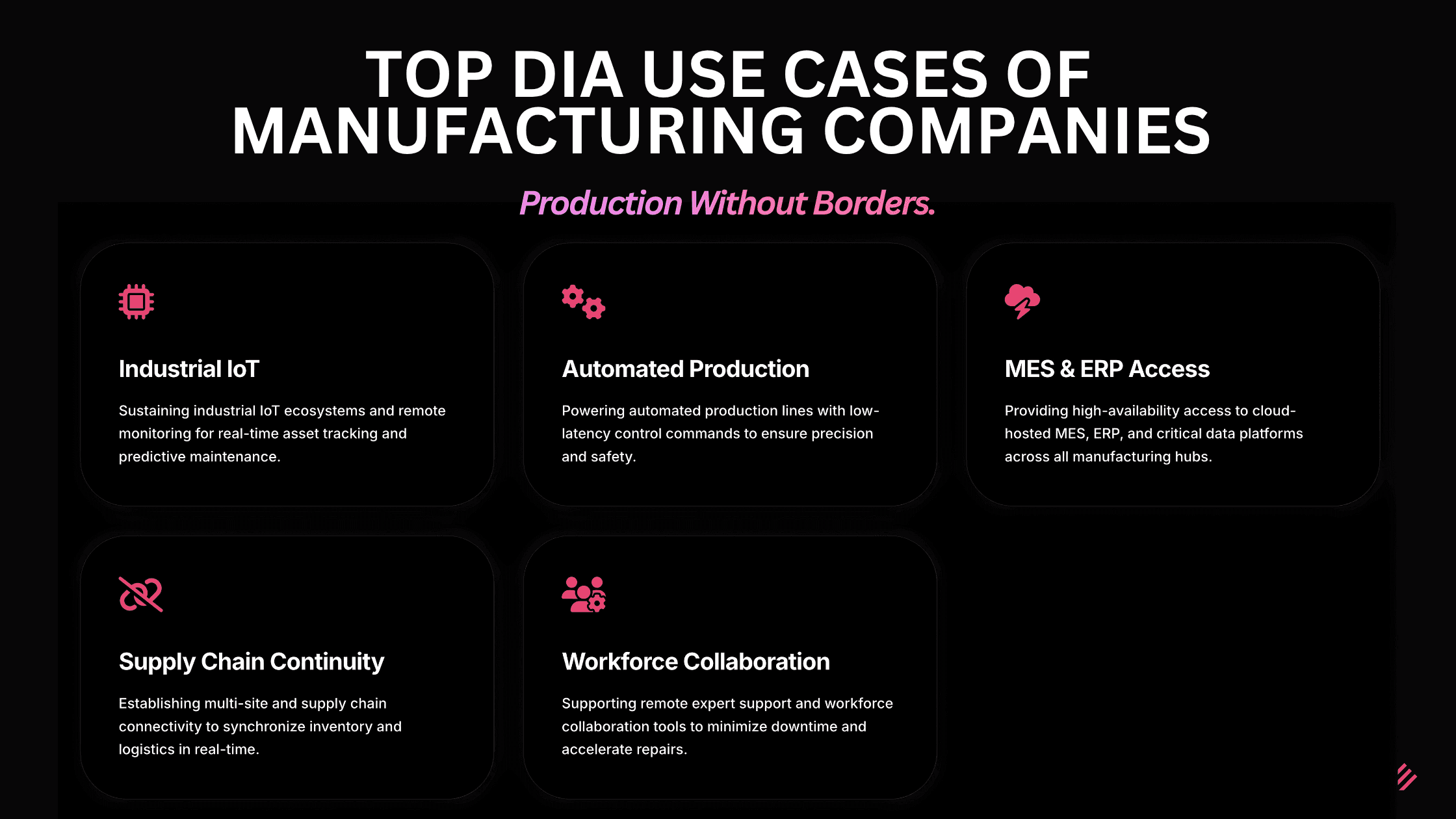
Manufacturing companies use dedicated internet access across five core areas: industrial IoT and remote monitoring, automated production and low-latency control, cloud MES, ERP, and data platform access, multi-site and supply chain connectivity, and remote support and workforce collaboration.
Industrial IoT and Remote Monitoring
Dedicated internet access keeps IIoT and remote monitoring systems continuously connected by providing the stable, low-jitter bandwidth that sensors, PLCs, SCADA/HMI systems, historians, and edge gateways need to send real-time telemetry to on-premises or cloud analytics platforms without interruption or data loss. Modern manufacturing plants run hundreds to thousands of connected devices. Each one generates data that feeds asset performance management systems, predictive maintenance platforms, quality monitoring tools, and operational dashboards. That data flow is continuous, not bursty, and it depends on a reliable internet connection from an internet provider that does not degrade at peak production hours. With hundreds of connected devices streaming data simultaneously, the connection must hold its committed rate under sustained load.
A shared broadband connection introduces the kind of variability that makes real-time monitoring unreliable. Packet loss causes data gaps. Congestion introduces latency that turns real-time dashboards into delayed indicators. DIA eliminates those variables by providing uncontended bandwidth at a committed rate, giving IIoT infrastructure the stable upstream path it needs to deliver the operational visibility plant leadership and engineering teams depend on.
For technical teams: Plants with moderate IIoT deployments typically target 500 Mbps to 1 Gbps on a business fiber circuit as a starting point, with larger facilities moving to multi-gigabit circuits as data volume grows. Note that actual speeds vary on shared broadband based on network conditions; a dedicated fiber network eliminates that variability by design. Low latency, typically below 20 milliseconds round-trip to the cloud region hosting analytics platforms, is a key performance requirement for time-sensitive monitoring applications.
Automated Production Lines and Low-Latency Control
Dedicated internet access supports automated production line operations by providing the low-latency, stable connectivity that coordination between OT systems on the shop floor and IT systems in data centers or cloud environments requires, where delays or jitter in control commands and telemetry can disrupt production sequences or trigger safety responses. As manufacturing moves toward greater automation, the volume and time-sensitivity of data moving between the production floor and connected systems increases. MES platforms receive production status updates. ERP systems process inventory and scheduling data. Remote diagnostics tools monitor line performance. Each of these integrations depends on the network connection performing consistently.
DIA's uncontended bandwidth reduces the jitter and congestion that can interfere with control loops and time-sensitive IIoT data flows. Reliable connectivity and good internet speed are not optional for plants where automated lines run continuously across multiple shifts. A connection that degrades during peak production hours is not a minor inconvenience. It is a production risk.
Cloud MES, ERP, and Data Platform Access
Dedicated internet access provides the reliable, high-capacity connectivity that manufacturing companies need to operate cloud-hosted MES, ERP, PLM, quality systems, and data lake environments continuously, with consistent access for plant users and the high-volume data transfers that feed production analytics and reporting. The shift toward cloud-hosted manufacturing applications has made the internet connection between the plant and the cloud as operationally important as the local network inside the facility. If the business internet service is slow or unreliable, the cloud application is slow or unreliable for every user on the plant floor, regardless of how well the application itself performs. Fast download speeds and consistent upload capacity across multiple users simultaneously is what plants running cloud-hosted production software actually require.
According to IDC, the global Internet of Things market is projected to exceed US$1.29 trillion by 2028, driven by advances in AI, edge devices, and deeper IoT integration. Manufacturing is consistently one of the largest IoT‑spending industries in IDC’s forecasts, as factories invest in connected equipment, smart‑factory projects, and Industry 4.0 use cases (IDC, 2024) Every cloud-connected plant in that adoption wave depends on a dedicated internet connection to get full value from the platforms it is investing in.
Multi-Site Manufacturing and Supply Chain Connectivity
Dedicated internet access for multi-site manufacturing organizations delivers consistent, SLA-backed connectivity at every plant, warehouse, field site, and distribution center, enabling real-time inventory visibility, logistics coordination, and shared access to centralized applications and partner portals across the full operational footprint. Manufacturing operations rarely run from a single location. Plants, warehouses, suppliers, design centers, and logistics partners all need to exchange data continuously. A connectivity strategy that works reliably at the main facility but delivers inconsistent performance at satellite plants creates operational inconsistency that IT and plant management teams spend significant time managing.
The right DIA provider can roll out consistent connectivity designs across multiple locations, with the same SLA standards and security posture at every site. For organizations expanding into new facilities or modernizing existing plants, professional installation with clear timelines and predictable construction requirements is equally important. Reliable internet at every business location from day one means production ramp-up is not delayed by connectivity provisioning.
Remote Support, Engineering Access, and Workforce Collaboration
Dedicated internet access enables secure remote access and workforce collaboration by providing the reliable, low-latency internet connection that engineers, OEM vendors, and technicians need to access SCADA/HMI systems, IIoT platforms, and OT environments remotely for diagnostics, maintenance, and troubleshooting, without exposing production systems to unnecessary risk. Remote maintenance has become standard practice across manufacturing. Equipment vendors diagnose issues remotely. Engineering teams in central offices access plant systems across geographies. AR-assisted maintenance tools deliver guidance to technicians on the floor. Video conferencing for shift handovers and remote engineering reviews keeps teams connected across sites. All of these use cases depend on a stable, wired connection that performs reliably under the sustained demands of remote OT access and keeps everyone who needs to stay connected actually connected.
DIA provides the secure foundation for VPN and zero-trust remote access architectures that give authorized users reliable connectivity into plant systems while enforcing the least-privilege policies and monitoring that OT security frameworks require.
The OT Security Case for Dedicated Internet Access
Dedicated internet access directly strengthens OT security posture by providing a controlled, private internet edge where built-in security capabilities including industrial firewalls, IPS, and network segmentation can be applied to protect internet-connected production equipment from the cyber threats that arrive over the public internet. For manufacturing organizations evaluating business internet options, security at the network edge is no longer separable from the connectivity decision itself.
Manufacturing environments historically ran on isolated OT networks that had no direct internet exposure. As plants connect more devices and systems to cloud platforms, those boundaries dissolve. Every IIoT device with an upstream path to a cloud platform, every remote access session opened for a vendor, and every cloud MES query represents a potential entry point if the internet edge is not properly controlled.
A dedicated internet connection with a static IP is a defined, accountable edge that security teams can instrument. Internet access for specific OT systems can be precisely controlled. Outbound connections can be whitelisted. Inbound access can be restricted and logged. Segmentation between IT and OT zones can be enforced at the internet edge rather than relying on internal network controls alone. For manufacturers moving toward IEC 62443 alignment or responding to increased regulatory scrutiny of OT security, the internet edge is a primary enforcement point and DIA gives security teams the stable, controllable foundation they need to operate it effectively.
When evaluating DIA providers for OT security alignment, manufacturing organizations should ask for:
Industrial firewall and IPS compatibility: Confirm the provider's circuit design works with the industrial security infrastructure already in place or planned, including leading OT-aware firewall and monitoring platforms.
Network segmentation support: The ability to implement logical or physical separation between IT and OT traffic at the internet edge, keeping production systems isolated from general business internet usage.
Secure remote access architecture: Support for VPN termination and zero-trust remote access frameworks that enforce least-privilege access to SCADA, HMI, and IIoT platforms for engineers and vendors.
Monitoring and logging: DIA edge logging that feeds SIEM and OT monitoring platforms, giving security teams visibility into traffic patterns and potential anomalies at the internet boundary.
SOC 2 and compliance documentation: Providers that carry current attestations and can support vendor risk assessments simplify the procurement process for organizations operating under NIST, IEC 62443, or internal OT security frameworks.
Questions Worth Asking Before You Sign
Not all dedicated internet providers understand the operational demands of manufacturing environments. Before committing to a provider, these are the questions that matter:
What latency can you guarantee to our cloud region? For IIoT and SCADA monitoring applications, round-trip latency to the cloud platform matters as much as raw bandwidth. Ask for a specific latency commitment to the relevant cloud region, not just a general uptime SLA.
What is your committed information rate, and is it symmetric? Manufacturing plants upload as much data as they download. Confirm the provider offers true symmetrical speeds and that the committed rate is contractual, not estimated.
What uptime SLA do you offer, and what does it cover? For 24/7 plants, ask specifically what qualifies as a reportable outage, what the financial remedies are, and what the mean time to repair commitment is.
Can you support redundant circuits with diverse physical routing? A second circuit sharing the same conduit as the first does not provide real redundancy. Ask specifically whether dual circuits enter the facility via physically separate routes.
Do you have on-net coverage at all of our plant locations? For multi-site manufacturers, consistent DIA coverage across every facility is essential. A provider that covers the main plant but cannot serve satellite locations creates the operational inconsistency you are trying to eliminate.
What is your experience with OT and industrial environments? Manufacturing connectivity has specific requirements around segmentation, remote access architecture, and OT security integration. Ask whether the provider has experience deploying in industrial environments and what support looks like during planned maintenance windows.
What are your installation lead times? For new facilities or modernization projects, connectivity delays push back production ramp-up. Get specific lead time commitments for on-net and near-net locations before signing.
The Bottom Line
Dedicated internet access for manufacturing companies provides the reliable, low-latency connectivity foundation that IIoT systems, cloud-hosted MES and ERP platforms, automated production lines, and remote access operations depend on to perform consistently across every shift, at every site, without introducing connectivity as a source of production risk.
Manufacturing's digital transformation, from basic connectivity to full Industry 4.0 integration, makes the internet infrastructure decisions companies make today consequential for the operational capabilities they will need to run at scale tomorrow. A shared broadband connection introduces variability that is incompatible with always-on production environments. Selecting the right internet plan is not just a cost decision for manufacturers. A dedicated business fiber internet service with guaranteed bandwidth, symmetrical speeds, low-latency performance, formal SLAs, and OT-aware security support is a reliable internet service foundation that smart factory operations are built on.
Source Dedicated Internet Access for Your Manufacturing Operations
Guaranteed bandwidth from 500 Mbps to 10 Gbps and above. Symmetrical upload and download speeds. 99.99% uptime SLAs with fast repair commitments. Low-latency connectivity to cloud MES, ERP, and IIoT platforms. OT-compatible security architecture. Consistent performance across every plant and warehouse in your network.
→ Source Manufacturing DIA
Not sure which provider or solution will work? Let our Manufacturing DIA Expert handpick the right option for you
About the Author

Chanyu Kuo
Director of Marketing at Inflect
Chanyu is a creative and data-driven marketing leader with over 10 years of experience, especially in the tech and cloud industry, helping businesses establish strong digital presence, drive growth, and stand out from the competition. Chanyu holds an MS in Marketing from the University of Strathclyde and specializes in effective content marketing, lead generation, and strategic digital growth in the digital infrastructure space.
Contact:
Email: