10 mins
Dedicated Internet Access for Logistics and Supply Chain Companies
In logistics, connectivity is an integral part of efficient operations. Every scan at a warehouse dock, every GPS ping from a fleet vehicle, every API call exchanging shipment status with a customer portal, and every routing decision fed by live traffic and weather data depends on the internet connection performing reliably at that exact moment. When it does not, the consequences are immediate and measurable: missed delivery windows, SLA penalties, idle labor, backed-up facilities, and customers who receive silence where they expected a real-time status update. In logistics, a network outage is not a background IT event. It shows up on the dock within minutes.
The global logistics industry was valued at just over US$9.4 trillion in 2023 and is projected to reach around US$14.6 trillion by 2030, driven by rising e‑commerce volumes, globalization, and the expansion of digitally connected supply chain networks (Statista, 2025). Other market studies similarly forecast the global logistics market roughly doubling over the next decade, with estimates in the US$20–23 trillion range by the early 2030s as e‑commerce, nearshoring, and tech‑enabled supply chains continue to scale (Yahoo Finance, 2025). That growth puts more pressure on the connectivity infrastructure underpinning logistics operations, not less. More shipments, more integration points, more customer-facing digital services, and more distributed facilities all create greater dependency on a network connection that performs consistently at every node.
Dedicated internet access (DIA)is a private, unshared internet connection with guaranteed bandwidth, symmetrical upload and download speeds, low latency, and contractual uptime backed by formal service level agreements (SLAs). It is the foundation of reliable connectivity for logistics operations that cannot afford a best-effort connection. For logistics companies where connectivity disruptions translate directly into SLA penalties, missed delivery commitments, and customer trust erosion, it is the internet infrastructure standard that 24/7 supply chain operations are built on.
In logistics, a connectivity outage is not an IT incident. It is an operational failure that shows up immediately in missed pickups, late deliveries, and the SLA penalty invoices that follow.
What Makes Dedicated Internet Access Different for Logistics
Dedicated internet access is different from standard broadband internet because the bandwidth is private, guaranteed, and delivers consistent speeds at all times, not internet speeds that fluctuate based on congestion or what other businesses on the same shared line are doing at peak shipping hours. Logistics facilities run at their highest internet demand precisely when they run at their highest operational demand: peak season surges, daily sort windows, end-of-day reporting runs, and the real-time carrier API exchanges that determine whether shipments leave on time. A shared business internet connection that degrades under load because other businesses on the same line are also hitting peak usage is not a manageable tradeoff in that environment.
Unlike broadband, a dedicated internet connection provides a committed information rate: the bandwidth your organization purchases is always available, in full, in both directions. For distribution centers uploading high volumes of scan data, label records, and EDI (Electronic Data Interchange) transactions, and for TMS (Transportation Management System) and WMS (Warehouse Management System) platforms receiving and sending data continuously throughout the operational day, that symmetrical capacity matters as much in the outbound direction as the inbound. Symmetrical upload and download speeds also support video calls for dispatch teams, transferring large files of shipment records and EDI archives, real-time collaboration across sites, and the telematics data flows that feed visibility platforms and customer portals.
For logistics IT and operations teams, the difference between DIA and broadband is a direct difference in operational efficiency and reliability. One introduces unpredictable variability into workflows where every minute of delay has a downstream cost. The other eliminates that variable entirely.
What Logistics Buyers Look for in a DIA Provider
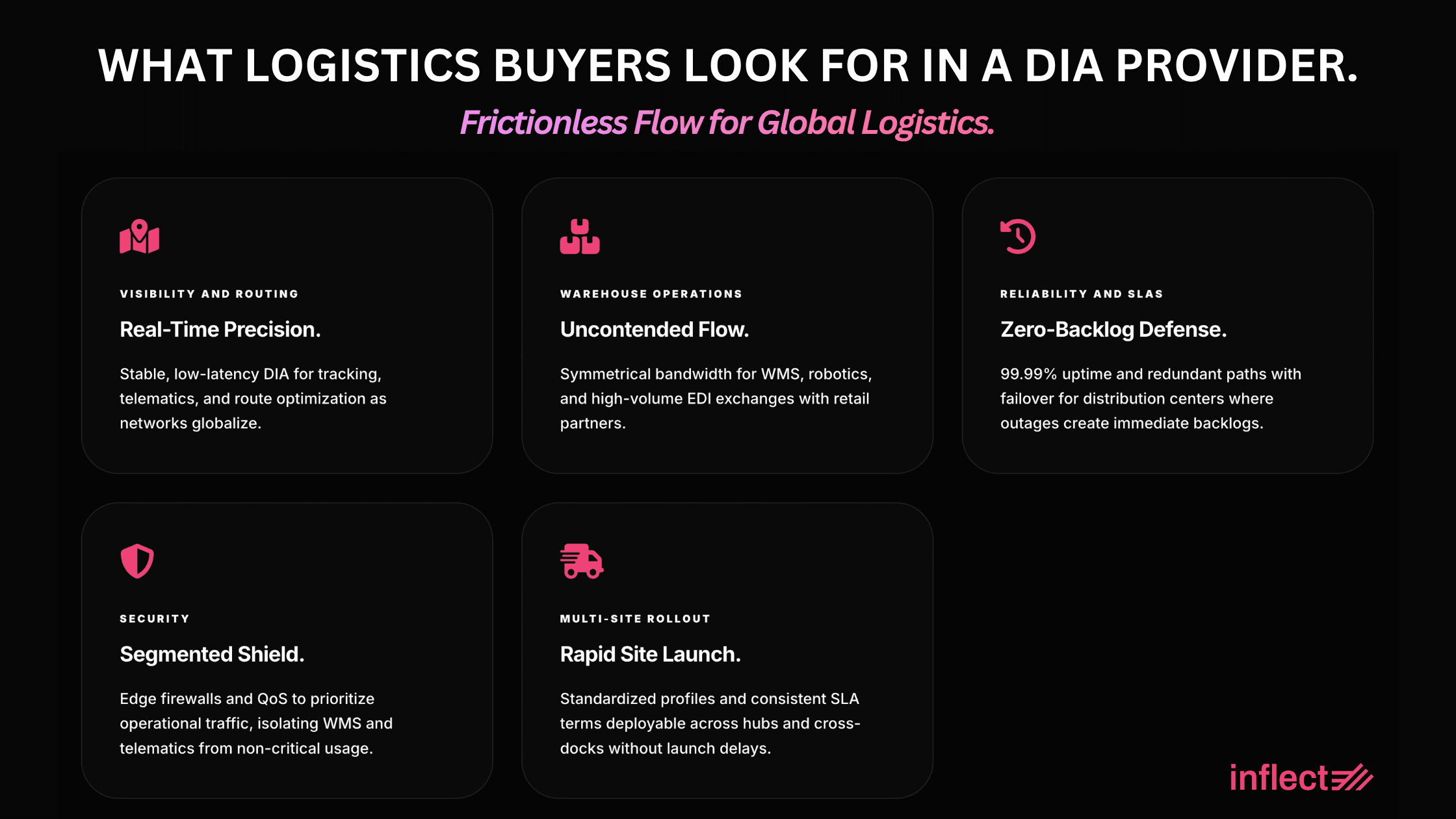
Logistics IT, operations, and network teams evaluate dedicated internet providers across five core dimensions: Visibility & Routing, Warehouse Operations, Reliability & SLAs, Security, and Multi-Site Rollout. The table below reflects what consistently appears in logistics connectivity RFPs and procurement discussions.
Dimension | What Logistics Buyers Expect |
|---|---|
Visibility and Routing | Stable, low-latency DIA for real-time tracking, telematics, carrier APIs, and route optimization engines, with multi-region and multi-cloud connectivity as logistics networks globalize. |
Warehouse Operations | Symmetrical, uncontended bandwidth for WMS, handheld scanners, conveyors, AS/RS, robotics, label printing, and high-volume EDI exchanges with retailers, marketplaces, and 3PL partners. |
Reliability and SLAs | High uptime SLAs of 99.9 to 99.99 percent, fast mean time to repair, and redundant paths with SD-WAN failover for 24/7 distribution centers and cross-dock facilities where outages create immediate backlogs. |
Security | Edge firewalls, VPN and zero-trust access, QoS (Quality of Services) to prioritize operational traffic, and network segmentation to isolate WMS and telematics from guest Wi-Fi and non-critical usage. |
Multi-Site Rollout | Standardized DIA profiles and consistent SLA terms deployable across DCs, regional hubs, cross-docks, and major depots, with clear installation timelines that do not delay new site launches. |
Where Logistics Companies Actually Use DIA
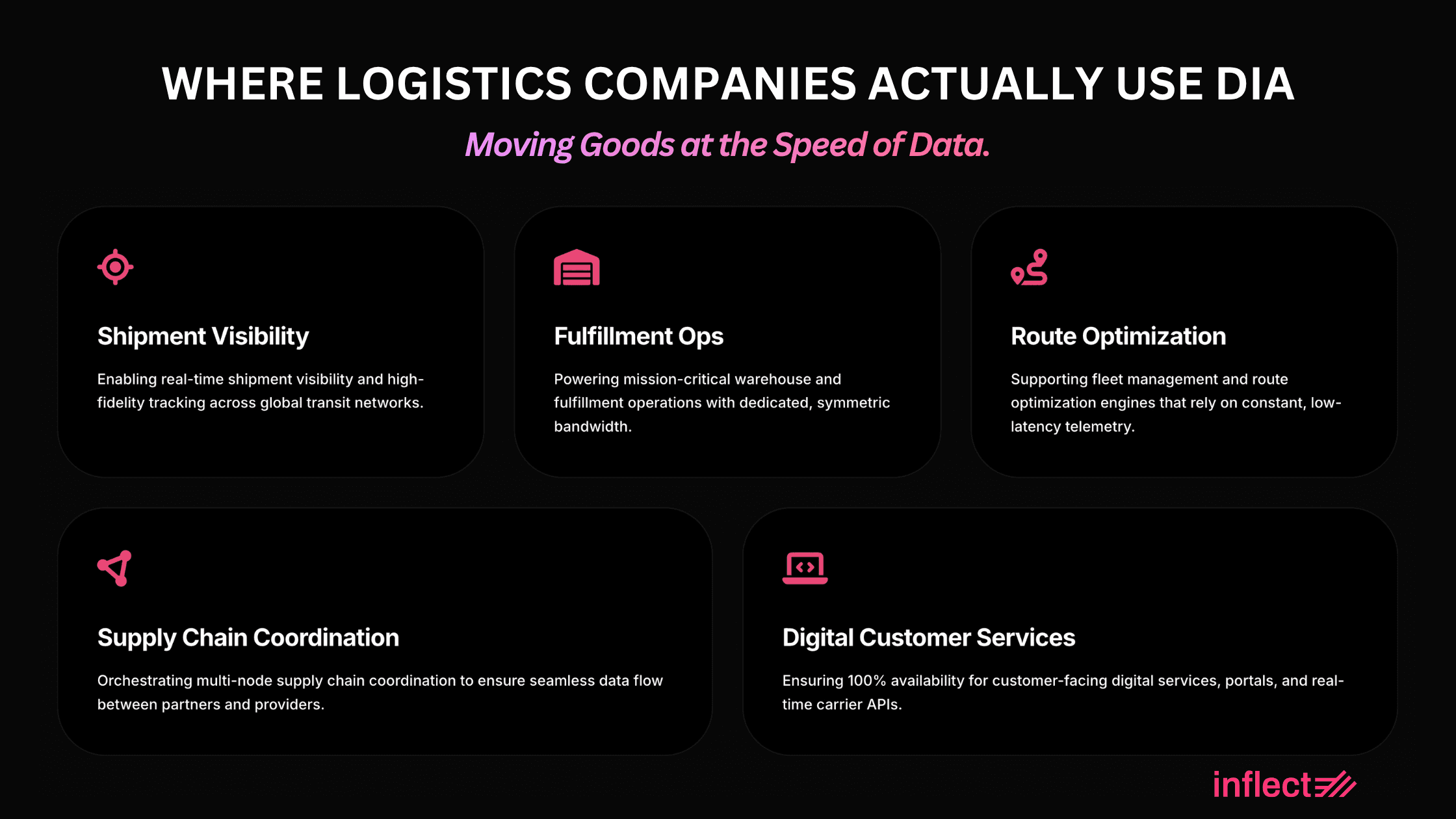
Logistics companies use dedicated internet access across five core areas: real-time shipment visibility and tracking, warehouse and fulfillment operations, fleet management and route optimization, multi-node supply chain coordination, and customer-facing digital services.
Real-Time Shipment Visibility and Tracking
Dedicated internet access keeps real-time shipment visibility systems online with high availability and low latency, providing the continuous connectivity that TMS platforms, carrier APIs, GPS and ELD (Electronic Logging Devices) telematics feeds, and customer-facing tracking portals depend on to exchange data without packet loss or interruption throughout every operational hour. Visibility is the product that logistics companies sell to their shippers. A customer-facing tracking portal that goes offline, a TMS that loses its carrier API connection during a critical handoff window, or a live tracking dashboard that goes stale during peak volume are all immediate customer experience failures that erode the trust logistics relationships are built on.
A shared broadband connection with no uptime SLA introduces the kind of latency spikes and congestion that turn real-time visibility into near-real-time at best. DIA provides guaranteed performance and uncontended bandwidth that keeps data flowing at the speed operations require. Proactive monitoring from a provider with a formal SLA means connectivity issues are caught before they affect the tracking data customers and shippers expect to see in real time. As logistics networks expand across regions and cloud platforms, DIA also needs to support multi-region and multi-cloud connectivity reliably. A TMS hosted in one cloud region and a WMS in another both require the same consistent, low-latency internet connection from every facility in the network.
Warehouse and Fulfillment Operations
Dedicated internet access supports reliable warehouse and fulfillment operations by providing the symmetrical, high-throughput bandwidth that WMS platforms, handheld scanners, conveyor systems, automated storage and retrieval systems, and robotics require to sync large amounts of data continuously with central data centers and cloud-hosted management systems over a fiber network without congestion or data loss during peak processing windows. A modern distribution center runs dozens of interconnected systems simultaneously. Scanners confirm receipts and picks. Label printers generate shipping documents. WMS platforms update inventory in real time. EDI transactions exchange order data with retailers, marketplaces, and 3PL partners. Each of these creates continuous, bidirectional data flows that require consistent upload and download capacity throughout the operational day.
For technical teams: Distribution centers with moderate automation typically target 500 Mbps to 1 Gbps of dedicated internet. Actual speeds vary on shared broadband based on congestion; a dedicated connection eliminates that variability. Fast download speeds and consistent upload capacity are both equally important given the bidirectional nature of warehouse data flows. SD-WAN orchestration that automatically fails over WMS, scanner, and telematics traffic to a secondary DIA or LTE/5G link during a primary circuit issue is the standard resilience architecture for facilities that cannot afford a single point of failure. QoS policies that prioritize WMS, scanning, and carrier API traffic over bulk transfers and non-critical internet usage ensure that operational workflows are protected even when overall bandwidth is under pressure. Larger facilities running heavy robotics, AS/RS, and high-volume EDI workflows often require multi-gigabit circuits, particularly during peak season when scan and transaction volumes can spike significantly above baseline. QoS policies that prioritize WMS and scanner traffic over bulk transfers and non-critical office traffic are a standard configuration in well-designed logistics network architectures.
Fleet Management and Route Optimization
Dedicated internet access enables reliable fleet management and route optimization by providing the stable, low-latency connectivity that depot and yard systems need to ingest live traffic, weather, and telematics data into route optimization engines, coordinate dynamic dispatch decisions, and sync with the edge devices at gate kiosks, yards, and loading bays that drivers and dock staff interact with throughout the operational day. Fleet operations run on real-time data and depend on every edge device staying connected through a stable, often ethernet-wired connection at each depot. A dispatcher making routing decisions based on stale traffic data, a yard management system that cannot confirm gate activity because the connection dropped, or gate kiosk devices that lose sync with central systems all create operational inefficiency that compounds across every vehicle and facility in the network. The connectivity profile at every depot and yard needs to support not just the back-office systems but also the edge devices that dock workers and drivers interact with continuously throughout the operational day.
DIA provides the uncontended bandwidth that keeps telematics and fleet data flowing at the cadence route optimization engines require. For logistics companies that have moved dispatch and fleet management to cloud-hosted platforms, the quality of the internet service at each depot and hub is the direct determinant of how well those platforms perform. Reliable internet connectivity from a service provider with a formal SLA and proactive monitoring is a non-negotiable requirement for real-time fleet operations. When latency or packet loss creeps into the connection between a depot and its cloud routing platform, dispatch decisions slow and fleet efficiency drops.
Multi-Node Supply Chain Coordination
Dedicated internet access for multi-site logistics networks delivers consistent, SLA-backed connectivity at every node in the supply chain footprint, from distribution centers and cross-docks to regional hubs, ports, and partner facilities, enabling real-time inventory data sharing, EDI and API exchanges with carriers and shippers, and coordinated fulfillment across the full network. Logistics networks are inherently distributed, with many connected devices and systems across multiple locations requiring stable internet access simultaneously. Standardized solutions that deliver consistent performance at every node are what logistics IT teams actively look for when evaluating connectivity for their network. A connectivity strategy that works reliably at the primary distribution center but delivers inconsistent performance at regional depots creates the kind of operational inconsistency that leads to inventory discrepancies, delayed handoffs, and the downstream SLA penalties that follow.
The right DIA provider can roll out standardized DIA profiles across all nodes, with the same SLA standards, security posture, and bandwidth tiers at every facility. Standardization is operationally significant for logistics IT teams: a repeatable design that can be deployed at a new DC or regional depot without custom engineering at each site reduces rollout time and the management overhead of maintaining different connectivity configurations across the network. For logistics companies expanding into new markets or opening new facilities, professional installation with predictable timelines from an internet provider with on-net coverage at the target business location is equally critical. Connectivity delays at a new distribution center push back the operational launch date and the revenue that should flow from it.
Customer-Facing Digital Services and Support
Dedicated internet access keeps customer-facing logistics platforms and support operations available and responsive by providing the guaranteed uptime and consistent bandwidth that branded tracking portals, self-service shipping tools, notification systems, and contact center platforms running cloud CCaaS and UCaaS need to perform reliably during the peak demand periods when customer inquiries are highest. For logistics companies, customer-facing digital services and the cloud services running contact center and support platforms are increasingly the primary interface between the brand and the shipper, accessed by employees and users across multiple sites simultaneously. A tracking portal that times out, a notification that fails to send because the connection dropped, or a contact center agent who cannot access the CRM because the internet connection is congested when multiple users are online simultaneously. These create the kind of customer experience failures that generate churn in a highly competitive market. Staying connected to customers and partners is not optional infrastructure for logistics companies.
DIA provides the platform availability and connection reliability that customer-facing logistics services require to maintain the service level commitments written into shipper contracts.
The SLA Penalty Argument for DIA Investment
Dedicated internet access is most accurately framed as a risk management investment for logistics companies, where the cost of the connectivity is evaluated against the direct financial exposure of the SLA penalties, missed delivery commitments, and extra labor costs that network outages and degraded connectivity produce.
This framing matters because logistics operations are run to contractual commitments. Shippers write delivery SLAs into their contracts with 3PLs and carriers. Retailers impose charge-back fees and SLA penalties on logistics partners for missed delivery windows. The financial exposure from a connectivity failure that disrupts a distribution center during a critical sort window or takes a TMS offline during a carrier API exchange is not abstract. It is measurable in penalties invoiced and contracts at risk.
When logistics IT teams present the business case for DIA investment to operations and finance leadership, the comparison is not broadband cost versus DIA cost. It is DIA cost versus the combined financial exposure of the outages, SLA penalties, missed pickups, idle labor, extra detention and demurrage charges, and customer relationship damage that unreliable connectivity produces. Business continuity in logistics depends on reliable internet service at every facility in the network. Logistics buyers who frame DIA as a risk management spend rather than an IT line item consistently find the business case straightforward. Selecting the right internet plan with a dedicated connection is not a premium decision. It is the cost-effective choice when the full picture of risk is on the table.
When evaluating DIA providers for logistics operations, procurement teams should confirm:
Committed information rate and symmetrical speeds: TMS, WMS, and telematics all require consistent upload and download capacity. Confirm the CIR is contractual and that the provider delivers true symmetrical bandwidth under load.
Uptime SLA scope and MTTR commitment: For 24/7 facilities, ask what qualifies as a reportable outage, what the financial remedies are, and what the mean time to repair commitment is. An 8-hour MTTR at a facility processing thousands of shipments per hour is an unacceptable risk.
Redundant circuit options with diverse routing: A second circuit sharing the same conduit as the primary does not provide real redundancy. Dual circuits with physically diverse paths, or DIA combined with 5G or fixed wireless internet failover, are the standard for mission-critical logistics hubs. A static IP address for consistent remote access to operational systems is also a standard requirement.
SD-WAN compatibility: Most logistics networks use SD-WAN to orchestrate traffic and failover across multiple links. Confirm the DIA provider's circuits integrate cleanly with the SD-WAN platform already in use.
On-net coverage across all locations: For distributed logistics networks, consistent DIA availability at every DC, hub, depot, and cross-dock is non-negotiable. A provider that covers the primary facility but cannot serve regional depots creates the operational inconsistency the investment is meant to eliminate.
QoS and traffic prioritization support: The ability to prioritize WMS, scanning, routing, and voice traffic over bulk transfers and non-critical internet usage at the network edge is a meaningful operational capability. Confirm whether QoS configuration is included in the service or requires additional procurement.
Security at the internet edge: Built-in security through edge firewall, VPN support, and network segmentation protects shipment data, customer information, and OT systems from the cyber threats arriving over the public internet. In logistics, a compromised WMS or carrier portal is not just a data breach. It is an operational disruption.
Questions Worth Asking Before You Sign
Not all dedicated internet providers understand the operational demands of logistics and supply chain environments. Before committing, these are the questions that matter most:
What latency can you guarantee to our cloud region? TMS, WMS, and routing platforms hosted in cloud environments are only as responsive as the connection reaching them. Ask for a specific latency commitment to the relevant cloud region.
What is your uptime SLA, and what exactly does it cover? Get specifics on what qualifies as an outage, what maintenance windows look like, what the financial remedies are, and what the MTTR commitment is.
Can you support redundant circuits with physically diverse routing? For primary logistics hubs and distribution centers, business continuity depends on true redundancy. Confirm the paths are physically separate.
Do you have on-net coverage at all of our facilities? Verify coverage at every site, including regional depots and newer locations that may be in less central markets.
What are your installation lead times? New facility openings cannot slip because connectivity provisioning is delayed. Get specific commitments for on-net and near-net locations before signing.
How does your service integrate with our SD-WAN environment? Confirm compatibility with the SD-WAN platform in use and whether the provider has deployment experience in logistics network architectures.
What controls do you support against ransomware and business portal compromise? Logistics operations have become high-value targets for ransomware and business email or portal compromise attacks. Ask about inbound traffic controls, anomaly monitoring, and whether the provider supports segmentation between operational systems and general internet traffic at the network edge.
The Bottom Line
Dedicated internet access for logistics and supply chain companies provides the reliable, always-on connectivity foundation that real-time visibility systems, warehouse operations, fleet management platforms, and customer-facing services depend on to perform consistently across every shift, at every node, without introducing connectivity as a variable that produces SLA penalties and missed delivery commitments.
The logistics industry's growth trajectory, with global logistics costs forecast to reach $14.62 trillion by 2030, is built on the expectation that digital supply chain infrastructure performs reliably at scale. A shared broadband connection routed over the public internet with no performance guarantees introduces the kind of variability that 24/7 logistics operations cannot absorb. Choosing the right internet plan for business connectivity is a strategic decision in logistics, not a commodity purchase. The competitive advantage of a well-run logistics network is speed, reliability, and visibility. A dedicated internet service that is secure, low-latency, formally SLA-backed, and consistently available across the full network footprint is the baseline those advantages are built on.
Source Dedicated Internet Access for Your Logistics Network
Guaranteed bandwidth from 500 Mbps to 10 Gbps and above. Symmetrical upload and download speeds. 99.99% uptime SLAs with fast mean time to repair. Low-latency connectivity to cloud TMS, WMS, and routing platforms. Redundant circuit options for 24/7 distribution centers and hubs. Consistent performance standards across every facility in your network.
→ Source Logistics DIA
If You Are Unsure Which DIA Provider or Solution Will Meet Your Logistic Company's Needs?
About the Author

Chanyu Kuo
Director of Marketing at Inflect
Chanyu is a creative and data-driven marketing leader with over 10 years of experience, especially in the tech and cloud industry, helping businesses establish strong digital presence, drive growth, and stand out from the competition. Chanyu holds an MS in Marketing from the University of Strathclyde and specializes in effective content marketing, lead generation, and strategic digital growth in the digital infrastructure space.
Contact:
Email: