8 mins
Dedicated Internet Access for Healthcare Organizations
Picture this: it is 2 a.m. in the emergency department. A patient comes in unresponsive. The nurse pulls up the EHR to check medication history and the screen freezes. The system is down. The team works around it, but those extra minutes matter.
Network outages in healthcare are not IT problems. They are patient safety events. Based on recent healthcare downtime studies, hospitals can lose between 7.5k and 25k dollars for every minute core systems or internet-dependent apps are offline, translating to 1.5–3.2 million dollars per hour for larger facilities (IT for Scrubs, 2025, Symmetric IT Group, 2025)
Dedicated internet access (DIA) is the infrastructure decision that closes that gap. It is a private, dedicated internet connection used exclusively by your organization, with guaranteed performance, contractual uptime, and a service provider that is financially accountable when they fall short.
''A network outage in healthcare is not a productivity issue. It is a patient safety event.''
What Makes Dedicated Internet Access Different
Dedicated internet access (DIA) is different from standard business broadband because the bandwidth is private, guaranteed, and backed by a contractual service level agreement, not shared with other tenants and subject to congestion. Standard broadband connections share capacity across an entire building or neighborhood. When that shared line gets busy, speeds drop and latency increases. For most businesses that is a minor frustration. For a clinician pulling up imaging results or a provider mid-telehealth consultation, it can directly affect the quality of care being delivered.
Dedicated internet access gives your organization a private circuit. No shared tenants. No contention. Unlike broadband internet, where speeds vary based on how many other users are online at the same time, DIA delivers symmetrical speeds and the full bandwidth you are paying for, consistently, around the clock, backed by a formal service level agreement that holds the service provider financially accountable if they do not deliver.
For healthcare, that distinction is not technical nuance. It is the difference between a network built to match the stakes of clinical work and one built for the lowest common denominator.
What Healthcare Buyers Look for in a DIA Provider
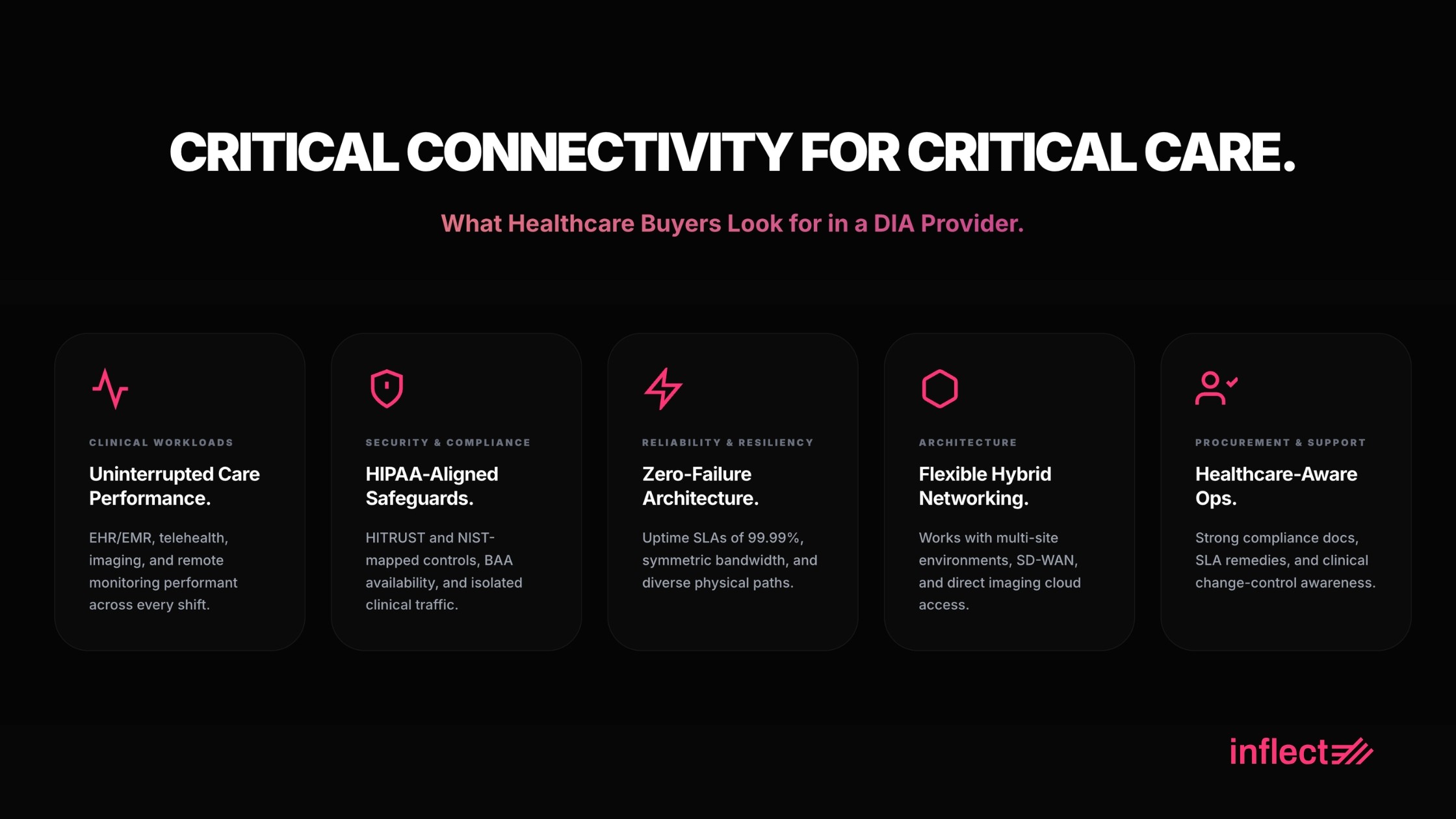
Healthcare IT, network, and compliance teams evaluate dedicated internet providers across five core dimensions: clinical workloads, security and compliance, reliability and compliance, architecture, and procurement and support. The table below reflects what consistently shows up in healthcare RFPs and procurement discussions.
Dimension | What Healthcare Buyers Expect |
Clinical Workloads | EHR/EMR, telehealth, imaging, remote monitoring, and connected devices always available and performant across every shift. |
Security and Compliance | HIPAA-aligned safeguards, HITRUST and NIST-mapped controls, BAA availability, and network segmentation to isolate clinical traffic. |
Reliability and Resiliency | Uptime SLAs of 99.9 to 99.99 percent, symmetric bandwidth, diverse physical paths, automatic failover, and fast mean time to repair. |
Architecture | Works with multi-site environments, hybrid WAN, SD-WAN, existing MPLS, and direct access to cloud-hosted EHR and imaging platforms. |
Procurement and Support | Strong compliance documentation, clear SLA remedies, healthcare-aware NOC support, and a team that understands clinical change-control requirements. |
Where Healthcare Organizations Actually Use DIA
Healthcare organizations use dedicated internet access to keep clinical systems available around the clock, support telehealth delivery, move large medical imaging files reliably, connect multiple care sites securely, and maintain continuous security monitoring across their network environment.
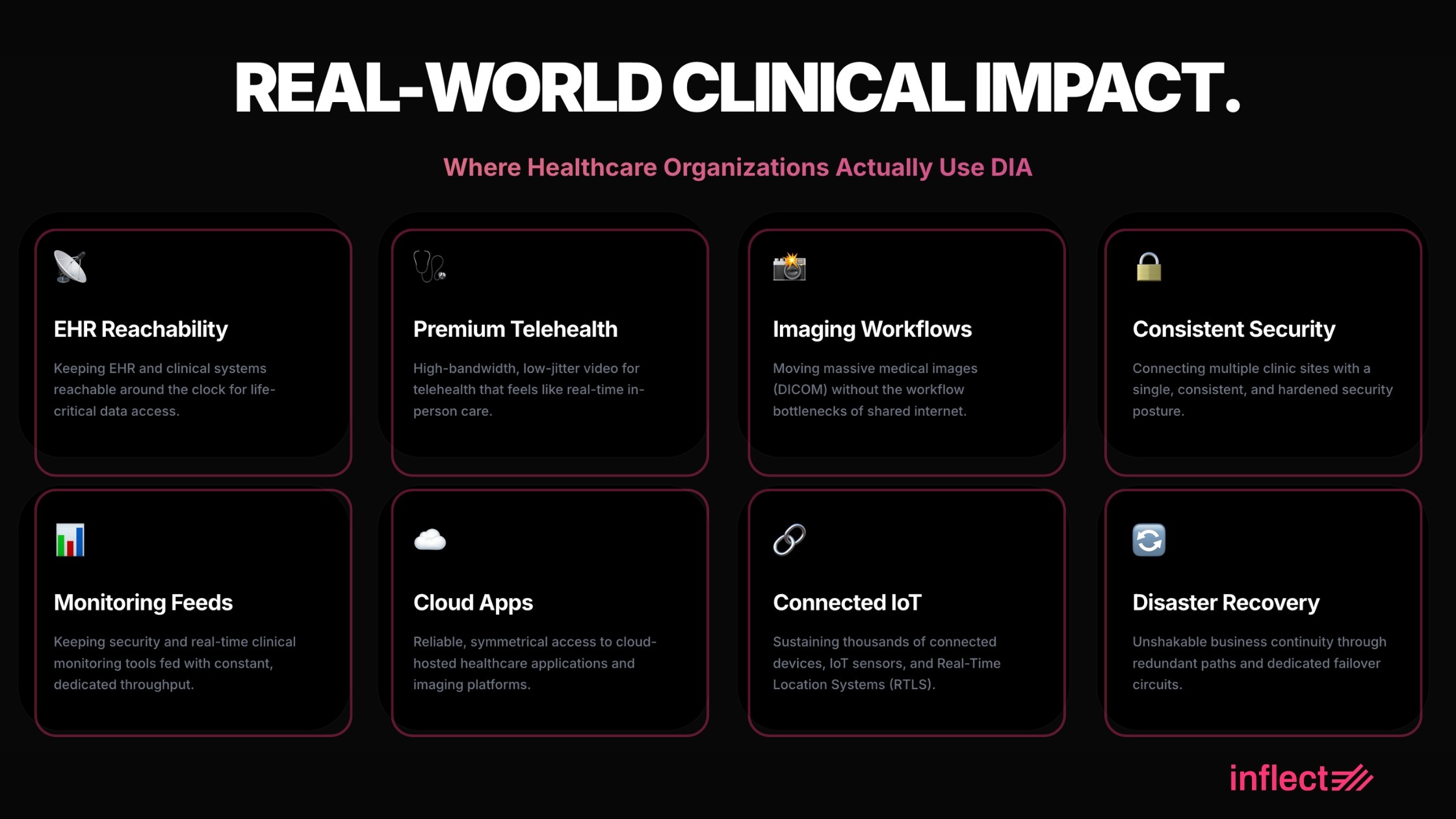
Keeping EHR and Clinical Systems Reachable Around the Clock
Dedicated internet access keeps EHR and clinical systems reachable 24/7 by providing guaranteed, uncontended bandwidth that does not degrade during peak usage periods or compete with other traffic on the same line. Epic, Cerner, and athenahealth depend on a stable, fast internet connection every minute of every shift. These are not just scheduling tools. They handle medication administration, clinical decision support, lab results, care coordination, and billing. A slow or dropped connection does not just frustrate clinicians. It creates documentation gaps, delays, and real compliance exposure.
DIA gives these critical applications the dedicated bandwidth and guaranteed uptime they deserve, not whatever is left over after the rest of the building's internet traffic has taken its share. Reliable internet connectivity is not a performance advantage for clinical systems; it is a baseline requirement.
Telehealth That Feels Like Real Care
Dedicated internet access supports reliable telehealth delivery by providing the consistent upload and download speeds and low latency that HD video consultations require, without the congestion or packet loss that cause a virtual visit to buffer, freeze, or drop. Based on the latest research from American Hospital Association, 2026, Telehealth utilization seems to have stabilized at 6-7% in primary care. For behavioral health, chronic disease management, or rural populations where telemedicine is often the only access point, a poor internet connection means a patient who does not get the care they came for.
DIA delivers the equal upload and download speeds that video conference platforms require, making a virtual visit feel like a real one rather than a choppy phone call. That reliability matters both for clinical quality and for patient trust.
Moving Medical Images Without Workflow Bottlenecks
Dedicated internet access eliminates medical imaging workflow bottlenecks by providing the predictable, high-throughput bandwidth that radiology, pathology, and cardiology departments need to move large DICOM files between sites, to cloud PACS platforms, and to specialists for second opinions without delays. A chest CT scan can be a gigabyte. A cardiology study, several more. On a congested shared network, those transfers slow down reporting and create friction that compounds across dozens of studies a day.
With a dedicated internet connection, large files move at the download speeds your team expects, consistently, without competing with everything else happening on the network at the same time.
Recommend Reading: HIPAA Compliant Bare Metal Servers for PACS Storage: Healthcare Data Dedicated Servers
Connecting Multiple Sites with a Consistent Security Posture
Dedicated internet access for multi-site healthcare organizations provides reliable, consistent connectivity at every care location, from flagship hospitals to small rural clinics, with the security controls needed to keep ePHI moving between sites in a HIPAA-compliant way. Most healthcare organizations are not a single building. They are a network of hospitals, satellite clinics, outpatient centers, urgent care locations, and partner facilities that all need to share patient records and clinical data securely.
The right DIA provider can serve all your locations with different bandwidth tiers where needed, but consistent network security standards and SLA commitments at every site.
Keeping Security and Monitoring Tools Fed
Dedicated internet access keeps healthcare security tools functioning properly by providing the stable, uninterrupted upstream path that SIEM platforms, network detection tools, and cloud-based security operations centers need to ingest real-time data continuously from across the clinical environment. A congested or unreliable internet connection does not just slow operations; it creates blind spots in security monitoring that can delay detection of a breach by hours.
For organizations relying on proactive monitoring through a SOC or managed network services partner, the reliability of that data feed is part of the compliance posture, not separate from it.
Reliable Access to Cloud-Hosted Healthcare Applications
Dedicated internet access gives healthcare organizations reliable, high-speed connectivity to the cloud-hosted platforms that clinical and operational workflows increasingly depend on, including cloud EHR systems, cloud PACS for imaging, population health analytics, and SaaS tools, without the congestion or variability that shared broadband introduces. As more healthcare applications move off-premise, the internet connection between clinicians and those platforms becomes as operationally important as the applications themselves.
A dedicated internet connection also simplifies HIPAA compliance for cloud-hosted workloads. Transmitting ePHI over a private, dedicated circuit with documented security controls and BAA coverage from the service provider is a cleaner posture than routing sensitive clinical data over a shared public internet connection with no performance or security guarantees.
Recommend Reading: HIPAA Compliant Colocation Services for Hospitals: 2026 Buyer’s Guide
The HIPAA Availability Requirement Most Teams Miss
The HIPAA Security Rule requires covered entities to ensure the availability of ePHI for authorized users, not just protect it from unauthorized access, and a shared broadband connection with no uptime SLA does not satisfy that requirement. Most healthcare IT teams focus on encryption when thinking about HIPAA and internet connectivity, which is correct but incomplete. Availability is an equally enforceable obligation under the Security Rule's Technical Safeguard requirements.
A shared broadband circuit with no uptime SLA does not satisfy that requirement. It is a best-effort service by definition. Traffic transmitted over the public internet on a shared connection carries inherent security and availability risks that dedicated internet access is specifically designed to eliminate. DIA, with its contractual uptime commitments, dedicated infrastructure, and documented network security controls, is built for exactly the availability standard HIPAA expects.
Beyond uptime, healthcare organizations evaluating DIA providers for HIPAA alignment should ask for:
Business Associate Agreement (BAA): If your DIA provider manages on-site equipment or touches your network in any way that could involve ePHI, a BAA is a HIPAA requirement, not a preference.
HITRUST and NIST control mapping: Many health systems use HITRUST CSF or NIST 800-53 as their security baseline. Providers that can show controls mapped to these frameworks simplify your vendor risk assessment process significantly.
Network segmentation options: The ability to keep clinical traffic logically or physically separated from guest Wi-Fi and general internet use reduces exposure and limits the blast radius of any incident.
SOC 2 and ISO 27001 documentation: Compliance, legal, and clinical leadership all want to see documentation. Providers with current attestations reduce the time your team spends on procurement due diligence.
Healthcare-aware support: A NOC that understands clinical change-control requirements, maintenance windows, and the patient-safety implications of an outage is meaningfully different from one that does not.
The Bottom Line
Dedicated internet access for healthcare gives clinical networks the same standard of reliability, security, and accountability that every other part of the clinical environment is held to. The operating room does not run on extension cords. The ICU does not rely on consumer-grade monitoring equipment. A network carrying patient records, telehealth sessions, real-time device data, and the medical imaging that drives diagnoses should be built to the same standard.
Dedicated internet access is what happens when you treat your internet service as clinical infrastructure rather than a commodity. For healthcare organizations where the cost of downtime far exceeds the cost of a dedicated connection, it is also the more cost effective choice when the full picture is on the table.
Build a Network That Matches the Stakes of Patient Care
HIPAA-aligned DIA with 99.99% uptime SLAs, automatic failover, and healthcare-aware support available around the clock.
Or let our Healthcare DIA Experts handpick it for you!
About the Author

Chanyu Kuo
Director of Marketing at Inflect
Chanyu is a creative and data-driven marketing leader with over 10 years of experience, especially in the tech and cloud industry, helping businesses establish strong digital presence, drive growth, and stand out from the competition. Chanyu holds an MS in Marketing from the University of Strathclyde and specializes in effective content marketing, lead generation, and strategic digital growth in the digital infrastructure space.
Contact:
Email: