12 mins
Dedicated Internet Access for Enterprise Organizations
Enterprise organizations run on connectivity. Every application employees use, every cloud platform the business depends on, every customer interaction that happens online, all of it flows through the network. When that network performs consistently and steadily, the business operates at full speed. When a network outage strikes or internet speeds become unreliable, the cost accumulates fast across every team, application, and customer interaction depending on that connection.
Industry studies consistently put the cost of downtime in the hundreds of thousands of dollars per hour: Gartner’s widely cited estimate is about $5,600 per minute (over $300,000 per hour) on average, and more recent ITIC research finds that 41 percent of enterprises now lose at least $1 million for every hour they are offline (Network Installer, 2026, TwoFish Technology, 2026) .
Dedicated internet access (DIA) is a private, unshared business internet service with guaranteed bandwidth, contractual uptime, and performance backed by formal service level agreements. It is also a business continuity decision: for enterprise organizations where network reliability is a core operational requirement, not just an IT preference, it is the connectivity standard the scale of the work demands.
Enterprise connectivity is not just infrastructure. It is the foundation that every application, every team, and every customer interaction runs on.
What Makes Dedicated Internet Access Different for Enterprise
Dedicated internet access is different from standard broadband internet because it provides a private connection with guaranteed bandwidth, symmetrical upload and download speeds, and a committed information rate that ensures the full purchased capacity is always available regardless of how many other businesses are online or how much traffic is running elsewhere on the shared network. Standard broadband is shared internet access. Internet speed varies based on congestion, time of day, and what other businesses and other customers on the same line are doing. For a distributed enterprise running dozens of business-critical applications across multiple locations, that variability is difficult to plan around and expensive to troubleshoot.
Unlike broadband internet, a dedicated internet connection is yours alone. No contention, no shared tenants, no best-effort caveats in the fine print. Symmetrical speeds with equal upload and download capacity matter for organizations pushing significant data in both directions: transferring large files, running cloud backups, video conferencing, and continuously synchronizing data between offices, data centers, and cloud environments. Many enterprise DIA providers also offer built-in security options at the network edge, giving organizations a flexible network foundation that addresses connectivity and threat protection together.
For enterprise IT teams managing complex environments across multiple locations, the difference between DIA and broadband is the difference between a network that meets uptime requirements and one they are perpetually explaining away to stakeholders.
What Enterprise Buyers Look for in a DIA Provider
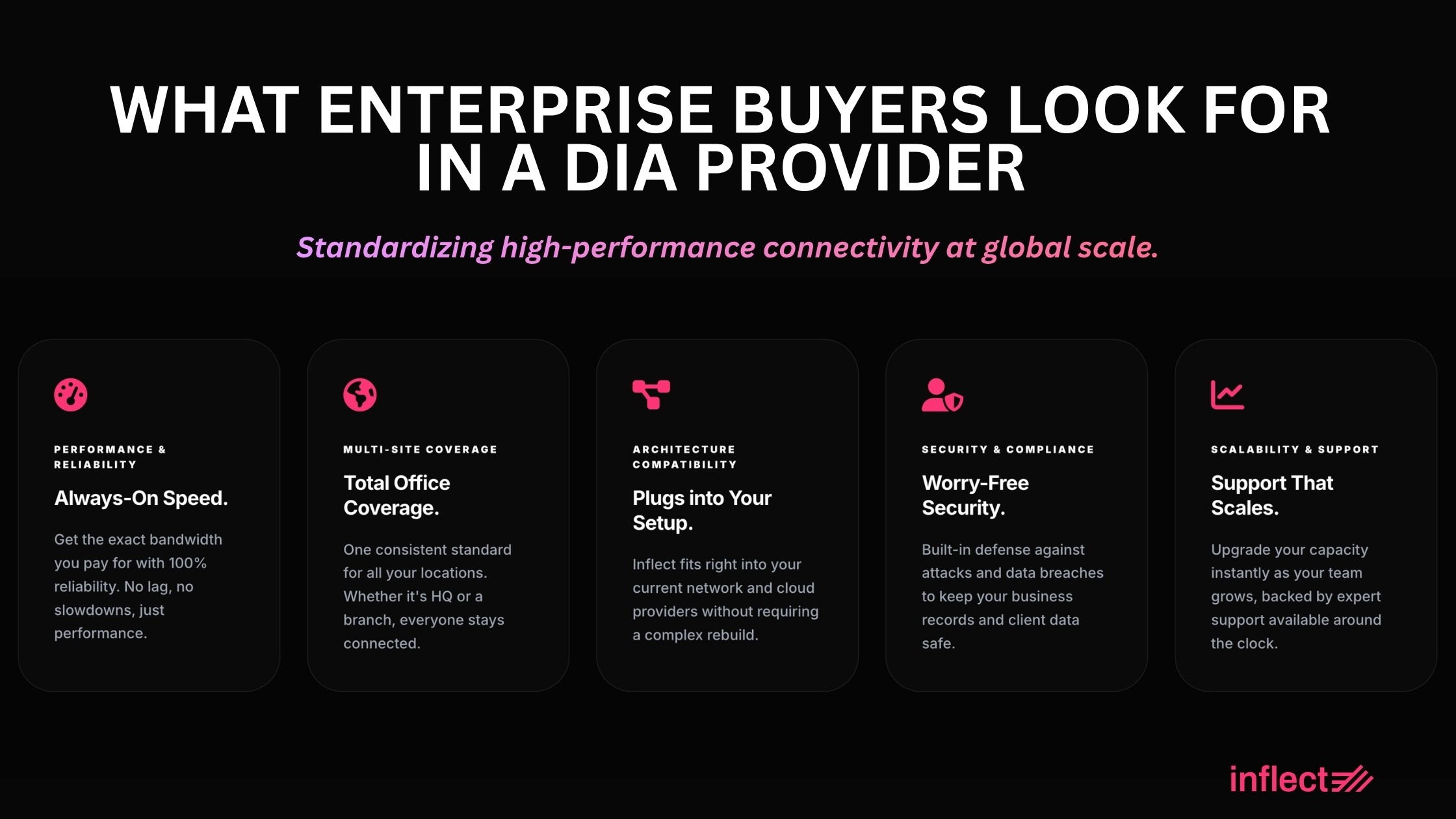
Enterprise IT, network, and procurement teams evaluate dedicated internet providers across five core dimensions. The table below reflects what consistently appears in enterprise RFPs and connectivity procurement discussions.
Dimension | What Enterprise Buyers Expect |
Performance and Reliability | Guaranteed bandwidth with committed information rates, symmetrical speeds, 99.9 to 99.99 percent uptime SLAs, and fast mean time to repair commitments. |
Multi-Site Coverage | Consistent DIA availability across all locations, from headquarters to regional offices and remote sites, with uniform SLA standards and security posture. |
Architecture Compatibility | Integration with existing SD-WAN, MPLS, and hybrid WAN environments, plus support for direct cloud connectivity to AWS, GCP, and Azure. |
Security and Compliance | DDoS protection, edge firewall, network segmentation, and support for zero-trust and SASE frameworks, with compliance documentation for regulated workloads. |
Scalability and Support | Fast bandwidth provisioning, flexible contract terms, proactive monitoring, and enterprise-grade support available around the clock. |
Top DIA Use Cases For Enterprise Organizations
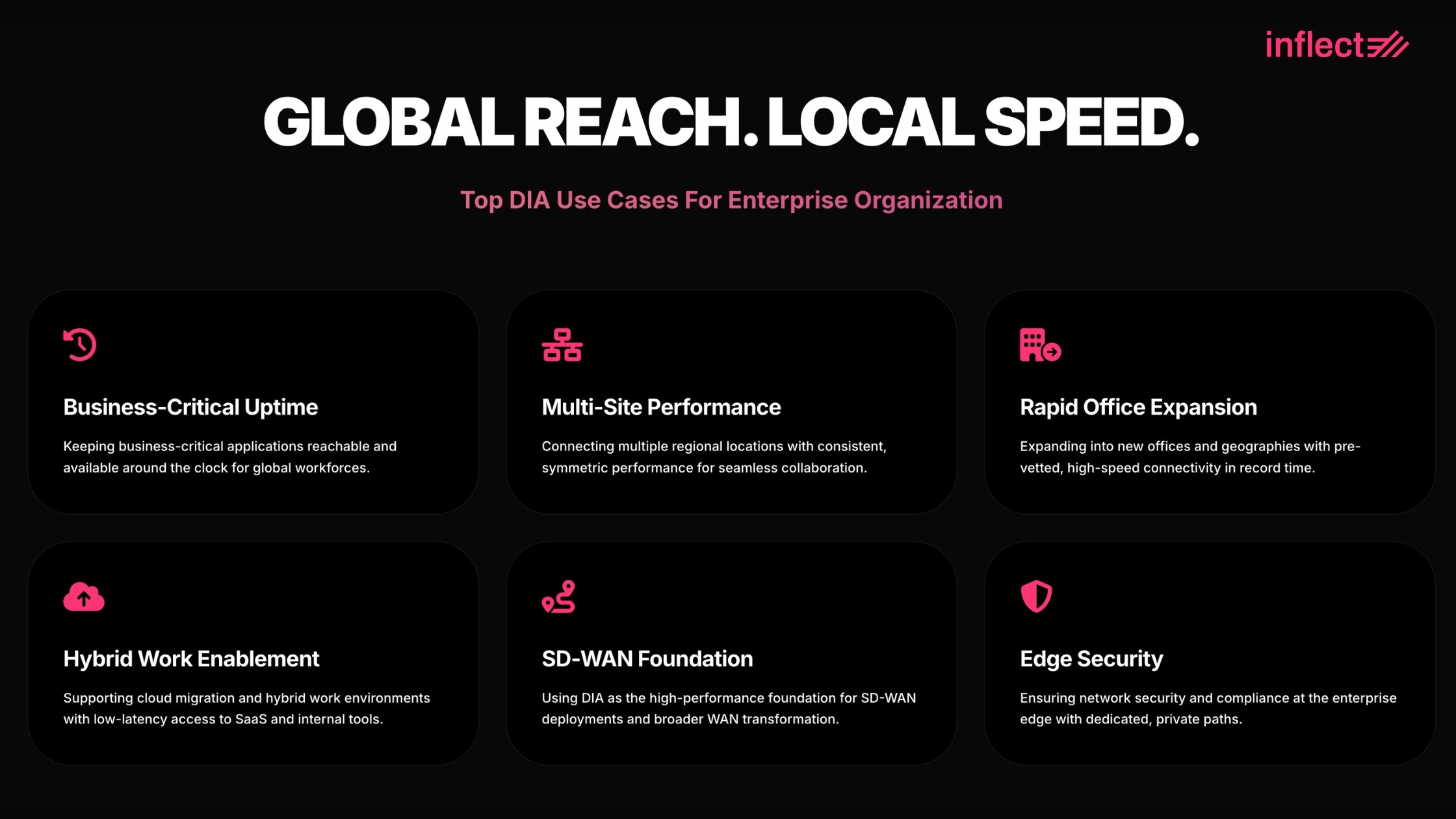
Enterprise organizations use dedicated internet access across six core areas: keeping business-critical applications and SaaS platforms available, connecting multiple locations consistently, enabling cloud migration and hybrid work, supporting SD-WAN and WAN transformation, expanding into new offices and sites, and maintaining security and compliance across the network edge.
Keeping Business-Critical Applications Available Around the Clock
Dedicated internet access keeps business-critical applications online and responsive for employees across every location by providing guaranteed bandwidth and uptime SLAs that do not degrade under load or vary by time of day. ERP systems, CRM platforms, unified communications tools, collaboration software, and the dozens of SaaS platforms that modern enterprises run all depend on a reliable internet connection that maintains high speeds regardless of how many users are online simultaneously. On a shared broadband connection, peak usage periods create congestion that slows applications at exactly the moments when the most people need them.
For enterprise IT teams, the operational impact of application slowdowns compounds quickly. When employees cannot access the tools they need at full speed, productivity falls across every team using that application. DIA removes the connection as a variable affecting application performance, so degradation, when it occurs, is traceable to the application layer rather than blamed on the network.
The same principle applies to IoT, supply chain tracking, operational telemetry, and the high-volume data streams feeding business intelligence platforms and analytics dashboards. These workloads run continuously in the background and depend on stable, uncontended bandwidth to deliver the real-time visibility that operations and leadership teams rely on. A congested shared connection introduces delays and data gaps that reduce the accuracy and timeliness of the decisions those platforms support.
Connecting Multiple Locations with Consistent Performance
Dedicated internet access for multi-site enterprise organizations delivers consistent, SLA-backed connectivity at every location, from headquarters and regional offices to smaller branch sites, ensuring employees at every location get the same reliable internet experience rather than performance that varies unpredictably by site. Most large enterprises operate across more locations than their central IT team can actively monitor at any given time. A connectivity strategy that works reliably at headquarters but delivers inconsistent speeds at regional offices creates a two-tier experience that IT teams spend significant time managing and employees notice daily.
A DIA provider with strong on-net building coverage allows enterprises to expand coverage consistently as the business grows. Uniform SLA standards, uniform security posture, and uniform support processes at every location reduce operational complexity and give IT teams a single accountability structure for network performance wherever the organization operates.
Expanding Into New Offices and Locations
Dedicated internet access provides the fast, reliable business internet service that enterprises need when opening new offices, expanding into new markets, or bringing acquired sites onto the corporate network, with consistent SLA standards and security posture from day one rather than relying on temporary broadband connections that create performance gaps during critical ramp-up periods. Every new location an enterprise opens carries internet access as a dependency for almost everything else: employees cannot use business applications, IT cannot enforce security policies, and leadership cannot get operational visibility until the connection is in place and performing reliably. Most enterprises choose DIA over broadband for new sites precisely because professional installation and formal SLA coverage are built into the service from day one, rather than requiring separate negotiation after the fact.
The key evaluation criteria when expanding are provisioning speed and on-net building coverage. A DIA provider with strong coverage across the markets the enterprise is entering can install and activate new circuits within typical timeframes of 30 to 90 days, and can commit to the same SLA terms at new locations as those already in service. Providers without on-net coverage in target areas introduce lead times and construction variables that delay productivity at new sites. For enterprises with aggressive expansion plans, a provider's geographic footprint and deployment track record are as important as price and speed. A flexible network architecture that allows new circuits to slot into the existing SD-WAN or WAN environment without complex additional setup is another criterion worth confirming before signing.
Supporting Cloud Migration and Hybrid Work Environments
Dedicated internet access supports enterprise cloud migration and hybrid work by providing the reliable, high-capacity internet connection that employees and cloud-hosted applications both depend on, whether staff are working from a central office, a regional location, or a campus environment that serves hundreds of simultaneous users. As enterprise workloads shift from on-premises data centers to cloud platforms, the internet connection becomes the primary path between employees and the applications they use every day. A shared broadband connection with no performance guarantees is not adequate infrastructure for a cloud-first enterprise strategy.
For hybrid work environments specifically, the demand on internet connectivity is sustained and spread across the entire working day rather than peaking at predictable intervals. VoIP, video conference tools, UCaaS platforms, cloud collaboration software, and ZTNA access to corporate systems all run simultaneously across large numbers of employees, generating continuous demand on the connection. These real-time applications are particularly sensitive to latency and jitter. Even modest packet loss on a shared connection causes dropped calls, frozen video, and laggy collaboration experiences that erode productivity and frustrate employees. DIA provides the low-latency, low-jitter connectivity these applications require, with guaranteed bandwidth that does not degrade at peak hours.
DIA as the Foundation for SD-WAN and WAN Transformation
Dedicated internet access is the connectivity foundation that SD-WAN and hybrid WAN architectures are built on, providing the reliable, high-performance internet underlay that SD-WAN policies depend on to intelligently route traffic across the enterprise network. IDC projects SD‑WAN infrastructure revenue to reach about $7.2 billion by 2026, with a 14.1% CAGR from 2021–2026, driven by WAN re‑architecture for cloud and distributed users (SDX Central).SD-WAN is transport-agnostic by design, but its ability to deliver on application performance policies is directly constrained by the quality of the underlying internet circuits it manages.
An SD-WAN deployment built on unreliable broadband connections is still an unreliable network. DIA provides the uncontended, SLA-backed circuits that give SD-WAN the reliable inputs it needs to make intelligent routing decisions and deliver consistent application experiences across every site. For enterprises migrating away from MPLS, DIA combined with SD-WAN is the standard architecture for maintaining performance while reducing WAN costs.
Customer-facing digital services sit in the same category. E-commerce platforms, customer portals, APIs, and real-time customer experiences including chatbots, personalization engines, and order tracking all depend on a reliable, high-capacity internet connection that stays responsive during traffic spikes. Contact centers and omnichannel support platforms running over the internet have zero tolerance for the kind of congestion a shared broadband connection produces during peak service hours. DIA provides the consistent bandwidth and uptime SLAs that keep customer-facing operations performing when demand is highest.
Network Security and Compliance at the Enterprise Edge
Dedicated internet access supports enterprise network security and compliance by providing a private, controlled internet edge where DDoS protection, firewalling, network segmentation, and zero-trust access controls can be applied consistently across every location, rather than relying on the unpredictable security posture of shared broadband connections. Enterprise organizations face sophisticated, sustained threats at their internet edges. Volumetric DDoS attacks, application-layer intrusions, and unauthorized access attempts all arrive over the public internet, and the frequency and scale of those threats continues to grow. A dedicated internet connection with integrated edge security gives IT and security teams a defined perimeter to apply controls, monitor traffic, and enforce policies.
For enterprises operating in regulated industries, the ability to document the network security controls applied at every internet edge is part of vendor risk assessments, audits, and compliance frameworks. DIA providers that carry SOC 2and ISO 27001 attestations and can provide clear SLA and security documentation reduce the time compliance and legal teams spend on network vendor reviews.
The Business Case for Enterprise DIA
The business case for dedicated internet access at the enterprise level is straightforward: the cost of a reliable dedicated connection is significantly lower than the cost of the downtime, productivity loss, and operational disruption that an unreliable one produces. Observability data from New Relic shows that every minute an IT outage causes an operational shutdown costs businesses a median of $33,333, or nearly $2 million per hour, with typical organizations losing around $76 million per year to outages. Combined with ITIC’s finding that over 90 percent of mid‑ and large‑size enterprises now peg hourly downtime at over $300,000, it’s clear that even small reductions in outage frequency or duration can translate into millions saved. That’s why many enterprises now evaluate dedicated Internet services with 99.99 percent availability and aggressive repair SLAs as part of their risk‑management and resilience strategy, not just their network design (Yahoo Finance, 2025, CIODive 2025).
The productivity argument is equally concrete. When employees cannot access the applications they need at full speed, work slows down across every team relying on that connection. Heavy internet usage periods on a shared broadband line are precisely when slowdowns hit hardest, and multiplying even modest per-employee productivity loss across hundreds or thousands of users makes the cost visible quickly. DIA eliminates that variable for the life of the contract.
For enterprises managing multiple locations, the operational cost of inconsistent connectivity across sites adds further justification. Troubleshooting performance issues at remote offices, managing different broadband providers with different support structures, and explaining to senior stakeholders why a regional office cannot access the ERP system reliably are all costs that disappear with a consistent DIA footprint.
Questions Worth Asking Before You Sign
Not all dedicated internet providers are built for enterprise scale and complexity. Before committing, these are the questions that matter:
What is your committed information rate, and is it guaranteed in the contract? Some providers advertise headline speeds that are not fully guaranteed under real load. The CIR should be explicit and contractual, not a best-effort estimate.
What are your SLAs for latency, jitter, and packet loss, not just uptime? Uptime tells you the connection is operational. Performance SLAs tell you it is actually usable. For business-critical applications, performance metrics are as important as availability percentages.
What is your mean time to repair commitment? How quickly can the provider restore service after a failure? Get a specific MTTR figure with escalation paths and service credit terms, not a general assurance of fast response.
Do you have on-net coverage across all of our locations? A provider that covers headquarters but cannot serve regional offices creates the exact problem you are trying to solve. Verify on-net building coverage at every site before signing.
How does your DIA integrate with our existing SD-WAN or MPLS environment? If you are running SD-WAN or hybrid WAN, confirm the provider's circuits are compatible with your architecture and that they have experience deploying alongside your existing infrastructure.
What edge security capabilities are available? DDoS protection, firewall, and network segmentation options should be confirmed upfront, along with whether they are included in the base service or require separate procurement.
What does your enterprise support model look like? Enterprise organizations need proactive monitoring, dedicated account management, and support that understands the complexity of large, distributed network environments, not a general helpdesk.
The Bottom Line
Dedicated internet access for enterprise organizations provides the reliable connectivity foundation that business-critical applications, multi-site operations, cloud environments, and hybrid work all depend on to perform consistently. Businesses choose dedicated internet over broadband because the risks of unreliable connectivity in performance, reliability, and operational continuity consistently outweigh the cost difference.
For large organizations where the cost of an unreliable internet connection is measured in productivity across thousands of employees and applications across dozens of locations, a dedicated internet service with guaranteed bandwidth, formal SLAs, and enterprise-grade support is not a premium upgrade. It is the baseline that the scale of enterprise operations requires.
Source Dedicated Internet Access for Your Enterprise
Guaranteed bandwidth from 1 to 10 Gbps and above. 99.99% uptime SLAs. Multi-site coverage with consistent performance standards. DDoS protection and edge security. Enterprise support built for complex, distributed environments.
Not sure which one will meet your requirements? Leverage our 0-Cost Expert who has a proven track record of achievements helping retail giants, and enterprises to get the right DIA for new offices and locations.
About the Author

Chanyu Kuo
Director of Marketing at Inflect
Chanyu is a creative and data-driven marketing leader with over 10 years of experience, especially in the tech and cloud industry, helping businesses establish strong digital presence, drive growth, and stand out from the competition. Chanyu holds an MS in Marketing from the University of Strathclyde and specializes in effective content marketing, lead generation, and strategic digital growth in the digital infrastructure space.
Contact:
Email: