15 mins
Data Center Power Shortage 2026: Why Grid Capacity Is Now the Bigger Constraint Than GPUs
In 2022 and 2023, the binding constraint on building an artificial intelligence (AI) data center was almost always the GPU. Hyperscalers and neoclouds fought over allocation from Nvidia, packaging capacity at TSMC lagged behind chip demand, and a facility with power and space to spare could still sit half empty waiting for silicon.

That constraint has moved. TSMC has doubled its CoWoS advanced packaging capacity multiple times since 2024, and GPU shipment volumes have scaled accordingly, easing the acute allocation crunch that defined the early AI buildout (Source: TrendForce, 2024). Grid capacity did not scale at the same pace. Interconnection queues, transformer manufacturing, and utility capital planning all operate on cycles measured in years, not chip generations, and none of them accelerated to match rising electricity demand.
This post breaks down why grid capacity has become the harder constraint than GPU supply in the current data center boom, what the interconnection queue and equipment shortage data actually show, how the shortage is reshaping where data centers get built, and what infrastructure buyers should evaluate amid the current wave of AI data center development in 2026.
Why Grid Capacity Replaced GPUs as the Primary AI Infrastructure Constraint
Grid capacity has replaced GPU availability as the primary driver of the AI data center power shortage because chip supply chains can scale in months while grid infrastructure takes years to expand, and because AI infrastructure development is now growing faster than utilities can add energy generation and transmission. Traditional data centers built around central processing units for enterprise and web workloads never generated this kind of concentrated load; AI data center demand, driven by GPU-dense training clusters, has no real equivalent in prior data center growth cycles. Gartner forecasts that power shortages will restrict 40% of existing AI data centers by 2027, and that the electricity required to run incremental AI-optimized servers will reach 500 terawatt-hours annually in 2027, 2.6 times the 2023 level (Source: Gartner, 2024). That forecast reflects an infrastructure gap, not a chip shortage, and it echoes a broader trajectory in data center demand worldwide: the International Energy Agency projects global data center electricity consumption will rise from 415 terawatt-hours in 2024 to 945 terawatt-hours by 2030, roughly 2.5 to 3 percent of total global electricity consumption (Source: International Energy Agency, 2025). In the United States specifically, the Electric Power Research Institute projects data center energy consumption could reach up to 9 percent of national electricity generation by 2030, up from 4 percent in 2023, a figure now shaping how the industry measures data center energy use (Source: Electric Power Research Institute, 2024).
How GPU Supply Constraints Eased After 2023
GPU supply eased after 2023 primarily because TSMC expanded CoWoS advanced packaging capacity, the step that had been the true bottleneck behind Nvidia's chip shortages, doubling output in 2025 with another doubling planned through 2026 (Source: TrendForce, 2024). This does not mean GPUs became abundant. Demand still outpaces supply by an estimated factor of 1.4 to 1.6 through 2027, and hyperscalers have locked up much of Nvidia's available allocation through multi-year commitments, squeezing smaller cloud and neocloud providers. What changed is the shape of the constraint: a buyer with a signed power agreement and a data hall can now get GPUs on a materially shorter timeline than they can get a grid connection.
Why Grid Expansion Did Not Keep Pace
Grid expansion did not keep pace with AI power demand because new energy generation, transmission capacity, and substation capacity require multi-year permitting, engineering, and construction cycles that cannot be compressed the way semiconductor output can. McKinsey projects that U.S. data center power demand will more than triple from roughly 25 gigawatts in 2024 to more than 80 gigawatts by 2030, moving from 3 to 4 percent of total U.S. electricity demand today to 11 to 12 percent by the end of the decade (Source: McKinsey & Company, 2024). Even if every currently announced generation and transmission project is delivered on schedule, McKinsey estimates a U.S. data center power supply deficit of more than 15 gigawatts by 2030. Utilities plan capital investment in decade-long cycles built around existing infrastructure and an energy system designed for historically flat load growth from large energy users, not compressed AI timelines. AI energy demand broke that assumption faster than the planning process can absorb.
The Resulting Constraint Shift in AI Cluster Deployment
The resulting constraint shift means that AI cluster deployment timelines are now set by grid interconnection dates and equipment delivery schedules rather than by GPU procurement, so a facility with confirmed power and a later chip delivery date will come online faster than one with chips in hand and no confirmed power capacity or substation access. Uptime Institute's 2025 Global Data Center Survey, based on responses from more than 800 data center operators, found power availability had become a top-tier strategic constraint alongside cost, with growing uncertainty over where AI workloads can even be sited (Source: Uptime Institute, 2025). For buyers, this reverses the sourcing priority that defined 2022 and 2023.
How Long Does It Take to Secure Grid Power for a New Data Center in 2026
Securing grid power for a new data center in 2026 typically takes 24 to 72 months depending on market and load size, with some large-load connections in constrained regions quoted at 5 to 7 years. These timelines are driven by a national data center interconnection queue that has grown far faster than grid operators can process it, fueled by load growth that most utilities did not anticipate in their long-range planning.
Why U.S. Interconnection Queues Exceed 2,000 Gigawatts
U.S. interconnection queues exceed 2,000 gigawatts because a decade of rapid solar, storage, and now large-load data center applications has overwhelmed utility and grid operator review capacity, even as withdrawal rates climb. Lawrence Berkeley National Laboratory's 2025 interconnection queue report found 2,061 gigawatts of generation and storage capacity actively seeking grid interconnection nationwide, a rare 10 percent decrease from 2024 driven by high project withdrawal rates rather than faster processing (Source: Lawrence Berkeley National Laboratory, 2025). Only about a quarter of active queue capacity nationally has an executed or draft interconnection agreement in hand, which means the majority of that capacity has no confirmed timeline at all. This lines up with World Resources Institute research finding that long lead times for new generation, transmission, and substations are extending data center construction timelines by 24 to 72 months in the markets most affected by the current data center boom (Source: World Resources Institute, 2025). This dynamic underscores why forecasting data center electricity demand has become one of the hardest planning problems facing U.S. utilities today.
Power Wait Times by Market: ERCOT, PJM, and Dominion
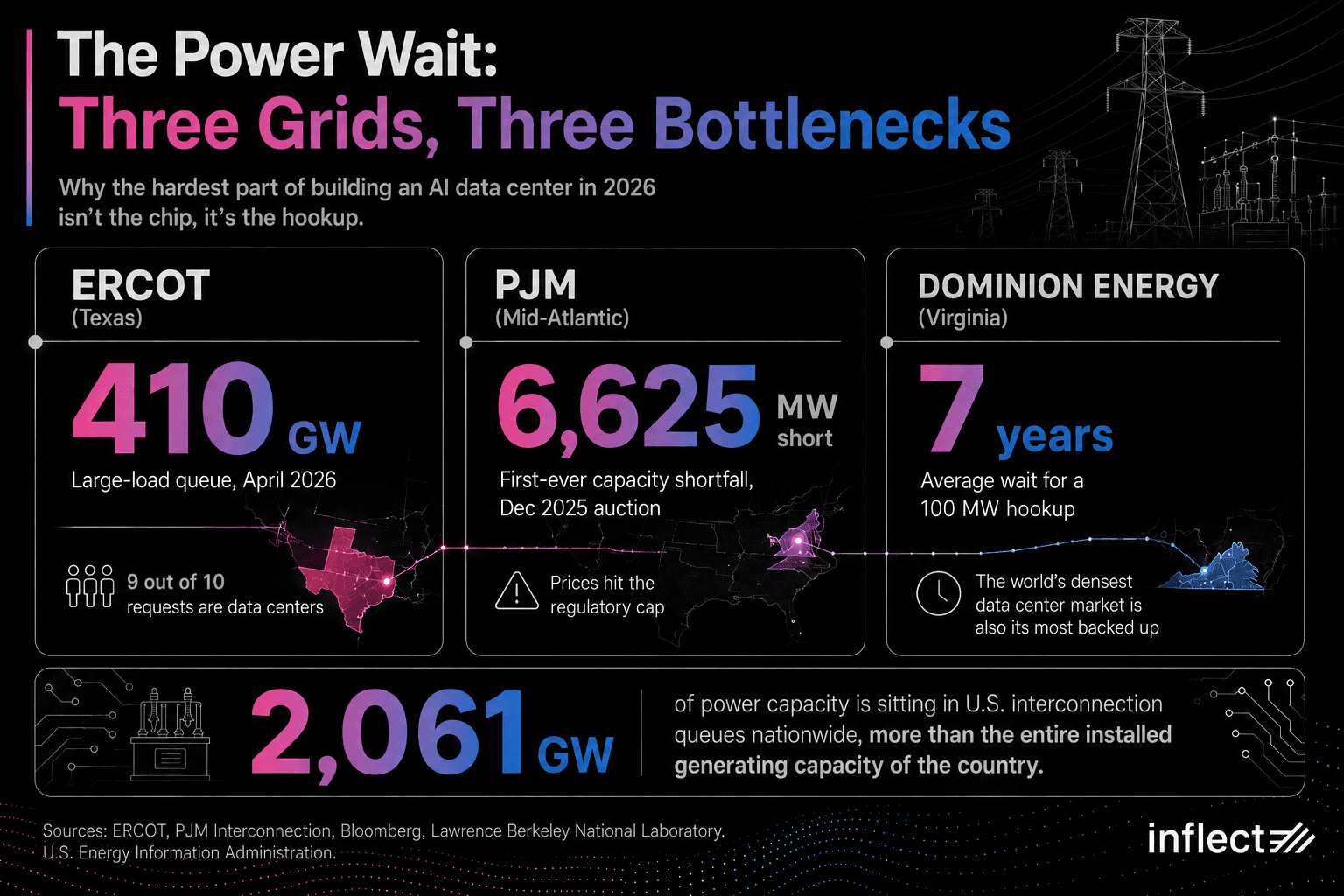
Power wait times vary sharply by market. The Electric Reliability Council of Texas, better known as ERCOT, was tracking a large-load interconnection queue of approximately 410 gigawatts as of April 2026, with data centers accounting for roughly 87 percent of that total (Source: ERCOT, 2026). PJM fell short of its reliability target by 6,625 megawatts in its December 2025 Base Residual Auction, the first shortfall in the grid operator's history, with natural gas supplying 43 percent of the cleared resource mix even as the Federal Energy Regulatory Commission pushes PJM to formalize how large loads can bring their own on-site generation (Source: PJM Interconnection, 2025). Dominion Energy in Virginia has quoted waits beyond 36 months for new substation service and up to seven years for a 100 megawatt connection in its most constrained territories (Source: Bloomberg, 2024; Data Center Dynamics, 2025). PJM's own load forecast attributes 94 percent of its projected 32 gigawatts of peak load growth through 2030 to data centers, with data center growth outpacing new generation additions by roughly two to one, which is why the grid operator has proposed a formal process to assess new large data center loads and require them to bring on-site generation, including natural gas turbines or storage capacity, or accept curtailment terms.
Why Transformer and Switchgear Shortages Are Delaying Data Center Power Delivery
Transformer and switchgear shortages are delaying data center power delivery because even a data center with an approved interconnection agreement still needs the physical equipment, substation transformers, generator step-up transformers, and switchgear, to actually receive power, and these critical components are now the tightest link in the supply chain for reliable energy supply. Data from Wood Mackenzie shows demand for generator step-up transformers grew 274 percent between 2019 and 2025, while substation transformer demand rose 116 percent over the same period, far outpacing domestic manufacturing capacity (Source: PV Magazine, 2026).
Why Transformer Lead Times Now Exceed 24 to 36 Months
Transformer lead times now exceed 24 to 36 months, and in the case of large high-voltage units, stretch to as long as four years, because manufacturers cannot add capacity fast enough to meet simultaneous demand from utilities, renewable energy projects, and data center developers competing for the same production slots, according to analysts at PwC (Source: PV Magazine, 2026). A transformer ordered today for a large data center project may not arrive before 2029 or 2030 in the most constrained product categories, which means equipment lead time, not construction time, is now the pacing item on many builds.
Manufacturing Bottlenecks and Material Constraints
The manufacturing bottleneck behind the transformer shortage centers on grain-oriented electrical steel, the specialized core material used in high-voltage transformers, combined with a global manufacturing base concentrated in a small number of countries, with China controlling roughly 60 percent of global transformer production capacity. Domestic U.S. manufacturers have limited ability to expand quickly because building new transformer manufacturing capacity within existing infrastructure requires the kind of multi-year industrial investment cycle that created the shortage in the first place. For technical teams: buyers evaluating a site should ask providers directly whether primary and backup transformers are already ordered and where they sit in the delivery queue, not just whether the interconnection agreement is signed, since equipment delivery has become an independent failure point.
How Power Constraints Are Reshaping Data Center Location Strategy
Power constraints are reshaping data center location strategy by shifting new AI infrastructure development and data center expansion away from traditionally dense, low-latency markets and proximity to major internet exchange points toward regions with available generation and transmission headroom, even when those regions carry latency or connectivity tradeoffs. Buyers who once optimized almost exclusively for proximity to fiber routes and existing data center clusters are now optimizing for megawatts they can actually secure on a workable timeline.
Why Traditional Hubs Like Northern Virginia and Silicon Valley Are Power-Constrained
Traditional hubs like Northern Virginia and Silicon Valley are power-constrained because decades of concentrated data center development in these markets have exhausted available substation capacity, pushed utilities like Dominion Energy into multi-year queue backlogs, and left little room for new large-load connections without major transmission upgrades. Northern Virginia alone represents one of the highest densities of data center load on a single utility grid in the world, which is precisely why its interconnection timelines now rank among the longest in the country.
The Rise of Secondary Markets with Available Capacity
Secondary markets in the Midwest, Mountain West, and parts of Texas outside the most saturated ERCOT zones are attracting new large-scale data center campus investment because they offer generation headroom, more responsive utility planning processes, and in some cases direct access to wind, solar, or natural gas generation that can support faster interconnection. Local governments in many of these data center markets are also offering tax incentives to attract this investment, which can accelerate site decisions even where grid upgrades are still catching up to demand. This shift reflects a broader energy transition in which integrating renewable energy sources and other clean energy resources into new generation has become as important to site selection as raw operational capacity, though heavier reliance on natural gas generation in some of these markets carries its own greenhouse gas emissions tradeoffs that buyers with sustainability commitments will need to weigh against speed to power. None of this eliminates latency and connectivity considerations; it reprioritizes them below power availability for large training workloads that are less latency-sensitive than inference or enterprise applications. For technical teams: buyers running latency-sensitive inference workloads should still weight connectivity heavily, while buyers siting large training clusters have more room to prioritize confirmed power over proximity to existing hubs.
What AI Infrastructure Buyers Should Evaluate Before Committing to a Site
AI infrastructure buyers should evaluate five factors before committing to a data center infrastructure site in a power-constrained market: the status of the interconnection agreement, not just the application, the specific delivery dates for primary and backup transformers and switchgear, whether the provider offers contractual timeline guarantees or financial remedies for delay, the availability and terms of on-site or behind-the-meter generation as a hedge against grid delays, and the flexibility of the capacity contract to scale in phases rather than committing to a single large block on a single timeline.
Your organization's procurement team should treat "power confirmed" as a specific, verifiable claim rather than a marketing statement. Ask for the actual interconnection agreement status, the utility's own queue position data, and equipment order confirmations with delivery windows. A provider that cannot produce these documents is asking your organization to underwrite grid and equipment risk it has not actually retired.
Efficiency matters once power is secured, not just before. Cooling systems account for a significant share of a facility's total draw, and efficiency gains reflected in power usage effectiveness, along with other energy efficient systems, determine how much of a site's allocated capacity, including any battery storage capacity held in reserve, actually reaches compute. A facility with strong power usage effectiveness and modern cooling systems delivers more usable compute within the same power allocation, which matters when megawatts, not floor space, are the scarcest part of the transaction and where energy efficiency directly affects total energy consumption.
Where to Find Power-Ready Capacity
Finding a site with confirmed power, not just confirmed compute, is now the harder half of the sourcing problem this post has described, and it is the specific gap Inflect is built to close. For data center companies and buyers across the data center industry, this makes sourcing itself a power-availability problem, not just a real estate problem, and it is why Inflect exists as a dedicated marketplace for data center services rather than a generic listings site. Inflect is a digital infrastructure marketplace where buyers can search, compare, and receive instant pricing across 6,000+ data centers and facilities in 100+ countries, filtering specifically for available capacity and power status rather than relying on a provider's word that power is coming.
Instead of submitting a request and waiting on a sales call, buyers on Inflect can search for specific megawatt capacity in specific regions, including markets with confirmed power availability outside the most saturated interconnection queues, and get pricing immediately. Providers on the platform include Equinix, Digital Realty, NTT, QTS, CyrusOne, Flexential, and hundreds of others across retail, enterprise, and wholesale colocation up to several hundred megawatts. Inflect's free expert advisory team, along with its AI agent Winston, can help buyers evaluate power status and interconnection timelines across shortlisted sites at no cost, which matters most in a market where the wrong assumption about power availability can add years to a deployment.
Get Sourcing Support for Power-Constrained Markets
Search live capacity by megawatt and market, filtering for facilities with confirmed grid interconnection rather than pending applications
Compare instant pricing across providers without a sales call, including wholesale blocks up to several hundred megawatts
Get free expert advisory on interconnection status, transformer lead times, and phased capacity contracts before you commit
Reach data center markets worldwide, including secondary markets with available power headroom, all through a single marketplace
Start your search on Inflect to find data center capacity where the power is actually ready, not just promised.
About the Author

Haley Rogers
Content & Social Media Specialist
Haley Rogers is the Content & Social Media Specialist at Inflect, bringing over two years of experience in social media, marketing, and content strategy — including time at a fast-paced tech company before joining the Inflect team. She specializes in translating complex digital infrastructure topics into clear, engaging content, with a particular focus on blog writing and brand storytelling across channels.
Contact: