12 mins
Coravel's 140MW Dallas-Fort Worth Data Center Deal: What It Means for AI Colocation and Hyperscale Buyers
Coravel is the vertically integrated data center development platform formed by ACS Group and BlackRock's Global Infrastructure Partners (GIP), and it launched publicly with a signed 140MW hyperscale colocation lease at its Dallas-Fort Worth campus (Source: Data Center Dynamics, 2026). The deal is driven by AI-related hyperscale demand outpacing available power in constrained markets like DFW, and by a development model that combines power strategy, construction, and capital under a single owner instead of splitting them across separate parties.

Before Coravel had a public name, it already had a customer. That sequencing matters more than the press release headline suggests, because it says something about how AI-driven hyperscale demand is now reshaping who gets to build at scale in the country's tightest power markets.
For most of the last decade, hyperscale colocation development ran through a familiar, fragmented chain: a developer secured land and entitlements, a separate utility relationship determined power delivery timing, a general contractor was brought in for construction, and a capital partner financed the build, often after the lease was already signed. Each handoff added negotiation time, and in power-constrained metros, utility interconnection alone could stretch a project's timeline by years.
Coravel collapses that chain. ACS Group brings construction and engineering through its Turner subsidiary, BlackRock's GIP brings balance-sheet capital and power sector relationships, and the combined platform holds site development and power strategy in-house rather than outsourcing it deal by deal. The result, according to the companies' own announcement, is a 140-megawatt hyperscale lease across three purpose-built facilities in Dallas-Fort Worth, plus rights to 100 additional megawatts across two more buildings, including a 140MW Dallas-Fort Worth hyperscale lease signed as the platform was being formed, before Coravel was publicly launched (Source: Tech Times, 2026).
For buyers evaluating large-block capacity in Dallas-Fort Worth or comparable power-constrained metros, whether they represent large enterprises or fast-growing AI companies, this deal is a signal worth reading carefully, not just a headline to skim. The rest of this piece breaks down what the deal actually includes, why the vertically integrated model behind it is spreading, what it tells buyers about the Dallas-Fort Worth data center market specifically, and how to evaluate a first-time platform like Coravel against more established hyperscale colocation providers.
What Is Coravel? Ownership, Leadership, and Backing
Coravel is a jointly owned data center development and operations platform launched on July 15, 2026 by Spanish construction group ACS and BlackRock's Global Infrastructure Partners (GIP), combining power sourcing, site development, construction, and capital under one organization rather than splitting them across separate vendors (Source: Data Center Dynamics, 2026). For buyers, that ownership structure answers the first question any procurement team should ask before signing a long-term lease: who is actually on the hook for delivery, and what happens if one partner exits.
Ownership Structure
ACS Group holds the construction and engineering side of the venture through its Turner Construction subsidiary, while BlackRock's GIP contributes infrastructure capital and power sector relationships built across GIP's broader energy and utility portfolio. The joint ownership means buyers are contracting with a platform backed by two large, independently rated institutions rather than a single-purpose developer with a thinner balance sheet.
Leadership
Howard Boville serves as Coravel's CEO. He previously held the president role at DXC Technology and has served in senior technology and infrastructure roles at IBM, Bank of America, BT, and Comcast (Source: w.media, 2026). That background gives Coravel executive-level credibility in enterprise technology buying cycles, which matters when the counterparty on the other side of a hyperscale lease is evaluating operational maturity, not just construction capability.
Portfolio Scale
Coravel launched with a 1.7-gigawatt development portfolio spanning the United States, Europe, and Australia, giving it global scale and a foothold in the Asia-Pacific region from day one, and positioning it immediately among the larger data center development pipelines in the market rather than as a single-site startup (Source: Tech Times, 2026). Scale alone doesn't guarantee execution, but a 1.7GW pipeline gives buyers more confidence that the DFW campus isn't Coravel's only shot at proving the model.
What the 140MW Dallas-Fort Worth Data Center Deal Includes
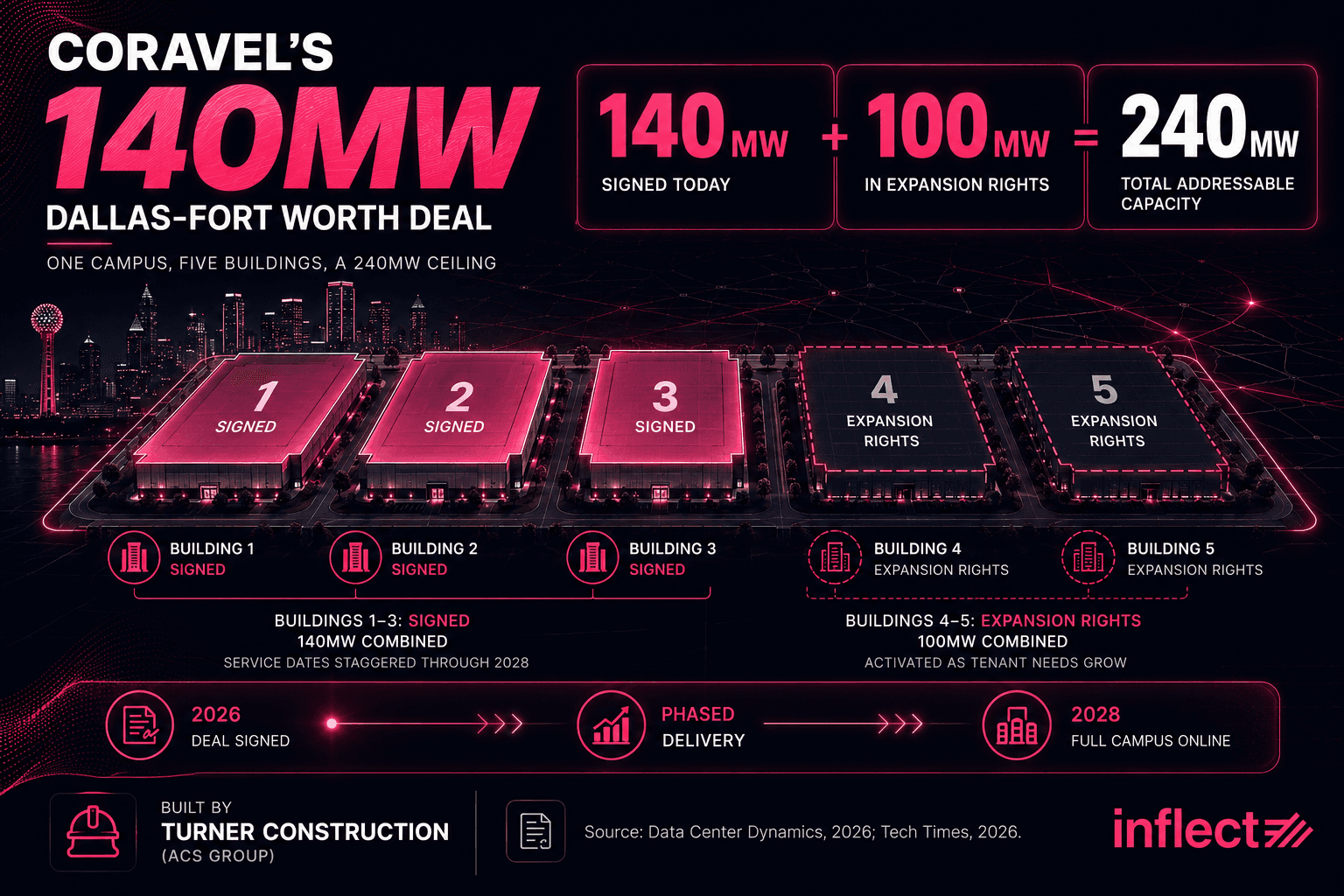
The Coravel deal commits an undisclosed hyperscaler customer to 140 megawatts of critical IT load across three purpose-built facilities at Coravel's Dallas-Fort Worth campus, with rights to an additional 100 megawatts across two future buildings and construction led by Turner through phased delivery ending in 2028 (Source: Data Center Dynamics, 2026). This ranks among the largest large-scale colocation deals disclosed in the Dallas-Fort Worth data center market this year, in a metro where AI-driven hyperscale capacity demand is increasingly constrained by power availability (Source: CBRE, 2025).
Facility Count and Campus Layout
The initial commitment covers three new facilities, purpose-built on a single Dallas-Fort Worth campus and designed and delivered as one coordinated build rather than as separate, independently timed projects.
Power Capacity Breakdown
The signed lease covers 140 megawatts of critical IT load, with the customer holding contractual rights to an additional 100 megawatts across two further buildings as the relationship expands, bringing the campus's total addressable capacity for this customer to roughly 240 megawatts (Source: Tech Times, 2026).
Hyperscaler Tenant Context
The customer has not been named publicly in any of the companies' disclosures, which is common in early-stage hyperscale leases where the tenant wants to control its own announcement timing, but the scale of the commitment (140MW with 100MW of expansion rights) is consistent with one of the major cloud providers, a large AI infrastructure company, or another of the tech companies operating at hyperscale, rather than a mid-market enterprise buyer.
Construction and Delivery Timeline
Turner Construction, an ACS Group company, will lead delivery of the three facilities, with service dates staggered through 2028 rather than delivered as a single completion date, reducing the risk that a single construction delay stalls the entire commitment (Source: Telecom Reseller, 2026).
Expansion Rights Structure Explained
The 100MW of expansion rights function as an option, not a firm commitment: the customer can activate additional capacity across two more buildings as its needs grow, without needing to renegotiate a new lease from scratch or compete with other tenants for the same land parcel.
What "Purpose-Built for AI Workloads" Likely Implies
Facilities described as purpose-built for a hyperscale AI tenant typically imply higher rack density, liquid or hybrid cooling infrastructure, and power distribution engineered for sustained, high-utilization compute load rather than the more variable draw of traditional enterprise IT, though Coravel has not published facility-level technical specifications for this campus.
How Vertically Integrated Developers Are Reshaping AI Colocation
Vertically integrated developers change AI colocation procurement in three concrete ways: they compress the timeline between site selection and power delivery, they reduce the number of counterparties a buyer has to negotiate with across the lifecycle of a lease, and they shift power procurement risk away from the buyer and onto the developer's own balance sheet and utility relationships. Coravel is the newest entrant built explicitly around this model, but it is not the only one, and the pattern is becoming a meaningful differentiator in how hyperscale buyers evaluate developers.
Traditional Colocation Development Model
In the traditional model, a developer acquires land and entitlements, negotiates separately with the local utility for power delivery, hires a general contractor for construction, and brings in a capital partner, often a private equity or infrastructure fund, to finance the build once a lease is in hand. Each of those relationships is negotiated on its own timeline, and a delay in any one of them, particularly utility interconnection, can push the entire project back.
What Vertical Integration Includes
Vertical integration means the same organization controls power strategy, site development, construction, and capital, rather than coordinating those functions across separate vendors and financing partners. In Coravel's case, that means ACS Group's construction arm and GIP's capital and power sector relationships sit inside the same platform from the earliest stage of site selection.
Impact on Delivery Timelines
For technical teams: Because power strategy and construction are managed by the same organization from day one, a vertically integrated developer can begin utility interconnection work and site engineering in parallel rather than sequentially, which is one of the primary reasons Coravel was able to have a signed 140MW lease in hand before its public launch.
Impact on Power Procurement Risk
Power procurement risk, the possibility that a signed lease outpaces actual grid capacity, traditionally sits with the buyer or gets absorbed through delayed service dates. A developer with in-house power sector relationships and capital, like GIP's utility and energy holdings, can absorb more of that interconnection risk itself rather than passing it downstream to the tenant.
Why This Matters Specifically for AI Workloads
AI training and inference workloads draw sustained, high-density power that strains grid capacity differently than traditional enterprise IT, and that shift is already visible in how cloud computing providers plan capacity, moving from general-purpose compute toward dedicated AI infrastructure builds. Global data center electricity demand for AI-specific facilities grew roughly 50% in 2025 alone, more than five times the rate of overall global electricity demand growth (Source: International Energy Agency, 2026). Buyers sourcing capacity for GPU clusters or large training runs are, in effect, betting on their developer's ability to deliver power on schedule, not just square footage.
What This Changes in Buyer Procurement Timelines and Deal Structuring
Fewer counterparties in a vertically integrated deal generally means fewer points of negotiation failure during the LOI-to-power-on timeline, and it can allow buyers to structure expansion rights, like Coravel's 100MW option, directly into the original lease rather than negotiating a separate agreement once the first phase is complete.
What This Deal Signals for Dallas-Fort Worth Data Center Capacity
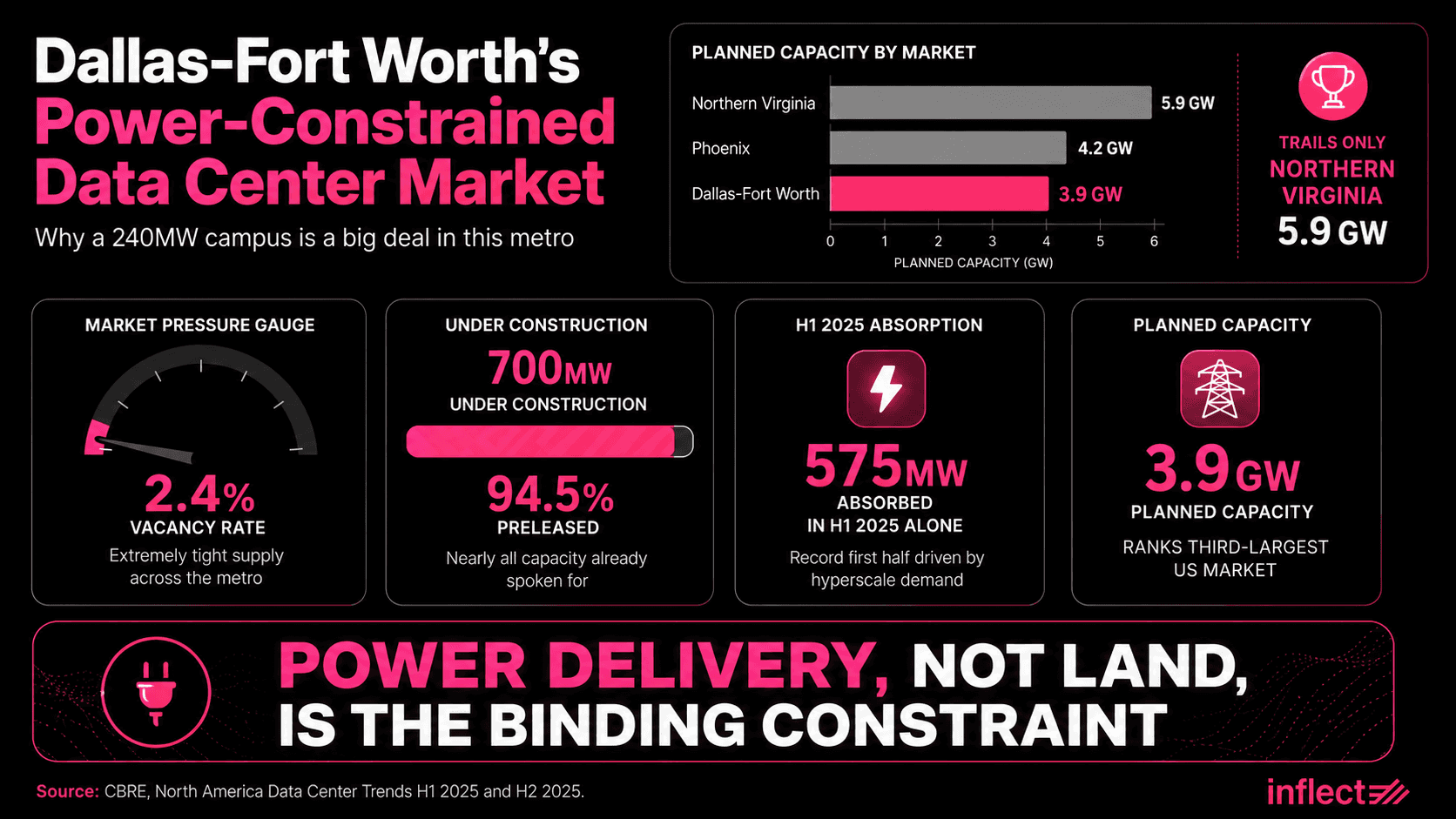
The Coravel deal signals that Dallas-Fort Worth data center growth remains among the fastest in North America, and that hyperscalers keep choosing the metro for its strategic location, business-friendly environment, and diverse economy even as the market tightens. Vacancy sits at 2.4% and 700 megawatts of under-construction colocation space already 94.5% preleased, meaning new large-block commitments like this one are landing in a market with very little existing slack (Source: CBRE, 2026). For buyers still shopping for capacity in the metro, that scarcity context matters as much as the deal itself.
Current DFW Power Constraints
Dallas-Fort Worth absorbed 575 megawatts of new colocation demand in the first half of 2025 alone, straining local utility capacity enough that the power queue has become restrictive and the market has implemented new controls limiting entry, with providers increasingly pursuing behind-the-meter power solutions to bypass grid bottlenecks (Source: CBRE, 2025).
What a 240MW-Capable Campus Implies
A single campus carrying 140MW signed plus 100MW of expansion rights, roughly 240 megawatts of total addressable capacity, represents a meaningful share of new supply in a metro where 3.9 gigawatts of capacity is planned, trailing only Northern Virginia's 5.9 gigawatts nationally, but where power delivery, not land, is the binding constraint (Source: CBRE, 2025).
How to Interpret Expansion Rights in Tight Markets
In a power-constrained market, expansion rights baked into an original lease are worth more than they would be in a less constrained metro, because they effectively reserve future power allocation for the tenant without requiring it to compete for a new interconnection slot later.
Does This Signal New Capacity or Faster Absorption of Existing Supply?
The deal represents genuinely new capacity coming online through 2028 rather than a reallocation of existing supply, but because Dallas-Fort Worth jumped two spots to become the region's third-largest data center market in Q1 2026 on inventory gains of nearly 380 megawatts, buyers should expect that new supply to be absorbed quickly rather than sitting available for long (Source: Data Center Frontier, 2026).
How AI Colocation Buyers Should Evaluate New Entrants Like Coravel
Buyers evaluating a first-time platform like Coravel should assess it against five criteria: financial backing, construction credibility, execution and timeline risk, the specific questions to raise before shortlisting, and a clear view of when a new entrant belongs in the running versus when an established provider is the safer choice.
Financial Backing
Coravel's backing by ACS Group and BlackRock's GIP gives it access to institutional capital that a standalone data center provider would need to raise deal by deal, which matters for buyers assessing whether a developer can absorb cost overruns or power delivery delays without passing them on as service date slippage.
Construction Credibility
Turner Construction's involvement, as an established general contractor with a long track record in large commercial and industrial builds, reduces one of the biggest execution risks in a new platform: an unproven construction partner.
Execution and Timeline Risk for a First-Time Platform
Coravel has no completed hyperscale colocation facility to point to yet, since this DFW campus is its first disclosed commercial deal, so buyers should weigh the platform's balance sheet and construction partner strength against the simple fact that it has not yet delivered a live facility on schedule.
Questions to Ask Before Shortlisting
Buyers should ask a new entrant like Coravel five specific questions before adding it to a shortlist:
What utility interconnection agreements are already in place for the specific site?
What happens contractually if a phase misses its service date?
How is power procurement risk allocated between developer and tenant?
What do the platform's other signed commitments look like across its broader portfolio?
Does the entity signing the lease have recourse to the parent companies' balance sheets?
When to Consider vs. Avoid New Entrants
A new, well-capitalized entrant is worth considering when a buyer needs large-block capacity in a power-constrained market and values speed-to-power over a long operating track record, but an established hyperscale colocation provider remains the safer choice when a buyer's risk tolerance is low or when the workload's launch timeline can't absorb any first-project execution risk.
What This Means for Your Next AI Colocation Decision
Every large-block colocation decision comes down to a tradeoff between speed and certainty, and the Coravel deal is a useful test case for how that tradeoff is shifting as vertically integrated developers enter power-constrained markets like Dallas-Fort Worth. A newer platform backed by institutional capital and a proven contractor can move faster on power delivery than a traditional, fragmented development chain, but it asks buyers to accept more first-project execution risk in exchange for that speed.
Inflect is a digital infrastructure marketplace where buyers evaluating exactly this kind of tradeoff can search, compare, and receive instant pricing across 6,000+ data centers and facilities in 100+ countries, without a sales call, including wholesale colocation options up to several hundred megawatts alongside retail and enterprise colocation from providers like Equinix, Digital Realty, CyrusOne, QTS, and TierPoint, plus network providers offering dedicated network connectivity between facilities. For buyers weighing a new entrant like Coravel against established providers with a longer operating history in Dallas-Fort Worth, that side-by-side visibility, backed by free expert advisory at no cost to the buyer, makes it easier to see the full range of available capacity in the metro before committing to a multi-year lease.
If your team is evaluating hyperscale or wholesale colocation capacity in Dallas-Fort Worth or another power-constrained market, Inflect can help you:
Search specific capacity, from 10MW to several hundred megawatts, across DFW and other hyperscale markets, with instant pricing and no sales call required
Compare established hyperscale colocation providers against newer, vertically integrated developers on the same platform
Get free expert advisory on how to evaluate power delivery timelines, expansion rights, and execution risk in a lease before signing
See real-time availability data instead of relying on a developer's own capacity claims
Talk to an Inflect advisor to compare Dallas-Fort Worth colocation options before your next large-block lease.
About the Author

Haley Rogers
Content & Social Media Specialist
Haley Rogers is the Content & Social Media Specialist at Inflect, bringing over two years of experience in social media, marketing, and content strategy — including time at a fast-paced tech company before joining the Inflect team. She specializes in translating complex digital infrastructure topics into clear, engaging content, with a particular focus on blog writing and brand storytelling across channels.
Contact: