6 mins
Colocation Pricing: What to Expect for Racks, Cabinets, and Cages in 2026
Most data center colocation providers hide pricing behind request-for-quote (RFQ) processes. You contact them, wait three to five business days, and only then learn whether colocation fits your budget. This opacity makes it nearly impossible to benchmark costs, negotiate terms, or plan infrastructure spending.
Market conditions have made transparent colocation pricing more critical than ever. North American data center vacancy fell to a record 1.4% at year-end 2025, according to CBRE’s North American Data Center Trends H2 2025 report (cbre, 2026). Tight supply means faster price escalation and less room for negotiation, making upfront pricing intelligence essential.
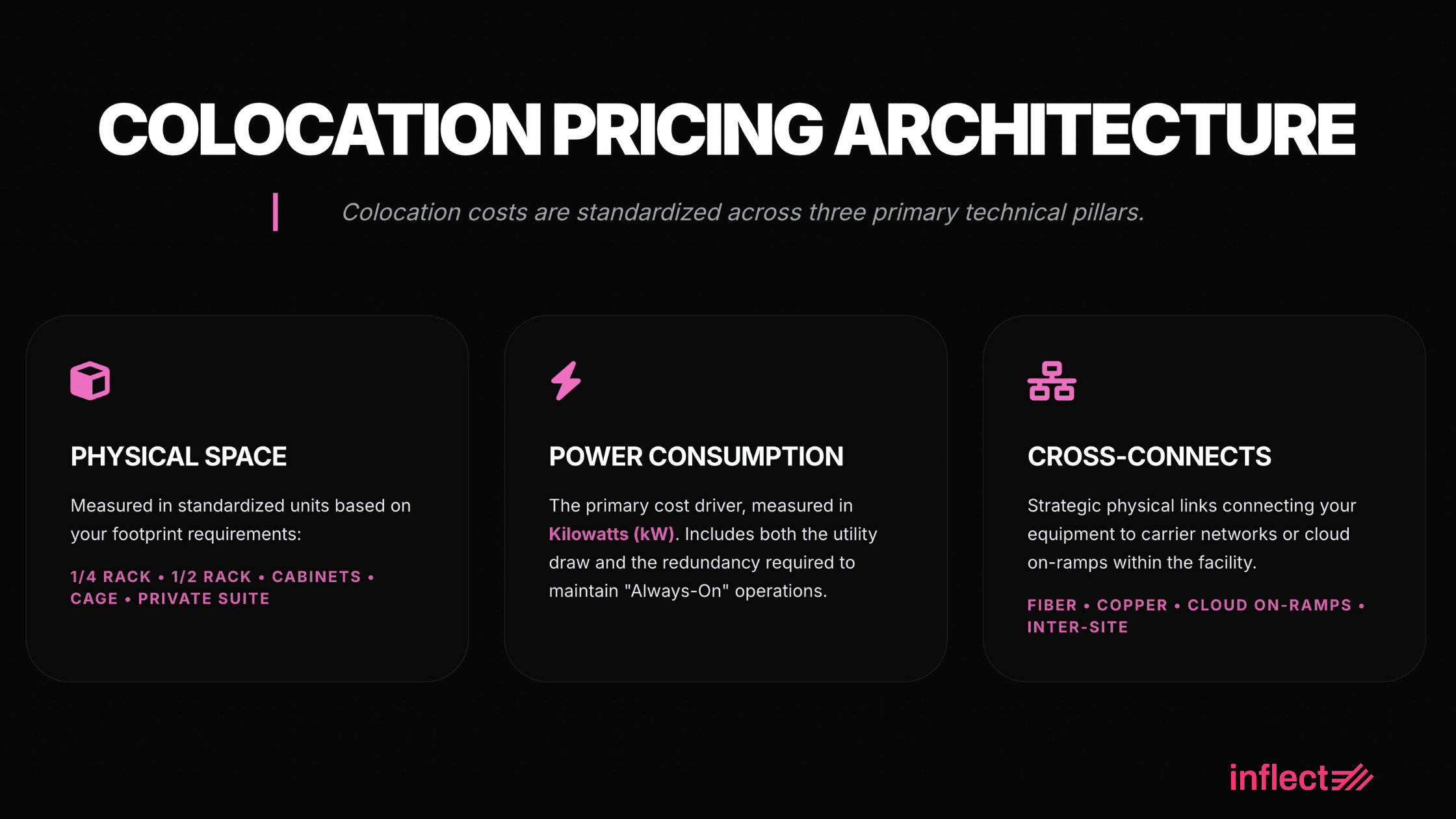
Colocation pricing is built on three main components: physical space (measured in rack units or cabinets), power consumption (measured in kilowatts), and cross-connects (the cables linking your equipment to your network). This post breaks down real pricing for each deployment size, from single-unit racks to private suites, so you can budget accurately and compare providers on an apples-to-apples basis.
The colocation market’s record-low vacancy rate is accelerating pricing increases, making transparent pricing comparison more valuable than ever.
What Makes Colocation Pricing Complex
Colocation pricing appears simple on the surface: you rent space and power, and the provider handles cooling and physical security. In reality, providers quote different metrics (per unit, per kW, per cabinet, or per cage), use different power assumptions, bundle services unpredictably, and apply variable fees for cross-connects, IP addresses, and remote hands support.
A critical distinction buyers often miss: the widely cited US colocation market average of $195.94/kW per month in H2 2025 (Source: CBRE, North American Data Center Trends H2 2025. cbre.com) is a base capacity rate covering space and rent only, it does not include power delivery, cross-connects, or ancillary services.
The all-in rate, once power and services are factored in, is closer to approximately $250/kW per month for most deployments. Conflating the base capacity rate with the all-in rate is one of the most common budgeting mistakes buyers make.
View Transparent & Listed Pricing From Global Top Colo Providers Now
What Buyers Look for in Colocation Pricing
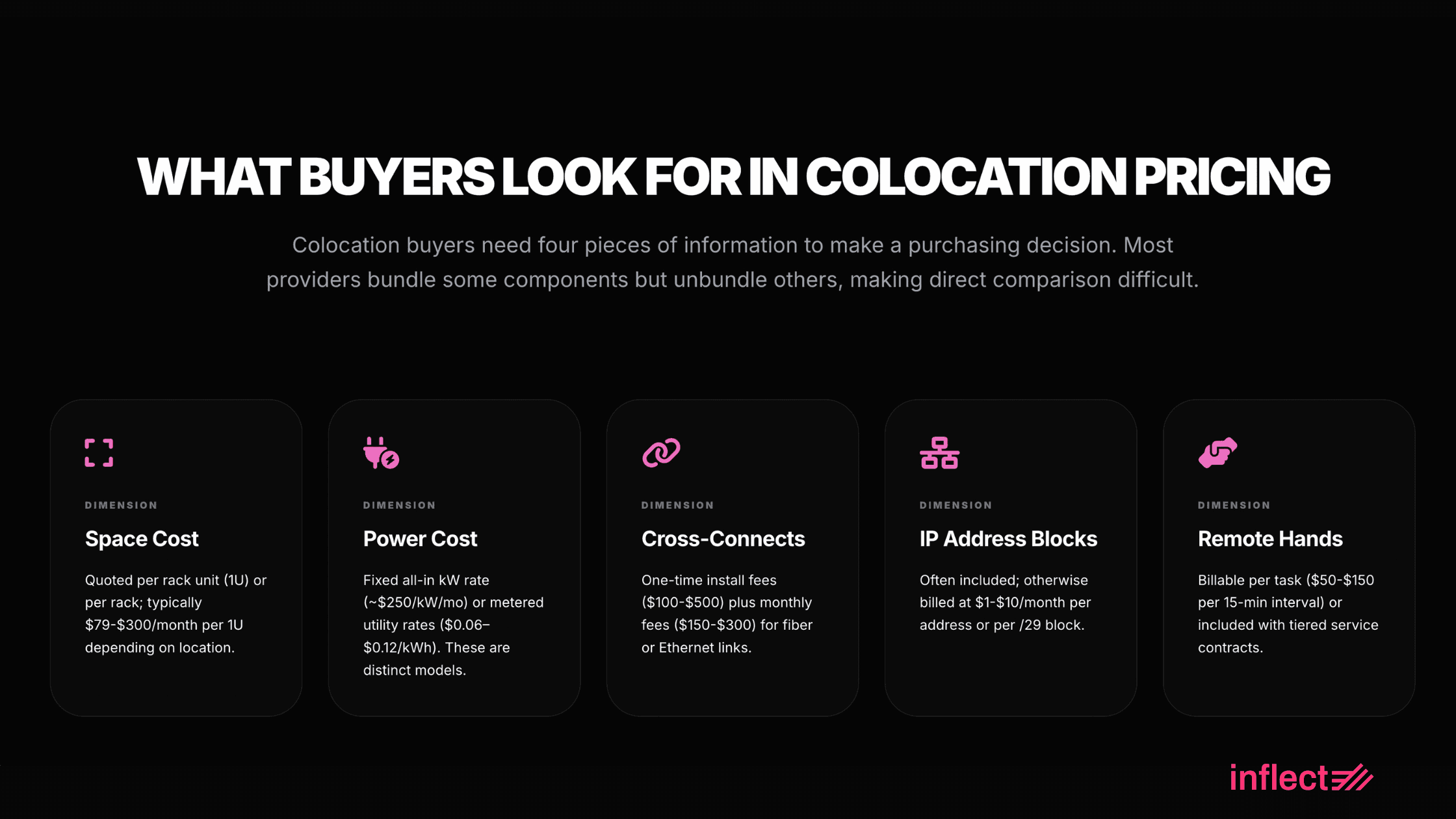
Colocation buyers need four pieces of information to make a purchasing decision: base space cost, power costs, connectivity fees, and any hidden or variable charges. Most providers bundle some components but unbundle others, making direct comparison difficult.
Dimension | What Buyers Expect |
Space cost | Quoted per rack unit (1U = 1.75 inches) or per full/half/quarter rack; typically $79-$300/month per 1U depending on location and market tier. |
Power cost | Fixed all-in kW rate (~$250/kW/month, covering space, power delivery, and cooling) or metered against the underlying utility rate ($0.06–$0.12/kWh). These are different pricing models, the all-in kW rate is not the same as the utility rate. |
Cross-connect fees | One-time install fees ($100-$500) plus monthly fees ($150-$300) for dark fiber or Ethernet connections to upstream carriers. |
IP address blocks | Often included; sometimes billed at $1-$10/month per address or per /29 block |
Remote hands support | Billable per task ($50-$150 per 15-minute interval) or included with tiered service contracts |
Real Colocation Pricing by Deployment Size
Deployment size is one of the most common factors that will impact colocation pricing. Based on the needs of buyers' projects and use cases, choosing from single rack unit (1U), half rack (18-22U), full rack (36-44U) up to private cage or even private suite.
Recommend reading: Cabinet, Cage, or Private Suite? A Definitive Guide to Data Center Colocation for Your Business
Single Rack Unit (1U)
A single 1U of space in a Tier III facility runs approximately $79 to $109 per month in secondary markets like Houston or New Jersey , and $79 is generally the floor for 1U colocation in the US market. This typically includes 1 to 2 amps of 208V power.
See pricing and availability from all data center providers, per rack unit
Half Rack (18-22U)
Half-rack pricing typically starts at 400 to 600 dollars per month in most US markets, according to industry benchmarks. This usually includes 20 to 30 amps of 208V power and covers space, basic power delivery, and shared cooling. Some providers position half-racks as only slightly cheaper than full racks, so confirm exact power allocations before comparing costs.
See pricing and availability from all data center providers, per half rack unit
Full Rack (36-44U)
Full-rack pricing ranges from 900 to 2,000 dollars per month depending on location, facility tier, and power circuit configuration, according to colocation provider data. A full rack in a centrally located Tier III facility with dual 20-amp 208V circuits typically costs 1,000 to 1,500 dollars per month. Facilities in secondary markets offer lower rates, while major metros (New York, Silicon Valley) command premiums.
See pricing and availability from all data center providers, per full racks
Private Cage (Minimum 2-4 Cabinets)
Private cages are semi-dedicated spaces (typically 200 to 400+ square feet) walled off from shared environments. Most providers require a minimum commitment of 2 to 4 full cabinets or a minimum power allocation (typically 10 to 20 kW) to justify a private cage. Pricing starts at 2,000 to 5,000 dollars per month depending on size, location, and included services. Larger cages (6 to 10 cabinets) or build-to-suit requirements are quoted custom.
Buyers should budget separately for non-recurring charges (NRCs), one-time setup, installation, and buildout costs that providers quote in addition to the monthly rate and are typically higher for private cages than for standard rack deployments.
See pricing and availability from all data center providers, per private cages
Custom Private Suite
A dedicated, climate-controlled room with its own power circuits, security, and infrastructure may cost 10,000 to 50,000+ dollars per month, depending on size (hundreds to thousands of square feet), power capacity (50 to 200+ kW), cooling redundancy, and included services. These are rarely transparent and always subject to negotiation.
See pricing and availability from all data center providers, per private suites
How Buyers Use Colocation Across Business Stages
Colocation buyers move through distinct deployment stages as infrastructure needs grow, with each stage carrying different space requirements, contract structures, and pricing expectations. A pilot rack unit, a full rack for a small team, and a multi-cabinet cage for a scaling production environment each represent a meaningfully different procurement conversation.
Pilot or Proof-of-Concept Deployments
Early-stage infrastructure projects typically start with 1 to 4 rack units to test equipment or validate workload requirements. Buyers need short contract terms (3 to 12 months), minimal commitment, and fast onboarding. A 2U pilot costs approximately 150 to 250 dollars per month plus one-time setup fees (typically 200 to 500 dollars). This is ideal for teams validating business model, testing geographic distribution, or moving off shared hosting.
Small Business or Branch Deployment
Small teams (50-200 people) often deploy half to one full rack to host business applications, backups, or disaster recovery capacity. These deployments typically require 3 to 5 years of capacity planning and benefit from slightly negotiated rates on longer contract terms. One full rack with dual circuits costs 1,000 to 1,500 dollars per month in tier-two US markets. This footprint supports 15-30 physical servers or a small Kubernetes cluster.
Scaling Production Environment
Mature companies deploying multiple racks (3-10 cabinets) across geographic markets begin negotiating volume discounts and long-term pricing. A multi-rack cage (5 cabinets, approximately 50-60 kW) costs 3,500 to 7,000+ dollars per month depending on market and facility grade. These deployments often benefit from marketplace comparison tools that aggregate pricing from dozens of providers in parallel.
Recommend reading: The Ultimate Guide to Colocation Strategy and Key Considerations for AI, Edge, and Enterprise Data Center Deployments
Cost Factors That Drive Colocation Pricing Up or Down
The top three cost factors that drive colocation pricing up or down are: Geography Location, Power Density, and Contract Length.
Geography
Geography matters more than facility brand. New York City colocation is typically 40 to 60 percent more expensive than Dallas or Phoenix for equivalent space. Facility tier affects pricing: Tier II facilities (99.9% uptime) cost 20-30 percent less than Tier III.
Recommend reading: Top Global Colocation Markets: Where to Locate Your Data Center for Optimal Performance & Growth
Power Density
Power density drives cost primarily through volume: a standard 5–10 kW rack requires less power than a high-density 40–80+ kW GPU rack, and the higher monthly cost reflects the higher kilowatt consumption, not a different per-kW rate. The monthly $/kW rate for liquid-cooled and air-cooled racks is generally the same. Where liquid cooling adds cost is in the non-recurring charge (NRC): if a facility needs to retrofit infrastructure for liquid cooling, that one-time engineering and installation cost is passed to the tenant. For facilities already fitted for liquid cooling, the per-kW monthly rate is comparable to air-cooled deployments.
Contract Length
Long-term contracts (3–5 years) often yield 10–20 percent discounts versus month-to-month terms. Service level agreements (SLAs) define the uptime guarantees and credit structures providers offer but SLA tier does not typically add a separate line-item cost to monthly pricing. Rather, uptime commitments are a facility quality indicator that buyers should verify before signing, not an add-on fee.
Questions Worth Asking Before You Sign
What is included in your quoted price? Does it cover space, power, cooling, basic IP transit, and cross-connect installation, or are these unbundled and billed separately? Hidden fees often appear after you commit.
How is power metered and billed? Are you charged a fixed monthly allocation or metered by actual kW consumption? Ask whether remote power distribution unit (PDU) circuits are shared or dedicated, and what happens if you exceed your allocation.
What is the true cost per kilowatt in this facility? Request the all-in $/kW/month figure covering space, power delivery, and cooling overhead. The base capacity rate alone does not reflect what you will actually pay.
Are there any mandatory or hidden fees? Cross-connect fees, IP address blocks, setup charges, security deposits, inspection fees, and remote hands minimums can add 500 to 2,000 dollars to your first-month invoice. Ask for a detailed cost breakdown before signature.
What are the NRC (non-recurring charges) for my deployment type? Private cages, liquid cooling retrofits, and custom buildouts carry one-time setup costs quoted separately from the monthly rate. Get the full NRC schedule upfront.
What is the contract term and early termination policy? Some providers charge 50-100 percent of remaining contract value if you leave early. Confirm the term length, renewal terms, and whether you can upgrade or downgrade mid-contract without penalty.
Does the facility have the power and cooling I need? High-density deployments (40+ kW) require specific infrastructure. Confirm the facility has available 208V circuits (not just 120V), supports your cooling method (air or liquid), and has capacity to scale if you grow.
How responsive is remote hands support? Remote hands can cost 50-150 dollars per 15-minute intervention. Ask about response times, whether support is 24/7, and whether you can prepay for a package of hours at a discount.
What is the facility’s power usage effectiveness (PUE)? Industry average PUE is 1.56, meaning 56 percent of power goes to cooling and infrastructure overhead. Confirm whether the quoted rate assumes a PUE in line with industry standards or if the facility is substantially less efficient.
Inflect Digital Infrastructure Marketplace - Research, Compare & Buy Colocation
Colocation pricing in 2026 ranges from under 100 dollars per month for a single 1U to 50,000+ dollars per month for a dedicated private suite. Most businesses deploying 1 to 10 racks pay between 900 and 7,000 dollars per month depending on geography, power requirements, and service level. The key to getting fair pricing is understanding the three main cost drivers (space, power, connectivity) and comparing apples-to-apples quotes across multiple providers using the same specifications.
Delaying colocation decisions because you cannot get transparent pricing is expensive. Each month your workload stays on unreliable shared hosting or over-provisioned cloud infrastructure costs you money, reliability risk, and performance penalties. The colocation market’s record-low 1.4 percent vacancy rate means prices are rising and availability is tightening. Getting multiple competitive quotes today protects your budget and locks in better terms before market conditions tighten further.
Compare colocation providers side-by-side and see transparent pricing from hundreds of facilities.
Use Inflect to get instant pricing from multiple colocation providers without submitting your information to each one individually. Compare racks, cabinets, cages, and private suites across geographies, and find the best fit for your budget and requirements.
-> View All Colocation Providers with Pricing Now
Not sure about which data center and colocation provider will be the right fit for your case?
-> Let Colocation Expert Handpick for You, 100% Free!
About the Author

Chanyu Kuo
Director of Marketing at Inflect
Chanyu is a creative and data-driven marketing leader with over 10 years of experience, especially in the tech and cloud industry, helping businesses establish strong digital presence, drive growth, and stand out from the competition. Chanyu holds an MS in Marketing from the University of Strathclyde and specializes in effective content marketing, lead generation, and strategic digital growth in the digital infrastructure space.
Contact:
Email: