10 mins
Colocation for Streaming Platforms: How to Choose Low-Latency Infrastructure for OTT and VOD
The alert comes in at 9:47pm. Rebuffering rates on the platform's live sports stream have climbed from 0.4% to 3.1% in eleven minutes. The CDN health dashboard is green. Edge nodes are performing within spec. The problem is upstream: the origin cluster sits in a cloud region three network hops from the nearest internet exchange point, and under peak concurrent load, round-trip latency to the CDN tier has spiked from 8ms to 64ms. The on-call team has no fast remediation path. The SLA clock is running, and subscriber churn will show up in tomorrow's retention report.

This is not an edge case. NPAW's 2025 Video Streaming Industry Report found that buffer ratio remains a critical driver of viewer experience, with streaming quality improvements directly impacting session retention across both VoD and live streaming at every concurrency level tested (Source: NPAW, 2025). For platforms carrying live sports, news, or concurrent event programming, the infrastructure decision that governs origin latency is not a CDN configuration question. It is a colocation question.
The decision most streaming operators face is not whether to use a CDN. Every serious OTT platform already does. The real decision is where to place the origin infrastructure that feeds the CDN, and whether public cloud is the right long-term home for workloads that run at sustained high throughput, require predictable network performance, and generate egress bills that compound with every gigabyte delivered. This post covers the evaluation framework, the five infrastructure requirements that separate capable providers from the rest, and the decision logic that determines which model fits your platform.
Why OTT and VOD Platforms Are Moving Origin Workloads from Cloud to Colocation
OTT and VOD operators move origin workloads from public cloud environments to colocation for two compounding reasons: cloud egress costs that become structurally punitive at sustained high throughput, and cloud network variability that introduces latency jitter incompatible with live streaming SLAs. Both problems worsen with scale, which is why the migration conversation consistently intensifies at the same inflection points in a platform's growth.
The Egress Cost Problem at Streaming Scale
Cloud egress costs for video streaming become one of the largest infrastructure line items once throughput reaches sustained multi-gigabit levels, with major cloud providers charging $0.08 to $0.09 per GB for internet egress in North America (Source: Cloudflare, 2024). A platform sustaining 5 Gbps of outbound origin traffic to CDN points of presence generates approximately 1.6 petabytes of egress per month, producing a cloud egress bill of roughly $130,000 to $145,000 monthly at standard rates before compute or storage costs are counted. Colocation eliminates the per-gigabyte charge entirely: the platform pays for port capacity and cross-connects, not data volume.
The crossover point varies by provider contract and CDN topology, but most platforms sustaining more than 1 to 2 Gbps of origin egress reach the colocation cost-efficiency threshold within 12 to 18 months of growth. Beyond that point, the cloud egress bill alone often exceeds the total cost of an equivalent colocation deployment, including hardware amortization, facility fees, and interconnection charges.
Why Cloud Latency Variability Breaks Live OTT SLAs
Cloud latency variability breaks live OTT SLAs because multi-tenant infrastructure cannot guarantee the consistent sub-10ms round-trip latency from origin to CDN point of presence that adaptive bitrate streaming requires to maintain segment delivery cadence under concurrent peak load. In a public cloud environment, network bandwidth, CPU scheduling, and storage I/O are shared across tenants. Under load, this produces jitter: not uniformly high average latency, but unpredictable spikes that cause adaptive bitrate players to drop quality tiers or stall entirely.
Live streaming is uniquely sensitive to this problem. On-demand VOD can buffer ahead and absorb modest delivery inconsistency without a visible viewer impact. Live streams cannot. A 500ms latency spike in the origin-to-CDN path during traffic spikes and peak concurrent events translates directly into rebuffering at the viewer level, with no buffer reserve to absorb it. This is why live streaming infrastructure requires dedicated origin resources in carrier-neutral colocation, not shared cloud capacity priced for variable demand.
What Low-Latency Infrastructure Actually Means for Streaming Platforms
Low-latency infrastructure for OTT and VOD platforms means minimising the time between a content request at the CDN edge and the retrieval of that content from the origin server, which is determined by two separate architectural decisions: the physical placement of origin infrastructure relative to internet exchange points, and the method of interconnection between origin and CDN providers.
Origin Latency vs. CDN Edge: Where Colocation Fits
Origin server latency and last-mile CDN delivery are separate infrastructure problems requiring separate solutions, and confusing them leads operators to optimize the wrong layer: CDN edge nodes solve the viewer-to-edge segment, while colocation governs the origin-to-CDN handoff that determines whether the CDN's cache is populated quickly and reliably enough to serve live content, including low-latency HLS and adaptive bitrate streams, at scale. Adding CDN points of presence does not fix an origin that sits too far from the CDN's pull network, connects over the public internet, or runs in a cloud region with inconsistent network performance under load.
A colocation facility located inside or adjacent to a major internet exchange point, with direct cross-connects to CDN providers such as Akamai, Cloudflare, or Fastly, reduces latency in the origin-to-CDN path to single-digit milliseconds through a direct physical handoff. The same origin hosted in a cloud region and reaching the CDN over the public internet may traverse five or more network hops under normal conditions, and significantly more under congestion. For origin infrastructure for streaming, the facility's position in the internet topology matters as much as the hardware inside it.
How Network Interconnection Density Reduces Time-to-First-Byte
Network interconnection density reduces time-to-first-byte for streaming origin infrastructure by enabling direct peering between the origin server and CDN providers within the same facility or exchange, eliminating the transit hops and associated latency that public internet routing introduces under any load condition. Carrier-neutral colocation facilities with access to major internet exchange points, such as Equinix Internet Exchange or DE-CIX, allow streaming platforms to establish private network interconnections to multiple CDN providers and content networks from a single physical location.
For streaming platforms, interconnection density determines the number of CDN providers reachable with low-latency, high-bandwidth connections, which affects both delivery quality and CDN negotiating position. A platform whose origin connects efficiently to only one CDN provider has no failover path and no pricing power. Network peering for streaming platforms is not an operational detail. It is a strategic infrastructure asset.
Five Colocation Infrastructure Requirements for Streaming Platforms
The five colocation infrastructure requirements for OTT and VOD platforms are: high-density power for transcoding and AI encoding workloads, carrier neutrality with direct IXP access, uptime and network SLAs calibrated to live streaming, geographic placement aligned to CDN topology, and contract flexibility that accommodates audience growth. Every provider shortlist should be evaluated against all five before a site visit is scheduled.
High-Density Power for Transcoding, Encoding, and AI Workloads
GPU colocation for video encoding requires facilities capable of supporting 15 to 30 kilowatts per rack or higher, compared to the 3 to 8 kilowatts per rack that standard enterprise colocation provides, because GPU-based encoding hardware operates at power requirements and densities that most general-purpose data centers are not designed to support. Modern streaming platforms run encoding and video processing pipelines on GPU hardware for live transcoding and AI-assisted perceptual compression, where models reduce bitrate requirements without visible quality loss at the viewer level. High-density colocation for transcoding is not a future consideration. Any platform already running GPU-dense encoding workloads needs it today.
Before shortlisting any provider, confirm the facility's maximum supported power density per rack, its cooling systems for high-density deployments, and whether it has existing GPU-dense tenants demonstrating operational experience at the power levels your workload requires. Providers without this experience frequently underestimate cooling requirements and impose power density caps that constrain future encoding capacity.
Uptime and Network SLA Thresholds for Live Streaming
Live streaming infrastructure requires a minimum of Tier III colocation with a 99.982% uptime guarantee, backed by redundant power feeds and a high availability architecture, equivalent to fewer than 1.6 hours of downtime per year, combined with a network SLA of 99.999% or better on IP connectivity (Source: Digital Realty, 2025). A single unplanned outage during a live event constitutes a complete service failure with no recovery path for viewers already watching and a serious business continuity risk for the platform. Evaluate SLAs across three dimensions: facility uptime covering power and cooling, network uptime covering IP connectivity, and network latency commitments to named CDN providers or internet exchange points.
Generic five-nines claims without named interconnection partners are insufficient for live streaming infrastructure procurement. Require that SLA credits be automatic and material, not opt-in claim processes with nominal payouts. A provider offering 10% monthly fee credit for a two-hour outage that costs the platform seven figures in subscriber churn and penalty exposure is not a genuine SLA partner.
Geographic Placement Strategy for Global OTT Audiences
Global OTT platforms should place origin infrastructure in three to five colocation markets aligned to their CDN provider's major point-of-presence locations and their largest audience concentration regions, because origin placement relative to CDN pull topology determines whether the CDN can maintain cache fill latency within the adaptive bitrate player's segment request window. A single origin in North America serving global audiences forces CDN points of presence in APAC and EMEA to pull content over long-haul transit paths, increasing cache fill latency and reducing resilience to regional origin failures.
For platforms with significant European audiences, Frankfurt, Amsterdam, and London offer the highest density of internet exchange infrastructure on the continent. Singapore and Tokyo are the primary carrier-neutral interconnection hubs for APAC coverage. North American platforms anchored in one coastal region should evaluate a secondary origin in Chicago or Dallas for central US interconnection reach and domestic failover.
How to Evaluate Colocation Providers for OTT and VOD Workloads
Evaluating colocation providers for streaming workloads requires assessing criteria beyond standard enterprise requirements: power density ceiling, carrier neutrality, named IXP access, CDN cross-connect availability, DDoS mitigation capability, scalable capacity for audience growth, and network latency commitments to specific interconnection points. A provider that meets five of seven but cannot support high-density power or direct CDN cross-connects is not a viable option for production streaming infrastructure.
The Colocation RFP Checklist for Streaming Platforms
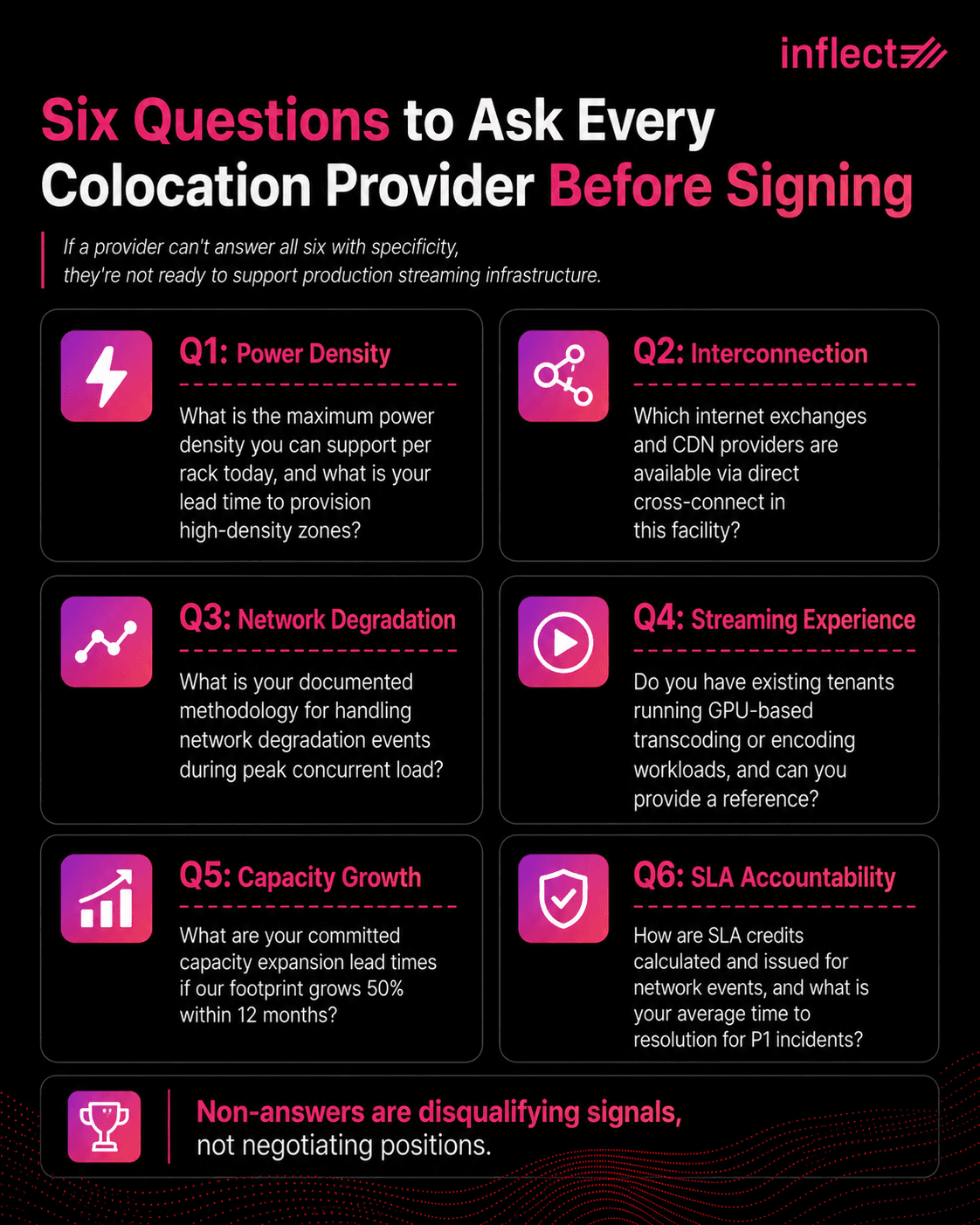
A colocation RFP for streaming platforms must include the following requirements to produce a shortlist of providers capable of supporting high-throughput video origin workloads: maximum supported power density per rack, with a minimum of 15 kW and a preference for 20 to 30 kW for GPU encoding; carrier-neutral status with access to at least one major internet exchange; available cross-connects to the platform's CDN providers; a 99.982% or higher facility uptime SLA with automatic credits; a 99.999% network SLA with named interconnection commitments; DDoS mitigation at the facility or upstream transit level; and committed lead times for additional cage space or power within 90 days of request.
Include a required question about existing streaming or media tenants. Providers with operational experience supporting video workloads at high concurrency understand the power and network demand profiles that come with encoding pipelines and peak concurrent viewing events. Providers without this experience are a procurement risk that reveals itself after the contract is signed.
Which Infrastructure Model Is Right for Your Streaming Platform?
Streaming platforms should choose their origin infrastructure model based on five operational factors: sustained throughput volume, live versus on-demand content mix, audience geography, encoding workload density, and tolerance for capital expenditure versus operational expenditure. The right answer is not always full migration. For many platforms, a hybrid model produces better outcomes than either pure cloud or pure colocation.
When Hybrid Cloud and Colocation Makes More Sense Than Full Migration
Hybrid cloud and colocation is the right model for streaming platforms with demand peaks that significantly exceed baseline load, platforms in early growth stages where audience geography is still consolidating, or platforms where live content represents less than 30% of total viewership hours, because hybrid architecture allows colocation to handle sustained baseline throughput while cloud absorbs burst capacity without requiring the platform to provision colo capacity sized for peak-only demand.
In a hybrid model, the primary origin and encoding pipeline sits in colocation for cost and latency efficiency. Cloud burst capacity handles concurrent peaks during major events, award shows, or sports finals where viewership may spike five to ten times above baseline for a limited window. This model performs best when the CDN layer can shift origin pull between the colocation primary and cloud burst without requiring player-side changes, and when the platform has enough operational maturity to manage a split-origin architecture without introducing new failure modes. Hybrid deployments also provide a natural disaster recovery path, with cloud capacity available as a fallback origin if the primary colocation site experiences an unplanned incident.
When Full Colocation Is the Right Call for OTT and VOD
Full colocation is the correct infrastructure model for OTT and VOD platforms with sustained throughput above 2 Gbps, a significant live programming slate, predictable audience growth curves, and AI or GPU-based encoding pipelines running continuously, because at that operational profile the economics and performance requirements both favor dedicated infrastructure over shared cloud capacity. At sustained scale, cloud egress costs alone typically exceed the fully loaded cost of colocation including hardware, facility fees, and cross-connect charges.
The inflection point is not purely financial. Platforms that have experienced live event incidents caused by cloud network variability, or that run GPU workloads at utilization levels where cloud GPU pricing is structurally inefficient at sustained use, have already passed the threshold where full colocation produces better outcomes across every dimension that matters: cost, latency, infrastructure control, and SLA reliability. At that point, the migration is not a risk. Delaying it is.
How to Source Low-Latency Colocation for Streaming Platforms
Inflect is a digital infrastructure marketplace where OTT and VOD operators can search, compare, and receive instant pricing from colocation providers across more than 6,000 data centers in over 100 countries, without a sales call or a form submission. For streaming infrastructure procurement, this means a buyer can search for carrier-neutral colocation with IXP access in a specific market, filter by power density capability, and compare colocation options and pricing from multiple providers in minutes rather than waiting weeks for RFP responses.
Providers available on Inflect that are directly relevant to streaming infrastructure include Equinix, Digital Realty, CoreSite, Colt, Megaport, and hundreds of others with carrier-neutral facilities and direct CDN interconnection capability. For platforms evaluating origin placement across multiple markets, Inflect's geographic search allows buyers to identify available capacity in Frankfurt, Singapore, Dallas, or any other target market and compare providers within that market on a consistent pricing basis, before any provider engagement begins.
Inflect's free expert advisory service is available to buyers at no charge, covering origin placement strategy, CDN interconnection requirements, and RFP evaluation support. For streaming teams building a colocation shortlist under time pressure, advisory support compresses the evaluation timeline by pre-qualifying providers against the technical requirements specific to video workloads, so the shortlist arriving at the final selection stage already excludes providers that cannot meet power density, SLA, or interconnection requirements.
About the Author

Haley Rogers
Content & Social Media Specialist
Haley Rogers is the Content & Social Media Specialist at Inflect, bringing over two years of experience in social media, marketing, and content strategy — including time at a fast-paced tech company before joining the Inflect team. She specializes in translating complex digital infrastructure topics into clear, engaging content, with a particular focus on blog writing and brand storytelling across channels.
Contact: