8 mins
Colocation for SaaS Companies: Infrastructure for Uptime, Hybrid Cloud, and Scalable Growth
SaaS companies use colocation to host production workloads on dedicated infrastructure they own and control, eliminating cloud egress fees, improving performance predictability for enterprise SLA commitments, and reducing the total cost of running stable, high-utilization workloads that public cloud prices for elastic, variable demand.
Colocation is the infrastructure model SaaS companies turn to when cloud costs are growing faster than revenue, enterprise customers are demanding dedicated infrastructure, and AI workloads have pushed power and compute requirements beyond what general-purpose cloud instances can serve economically.
The cloud invoice arrives on the first of the month, and this time the number stops you mid-scroll. Egress is up 38% quarter over quarter. Your AI inference feature, the one that went Generally Available six weeks ago, added $80,000 in monthly compute spend overnight. Reserved instance commitments are locking you into capacity you sized eight months ago for a product that looks nothing like it does today. And your VP of Finance has forwarded it with a single line: "Can we talk about this?"
You built on cloud because it was right. No upfront capital, no data center space to procure, no in house data center to staff and manage, and your team could ship without worrying about physical infrastructure. That calculus made sense at $50,000 a month. At $400,000 a month, it deserves a harder look.
Colocation does not mean abandoning cloud. Most SaaS companies that move to colocation run a hybrid model that spans public and private clouds alongside colocation data centers: cloud for development, staging, burst capacity, and global edge; colocation for production databases, core application servers, and AI infrastructure that runs continuously at high utilization. The question is not cloud versus colocation. The global SaaS market was estimated at US$399.10 billion in 2024 and is projected to reach US$819.23 billion by 2030, according to Grand View Research. The infrastructure decisions that got the market here are not necessarily the ones that will sustain it at that scale. The question is which workloads belong where, and whether you have made that decision deliberately or by default.
Why Growing SaaS Companies Are Moving Production Workloads to Colocation
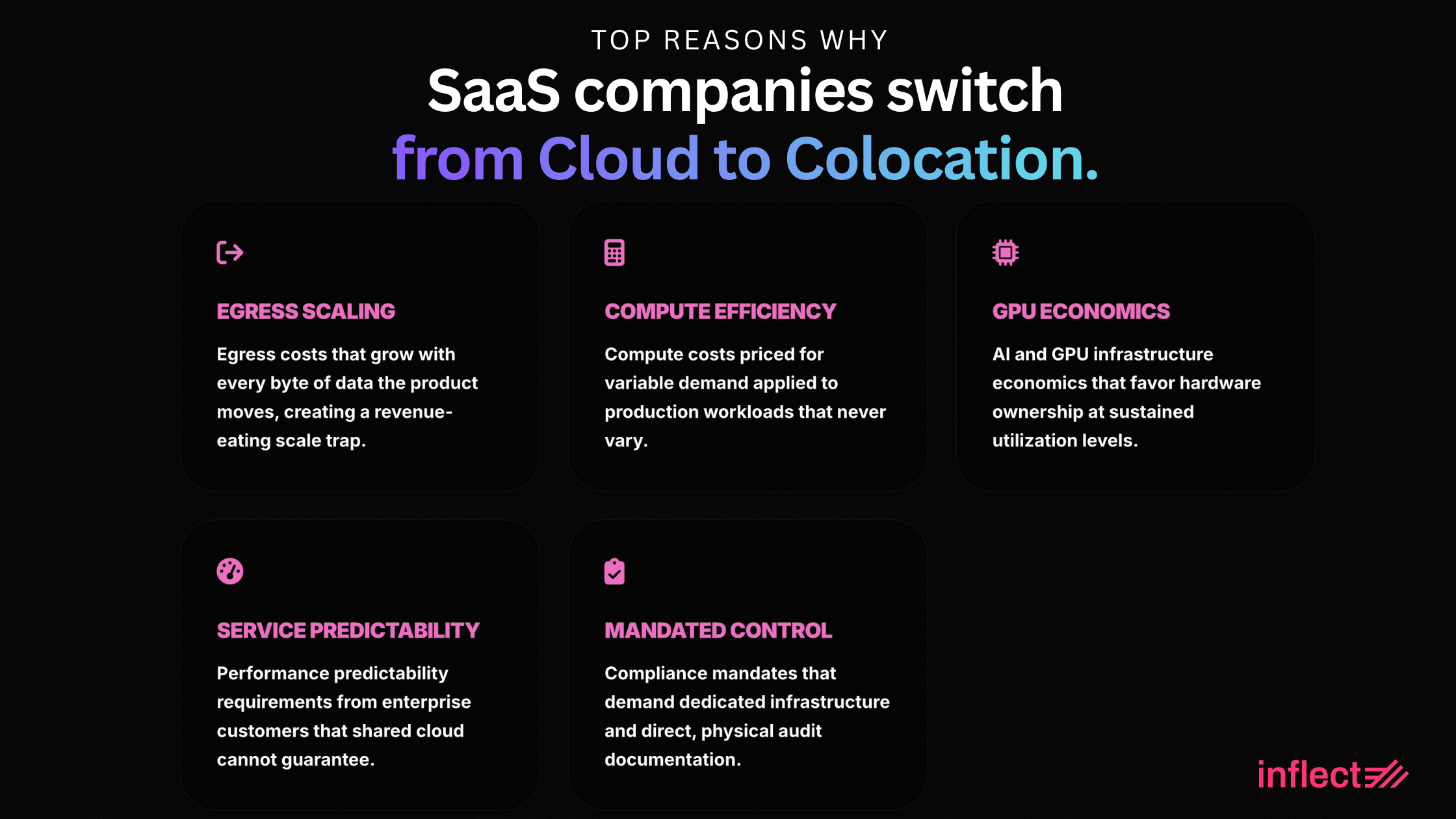
SaaS companies move production workloads from cloud service providers to colocation for five reasons that compound with scale: egress costs that grow with every byte of data the product moves, compute costs priced for variable demand applied to workloads that never vary, AI and GPU infrastructure economics that favor ownership at sustained utilization, performance predictability requirements from enterprise customers that shared cloud cannot guarantee, and compliance mandates that demand dedicated infrastructure and direct audit documentation. Colocation service providers offer an off site data center model where the SaaS company retains hardware ownership while the facility handles power, cooling, and physical security.
Egress costs that compound with growth
Cloud providers charge for every gigabyte of data that leaves their network. For SaaS platforms serving enterprise customers, moving data between application layers, databases, CDNs, and end users generates egress charges that scale directly with product usage. A platform moving 500 TB per month out of AWS at standard rates pays approximately $45,000 per month in transfer costs alone, before compute, storage, or support. In colocation, you rent space in a facility operated by professional data center operators, pay for the network port, and connect directly to carriers and cloud on-ramps within the building. There are no per-GB egress charges. For high-throughput SaaS platforms, egress is frequently the single largest driver in the colocation ROI calculation, and it is a cost that only grows as the product succeeds.
Compute costs priced for elastic demand applied to stable workloads
Cloud compute is priced to recover infrastructure investment across variable utilization patterns. That pricing works well for workloads that scale up and down. Production databases, application servers, and API layers that run at 70 to 90 percent utilization 24 hours a day are effectively paying the flexibility premium without receiving the flexibility benefit. Dedicated servers in professional data centers run the same workload at a fraction of the equivalent cloud cost once you account for reserved instances, support tiers, and the infrastructure overhead cloud providers embed in their pricing. For high performance computing workloads including AI inference and data-intensive pipelines, the operational costs of owned hardware in colocation are consistently lower than cloud at sustained utilization.
AI and GPU infrastructure economics
As SaaS products add AI features, the compute requirements for model inference, data pipelines, and GPU-accelerated processing create a new cost line that public cloud pricing does not serve efficiently at sustained utilization. Cloud GPU instances are priced for sporadic training runs and development workloads. A GPU cluster running inference continuously costs materially less in colocation over an 18-month horizon than the equivalent cloud instance spend. High-density colocation facilities supporting 30 to 100 kW per rack with liquid cooling give SaaS AI teams dedicated GPU infrastructure, the ability to scale resources as AI workloads grow, and continuous operation without the overhead of managing a data center footprint of their own.
Recommend reading: Why Colocation is the Smartest First Step for Your AI Strategy Under the New Action Plan
Performance predictability for enterprise SLA commitments
Standard cloud instances run on shared physical hardware. Performance variability from resource contention between tenants is a documented characteristic of cloud infrastructure that dedicated hardware eliminates. For SaaS platforms where application response time directly affects renewal rates and enterprise contracts carry 99.95% or higher availability commitments with financial penalties, the consistent performance floor that dedicated colocation provides is operationally significant. SaaS companies that move latency-sensitive workloads into private clouds or dedicated colocation environments gain full control over the hardware variables that cloud environments abstract away, eliminating the class of SLA breach caused by shared infrastructure events outside the SaaS company's visibility.
Enterprise compliance requirements
Enterprise customers in financial services, healthcare, and government increasingly require SaaS vendors to demonstrate dedicated infrastructure, physical access controls, and compliance certifications including SOC 2 Type II and ISO 27001. SaaS companies hosting production workloads in colocation can produce audit documentation their enterprise sales process requires more directly than companies relying on cloud provider compliance reports. For SaaS vendors where a security questionnaire is a standard part of every enterprise deal, the ability to produce a current SOC 2 Type II report naming the specific physical facility is a sales accelerator.
Recommend reading: The Ultimate Guide to Colocation Strategy and Key Considerations for AI, Edge, and Enterprise Data Center Deployments
Top SaaS Colocation Use Cases
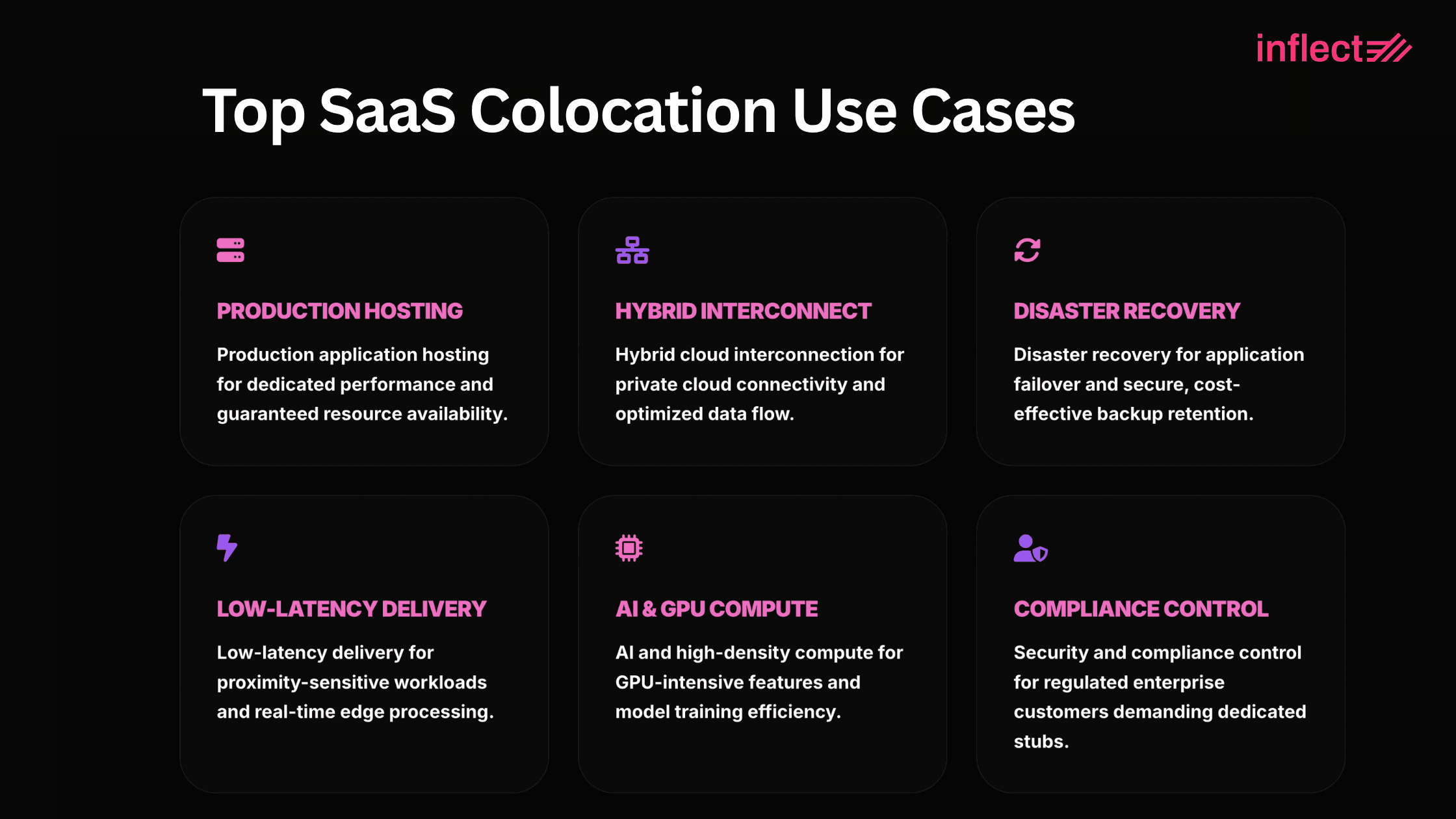
SaaS companies deploy colocation across six distinct infrastructure contexts, each solving a specific problem that public cloud addresses less efficiently: production application hosting for dedicated performance, hybrid cloud interconnection for private cloud connectivity, disaster recovery for application failover and backup retention, low-latency delivery for proximity-sensitive workloads, AI and high-density compute for GPU-intensive features, and security and compliance control for regulated enterprise customers.
1. Production Application Hosting
B2B SaaS platforms with enterprise customers colocate production environments in colocation data centers to run application servers, databases, caching layers, and API infrastructure on hardware the company owns and configures for its specific workload, gaining the data center space, power, and cooling needed to deliver dedicated performance that shared cloud resources cannot guarantee at equivalent cost. The cost and performance advantages over cloud are most pronounced for high-utilization stable workloads where cloud's elasticity pricing is not justified by actual demand patterns. SaaS companies typically reach this inflection point when their monthly cloud spend crosses a threshold where dedicated infrastructure delivers equivalent or better performance at 40 to 60 percent lower total cost over a two-year horizon.
2. Hybrid Cloud Interconnection
Carrier-neutral colocation serves as the private interconnection layer between a SaaS company's owned production infrastructure and public cloud services, enabling core application servers and databases to connect to AWS, Azure, or Google Cloud over private circuits at sub-millisecond latency rather than routing over the public internet. For SaaS companies running hybrid architectures, the colocation solution is the structural anchor of the stack: it holds the infrastructure that benefits from dedicated ownership on reliable power grids with redundant connectivity, and it connects that infrastructure privately to the cloud services that provide flexibility, managed services, and global reach. Direct cloud on-ramps in the facility eliminate the public-internet routing that introduces latency variability, security exposure, and the additional egress charges that come from crossing cloud network boundaries.
3. Disaster Recovery and Business Continuity
A geographically separated DR site in a retail colocation facility gives SaaS vendors a professionally managed off site data center for application failover, database replication, backup retention, and continuity testing without requiring a second full production footprint, covering everything from application server failover with tested recovery time objectives to backup storage for regulated customer data. The DR facility should be at least 100 miles from the primary site to avoid single-event failure scenarios, should mirror the same network connectivity and compliance certifications as the primary environment, and should be activated on a defined test schedule. For SaaS companies with enterprise uptime commitments, a tested and documented DR site is a contractual requirement, not optional infrastructure.
4. Low-Latency Customer Delivery
SaaS platforms with latency-sensitive workloads, including financial data applications, real-time analytics, collaboration tools, and API-heavy products with strict response time requirements, colocate infrastructure near major internet exchange points to reduce round-trip times and improve application responsiveness for end users and downstream systems. Proximity to IXPs such as Equinix NY5, CoreSite LA1, or DE-CIX in Frankfurt reduces round-trip latency for users and peering partners in ways that regional cloud zones cannot fully replicate through their own network infrastructure. For SaaS companies serving enterprise customers concentrated in specific geographic markets, a presence in a carrier-neutral colocation facility in that market often outperforms a cloud regional deployment for latency-critical production workloads.
5. AI and High-Density Workloads
SaaS products incorporating AI features, machine learning pipelines, or large language model inference are generating GPU compute requirements that cloud instance pricing does not serve economically at sustained utilization, making high-density colocation with liquid cooling the preferred infrastructure for SaaS AI teams that need dedicated GPU capacity at production scale. The economics are specific: cloud GPU instances are priced for variable, on-demand use. A GPU cluster running production inference at high utilization continuously generates a TCO (Total Cost of Ownership) case for owned hardware in colocation within 12 to 18 months of deployment. High-density colocation facilities supporting 30 to 100 kW per rack with rear-door heat exchange, direct-to-chip cooling, or immersion cooling provide the physical infrastructure foundation that AI inference at scale requires.
6. Security and Compliance Control
SaaS companies handling regulated data, including financial records, healthcare information, legal documents, and government data, colocate production workloads to maintain direct control over hardware ownership, physical access logging, and network segmentation in a SOC 2 Type II and ISO 27001 certified facility that produces audit documentation enterprise security teams can evaluate directly rather than through provider-managed compliance reports. For SaaS vendors in enterprise sales cycles where security questionnaires and vendor risk assessments are a standard procurement step, direct compliance documentation from a named colocation facility answers the physical infrastructure questions that cloud compliance reports address only indirectly. It also simplifies the compliance evidence burden for regulated SaaS companies operating under frameworks like SOC 2, PCI DSS, or FedRAMP that require explicit documentation of where and how production data is stored.
What SaaS Companies Must Evaluate in a Colocation Provider
SaaS infrastructure teams evaluating data center colocation should assess six dimensions that determine whether a facility can support production SaaS workloads at the performance, compliance, and operational level enterprise customers require. The best colocation data centers for SaaS companies demonstrate all six: uptime SLAs with component-level specificity, network and cloud on-ramp availability, power density and cooling architecture for AI workloads, compliance certifications scoped to the specific facility, contract flexibility for a growth-stage company, and remote hands support for teams without local staff.
Uptime SLA structure: Separate SLAs for power, cooling, and network availability, not a blended percentage. Tier III minimum with N+1 redundancy for production SaaS. Confirm financial remedies per hour of downtime, not just service credits applied to future invoices.
Network and cloud on-ramps: Carrier-neutral facilities with multiple carrier terminations, direct on-ramps to the cloud platforms your hybrid architecture requires, and IXP access if latency-optimized delivery is a product requirement. Get cross-connect fees, port speeds, and provisioning timelines in the contract before signing.
Power density and cooling: Confirm the specific hall supports your workload requirements. Standard SaaS application workloads run at 3 to 10 kW per cabinet. AI and GPU infrastructure requires 30 kW or above with liquid cooling options. Get the answer for your specific cage, not a facility-wide average that may not reflect where your equipment will actually sit.
Compliance certifications: SOC 2 Type II is the baseline for enterprise SaaS vendor qualification. Confirm the audit scope covers the specific facility and cage, not just the corporate entity. ISO 27001 for international enterprise customers. PCI DSS if payment data flows through the production environment.
Contract flexibility: SaaS growth trajectories are nonlinear. Confirm terms for adding cabinet space within the contract, notice periods for expansion, and whether a footprint change requires a new master service agreement. Facilities that force a new MSA for every capacity addition create friction at exactly the moments when you cannot afford it.
Remote hands support: For SaaS teams without local data center staff, remote hands response time, after-hours availability, and per-incident rates are operationally critical. Confirm the SLA, the escalation path for emergencies, and the per-hour rate before signing. Model expected usage against your operational calendar.
Questions SaaS Infrastructure Teams Must Ask Before Signing
SaaS engineering leads and CTOs evaluating colocation providers should ask seven questions that surface real capability and distinguish production-grade SaaS facilities from general enterprise providers that check specification boxes without the operational depth SaaS workloads require.
What are your separate SLAs for power, cooling, and network availability, and what are the financial remedies per hour? A combined uptime percentage without component-level SLAs and defined financial remedies is not sufficient for a SaaS platform with enterprise SLA commitments downstream.
Which cloud providers do you have direct on-ramps to, at what latency, and what are the cross-connect fees? For hybrid cloud architecture, this is the most consequential technical question. Get specific answers, not a reference to the provider's website.
What is the maximum supported kW per cabinet in the specific hall where our equipment will be housed, and what cooling architectures are available? Do not accept facility-wide averages. AI infrastructure requirements vary by hall and cage, and you need the answer for your specific location.
Can you provide your current SOC 2 Type II report, and does the scope explicitly cover this facility and the cage configuration we would occupy? A corporate-level SOC 2 that does not name the physical facility is insufficient for enterprise SaaS vendor qualification.
What are the terms for expanding our footprint mid-contract, and what triggers a new MSA? Growth-stage SaaS companies that outgrow their initial allocation mid-term face either renegotiation friction or capacity constraints at the worst possible time.
What is your remote hands SLA, including after-hours response time and per-incident rates? For SaaS companies without local staff, remote hands is your on-site operations team. Model the cost and confirm the escalation path before it matters.
Do you have SaaS company tenants, and can you share relevant references? A colocation provider whose experience is primarily with enterprise IT departments has a different operational culture and flexibility posture than one with a track record of supporting SaaS companies with dynamic, rapidly evolving infrastructure needs.
Best Place To Source Colocation For SaaS Companies
The Best place to source colocation for SaaS Companies is Inflect Digital Infrastructure Marketplace. Inflect is a digital infrastructure marketplace and advisory platform where SaaS companies can source, compare, and evaluate colocation providers across primary, secondary, and tertiary markets globally, with filters for uptime SLA tier, network and cloud on-ramp availability, power density and cooling architecture, compliance certifications, contract flexibility, and remote hands support capability.
SaaS infrastructure teams use Inflect to compress what is typically a months-long RFP process into a structured, parallel evaluation across multiple qualified providers. The advisory team works directly with SaaS CTOs and infrastructure leads on workload economics analysis, hybrid cloud architecture design, provider shortlisting, and contract negotiation. Whether you are moving your first production environment out of cloud, adding a geographically separated DR site, or sourcing high-density GPU infrastructure for an AI workload that has outgrown cloud pricing, Inflect provides the market access and expert guidance that growing SaaS infrastructure teams need to make the right decision faster.
Source SaaS Colocation on Inflect Compare providers on uptime SLAs, cloud on-ramp availability, power density, compliance certifications, and contract flexibility. Production hosting, disaster recovery, hybrid cloud interconnection, and AI infrastructure across primary and secondary markets globally.
→ Source SaaS Colocation on Inflect
Might help finding the right colocation for your SaaS company? Or looking for specific capacity in specific region?
About the Author

Chanyu Kuo
Director of Marketing at Inflect
Chanyu is a creative and data-driven marketing leader with over 10 years of experience, especially in the tech and cloud industry, helping businesses establish strong digital presence, drive growth, and stand out from the competition. Chanyu holds an MS in Marketing from the University of Strathclyde and specializes in effective content marketing, lead generation, and strategic digital growth in the digital infrastructure space.
Contact:
Email: