9 mins
Colocation for Manufacturing Companies: How to Choose Reliable Infrastructure for Mission-Critical Operations
Manufacturing infrastructure decisions carry consequences that many IT procurement processes still underestimate. A recent Siemens analysis found that unplanned downtime can cost automotive manufacturers about $2.3 million per hour (Source: Siemens, 2024). The infrastructure layer beneath ERP, MES, and SCADA environments is not an IT cost center. It is an operational dependency.
The failure modes that cause manufacturing colocation deployments to underperform are rarely dramatic. They are contractual: a facility running N+1 power on paper but sharing upstream power infrastructure with adjacent tenants, or a "diverse" fiber path running through the same physical conduit. Both are preventable at contract negotiation. Neither shows up in marketing materials. This guide gives IT directors, infrastructure leads, and procurement teams the framework to evaluate providers, verify claims, and negotiate contracts that hold up under operational pressure.
Why Manufacturing Workloads Are Moving to Colocation Now
Manufacturing companies are moving mission-critical workloads to colocation for four reasons: the convergence of IT and OT networks has outgrown on-premise infrastructure, legacy data rooms cannot support modern compute density, specific workload types perform better and cost less in colocation than in public cloud, and disaster recovery requirements for production environments demand geographic redundancy that self-managed facilities cannot reliably provide.
How IT/OT Convergence Is Changing Infrastructure Requirements for Manufacturers
IT/OT convergence, the integration of enterprise IT systems with operational technology networks controlling physical production equipment, creates infrastructure requirements that most manufacturer-owned facilities were not built to meet. When SCADA, historian databases, and MES platforms share infrastructure with ERP and analytics workloads, the combined power density, redundancy, and connectivity requirements exceed what a typical on-premise server room can deliver. IDC's Manufacturing Insights research indicates that connected factory platform adoption is accelerating rapidly, with projections that 70% of manufacturers will deploy these platforms by 2026, driving a 40% increase in plant-floor data volumes (Source: Microsoft, 2023).
Why Legacy On-Premise Data Rooms Are Failing Modern ERP and MES Workloads
Legacy on-premise server rooms fail modern manufacturing workloads on three dimensions: power density, cooling capacity, and redundancy architecture. Most manufacturer-owned facilities were designed for server densities of 3 to 5 kW per rack. Modern ERP and MES deployments regularly exceed 10 kW per rack, and AI inference workloads on GPU hardware can reach 30 kW or higher. The upgrade and maintenance costs to bring a legacy server room to Tier III equivalent standards, including redundant power feeds, precision cooling, and generator backup, typically exceed the five-year total cost of equivalent colocation capacity.
When Colocation Beats Cloud for Manufacturing Workloads
Colocation outperforms public cloud for manufacturing workloads in three situations: sustained high-throughput compute where cloud egress costs compound over time, real-time processing where cloud latency variability cannot meet control system requirements, and regulated environments where ITAR, CMMC, or sector-specific compliance requires physical access controls. SAP S/4HANA is the clearest example: at scale, colocation with dedicated or bare metal servers is materially cheaper than public cloud at sustained utilization. OSIsoft PI and Wonderware similarly benefit from consistent low-latency connectivity between historian and plant floor that cloud architecture cannot guarantee.
How Colocation Fits Into a Manufacturing Disaster Recovery and Business Continuity Plan
A second colocation facility in a geographically separate market supports the sub-hour recovery time objectives that production system outages demand, making it more reliable for manufacturing DR than cloud-only or tape backup. A cloud-only DR approach for a large SAP environment can take four to six hours to restore, well outside most manufacturing continuity plan targets. The contractual requirements are: guaranteed power-on time in the event of a failover declaration, remote hands response SLAs in minutes, and dedicated network capacity between sites.
The Six Infrastructure Requirements to Verify Before Signing a Manufacturing Colocation Contract
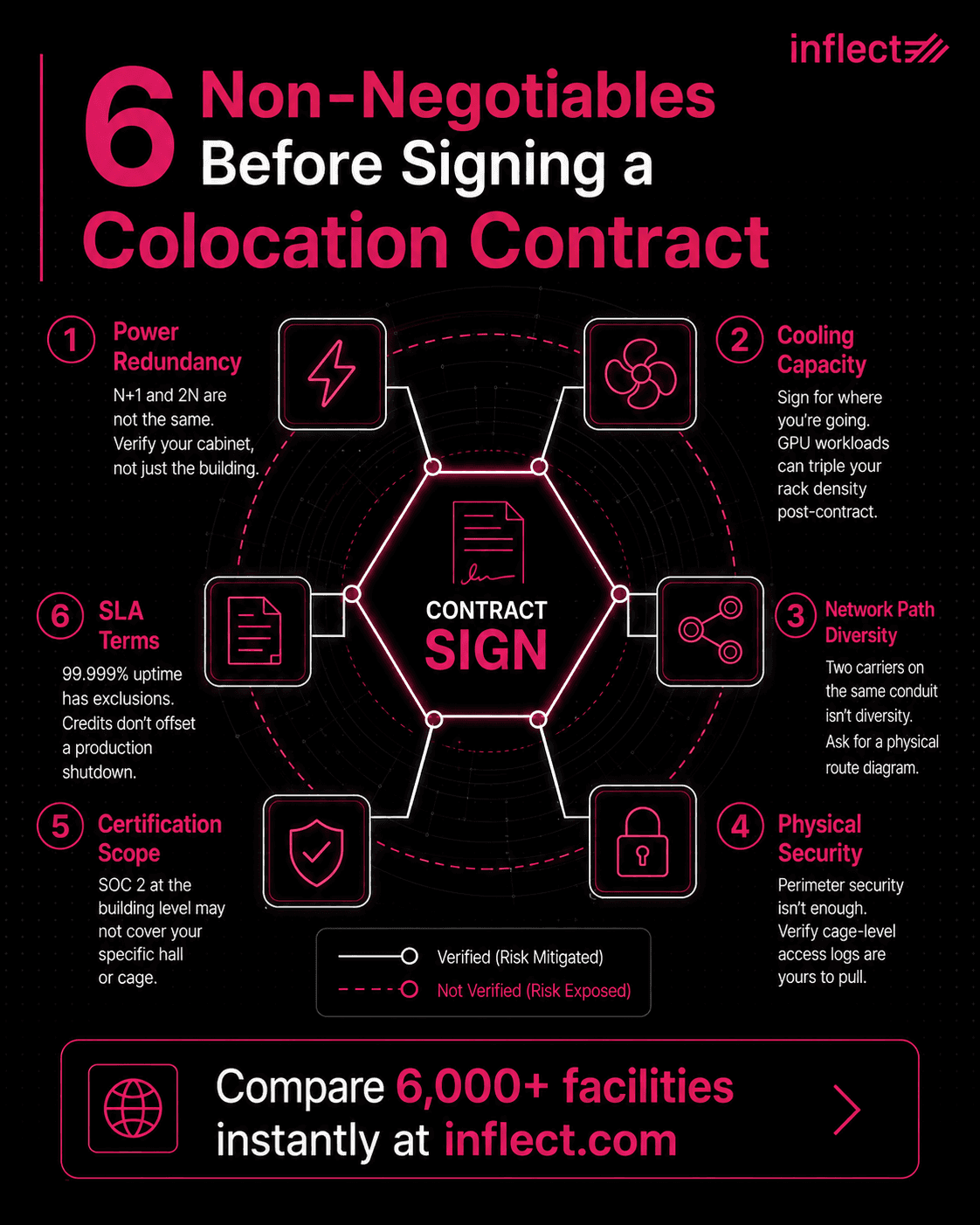
The six infrastructure requirements manufacturing companies must verify before signing a colocation contract are power redundancy architecture, cooling capacity per rack, network path diversity and latency, physical security controls, compliance certifications, and SLA terms for uptime, power, and incident response.
How to Verify Power Redundancy for 24/7 Manufacturing Operations
Power redundancy is defined by the architecture of the delivery path. N+1 means one backup component for the entire system; 2N means a fully redundant parallel system. For mission-critical manufacturing workloads, 2N redundant power architecture from utility feed through backup generators and UPS to PDU is the correct requirement. The shared upstream power failure mode described in the introduction, where a facility advertises N+1 but shares a utility transformer with adjacent tenants, is common in older facilities and rarely disclosed in sales. Verify the architecture in the contract and during the site inspection. The SLA language to require: guaranteed power availability at the cabinet level, measured independently from upstream utility incidents.
What to Ask About Cooling Capacity Before Deploying High-Density Manufacturing Compute
Colocation cooling requirements per rack vary by workload: MES and SCADA at 5 to 8 kW, SAP and analytics at 8 to 15 kW, and GPU-based inference or simulation at 20 to 40 kW. Verify that the facility can support your maximum projected density, not your current draw. Ask: What is the maximum kW per cabinet your cooling systems support? Is that limit per cabinet, per row, or per zone? What is the current cooling utilization in the hall where your equipment will be housed? A provider running at 80% utilization has limited headroom for future growth regardless of available contracted power.
How to Confirm Network Path Diversity and Low-Latency Connectivity for Plant Integration
Network path diversity means two or more fiber paths entering the building from physically separate routes, separate conduits, and separate street-level access points. Logical diversity on the same physical path does not protect against a single backhoe event. For SCADA colocation requirements, round-trip latency between the facility and the plant floor must be under 10 milliseconds for real-time control applications, under 25 milliseconds for MES, and under 50 milliseconds for ERP and analytics. Verify actual measured latency to your plant locations, not advertised network specifications. Strong network connectivity is only as reliable as the physical path delivering it, and the single carrier path failure mode described in the introduction is preventable when buyers look beyond the carrier list.
Physical Security Verification for ITAR, CMMC, and Regulated Manufacturing Environments
Physical security and data security requirements for ITAR compliant colocation and CMMC data center environments include man-trap entry systems, biometric access authentication, CCTV with retention periods meeting your regulatory requirements, and physical separation in a dedicated cage or suite. For a site audit, verify access logs are exportable, CCTV retention meets your minimum period, and the provider can execute a subcontractor acknowledgment of your security requirements in writing. Certifications are a starting point. Physical verification is the requirement.
Which Certifications to Require for Manufacturing Colocation: SOC 2, ISO 27001, and CMMC
The certifications that matter depend on vertical: SOC 2 Type II is the baseline for sensitive business data; ISO 27001 is required for manufacturers with European operations; CMMC Level 2 or 3 is required for defense contractors handling Controlled Unclassified Information; and ITAR compliant colocation requires access controls, personnel vetting, and documentation beyond any single certification. For ITAR and CMMC data center requirements, request the most recent audit report, ask about findings and remediation, and verify that the certification scope covers the specific hall and cage, not just the facility at a building level.
How to Read a Colocation SLA So You Know What You Are Actually Buying
A colocation service level agreement (SLA) stating 99.999% uptime permits approximately 5.26 minutes of downtime per year at the facility level, and does not cover network outages upstream of the facility, scheduled maintenance windows, or power incidents originating from the utility. The terms that matter most are: what is included in the uptime calculation, the credit structure for breaches (credits are not compensation for production losses), the incident notification timeline, and the remote hands response commitment. If the boundary between provider responsibility and customer responsibility is not explicit in the contract, assume the exclusion list is longer than it appears.
Colocation Location Strategy for Manufacturing Companies
The location decisions for manufacturing colocation are: required proximity to plant sites based on latency thresholds, primary vs. secondary market selection, single vs. multi-site footprint architecture, and network access and fiber path verification at the facility level.
How Close Does Your Colocation Facility Need to Be to Your Plant?
Colocation latency requirements vary by workload: SCADA and control systems require under 10 milliseconds round-trip, MES and production scheduling under 25 milliseconds, and ERP and analytics under 50 milliseconds. For most discrete manufacturing environments, a facility within 50 to 150 kilometers of the primary plant site meets all latency requirements. For real-time closed-loop control, verify measured latency directly rather than estimating from distance.
Primary Market vs. Secondary Market Colocation for Manufacturing Buyers
Manufacturing colocation buyers in the US have a strong case for secondary markets including Columbus, Indianapolis, Greenville, and Memphis, where power costs are lower, carrier density is sufficient for most manufacturing connectivity requirements, and available capacity is higher than in constrained Tier 1 markets. Primary markets including Chicago, Dallas, and Atlanta offer higher carrier density at a cost premium that most manufacturing ERP, MES, and SCADA environments do not justify. The exception is workloads with direct dependencies on financial systems or partners concentrated in a specific primary market.
How Multi-Site Manufacturers Should Structure a Colocation Footprint
Manufacturers operating across multiple locations should evaluate a hub-and-spoke architecture: a primary facility hosts core ERP and data management, secondary facilities host the MES and SCADA infrastructure local to each production region. This reduces latency to plant-floor systems, maintains centralized data governance, and provides a natural DR architecture when hubs are in separate markets. Negotiate consistent SLA terms, security standards, and expansion rights across all facilities at execution.
Network Access, Carrier Diversity, and Fiber Path Verification
Carrier neutral data center facilities provide access to multiple independent carriers within the same building, allowing buyers to select based on performance to specific plant locations and maintain connectivity through a single carrier outage. Fiber path diversity requires physically separate conduits and street-level access points, not just separate carriers on the same path. Request a facility diagram showing fiber entry points and get written confirmation of physical path separation. This is the verification step that prevents the single-path failure described in the introduction.
For Global Manufacturers: Evaluating Colocation in International Markets
Global manufacturers sourcing colocation in EMEA or APAC face additional dimensions: data sovereignty restrictions, import/export control obligations affecting facility access, provider density variations by country, and cross-border latency to home-country ERP environments. In EMEA, GDPR creates data residency requirements for personal data. In APAC, data localization laws in China, India, and Indonesia create mandatory in-country hosting requirements for certain data categories. Verify applicable requirements with legal counsel before committing to a facility location in any international market.
Six Mistakes Manufacturing Companies Make When Choosing a Colocation Provider
The six most consequential mistakes are: underspecifying power density at contract signature, choosing shared infrastructure where compliance requires dedicated, skipping the physical site audit, failing to negotiate remote hands SLAs, sole-sourcing without a failover architecture, and locking into a term without expansion rights.
Signing for Standard Power Density Before Knowing Your Actual Compute Draw
The most common contract error is signing for standard rack density, typically 3 to 5 kW per cabinet, before completing a workload power assessment. When AI inference, GPU-based simulation, or high-density SAP HANA deployments are added post-contract, the facility may not have capacity in the originally assigned space. The result is forced migration or renegotiation at higher rates. Complete a full power draw assessment for current and projected 36-month workloads, and size for peak load, not average.
Choosing Shared Infrastructure When Your Compliance Profile Requires Dedicated
Shared floor space does not satisfy physical access control requirements for ITAR compliant colocation or CMMC data center environments. Both frameworks require access restricted to authorized personnel via a locked cage, dedicated space, or private suite with independently logged entry. The cost difference between a shared cabinet and dedicated space is real, and smaller than the cost of a compliance finding or incident triggered by inadequate access controls.
Skipping the Physical Site Audit
Certifications confirm that a provider met a standard at a point in time. A site audit confirms the facility matches what is described in the contract. Buyers who relied on documentation alone have found cooling infrastructure recently modified and not yet re-audited, fiber entry points that did not match diversity claims, and access controls covering the perimeter but not the specific hall or cage. An audit should cover the power path from utility feed to cabinet, fiber entry points, access log export capability, and maintenance records for generator and UPS systems.
Not Negotiating Remote Hands and Smart Hands Response SLAs
Remote hands and smart hands services are the provider's ability to perform physical tasks at your equipment on your behalf. For manufacturing buyers without on-site IT staff at the colocation facility, the response time SLA directly affects recovery time in an incident. Standard industry SLAs range from 30 minutes to 4 hours for initial response. Negotiate a 30-minute or better commitment with escalation provisions, and verify whether the commitment applies 24/7/365 or only during business hours.
Choosing a Single-Provider Strategy Without a Failover Architecture
A single-provider, single-facility strategy creates concentration risk inconsistent with most manufacturing BCP/DR requirements. A second facility in a geographically separate market is the correct architecture for production-critical workloads. The business case is the cost of an outage at your primary facility measured against the annualized cost of DR capacity at a second site.
Locking Into a Term Without Expansion Rights
Standard colocation contracts run two to five years with no automatic right to expand within the term. Manufacturers who sign for current requirements and then add production lines, AI workloads, or analytics infrastructure have no mechanism to expand without renegotiating at market rates. Negotiate expansion rights at execution: right of first refusal on adjacent space, a pre-agreed rate schedule for additional power, and a process for suite upgrades if your footprint grows.
How Inflect Helps Manufacturing Buyers Source and Compare Colocation
Inflect is a digital infrastructure marketplace where buyers search, compare, and receive instant pricing across 6,000+ facilities in 100+ countries, covering retail colocation, wholesale colocation, and dedicated space options, without a sales call.
Searching Facilities by Certification, Capacity, and Market
Inflect allows buyers to filter by geographic market, power capacity, compliance certifications, and carrier access, applying the evaluation criteria from this guide directly to a provider search. Facilities with interconnection services and cloud on-ramps are searchable alongside standard options. Buyers receive matching results with pricing across multiple providers in a single view rather than assembling information through separate provider conversations.
Getting Instant Pricing Without a Sales Call
Inflect provides instant pricing across its provider network, including Equinix, Digital Realty, QTS, Iron Mountain, TierPoint, and Flexential, among hundreds of others. Once requirements are defined, procurement teams receive comparable pricing from multiple providers immediately rather than entering a multi-week RFP cycle with each one. Inflect's advisory team can identify which specific facilities within a provider's portfolio best match a given manufacturing use case, at no cost to the buyer.
What to Prepare Before You Search: A Pre-Sourcing Checklist
Before searching on Inflect, have the following ready: estimated power draw per cabinet at peak load and projected 36-month maximum, required certifications (SOC 2 Type II, ISO 27001, CMMC level, ITAR), latency requirements between the colocation facility and each plant site, preferred geographic markets for primary and secondary facilities, contract term preference, and whether dedicated cage or suite space is required. Having these inputs defined before beginning a provider search produces accurate results and eliminates providers who cannot meet requirements before any time is spent in a sales conversation.
Manufacturing Colocation Evaluation Checklist
Before selecting a provider, confirm each of the following:
Power: 2N architecture confirmed in contract, not just sales materials. Cabinet-level power SLA in place. Generator and UPS records reviewed on site.
Cooling: Maximum kW per cabinet confirmed for peak projected density. Cooling utilization of the specific hall reviewed. Future headroom addressed in contract.
Network: Carrier neutral facility with physically separate fiber entry points confirmed in writing. Measured latency to plant sites verified. Path diversity confirmed beyond the carrier list.
Security: Physical access controls meet ITAR, CMMC, or applicable requirements. Dedicated cage or suite in place where shared space is insufficient. Access logs exportable with required retention period.
Certifications: Audit scope confirmed to cover your specific facility zone. Most recent report and findings reviewed, not just the certificate.
SLA: Uptime calculation scope and exclusions understood. Remote hands response committed in writing with 24/7 coverage. Incident notification timeline defined.
Contract: Expansion rights for power, space, and suite upgrades negotiated before execution.
Once requirements are defined, search Inflect to receive instant pricing across facilities and identify a shortlist before the first provider conversation begins.
About the Author

Haley Rogers
Content & Social Media Specialist
Haley Rogers is the Content & Social Media Specialist at Inflect, bringing over two years of experience in social media, marketing, and content strategy — including time at a fast-paced tech company before joining the Inflect team. She specializes in translating complex digital infrastructure topics into clear, engaging content, with a particular focus on blog writing and brand storytelling across channels.
Contact: