15 mins
Colocation for Gaming Companies: How to Choose Low-Latency, High-Availability Infrastructure
It's 9:40pm on a Friday, three hours after a major patch went live, and concurrent players on the East Coast matchmaking pool just crossed the seasonal peak. Average latency on that pool climbs from 22ms to 190ms in under four minutes, matchmaking times out, and players start posting in Discord to complain before the client even finishes reconnecting.

None of this is really about the patch. The global games market generated roughly $197 billion in revenue in 2025 (Source: Newzoo, 2025), and an increasing share of that comes from live service titles where retention, not the initial sale, determines whether a game is profitable, so a peak-hour latency spike directly threatens the churn numbers the model is built on.
The cost of getting infrastructure wrong is measurable. Large enterprises report hourly downtime costs averaging over $300,000, with 41 percent reporting $1 million to $5 million or more per hour (Source: ITIC, 2024), and esports operators carry an even narrower margin since a mid-match outage during a broadcast tournament cannot simply be resolved with a refund.
This post lays out the criteria gaming companies use to evaluate low-latency game server hosting and gaming infrastructure colocation, and where cloud, bare metal, and hybrid models each earn their place.
Why Latency and Uptime Are Non-Negotiable for Gaming Infrastructure
Gaming infrastructure carries a stricter latency and availability bar than most enterprise workloads because player perception of lag is immediate, matchmaking systems are sensitive to jitter as much as raw ping, and a single regional outage during a launch or tournament can erase months of player acquisition spend in one night.
How Milliseconds of Latency Affect Player Retention and Matchmaking
Player tolerance for latency varies sharply by genre: competitive first-person shooter players generally expect total latency under 50 milliseconds, with experienced players perceiving delay as low as 15 milliseconds, while slower-paced genres can remain playable well past 100 milliseconds before responsiveness noticeably suffers (widely cited industry benchmark, illustrative). Peer-reviewed research confirms the underlying mechanism: latency measurably degrades player target-selection performance and self-reported quality of experience in first-person shooters, and individual latency-compensation techniques cannot fully offset the effect on their own (Source: ACM Digital Library, 2023). Matchmaking server infrastructure compounds this because it groups players by latency band, not just skill, so a modest peering degradation silently narrows the pool and produces the mismatched-latency matches players describe as "lag that comes and goes."
What an Hour of Downtime Costs a Live Service Game
The same downtime economics cut directly against gaming: enterprises report hourly outage costs averaging over $300,000, with 41 percent seeing $1 million to $5 million or more per hour (Source: ITIC, 2024). Live service revenue concentrates into peak evening and weekend hours, so an outage in that window captures a disproportionate share of the day's total, and review bombing, refund spikes, and drops in daily active users tend to persist for days afterward.
Tick Rates, Server Authority, and Their Impact on Latency Sensitivity
Server tick rate, the frequency at which a game server processes and broadcasts state updates, determines how much of a game's responsiveness depends on network latency versus server-side simulation. A 64Hz server updates roughly every 15.6 milliseconds and a 128Hz server every 7.8 milliseconds, and a facility with excellent raw latency but inconsistent jitter can still produce a worse experience on a high-tick-rate title than a slightly higher but more stable latency path, since responsive gameplay depends as much on consistency as on raw speed.
Regional vs. Global Matchmaking Architectures and Latency Tradeoffs
Gaming companies typically choose between regional pools that keep players within a single low-latency zone and global pools that widen the population, serving global audiences at the cost of a broader latency spread. A title with a small, concentrated player base may do fine on one regional deployment, while a global live service title with millions of concurrent players typically needs multi-region colocation, effectively a global game server deployment, to keep queue times and latency within range.
Jitter, Packet Loss, and Network Stability vs. Raw Latency
Jitter, the variation in latency from one packet to the next, and packet loss often affect gameplay more severely than a slightly elevated but stable ping, since a steady 60 millisecond connection frequently plays better than one averaging 40 milliseconds but swinging between 20 and 90. Colocation facilities with dense, high-quality peering reduce jitter by keeping traffic on fewer network hops and away from congested transit routes.
Player Experience Latency Thresholds by Game Type
Acceptable latency thresholds differ by genre: competitive first-person shooters generally require under 50 milliseconds, fighting and rhythm games sit in a similarly tight window, real-time strategy and MOBA titles tolerate roughly 60 to 100 milliseconds, and turn-based multiplayer titles remain playable up to 150 milliseconds or more (widely cited industry benchmark, illustrative). Infrastructure teams should set latency targets against the specific genre and title rather than one company-wide standard.
Key Criteria for Choosing Low-Latency Colocation Providers
Evaluating low latency colocation providers for gaming infrastructure comes down to six criteria: proximity to player population centers, carrier-neutral facilities with dense peering and optimized network paths, DDoS protection capacity, interconnection to cloud and CDN providers, real-time network telemetry, and hardware availability for bare metal and GPU-adjacent workloads. Each should appear as an explicit RFP line item, not an assumed baseline.
Proximity to Player Population Centers and Network Edge
The single largest lever on latency is physical distance between the data center and the player, since latency scales roughly with round-trip distance.
For technical teams: map your player population against available colocation markets before evaluating providers within any single market, since it is common to overinvest in redundancy in one metro while leaving an entire region several hundred kilometers from the nearest point of presence.
Carrier-Neutral Facilities, Peering Density, and Optimized Network Paths
Carrier neutral data centers built for gaming workloads let a tenant connect to major internet service providers, internet exchanges, and cloud platforms within the same facility rather than being locked into a single provider's network, enabling direct peering and cross-connects, often over dedicated fiber optic cables, that bypass congested transit routes and reduce latency along the path players actually use. Dense peering ecosystems and edge computing capacity near major internet exchange points also make it easier to implement route optimization such as Anycast routing and active traffic steering, so providers should be evaluated on the number and quality of network operators present, not just theoretical bandwidth.
DDoS Protection and Mitigation Capacity
DDoS protection for game servers has become a baseline requirement rather than an add-on, since gaming was among the most targeted industries in Cloudflare's 2025 DDoS threat reporting, with competitive rivalry between titles and players cited as a leading attack motivation in the sector (Source: Cloudflare, 2025). Attack scale grew sharply alongside frequency, with Cloudflare recording a record 31.4 terabit-per-second attack in Q4 2025 (Source: Cloudflare, 2026), so evaluation should focus on mitigation capacity in terabits per second and whether protection is always-on rather than triggered reactively, backed by standard access controls such as biometric authentication and audited access logs at the facility level.
Interconnection to Cloud, CDN, and Backbone Providers
Nearly every gaming company runs a hybrid footprint connecting colocated game servers to major cloud providers, content delivery networks (CDN) that optimize content delivery for patches and assets, and backbone providers for global reach. Direct cross-connects to major cloud on-ramps and CDN providers inside the same facility remove the latency and cost penalty of routing that traffic over the public internet, enabling fast, predictable network performance, while a facility with poor on-ramp access forces a choice between a slower public path or a costly dedicated circuit.
Telemetry, Monitoring, and Real-Time Network Visibility
Real-time visibility into latency, jitter, packet loss, and traffic patterns supports proactive monitoring and proactive management of network performance, letting infrastructure teams catch a degrading peering path before players start reporting lag on real time interactions between clients and servers. This becomes critical during launches and live events, when teams need to distinguish a genuine network problem from a client-side or game-logic issue within minutes.
Hardware Availability, Bare Metal Options, and Specialized GPU/CPU Support
Provider selection should account for what hardware is actually available on demand, since bare metal servers with high single-thread CPU performance remain the standard for high performance infrastructure supporting latency-sensitive game and matchmaking servers, while GPU-adjacent capacity is increasingly relevant for AI-driven matchmaking and anti-cheat detection. Confirm before signing a contract that a provider's hardware catalog matches the server profile a title's engine requires to sustain optimal performance, since retrofitting a facility choice after launch is far more disruptive.
Designing High-Availability Architecture for Live Service Games
High availability gaming infrastructure rests on four pillars: certified uptime tier standards, redundant power and cooling, multi-region failover with a defined disaster recovery plan, and explicit recovery time and recovery point targets written into provider contracts.
Uptime Tier Standards and SLA Benchmarks to Require
The Uptime Institute's Tier Classification System defines Tier III as concurrently maintainable infrastructure, where any component can be taken offline for maintenance without disrupting operations, and Tier IV as fault tolerant infrastructure that keeps operating through an actual equipment failure (Source: Uptime Institute, 2026). Live service games with continuous global player bases should generally require Tier III as a floor and evaluate Tier IV for any facility hosting a single point of failure for the entire title.
Redundant Power and Cooling for 24/7 Operations
Redundant power and cooling, meaning independent distribution paths for both systems, is what lets a facility perform maintenance or absorb a component failure without taking a live game offline.
For technical teams: confirm redundant power and cooling have been tested under a real failover event, not just documented on paper, since a tier certificate describes design intent rather than proof of tested performance.
Multi-Region Failover and Disaster Recovery Planning
Multi-region failover means running duplicate or near-duplicate game server and matchmaking capacity across a distributed architecture spanning a second geographic region, absorbing player traffic if the primary region degrades or fails and protecting against the gaming-specific failure mode where an entire regional player base loses service simultaneously during a peak window. Disaster recovery planning should explicitly cover state synchronization for persistent game data, since a title with player inventories and in-game economies cannot fail over the way a stateless web application can.
Active-Active vs. Active-Passive Deployment Models
Active-active deployment runs full production traffic across two or more regions simultaneously, while active-passive keeps a secondary region on standby, ready to take over but not serving live traffic under normal conditions. Active-active eliminates failover delay at higher cost, which matters most where even a short interruption would be visible mid-match, while active-passive is often more practical for titles with lower concurrent density or tighter budgets.
Latency-Aware Load Balancing Across Regions
Latency-aware load balancing routes each player to the region or point of presence that delivers the best network path for their location, rather than a fixed assignment or round-robin distribution, which is what lets a multi-region footprint actually deliver a latency benefit rather than just a redundancy benefit. Without it, players can still be routed to a distant region during partial outages, defeating much of the purpose of building the additional regions.
Recovery Time Objective (RTO) and Recovery Point Objective (RPO) Targets
Recovery time objective specifies the maximum acceptable time between a disruptive event and full restoration of service, while recovery point objective specifies the maximum acceptable data loss, measured as a point in time, that an organization can tolerate during that event (Source: NIST, 2026; NIST, 2026). Gaming companies should set these separately for game server availability and persistent player data, since a live service game can often tolerate a short RTO but needs a much tighter RPO for player progress and transaction data.
Scaling Colocation Infrastructure for Launches, Patches, and Esports Events
Scaling multiplayer game server hosting infrastructure for demand spikes requires five capabilities working together: burst capacity planning for concurrent player surges, sufficient hardware density and GPU/CPU availability to support that burst, a clear bare metal versus hybrid cloud allocation strategy, infrastructure automation for rapid environment provisioning, and patch deployment practices that do not interrupt players already in session.
Burst Capacity Planning for Concurrent Player Spikes
Burst capacity planning, the foundation of game server scaling for peak traffic, starts with modeling the shape of demand spikes a title will face, since launch day, major content drops, patch nights, and scheduled esports events all produce distinct and largely predictable surges. A studio that provisions ahead of a known launch date avoids the matchmaking degradation and queue backups a reactive scaling approach cannot fully prevent once player volume has already exceeded capacity.
Hardware Density and GPU/CPU Availability for Game Server Scaling
Scaling during a demand spike depends on how quickly additional compute density, both CPU capacity for game and matchmaking servers and GPU capacity for AI-driven systems, can come online in the regions where demand is growing. A provider with deep, readily available hardware inventory in the right markets can absorb a launch spike in hours, distinct from the provider-selection question of whether the right hardware category exists at all.
Bare Metal vs. Hybrid Cloud for Matchmaking and Game Servers
Bare metal game server hosting delivers the most consistent, highest single-thread performance for latency-sensitive workloads, since there is no hypervisor overhead between game logic and hardware, while hybrid cloud arrangements pair that bare metal core with cloud-based burst capacity for temporary overflow.
For technical teams: the most common production pattern is bare metal or dedicated colocation for the steady-state player base paired with cloud auto-scaling for demand peaks, a pattern that extends naturally to esports server hosting solutions during scheduled tournament windows.
Infrastructure Automation (IaC) for Rapid Environment Spin-Up
Infrastructure as code lets a team define server configurations, network settings, and scaling rules in version-controlled templates deployable consistently across regions in minutes rather than hours, turning a burst capacity plan into something that can actually execute during a live spike. Automation also reduces the manual configuration errors more likely when a team is provisioning capacity in real time during an active incident.
Pre-Provisioned Capacity vs. On-Demand Scaling Strategies
Pre-provisioned capacity reserves hardware or cloud instances ahead of a known event, guaranteeing availability at the cost of some idle capacity between events, while on-demand scaling requests capacity only as needed but risks unavailability in the exact market and quantity needed during an unplanned spike. Most live service studios blend the two: pre-provisioning a baseline for predictable events and relying on cloud burst capacity for the unpredictable tail of demand.
Patch Deployment Strategies Without Player Disruption
Rolling and blue-green deployment strategies let a studio push a patch to a new server pool while existing sessions continue on the current one, migrating players over as sessions naturally end rather than forcing an immediate disconnect, avoiding the mass reconnection spike a hard cutover produces. Coordinating deployment timing with known player activity patterns, deploying during confirmed low-concurrency windows per region, further reduces the number of players affected by any instability.
Colocation vs. Cloud Hosting for Gaming Workloads
Colocation and cloud hosting solve different parts of the gaming workload infrastructure optimization problem, and most live service studios run both rather than choosing one exclusively. The decision comes down to three tradeoffs: cost behavior at scale, the level of latency control required, and how much operational overhead a team is prepared to own directly.
Cost is often the clearest breakpoint. Cloud egress pricing for data transferred out to the internet runs $0.09 per gigabyte for the first 10 terabytes per month on major public cloud platforms, stepping down at higher volumes but still scaling directly with traffic (Source: AWS, 2026). A live service title with heavy state synchronization and telemetry traffic can push that egress bill into a large, variable monthly cost as concurrent players grow, while colocation shifts the same traffic into a fixed bandwidth and cross-connect contract that does not scale linearly with player growth.
Latency control is the second breakpoint, and it favors colocation for anything genre-sensitive, since public cloud regions are limited in number and location while colocation lets a studio place infrastructure in the specific metro closest to a concentration of players. Operational overhead favors cloud, at least for smaller teams, since managing colocated hardware requires an in-house operations team or a managed services relationship, while cloud platforms abstract most of that responsibility away in exchange for the tradeoffs above.
The pattern that has emerged across most live service studios is a hybrid cloud gaming infrastructure baseline: colocated bare metal or dedicated servers carrying the steady-state workload, cloud capacity absorbing burst demand during launches and events, and CDN handling asset delivery to keep gaming experiences consistent regardless of where the core servers live.
Which Infrastructure Model Fits Your Gaming Company
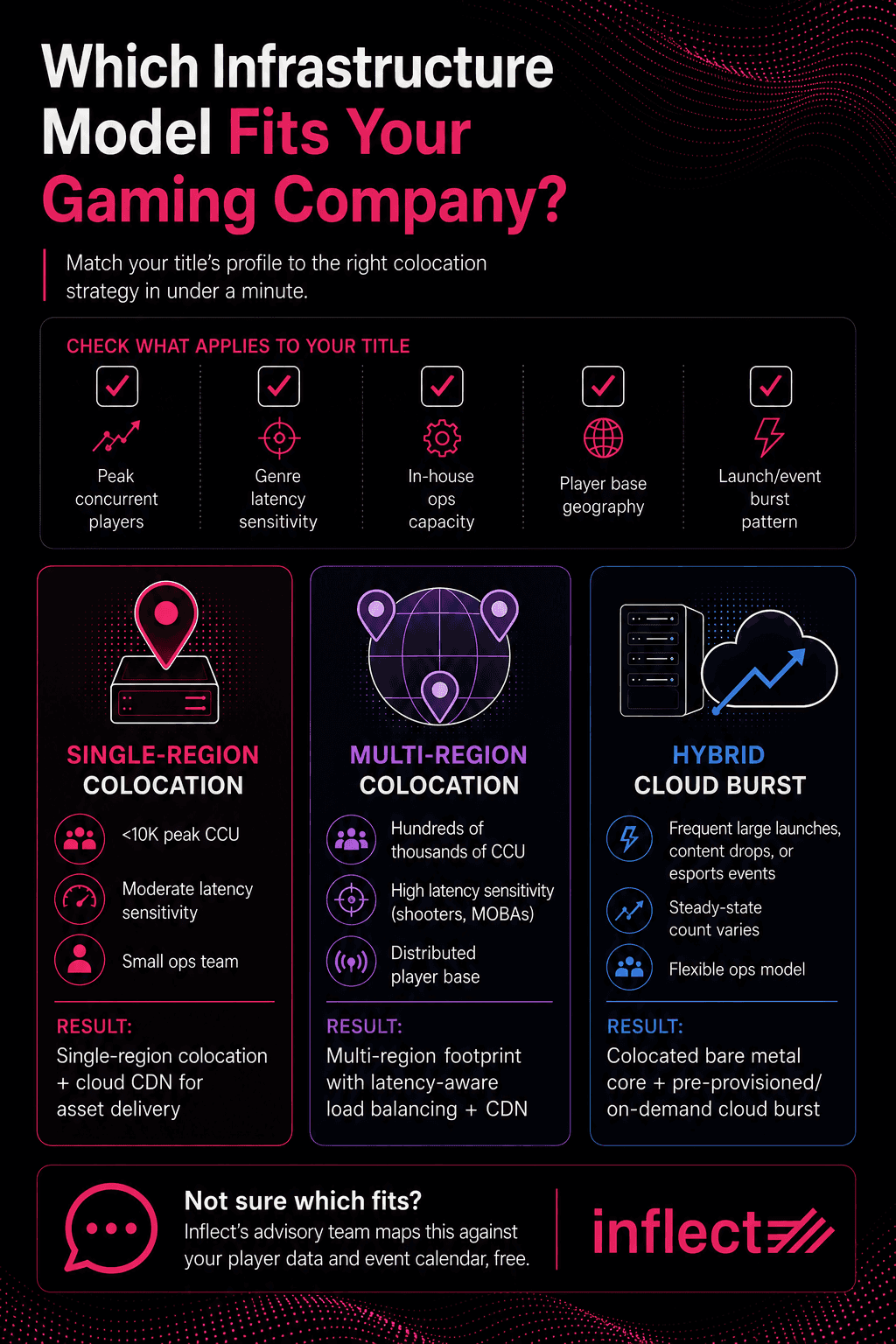
Five questions determine which infrastructure model a gaming company should run: how many concurrent players the title supports at peak, how latency-sensitive the genre is, whether the team has in-house infrastructure operations capacity, how geographically distributed the player base is, and how large and predictable the studio's launch and event burst demand is.
A title with under roughly 10,000 peak concurrent players, moderate latency sensitivity, and a small operations team is generally best served by a single-region colocation deployment paired with cloud CDN for asset delivery. Titles with hundreds of thousands of concurrent players, high latency sensitivity such as a competitive shooter or MOBA, and a distributed player base typically need a multi-region colocation footprint with latency-aware load balancing and CDN in front of it. A studio running frequent large-scale launches, content drops, or scheduled esports events, regardless of steady-state player count, generally needs the hybrid cloud burst model: a colocated bare metal core sized to steady-state demand, with pre-provisioned or on-demand cloud capacity absorbing predictable spikes around those events.
Inflect's advisory team can walk through this branching logic against a specific title's player data and event calendar at no cost, refining which pattern, or combination of patterns, fits before a studio commits to a facility or contract.
Choosing colocation for a live service title, an esports platform, or a global launch is a set of linked decisions: where to place capacity relative to players, what availability tier to require, how to handle burst demand, and where cloud and bare metal each earn their place. Buyers who treat these as separate RFP line items, backed by measurable standards like Tier III/IV certification, defined RTO/RPO targets, and terabit-scale DDoS mitigation, consistently end up with infrastructure that survives launch night rather than infrastructure that merely passed a sales pitch.
Sourcing Gaming Colocation Through Inflect
Inflect is a digital infrastructure marketplace that lets gaming companies search, compare, and get instant pricing on gaming server colocation across 6,000+ data centers and facilities in 100+ countries, without a sales call or RFQ process slowing down a launch timeline. Providers confirmed on the platform include Equinix, Digital Realty, CoreSite, TierPoint, Flexential, and Megaport, giving gaming buyers access to some of the most established gaming data center providers, with the peering density and cloud on-ramp access that low-latency, hybrid architectures depend on. Inflect's free expert advisory team supports buyers through the evaluation criteria in this post, including tier standards, DDoS mitigation capacity, and hardware availability, at no additional cost regardless of deal size.
Choosing the right colocation partner for a live service title, an esports platform, or a global launch comes down to matching latency, availability, and scale requirements to the right facility footprint, not defaulting to whatever capacity is easiest to find.
Search instant pricing across carrier-neutral gaming server colocation facilities in the markets closest to your player base
Compare uptime tier standards, DDoS mitigation capacity, and hardware availability side by side, without a sales call
Get free expert advisory on regional footprint, hybrid cloud burst strategy, and disaster recovery planning for your specific title
Source capacity for a single regional deployment or a full multi-region, high-availability architecture from the same platform
Get instant pricing on gaming colocation through Inflect and start comparing facilities today.
About the Author

Haley Rogers
Content & Social Media Specialist
Haley Rogers is the Content & Social Media Specialist at Inflect, bringing over two years of experience in social media, marketing, and content strategy — including time at a fast-paced tech company before joining the Inflect team. She specializes in translating complex digital infrastructure topics into clear, engaging content, with a particular focus on blog writing and brand storytelling across channels.
Contact: