10 mins
Colocation for E-Commerce Companies: Low-Latency, Scalable Infrastructure for Growth
It is 8:47pm Eastern on Black Friday. A mid-market retailer's checkout API has slowed from 180 milliseconds to 1.4 seconds. Add-to-cart events are queuing behind saturated database read replicas. Autoscaling is firing, but the new pods are landing in an availability zone already at capacity. The engineering lead is in the war room. The CFO is watching the cloud spend dashboard tick past the forecast threshold the board flagged.
The cost of that 1.4-second delay is quantifiable. A 0.1 second improvement in mobile site speed correlates with an 8.4% lift in retail conversions and a 9.2% lift in average order value (Source: Deloitte, 2020). For a retailer running $40M in Black Friday weekend revenue, every 100ms of avoidable latency carries a seven-figure cost.
This guide explains where colocation outperforms public cloud, how the unit economics work, what a hybrid reference architecture looks like, and how to evaluate and source a facility.
Why E-Commerce Companies Are Moving Production Workloads to Colocation
E-commerce companies move production workloads to colocation for six reasons: catalog and image egress costs that compound with traffic, latency targets tied to conversion revenue, predictable performance during peak shopping events, GPU economics that favor sustained inference utilization, PCI DSS scope reduction through dedicated infrastructure, and a broader cloud repatriation trend among mid-market and enterprise retailers.
Cloud Egress Costs at Catalog and Image Scale
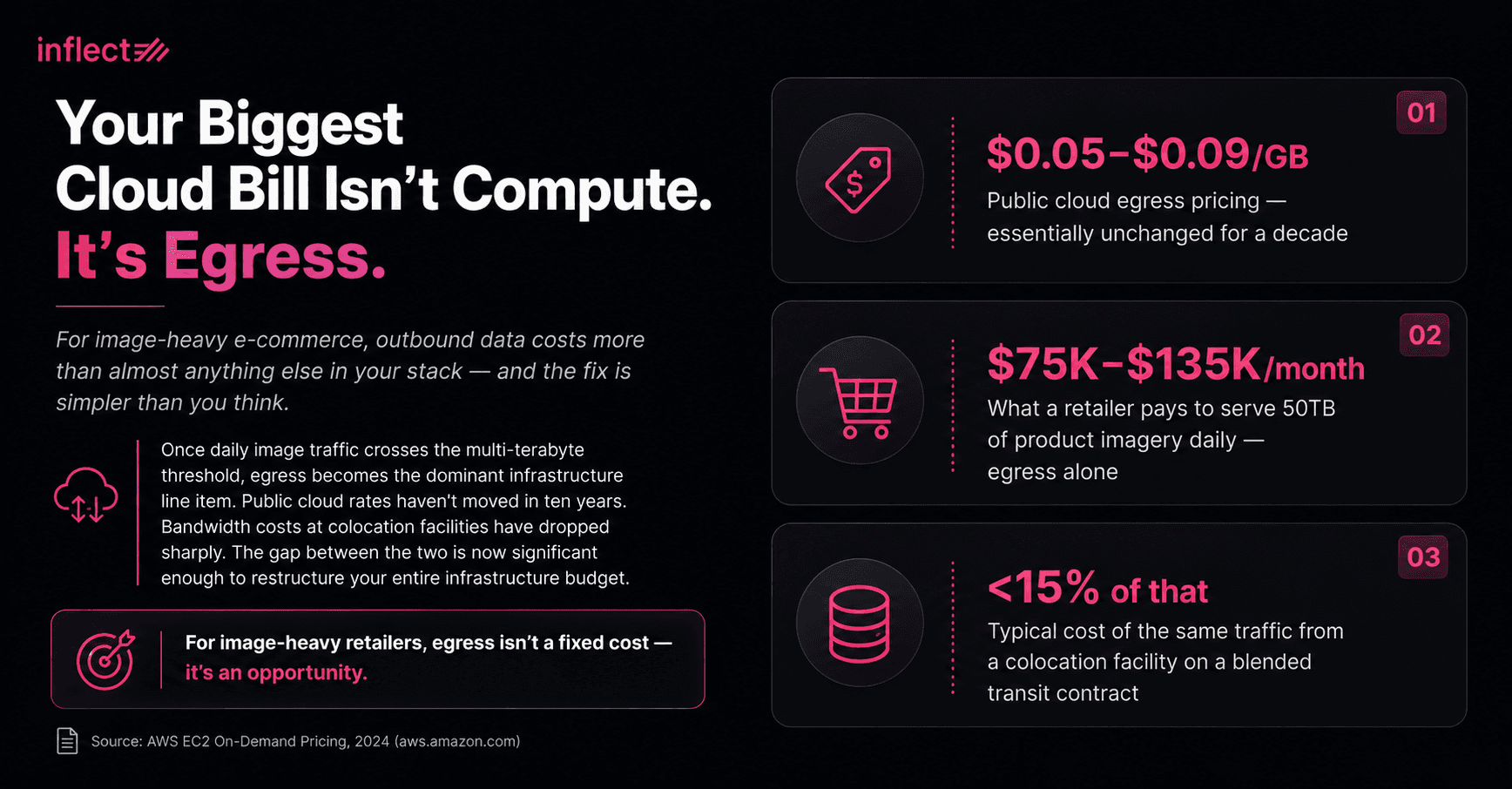
E-commerce platforms with image-heavy catalogs pay more in cloud egress fees than any other infrastructure line item once daily traffic crosses the multi-terabyte threshold. Public cloud providers charge $0.05 to $0.09 per GB of outbound data (Source: InfraCost, 2026), while the same traffic from a colocation data center through a blended IP transit contract typically costs under 15% of that amount, with competitive pricing on transit and adequate bandwidth at a fraction of cloud rates.
Latency and Conversion: Why Network Proximity Matters
Latency between a buyer's device and the application tier is a direct multiplier on conversion rate, governed by physical distance and network path quality. A page load slowdown from 1 to 3 seconds increases bounce probability by 32% (Source: Fleexy, 2024), and colocation in a carrier-dense facility with low latency connections to Tier 1 carriers, content delivery networks (CDNs), and major internet exchanges removes the variable network hops public cloud regions impose.
Predictable Performance During Peak Events
Autoscaling does not eliminate the latency penalty during traffic surges; it adds capacity after the surge is detected, leaving the first minutes of a flash sale served from saturated infrastructure. Colocation lets e-commerce teams pre-provision dedicated server capacity sized for peak traffic periods, which is what high availability and business continuity require during the hours that matter most.
AI Personalization and Recommendation Infrastructure
E-commerce companies running production AI workloads, including recommendation engines, personalization models, and search ranking, increasingly run those workloads on colocated GPU hardware because sustained inference utilization breaks the economics of on-demand GPU cloud. An NVIDIA H100 on public cloud runs $3 to $5 per GPU per hour, while the same H100 racked in a colocation suite amortizes to a meaningfully lower per-hour cost over a three-year hardware life.
PCI DSS Scope Reduction Through Dedicated Infrastructure
Dedicated colocation reduces PCI DSS audit scope by removing the shared-tenancy variables that expand the cardholder data environment in public cloud. In colocation, the CDE perimeter is the rack or the cage, and the physical, network, and access controls protecting payment processing workloads, customer data, and sensitive data are auditable to a discrete location.
Cloud Repatriation Among Mid-Market and Enterprise Retailers
Cloud repatriation has become a recognized pattern across mid-market and enterprise e-commerce, as predictable workloads at scale make the unit economics of public cloud harder to defend. Retailers running steady production traffic with known peak windows increasingly move primary infrastructure to colocation while retaining cloud for marginal burst capacity and managed services.
Colocation vs Public Cloud: Cost, Performance, and the Financial Case
The choice between colocation and public cloud for e-commerce workloads comes down to six considerations: cost at steady state and the egress differential, latency consistency and noisy neighbor effects, scalability and operational control, page load time and conversion rates, 36-month total cost of ownership, and the scenarios where public cloud still wins.
Cost at Steady State and the Egress Differential
Public cloud pricing rewards variable workloads and penalizes steady-state ones, and the egress fee differential is the single biggest cost driver where colocation wins. A catalog-heavy retailer serving 100TB per day can spend $4M to $6M per year on cloud egress alone, while the equivalent traffic from colocation typically costs $400,000 to $700,000 per year, with cost savings compounding as traffic grows.
Latency Consistency and Noisy Neighbor Effects
Cloud regions deliver consistent latency to the cloud's edge but variable latency from the edge to the buyer, and noisy neighbor effects on shared compute and networking cause p99 latency spikes that show up in checkout abandonment but not in average network performance metrics. Dedicated colocation infrastructure removes both variables.
Scalability and Operational Control
Public cloud autoscaling is faster to provision but slower to actually serve traffic during the first minutes of a surge, while colocation pre-provisioning is instant at the moment of demand and gives engineering teams direct control over their own equipment, network topology, and compliance boundaries.
E-Commerce Page Load Time and Conversion Rates
Every 100 milliseconds of additional page load time on a retail site reduces conversion rates by approximately 7% (Source: Akamai, 2026), which means a retailer running $500M in annual digital revenue at a 2.5% conversion rate loses roughly $35M annualized for every 100ms of avoidable latency.
36-Month Total Cost of Ownership Comparison
A 36-month TCO comparison between colocation and public cloud for a steady-state e-commerce workload typically favors colocation by 40% to 60% once sustained utilization clears the roughly 50% break-even threshold, with the cost efficiency gap widening as egress, GPU inference, and PCI compliance overhead are included. A modeled scenario for a mid-market retailer with steady baseline traffic, two annual peaks at 5x load, and a 16-GPU inference cluster runs roughly $14.2M on public cloud vs $6.4M on colocation plus cloud burst over 36 months (modeled estimate, illustrative).
When Public Cloud Still Wins
Public cloud still wins for early-stage e-commerce companies with unpredictable growth, teams that need infrastructure-as-code velocity for daily experimentation, and short-term burst capacity above pre-provisioned colocation baseline. The decision is not binary; it is architectural.
Reference Architecture: Hybrid Colocation for E-Commerce
The reference hybrid architecture for e-commerce at scale spans six layers: content delivery networks (CDNs) for static assets, an application tier in colocation, a database placement strategy split between colo and managed cloud, a GPU inference cluster in colocation, a cloud burst layer, and cross-region replication for multi-market reach.
CDN and Edge Layer
Static assets (product images, video, CSS, JavaScript bundles) sit on a CDN with multi-provider redundancy, paired with edge computing where personalization or A/B test logic benefits from execution closer to the buyer. Origin pulls hit the colocation facility through direct interconnects, keeping egress costs low.
Application Tier in Colocation
Web servers, API gateways, and the order management application run on dedicated hardware in a carrier-dense facility close to the largest customer segment. Capacity is sized for 1.5x to 2x baseline daily peak, with burst to cloud for marginal load.
Database Placement Strategy
Primary OLTP database in colocation on dedicated hardware with NVMe storage and a read replica fleet sized for peak. Analytics workloads can run on managed cloud services (BigQuery, Redshift, Snowflake) with batched data pipelines from the primary database.
GPU Inference Cluster
Recommendation engines, personalization model serving, and search ranking run on dedicated GPU hardware in a high-density section of the colocation facility, with direct connectivity to the application tier. Teams running at the largest scale move into private suites for power, security, and physical isolation.
Cloud Burst Layer
Pre-warmed cloud capacity with direct connect to the colocation facility, triggered above pre-defined load thresholds and treated as marginal capacity, not a primary tier.
Cross-Region Replication for Multi-Market Reach
Multi-region e-commerce deployments replicate the primary database and inference layer across two or more geographically diverse colocation facilities, with traffic management directing buyers to the nearest healthy region and failover paths pre-tested before peak events.
Peak Traffic, Security, and Compliance
E-commerce platforms protect revenue and meet regulatory obligations across six operational layers: hybrid cloud burst architectures, pre-provisioned reserved capacity, DDoS mitigation, PCI DSS physical requirements, audit scope reduction inside the cage, and SOC 2 and ISO 27001 attestations.
Hybrid Cloud Burst Architectures
Hybrid burst works when the latency penalty of routing through cloud is acceptable for marginal traffic and fails when the cloud burst path becomes the bottleneck. The architecture requires direct interconnects between colocation and cloud, traffic policies that route only overflow, and database replication that handles cross-tier writes without inconsistency.
Pre-Provisioned Reserved Capacity
Pre-provisioning sizes colocation capacity for peak with deliberate idle cost during baseline periods, trading steady-state efficiency for absolute predictability during the hours per year that matter most for revenue. The math works for retailers whose peak events are predictable (Black Friday, Cyber Monday, product launches), justifying the carrying cost as a business continuity investment.
DDoS Mitigation and Network-Level Protection
Carrier-grade DDoS mitigation at the colocation facility absorbs volumetric attacks before they reach the application tier, which is critical for platforms that become higher-value targets during peak shopping periods. Most Tier 1 colocation providers offer scrubbing through redundant network connections with carriers like Lumen, Zayo, and GTT.
PCI DSS Physical and Procedural Requirements
PCI DSS compliance depends on the facility meeting four requirements: documented physical security controls with badge and biometric access controls, environmental monitoring including video surveillance with retention, audit logging tied to the cardholder data environment, and a SOC 2 Type II or PCI DSS attestation report covering the facility.
Audit Scope Reduction in a Colocation Cage
In a shared cloud environment, PCI scope sprawls across hypervisors, shared networking, and managed services; in a colocation cage with dedicated hardware, the scope contracts to the cage perimeter and the equipment inside it, which makes data security boundaries and data encryption controls easier to attest to.
SOC 2, ISO 27001, and Required Attestations
The comprehensive security measures that satisfy regulatory compliance for e-commerce colocation are PCI DSS attestation, SOC 2 Type II, and ISO 27001. The largest providers, including Equinix, Digital Realty, CoreSite, and CyrusOne, hold all three across major facilities, making security and compliance review a documentation exercise.
How to Choose and Source E-Commerce Colocation on Inflect
E-commerce buyers should evaluate and source colocation across six dimensions: network density and carrier diversity, power density for GPU workloads, compliance certifications to verify, instant pricing across 6,000+ facilities on Inflect, GPU cloud and bare metal alongside colocation, and free expert advisory with an infrastructure decision tool.
Network Density and Carrier Diversity
A facility's carrier list determines both peering options and pricing leverage, so e-commerce buyers should look for at least 20 carriers on-net with redundant network connections through diverse entry paths, peering at major internet exchanges, and Tier 1 carriers like Lumen, Zayo, GTT, and NTT alongside major regional providers.
Power Density for GPU Workloads
GPU inference clusters require 15 kW per rack at minimum and 30 to 50 kW per rack for high-density H100 deployments, which excludes older facilities not retrofitted for high-density power and means buyers should confirm power density per cage, redundant power feeds backed by N+1 backup generators, and cooling systems rated for the rack density they plan to deploy.
Compliance Certifications to Verify
E-commerce buyers should request PCI DSS attestation, SOC 2 Type II, ISO 27001, and HIPAA reports where relevant during evaluation, confirming the audit scope covers the specific facility and the report year matches the buyer's audit cycle.
GPU Cloud and Bare Metal Alongside Colocation
Inflect lets buyers compare colocation alongside bare metal and GPU cloud in a single workflow, with competitive pricing across colocation solutions, direct connect availability to AWS, Google Cloud, and Azure, and cross-connect pricing transparency at the facility level.
Free Expert Advisory and Infrastructure Decision Tool
Free expert advisory is available without a sales call, and Inflect's e-commerce infrastructure decision tool maps your workload to one of three sourcing paths: retail colocation with hybrid cloud for $1M to $5M cloud spend with predictable workloads, hybrid colocation plus bare metal and GPU for $5M to $20M spend with AI workloads, and wholesale colocation for spend above $20M or multi-megawatt deployments.
When E-Commerce Colocation Makes Sense
E-commerce colocation works for retailers, marketplaces, and DTC brands operating at multi-terabyte daily traffic with predictable peak windows or AI workloads at sustained utilization, where cloud egress, latency consistency, and GPU economics tip the analysis. The hybrid pattern is consistent across the market: production tier and inference in colocation, marginal burst and managed analytics in cloud, with direct interconnects between the two. Start with the facility-level data that determines fit, including carrier density, power density, cloud on-ramp proximity, and compliance attestations, then compare instant pricing across providers on Inflect before committing.
About the Author

Haley Rogers
Content & Social Media Specialist
Haley Rogers is the Content & Social Media Specialist at Inflect, bringing over two years of experience in social media, marketing, and content strategy — including time at a fast-paced tech company before joining the Inflect team. She specializes in translating complex digital infrastructure topics into clear, engaging content, with a particular focus on blog writing and brand storytelling across channels.
Contact: