12 mins
Best Wholesale Colocation Providers for Enterprises: How to Compare Facilities, Power, and SLAs
Wholesale colocation is a procurement model in which enterprises lease large blocks of powered data center space (typically from 500 kW to several hundred megawatts) directly from an operator, gaining full control over IT infrastructure, cooling, and fit-out within a dedicated private environment. The primary evaluation criteria for enterprises comparing providers are facility and campus infrastructure, power density and cooling capability for AI and high-performance workloads, and SLA terms that hold up under real operating conditions rather than just on paper.

Your board has approved the capacity. Five megawatts, target online in eighteen months. Your team starts the market research: three listing platforms, two broker introductions, four RFP responses. The wholesale capacity descriptions look credible. The provider names are recognizable. Then diligence begins.
Two of the four sites are marketed on specs that have not been updated in three years. One has a power constraint that was not disclosed in the initial quote. One broker turns out to be representing the same facility as two others, under slightly different terms, with none of them holding a direct relationship with the operator. Eight weeks in, your team is back to zero. Your timeline just got shorter.
This is not a corner case. It is the standard experience for enterprises entering the wholesale capacity market without a vetted source. Most publicly available listing data is AI-scraped, recycled from operator websites, or simply never confirmed against current availability. Brokers collect commission against that data regardless. This post is the evaluation framework that should come before the first RFP goes out: how to compare providers on what actually matters, where real wholesale capacity exists right now, and how to find it without spending months chasing inventory that was never available as described.
What Wholesale Colocation Is and When an Enterprise Actually Needs It
Wholesale colocation is a procurement model in which enterprises lease large blocks of powered data center space (typically from 500 kW to several hundred megawatts) directly from an operator, gaining full control over IT infrastructure, cooling, and fit-out within a dedicated facility, private suite, or purpose-built campus. In the retail and wholesale colocation spectrum, it sits between retail colocation (shared space, operator-managed infrastructure, priced per cabinet or kW) and owned or build-to-suit construction (full capital outlay, maximum control, longest timeline).
The signals that tell an enterprise they have outgrown retail colocation and need a wholesale procurement model are specific: sustained power requirements above 500 kW, density needs above 20 kW per rack that most retail environments cannot reliably support, compliance, sensitive data protection, or sovereignty requirements that rule out shared tenancy, and a total cost of ownership analysis where retail colocation OpEx over a five-to-seven-year horizon exceeds the capital expenditures of a comparable wholesale arrangement. NeoCloud operators, AI infrastructure platforms, large financial institutions, government contractors and agencies, and enterprises with disaster recovery and business continuity obligations that require dedicated isolated infrastructure are the most frequent wholesale buyers, but any organization running sustained, high-density compute at scale will eventually reach this decision.
The distinction that matters most for evaluation is control and responsibility. In a wholesale colocation arrangement, the operator delivers power and cooling to the suite or hall boundary, maintains the building and shared infrastructure, and commits to the SLA terms in the contract. The tenant designs, deploys, and operates everything inside that boundary. Understanding exactly where the operator's responsibility ends and the tenant's begins is the first question any wholesale evaluation should resolve, because that boundary is also where most SLA disputes originate.
How to Evaluate Wholesale Colocation Facilities: Location, Campus Infrastructure, and Expansion Path
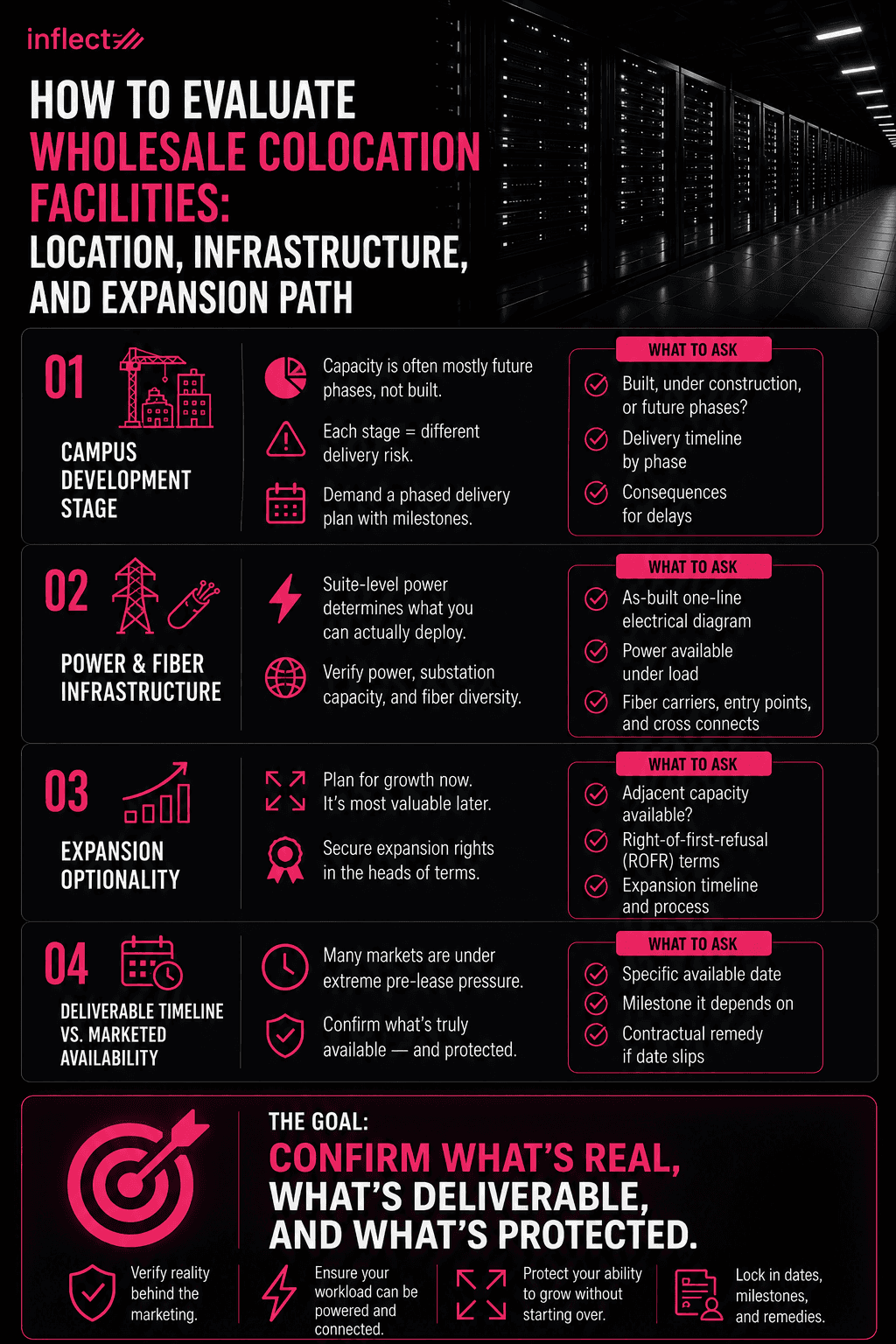
Evaluating wholesale colocation facilities requires assessing four dimensions beyond headline location: campus development stage, available power and fiber infrastructure, expansion optionality, and the gap between marketed capacity and capacity that is actually deliverable on your required timeline.
Campus development stage
Campus development stage is where most RFP processes produce misleading results. A provider marketing 100 MW of campus capacity may have 10 MW built and operational, 20 MW under construction with a twelve-month delivery estimate, and 70 MW as future phases that depend on permits, utility substation agreements, and construction timelines that have not started. Each stage carries materially different delivery risk, and a quote that does not distinguish between them is not a real quote. Ask for a phased delivery schedule tied to specific milestones, with contractual consequences if those milestones slip.
Power and fiber infrastructure
Power and fiber infrastructure at the suite level, not the campus level, determines what you can actually deploy. Utility substation capacity, on-site generation, power availability under load, and the number and diversity of fiber entry points are the variables that determine whether a specific space can support your actual workload. A campus with 200 MW of total utility capacity may still be unable to deliver 10 MW to the hall you are considering if substation expansion is not yet complete. Ask for the as-built one-line electrical diagram, the confirmed fiber carrier list, available cross connects, and access to multiple networks before any contract discussion.
Expansion optionality
Expansion optionality is the variable that looks least important at signing and matters most eighteen months later. If your initial requirement is 2 MW and your growth model projects 10 MW within three years, a provider that can offer adjacent expansion within the same campus under a pre-negotiated right-of-first-refusal is worth significantly more than one who cannot make that commitment. Expansion rights should be a named term in the heads of terms, not an informal understanding.
Deliverable timeline versus marketed availability
Primary wholesale markets including Ashburn, Silicon Valley, Dallas, Chicago, and London remain under severe pre-lease pressure from hyperscalers and large NeoCloud operators, with vacancy near record lows and occupiers often pre-committing 18 to 36 months in advance as power constraints and grid delays limit new supply. (JLL, 2026) Providers showing inventory in these markets are frequently selling against future delivery rather than available capacity. Confirming the specific available date, the construction milestone it depends on, and the contractual remedy if that date slips are the three questions every wholesale RFP must require a direct written answer to.
Power Density, Cooling, and the AI Workload Reality
Power density requirements for enterprise wholesale colocation have shifted materially as AI workloads have scaled, with 40–60 kW per rack now a common design target for GPU-dense deployments and the highest-density configurations reaching 100 kW+. A wholesale facility that was appropriate for enterprise IT three years ago may be structurally unable to support the thermal load that current AI hardware generates under sustained operation.
When evaluating a provider's power and cooling capability, three questions separate a real evaluation from a marketing review.
What is the maximum rack density the provider can support in the specific space you are leasing?
The density ceiling in any given suite or hall is determined by the mechanical and electrical design of that space, not the campus average. A facility might support 100 MW total while being unable to deliver above 20 kW per rack in the legacy halls it is actively marketing. Request the per-suite mechanical design basis, not the campus specification sheet.
What cooling architecture is in place or available as a fit-out option?
Air-cooled facilities with raised-floor CRAC systems cannot sustain 40+ kW per rack densities reliably. Wholesale providers worth evaluating for AI and high-density workloads will have cooling systems that include rear-door heat exchanger compatibility, in-row cooling support, or direct liquid cooling infrastructure available for tenant fit-out. The provider should specify which cooling approach applies to the exact space in your contract. Vague references to campus-level cooling capability are not sufficient.
What does the power delivery commitment actually cover?
A "99.9999% uptime SLA" typically covers the facility's utility feed and UPS infrastructure, not the power delivered to your IT equipment at the rack. The boundary of the power SLA, what constitutes a qualifying failure, and what the provider's financial exposure is when they miss it are the terms that determine whether that SLA has any real value. Get the definition, not the headline.
Wholesale Colocation SLAs: What to Negotiate and What Providers Often Leave Out
The four SLA components that determine operational reliability in a wholesale colocation contract are uptime commitment and measurement methodology, power delivery SLA covering utility, UPS, and generator handoff, cooling SLA and thermal excursion response time, and incident notification and root cause analysis obligations.
Uptime commitment and measurement
Most wholesale providers advertise high availability through Tier III or Tier IV equivalent uptime (99.982% and 99.995% annualized respectively). What varies across providers is how downtime is measured, what constitutes a qualifying outage, and what the financial remedy is when the SLA is missed. Contracts that define a qualifying outage as any interruption exceeding thirty minutes create a meaningful gap: a twenty-nine-minute failure at 3am costs the provider nothing. Read the definition clause, not the headline availability figure.
Power delivery SLA
Power redundancy across the utility feed, UPS system, and backup generators represents three separate failure points, and the SLA should address each independently. Generator transfer during a utility failure creates a power gap (typically 10–30 seconds) that your IT hardware must ride through on UPS capacity alone. Confirm the UPS capacity allocated to your specific suite and the documented transfer time under full load, not the specification value under test conditions.
Cooling SLA and thermal excursion response
A cooling SLA should specify the maximum allowable ambient temperature in your leased space, the response time when a thermal threshold is exceeded, and the financial remedy for excursions that run beyond the committed response window. Language committing to "commercially reasonable efforts" to maintain temperature is not a cooling SLA. It is a placeholder. Negotiate a temperature commitment in degrees, a response time in minutes, and a credit structure tied to both.
Incident notification and RCA obligations:
How quickly the provider commits to notify you of an infrastructure event, and how thoroughly they commit to delivering a written root cause analysis, is a negotiable SLA term that the majority of enterprise buyers do not include in their initial RFP. For organizations with compliance, audit, or insurance obligations, the RCA format and delivery timeline can matter as much as the uptime figure itself.
Providers commonly cited in wholesale colocation searches (Digital Realty, Equinix, CyrusOne, QTS, and NTT) each structure their SLA terms differently. Comparing them on uptime percentage alone, without comparing how each measures, remediates, and provides financial recourse against that commitment, is one of the most expensive oversights in enterprise wholesale procurement.
Where Wholesale Capacity Is Actually Available, and Why Most of What You Find Online Is Not
Wholesale capacity in primary markets is severely constrained, and most of the information available through listing platforms, broker networks, and public databases has not been verified against current operator availability. These are two separate problems that compound each other in ways that cost enterprise buyers significant time and resources.
On availability: hyperscale data centers and large NeoCloud operators continue to consume a disproportionate share of near-term delivery capacity across primary markets in North America and Europe. Enterprise buyers that are not pre-committing at very large scale are competing for a constrained supply pool, with vacancies at record lows and preleasing still running far above historical norms. Secondary markets such as Phoenix, Atlanta, Columbus, San Antonio, and select Amsterdam/Frankfurt-area campuses generally offer more available wholesale capacity and better power-cost economics, though they can trade off carrier density and ecosystem maturity.
On information quality: most wholesale capacity data that reaches buyers through listing platforms, broker introductions, or publicly available databases is not vetted against current operator availability. The dominant data collection method for listing platforms is scraping provider websites and aggregating broker-submitted information, neither of which reflects real-time availability or has been confirmed with the operator. AI-generated summaries of that data have further degraded the signal. The result is that a buyer researching wholesale capacity online will routinely encounter listings that are outdated, available only under terms not disclosed in the listing, or in some cases entirely synthetic: assembled from secondary sources with no operator relationship behind them at all.
Buyers entering the wholesale market from outside the data center industry are the most exposed to this. Without the ability to cross-reference a listing against known operator delivery schedules, campus development timelines, or utility substation status, there is no quick way to tell a real available opportunity from a lead-generation placeholder. Brokers operating on commission against that unvetted data have no structural incentive to tell you the difference. The cost shows up in procurement cycles that run eight to twelve weeks against inventory that was never deliverable as described, delaying infrastructure programs and in some cases forcing enterprises into suboptimal arrangements simply to resolve the uncertainty.
How to Source and Compare Wholesale Colocation Providers on Inflect
Inflect is a digital infrastructure marketplace and wholesale infrastructure expert, helping enterprises and NeoClouds source colocation from 500 kW to multi-megawatt and beyond, with deep advisory across financing, fit-out, connectivity, and offtake. Inflect has supported over 400 MW of contracted capacity to date, working with buyers across the full range of wholesale requirements: move-in ready, soon available, pre-leasing, and build-to-suit.
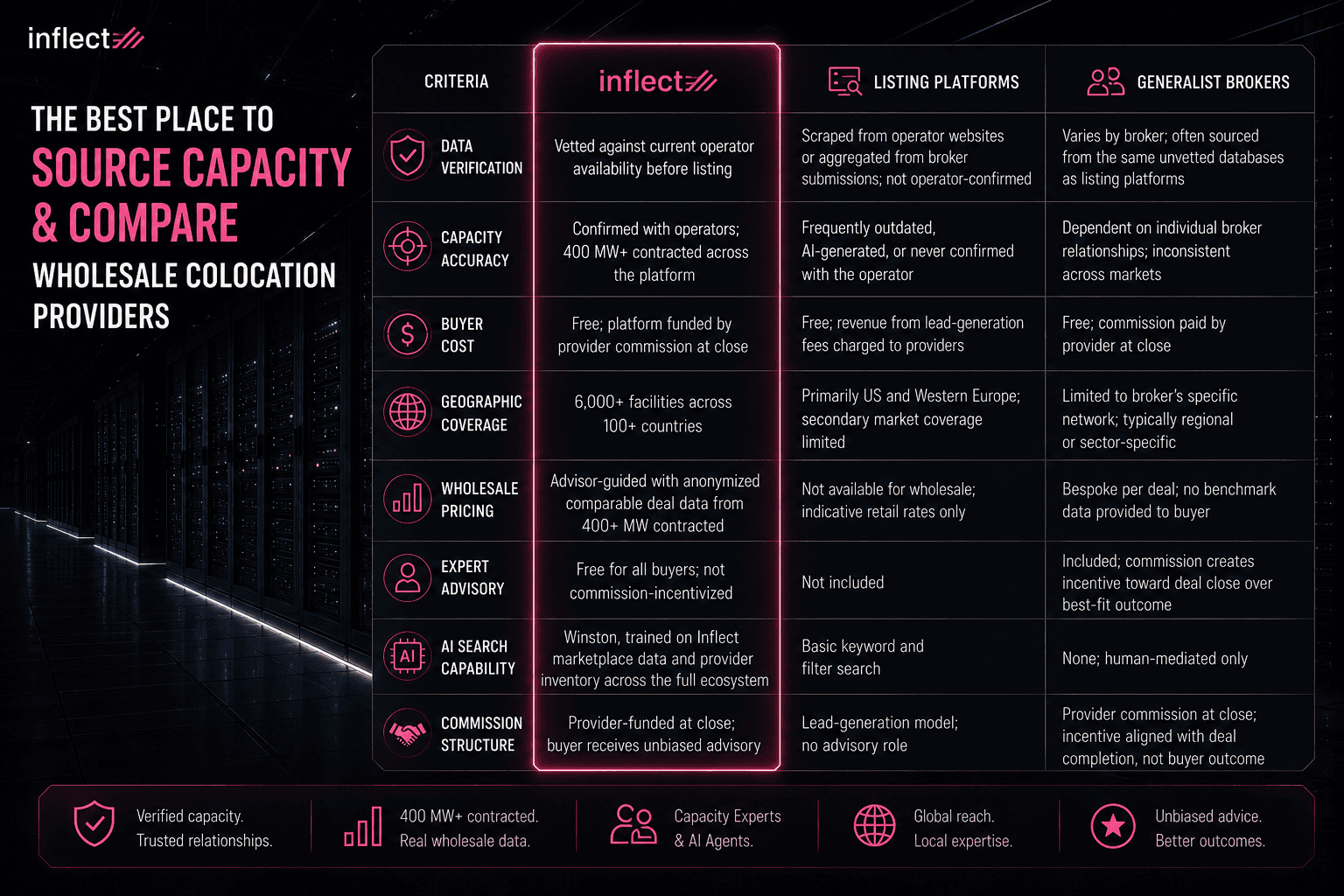
The difference between sourcing through Inflect and sourcing through a listing platform or generalist broker is the data layer. Inflect, listing platforms such as Datacenters.com, Cloudscene, and Ocolo, and generalist brokers differ across eight dimensions that matter to a wholesale colocation buyer: data verification method, capacity accuracy, buyer cost, geographic coverage, wholesale pricing transparency, expert advisory quality, AI search capability, and commission structure.
Criteria | Inflect | Listing platforms | Generalist brokers |
|---|---|---|---|
Data verification | Vetted against current operator availability before listing | Scraped from operator websites or aggregated from broker submissions; not operator-confirmed | Varies by broker; often sourced from the same unvetted databases as listing platforms |
Capacity accuracy | Confirmed with operators; 400 MW+ contracted across the platform | Frequently outdated, AI-generated, or never confirmed with the operator | Dependent on individual broker relationships; inconsistent across markets |
Buyer cost | Free; platform funded by provider commission at close | Free; revenue from lead-generation fees charged to providers | Free; commission paid by provider at close |
Geographic coverage | 6,000+ facilities across 100+ countries | Primarily US and Western Europe; secondary market coverage limited | Limited to broker's specific network; typically regional or sector-specific |
Wholesale pricing | Advisor-guided with anonymized comparable deal data from 400+ MW contracted | Not available for wholesale; indicative retail rates only | Bespoke per deal; no benchmark data provided to buyer |
Expert advisory | Free for all buyers; not commission-incentivized | Not included | Included; commission creates incentive toward deal close over best-fit outcome |
AI search capability | Winston, trained on Inflect marketplace data and provider inventory across the full ecosystem | Basic keyword and filter search | None; human-mediated only |
Commission structure | Provider-funded at close; buyer receives unbiased advisory | Lead-generation model; no advisory role | Provider commission at close; incentive aligned with deal completion, not buyer outcome |
Capacity on Inflect is vetted against current operator availability: not scraped, not AI-generated from public sources, and not carried forward from a database that has not been refreshed since the last provider announcement. Buyers access instant pricing and side-by-side comparison across 6,000+ data centers and facilities in 100+ countries, with free expert advisory at no charge to the buyer.
For wholesale buyers specifically, Inflect covers colocation services from operators across the full market including Digital Realty, Equinix, CyrusOne, QTS, NTT, and hundreds of additional providers in primary and secondary markets worldwide. Whether the requirement is a powered shell in a specific metro, a dedicated suite with a defined cooling specification, or a multi-phase campus program with operator build commitment, Inflect's advisory team has closed comparable deals and can shorten the path from requirement to signed heads of terms materially.
Winston, Inflect's AI agent trained on marketplace data and provider inventory, can model wholesale capacity options across markets, surface comparable deal structures, and connect buyers with advisors before a formal procurement process begins.
Finding verified wholesale colocation capacity does not have to start with eight weeks of unqualified leads. It starts with knowing what to look for, and having a source where the data behind the listings has actually been checked.
Source verified wholesale capacity on Inflect. No RFQ required.
Access vetted wholesale colocation capacity from move-in ready to build-to-suit, across 6,000+ facilities in 100+ countries
Compare hundreds of wholesale operators across primary and secondary markets with real availability and instant pricing
Get free expert advisory on your wholesale requirement: market selection, power and cooling specifications, SLA negotiation, and provider comparison
Ask Winston to model options across primary and secondary markets before you commit to a procurement path
About the Author

Chanyu Kuo
Director of Marketing at Inflect
Chanyu is a creative and data-driven marketing leader with over 10 years of experience, especially in the tech and cloud industry, helping businesses establish strong digital presence, drive growth, and stand out from the competition. Chanyu holds an MS in Marketing from the University of Strathclyde and specializes in effective content marketing, lead generation, and strategic digital growth in the digital infrastructure space.
Contact:
Email: