14 mins
Bare Metal vs Cloud for AI Workloads: The Enterprise Decision Guide (2026)
The quarterly cloud bill arrived on a Tuesday. Finance had flagged it first: three months of LLM training runs across a hyperscale GPU cluster had produced a number larger than the organization's entire on-premises infrastructure budget two years prior. In the review meeting, someone asked out loud why the team hadn't just bought dedicated servers. And the question hung there, because no one had a framework ready to answer it.
The real issue in that meeting was not cloud versus bare metal. It was GPU utilization rate, workload type, data governance obligations, latency requirements, and how long the organization planned to run at that level of compute. Get those five variables right, and the infrastructure decision becomes clear.
The scale of enterprise GPU investment makes this decision financially material. NVIDIA reported $115.2 billion in Data Center revenue for fiscal year 2025, driven almost entirely by GPU demand from enterprises and cloud providers building AI compute capacity (Source: NVIDIA, 2025). The organizations contributing to that demand are, in many cases, paying hyperscale cloud rates for workloads that would be significantly cheaper on dedicated infrastructure, because they have not mapped their workloads against the variables that determine which model wins.
This guide provides that framework: precise definitions of both models, the five variables that determine which wins, the scenarios where each is the right choice, and how to source options without a lengthy procurement process.
What "Bare Metal for AI" and "Cloud for AI" Actually Mean
Bare metal for AI and cloud for AI describe two fundamentally different approaches to provisioning the GPU compute that AI training and inference workloads require, differing in tenancy model, pricing structure, hardware access, and operational overhead.
Bare Metal GPU Servers: Dedicated Compute, No Virtualization Layer
Bare metal GPU servers are single-tenant, physical servers that give organizations direct control over the hardware with no hypervisor layer between workloads and the GPU. A dedicated GPU server for AI provides the full available memory bandwidth, NVLink interconnect performance, and inter-GPU communication speed of the physical hardware, with no noisy-neighbor effect and no shared scheduling. Bare metal GPU infrastructure is typically provisioned on monthly contracts, hosted in a colocation facility or sourced from a managed bare metal provider, with the customer responsible for software configuration and ongoing management.
Cloud GPU Instances: Flexible, Virtualized, and Priced for Variable Demand
Cloud GPU instances, including AWS p4d and p5 series, Azure NDv5, and Google Cloud A3, are virtualized environments where each workload runs as a virtual machine on shared physical infrastructure managed by a hyperscale provider. The cloud model delivers flexibility: GPU compute is available on demand, billed by the hour, and requires no capital commitment or infrastructure management. Cloud GPU instances suit workloads where demand is unpredictable, experiments are short-lived, or the operational overhead of managing dedicated infrastructure is not warranted by the workload's scale. The trade-off is cost at sustained utilization, variable tail latency in production inference environments, and, in regulated industries, the compliance complexity of operating on shared multi-tenant infrastructure.
Bare Metal GPU vs Cloud GPU: Which One to Choose
Bare metal GPU versus virtualized options such as cloud GPU instances and Virtual Private Servers is the most common infrastructure decision businesses face when scaling AI workloads, but the right answer depends on your technical resources, cost structure, speed to market, flexibility needs, and how much control and responsibility you want over your infrastructure. Inflect aggregated thousands of real-world use cases, provider data, and marketplace intelligence to build a short decision tool that matches your specific situation to the right infrastructure model.
Find your right fit now → inflect.com/resources/tools/colocation-vs-baremetal-vs-vps-vs-cloud
The 5 Variables That Determine Which AI Infrastructure Model Wins
The five variables that determine whether bare metal or cloud is the correct infrastructure model for enterprise AI workloads are: GPU utilization rate, workload type (training vs inference), data sovereignty and compliance requirements, latency sensitivity, and total cost of ownership at the organization's actual operating scale. Every AI infrastructure decision should be mapped against these five variables before any procurement begins, because the correct answer differs at different positions on each axis.
GPU Utilization Rate: The Crossover Point Where Bare Metal Becomes Cheaper
GPU utilization rate is the single most important variable in the bare metal vs cloud AI cost comparison, because cloud GPU pricing is structured for variable demand while bare metal pricing is structured for sustained, high-utilization workloads. As an illustrative comparison: an 8x H100 cloud GPU instance at major hyperscalers runs approximately $80 to $100 per hour at on-demand rates (Source: AWS, 2025). The same GPU configuration on dedicated bare metal typically costs $12,000 to $20,000 per month from a bare metal GPU provider (illustrative market range based on publicly listed provider pricing, 2025). At continuous operation, cloud GPU pricing at $90/hour reaches approximately $64,800 over 30 days, compared to a bare metal equivalent at $16,000/month. The GPU utilization crossover point, where bare metal becomes less expensive than cloud on a per-compute-unit basis, typically falls between 40% and 65% sustained monthly utilization, depending on configuration and provider (illustrative estimate based on published pricing, 2025).
Training vs Inference: Why the Right Answer Is Often Different for Each
AI training and inference workloads have different infrastructure requirements, and the best infrastructure for AI training is not always the best infrastructure for AI inference. Training runs are compute-intensive, long-duration, and often predictable: deep learning and generative AI model training runs may occupy 8, 16, or 64 GPUs for days or weeks, processing large datasets at near-100% utilization. Inference serving is variable: it must handle traffic peaks, scales with user demand, and may carry strict latency SLAs that training does not. Many enterprises use bare metal GPU servers for sustained training workloads, where the economics are clear, and maintain cloud GPU capacity for inference demand spikes.
Data Sovereignty, Compliance, and AI Governance Requirements
Data sovereignty for AI is a binding constraint in regulated industries, where the infrastructure model is not a cost optimization question but a compliance requirement. Enterprises in financial services, healthcare, defense, and the public sector face AI governance mandates that specify where training data can be processed, where model weights can reside, and who can access the infrastructure at the physical layer. Hyperscale cloud environments offer compliance certifications, but require the customer to trust the provider's multi-tenant architecture and shared control plane. Bare metal infrastructure in a colocation facility provides strict data isolation, clear data residency, and audit trails that many regulatory frameworks require. For organizations subject to GDPR, HIPAA, SOC 2, ISO 27001, or sector-specific AI governance frameworks, the compliance question often settles the infrastructure decision before cost is even considered.
Latency for Real-Time AI Applications
Low-latency AI inference requires infrastructure where the round-trip time between the application and the GPU is minimized, which typically means bare metal servers hosted close to the application tier rather than cloud GPU instances accessed over the public internet. Cloud GPU instances introduce virtualization overhead, variable network latency, and shared scheduling that can produce tail latencies incompatible with real-time applications. Enterprises deploying AI-powered customer experience tools, fraud detection systems, real-time recommendation engines, or autonomous system control typically require sub-10ms inference latency. That requirement is reliably achievable on co-located bare metal GPU infrastructure and inconsistently achievable on cloud GPU instances at production scale, where shared scheduling and multi-tenant network contention introduce variability that SLA-bound workloads cannot absorb.
Total Cost of Ownership: Cloud Sticker Shock vs Bare Metal Economics
The AI infrastructure TCO comparison between cloud and bare metal must include GPU compute costs, egress fees, storage costs, operational labor, and the cost of idle capacity, not just the hourly instance rate. Cloud GPU costs are frequently underestimated because organizations price their workloads at on-demand rates without accounting for the egress charges generated by moving training data in and large model checkpoints out. AWS charges $0.09 per GB for data transfer out beyond the free tier (Source: AWS, 2025); at the scale of enterprise AI training runs, egress alone can add thousands of dollars per month to the effective compute cost. Bare metal TCO includes the monthly server cost, colocation or hosting fees, and operational overhead, but generates no per-GB egress charges on internal traffic. The full AI infrastructure cost comparison, conducted at a sustained utilization rate above 50%, consistently favors bare metal for production workloads.
When Cloud Is the Right Choice for Enterprise AI
Cloud is the right infrastructure model for enterprise AI when GPU utilization is low, demand is truly variable or bursty, workloads are in the active experimentation phase, or the team lacks the operational capability to manage dedicated infrastructure.
Early-Stage Model Development and Experimentation
When GPU utilization is inherently low and unpredictable because workloads are experimental by nature, cloud GPU instances are the correct starting point. Early-stage model development involves frequent stops, restarts, and architectural changes that make sustained hardware commitment inefficient. The best infrastructure for AI training at the experimentation phase is cloud, where a team can provision 8 H100s for a three-hour experiment, evaluate the results, and release the instances immediately. Low average utilization, no predictable schedule, and no production SLA mean the hourly pricing model is a genuine advantage, not a liability.
Bursty or Unpredictable Inference Demand
When inference demand follows a traffic pattern that cannot be predicted or smoothed, cloud GPU instances provide the dynamic scaling capacity that bare metal cannot match without significant overprovisioning. Consumer-facing AI applications, seasonal enterprise workloads, and products in early growth stages may see 10x traffic variation week over week. Provisioning bare metal GPU capacity for peak demand means paying for idle GPUs during off-peak periods, eliminating the cost advantage that bare metal holds at sustained utilization. Cloud GPU infrastructure for AI inference serves this scenario well, particularly when latency requirements are not strict and the application can tolerate the variable tail latency of a virtualized environment.
Teams Without Dedicated Infrastructure Operations
When the organization does not have the operational staffing or expertise to manage dedicated GPU infrastructure, the cloud model removes a layer of operational risk that would otherwise offset the cost savings. Bare metal GPU servers in a colocation facility require someone to manage firmware updates, hardware failures, network configuration, and vendor relationships. Cloud GPU instances abstract that complexity entirely. For organizations where AI is a product feature rather than a core infrastructure competency, the managed operational model of cloud infrastructure is a genuine advantage that belongs in the TCO calculation alongside raw compute cost.
When Bare Metal Wins for Enterprise AI Workloads
Bare metal wins for enterprise AI when GPU utilization is sustained above the cloud crossover point, latency requirements cannot be met by virtualized infrastructure, data sovereignty mandates impose physical tenancy requirements, or the organization has reached the point where cloud GPU pricing is the dominant infrastructure cost.
Sustained Large-Scale Model Training
When GPU utilization exceeds 50 to 60 percent on a sustained monthly basis, the TCO for bare metal GPU servers is materially lower than equivalent cloud GPU instances. AI training on bare metal vs cloud is not a close comparison at this utilization level: an enterprise running high-throughput, multi-week LLM training runs at high GPU occupancy is paying two to four times more per compute-unit on cloud than on equivalent dedicated bare metal, based on published pricing at the configurations described above (illustrative calculation based on AWS p5.48xlarge on-demand pricing vs market bare metal GPU rates, 2025). The best infrastructure for AI training at production scale, with known workloads and predictable schedules, is dedicated bare metal.
Low-Latency Production Inference
Bare metal GPU servers in a colocation facility deliver consistent performance and predictable low-latency inference that production AI applications require, without the scheduling variability and virtualization overhead of cloud GPU instances. Enterprises running real-time fraud detection, AI-powered customer service at volume, or inference pipelines with committed SLAs cannot absorb the tail latency that cloud GPU infrastructure introduces at scale. Bare metal GPU vs cloud GPU for production inference is not primarily a cost argument: it is a performance and reliability argument. Physical tenancy eliminates the scheduling unpredictability that causes tail latency spikes.
Regulated Industries and Data Sovereignty Mandates
Enterprises in financial services, healthcare, and the public sector face compliance for AI workloads requirements that frequently cannot be satisfied by hyperscale cloud infrastructure alone. Regulated AI infrastructure must provide physical tenancy isolation, clear data residency documentation, signed data processing agreements at the infrastructure layer, and in some cases the ability to audit physical access logs. Bare metal GPU servers in a certified colocation facility, with single-tenant physical access and jurisdiction-specific data residency, satisfy these requirements in ways that multi-tenant cloud environments cannot match at the infrastructure layer. For organizations subject to FCA guidelines, HIPAA, the EU AI Act, or sector-specific model governance obligations, regulated AI infrastructure on dedicated hardware is not a preference: it is frequently the only compliant path.
Enterprises That Have Hit the Cloud Cost Ceiling
When cloud GPU costs have become the dominant infrastructure line item and the organization is running AI workloads at sustained high utilization, bare metal GPU infrastructure is the financially correct decision. The AI infrastructure TCO calculation at this point is clear: an organization paying $60,000 per month for cloud GPU capacity to run sustained training and production inference at 70% average utilization will, in most configurations, achieve equivalent or greater performance on dedicated bare metal GPU servers at $15,000 to $20,000 per month all-in, including colocation and networking costs (illustrative estimate based on published pricing, 2025). Cloud repatriation for AI workloads follows the same economics that drove SaaS companies to move production workloads off cloud compute: the variable-demand pricing model becomes expensive the moment demand is no longer variable.
How to Source and Compare Bare Metal GPU Infrastructure
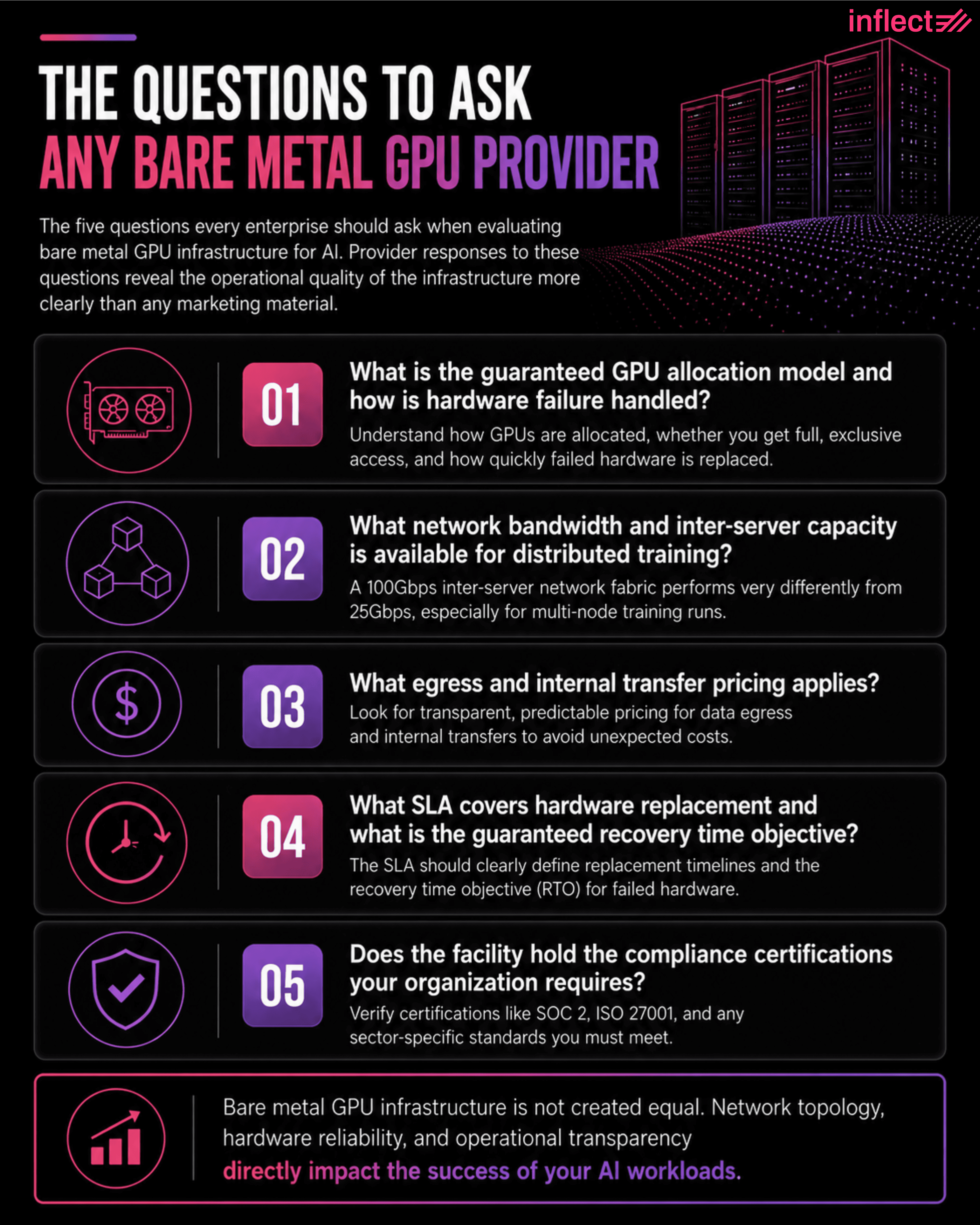
Once you have mapped your AI workloads against the five variables and determined that dedicated GPU infrastructure is the right model, the next challenge is sourcing and comparing options without a six-month RFP cycle. The bare metal GPU market spans hyperscale cloud providers, specialist bare metal GPU providers, and colocation operators, and the differences in pricing, SLA, and network access are significant enough to materially affect TCO.
The Questions to Ask Any Bare Metal GPU Provider
Common Pitfalls When Comparing GPU Providers
The most common mistakes enterprises make when comparing dedicated GPU servers for AI workloads are: comparing on-demand cloud GPU pricing to bare metal committed pricing without normalizing for utilization rate, ignoring egress costs in the full TCO model, evaluating GPU generation without evaluating network interconnect capacity for distributed training, and selecting colocation-based bare metal without confirming the facility is within acceptable latency range of the application tier. A second category of errors involves contract structure: some bare metal GPU providers quote low monthly server rates and charge separately for bandwidth, power, and remote hands support in ways that erode the cost advantage over cloud. Get a fully loaded monthly cost, inclusive of all recurring charges, before comparing providers.
Start Your Bare Metal vs Cloud Evaluation on Inflect
Inflect gives enterprises a faster path to comparing bare metal GPU infrastructure and cloud GPU options across the global market, without committing to a provider or a sales process.
Search bare metal GPU servers and GPU cloud instances from providers including Equinix, Digital Realty, NTT, Iron Mountain, CoreSite, CyrusOne, QTS, and hundreds more
Receive instant pricing across more than 6,000 facilities in more than 100 countries, with no form submission or sales call required
Access free expert advisory from infrastructure specialists who have guided enterprise teams through the same bare metal vs cloud AI infrastructure decision
Filter by GPU configuration, compliance certification, geographic market, and capacity requirement to build a shortlist in a single session
About the Author

Haley Rogers
Content & Social Media Specialist
Haley Rogers is the Content & Social Media Specialist at Inflect, bringing over two years of experience in social media, marketing, and content strategy — including time at a fast-paced tech company before joining the Inflect team. She specializes in translating complex digital infrastructure topics into clear, engaging content, with a particular focus on blog writing and brand storytelling across channels.
Contact: