8 mins
Bare Metal Servers for Esports and Competitive Gaming Infrastructure
The ops team watching the monitor during a regional qualifier isn't looking for a crash. They're watching jitter. Specifically, they're watching whether the server update intervals on match 7 are holding consistent, or whether the variance is starting to creep in ways that will show up in player telemetry before they show up in support tickets. The infrastructure is performing, technically. Uptime is fine. But "uptime is fine" is the wrong metric for competitive gaming. What matters is whether the latency profile at 14:00 looks the same as it did at 10:00, under three times the concurrent load.

This is the operational reality of esports infrastructure: the standard isn't availability, it's determinism. A system that averages 20 ms latency but swings ±15 ms during peak concurrent sessions is, from a competitive integrity standpoint, a broken system. Players don't complain about average latency. They complain about the round where something felt wrong, and what they're describing is jitter.
The infrastructure decision that resolves this, across tournament operators, game publishers, and regional esports organizations, is the move from virtualized cloud game servers to dedicated bare metal. This post covers why that decision gets made, where cloud still fits, what bare metal actually delivers at the hardware and network level, and how to evaluate and source the esports server infrastructure that competitive gaming workloads require.
Why Match Infrastructure Has Different Requirements Than General-Purpose Cloud Workloads
Competitive gaming imposes four specific infrastructure requirements that separate it from standard enterprise workloads: sub-20 ms round trip time for player input registration, bounded jitter variance within a defined budget, tick rates high enough to resolve fast-twitch gameplay events, and packet loss below 1% to prevent desynchronization between client and server game state.
Latency Thresholds and What Competitive Integrity Actually Requires
Acceptable latency for competitive gaming, measured as round trip time between player input and server acknowledgment, falls into three genre-specific bands: sub-10 ms for fighting games and rhythm titles, 10 to 20 ms for first-person shooters, and up to 60 ms for real-time strategy titles where reaction time is less determinative of outcome. The ITU-T G.114 recommendation sets 150 ms as the threshold for voice-quality degradation, but competitive match infrastructure operates at a standard roughly ten times stricter (Source: ITU, 2020). More important than the absolute player ping figure is consistency: a server delivering 18 ms reliably outperforms one delivering 12 ms with variance, because players calibrate their timing to a stable signal.
Tick Rate, Jitter Budgets, and the Variables Players Notice Before Engineers Do
The four performance variables that most directly affect competitive fairness are tick rate, jitter, packet loss, and interpolation lag, and infrastructure teams must treat all four as interdependent rather than individual metrics. A 128 Hz server processes game state and sends updates to clients every 7.8 ms; a 64 Hz server sends updates every 15.6 ms. At 64 Hz, fast events like weapon fire and character collision detection can fall between update cycles, creating the perception of registration failures that players commonly describe as "lag" but are actually temporal resolution problems. The jitter budget framing clarifies why tick rate alone is not the deciding variable: a server running at 128 Hz but experiencing 8 ms of variance effectively collapses to sub-64 Hz reliability under load, which means consistent delivery at 64 Hz outperforms variable delivery at 128 Hz in competitive play.
Event-Driven Load Patterns vs. Sustained Tournament Infrastructure
Esports infrastructure has to handle two different load patterns: sharp spikes during live qualifiers and sustained high concurrency across long tournament windows, often spread across regions and time zones. That makes generic autoscaling a poor fit, because match servers need warm capacity ready before traffic arrives, not instances spinning up after demand has already hit. For live competition, the right model is pre-provisioned headroom, regional placement, and enough redundancy to keep match continuity intact when concurrency surges, rebalances, or shifts unexpectedly (Source: AWS, 2026).
Where Cloud Fits and Where It Breaks Down in Competitive Gaming
Cloud infrastructure serves competitive gaming well for non-real-time workloads including matchmaking queues, player statistics processing, bracket management, and spectator CDN delivery, and serves it poorly for latency-sensitive match server workloads where network path determinism is a functional requirement, not a preference.
Non-Real-Time Services Where Cloud Remains the Right Call
The services where cloud infrastructure is the correct choice for competitive gaming organizations are matchmaking systems, authentication backends, anti-cheat telemetry aggregation, replay storage, and spectator stream delivery, because these workloads tolerate latency variance, benefit from elastic scaling, and do not require the microsecond-level consistency that match servers demand. A hybrid architecture placing game servers on bare metal while keeping supporting services on cloud is the production standard at publisher scale, not an either/or choice, and treating this as a binary decision is where many infrastructure plans go wrong.
Why UDP Game Traffic Behaves Differently Under Virtualization
Game servers operating on virtualized cloud instances face two constraints that shared infrastructure imposes: hypervisor scheduling jitter that introduces unpredictable microsecond delays in packet dispatch, and NIC sharing overhead from ENA or virtio interfaces that adds latency variance under contention from neighboring instances. Even cloud placement groups, which co-locate instances within a single availability zone to reduce cross-rack latency, do not eliminate the hypervisor layer. Cross-AZ or cross-region deployments for redundancy reintroduce the network variance that placement groups are designed to reduce. Best-case cloud setups still cannot guarantee the cross-AZ consistency that multi-region tournament infrastructure requires, because the variance source is architectural, not configurational.
Egress Costs at Scale for Streaming and Live Match Traffic
High-throughput UDP game traffic and spectator streams can make cloud egress costs a major scaling bottleneck. Recent industry pricing summaries still place outbound data transfer from major clouds around $0.09 to $0.12 per GB, so a tournament with many simultaneous matches can turn bandwidth into a significant share of total spend. That is why many esports operators move toward bare metal or committed colocation capacity: not only for performance, but to avoid paying a per-gigabyte premium every time concurrency and viewership rise. Over time, the bandwidth bill can matter as much as the server bill (Sources: Gameye, 2026).
What Bare Metal Delivers for Latency-Critical Game Server Workloads
Bare metal servers eliminate the four primary infrastructure variables that make virtualized environments unsuitable for competitive gaming: hypervisor scheduling jitter, NIC sharing overhead, noisy neighbor CPU contention, and network path non-determinism. The performance gains are architectural, not incremental.
CPU Pinning, Core Isolation, and NUMA Awareness for Deterministic Tick Rate
Dedicated bare metal game servers support CPU pinning and core isolation, assigning specific CPU cores exclusively to game server processes and preventing the OS scheduler from migrating workloads between cores under load. Combined with NUMA-aware RAM allocation, which ensures memory accesses stay within the CPU's local domain rather than crossing the NUMA boundary (a crossing that adds 30 to 100 ns of latency per access), bare metal game servers maintain consistent tick rate intervals under full concurrent load that virtualized instances cannot match. These tuning options are either unavailable or unsupported in most managed cloud environments, which removes the possibility of achieving the same outcome through configuration alone.
Anycast Routing, IX Peering, and Why Network Topology Outweighs Raw CPU Specs
The network infrastructure connecting players to game servers has more impact on competitive fairness than any single hardware specification, because a well-tuned server on a poorly peered network underperforms a modestly specified server with direct IX connectivity to the player's ISP. Bare metal servers deployed at carrier-neutral colocation facilities offer direct peering with regional internet exchanges, reducing the hop count between player and server from the 8 to 15 hops typical of transit-dependent paths to 2 to 5 hops on IX-peered paths. Anycast routing allows a single game server address to route players to the nearest available node at the network edge, reducing geographic latency without requiring clients to select regional endpoints, and it is a capability that depends entirely on the provider's network relationships rather than on server hardware.
IRQ Balancing and Kernel Tuning for High-Throughput Packet Processing
Bare metal servers running Linux-based game server workloads benefit from IRQ affinity configuration that pins hardware interrupt handling to specific CPU cores, preventing interrupt contention from competing with game server threads during high packet-rate events. Combined with kernel parameters tuned for UDP throughput, including socket buffer sizing, receive packet steering, and CPU frequency scaling set to performance mode, a properly tuned bare metal game server handles high-volume packet loads with consistent sub-millisecond processing variance. Virtualized instances running default kernel configurations introduce multi-millisecond jitter at equivalent packet rates, which is the infrastructure-level source of the inconsistency that players and observers attribute to "server issues."
Bare Metal Deployment Models Mapped to Organizational Maturity
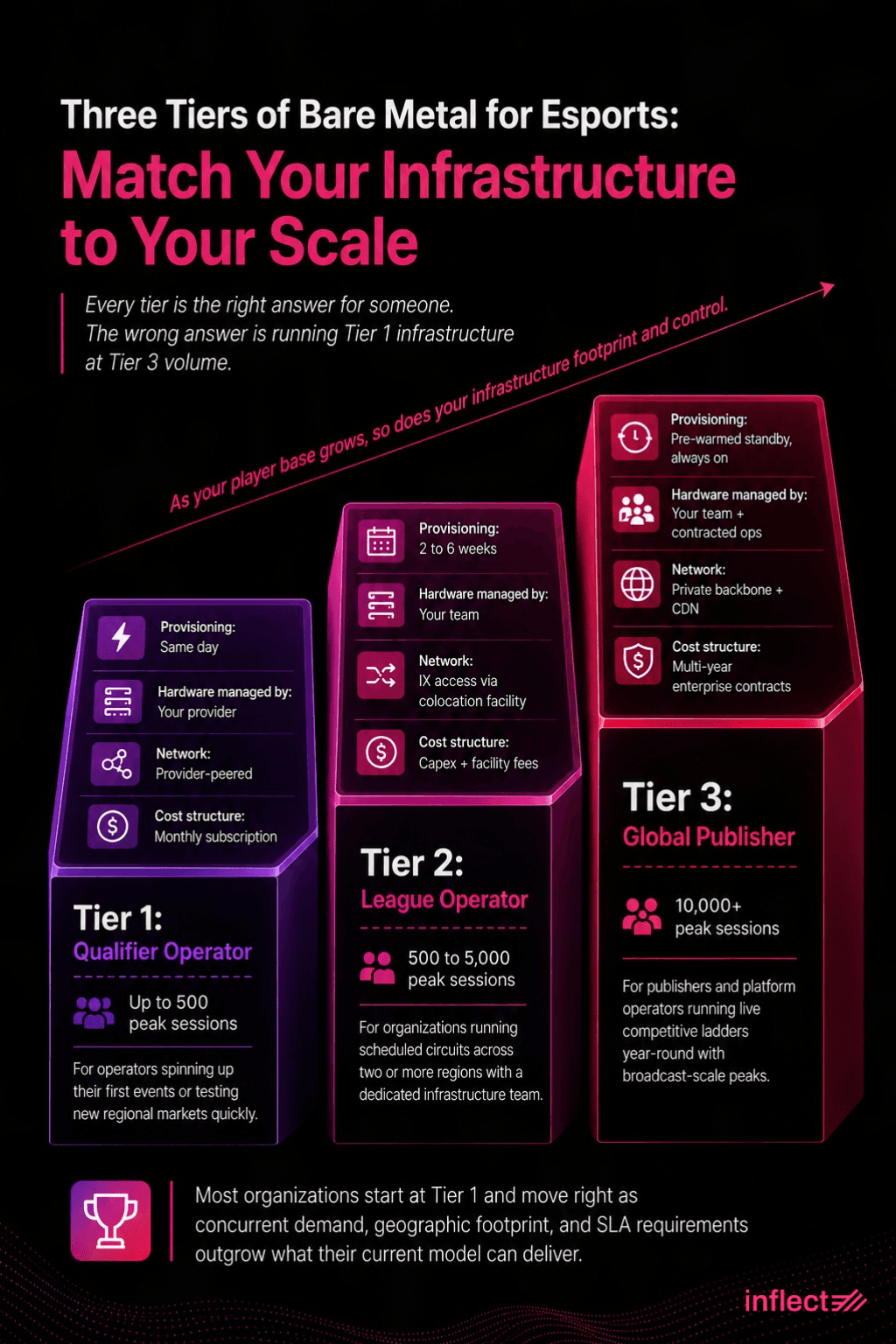
Esports organizations source bare metal game server hosting through three primary models suited to different stages of operational scale: managed bare metal from a hosting provider, colocation-hosted leased hardware, and hybrid bare metal with private backbone connectivity. The right model depends on concurrency requirements, how many game servers need to run simultaneously across multiple regions, and time-to-provision needs, which vary significantly across the maturity spectrum.
Early-Stage Operators: Managed Bare Metal and Provider-Hosted Infrastructure
Regional qualifiers with under 500 concurrent players are often a better fit for managed bare metal than for full colo buildouts, because the provider pre-stages physical servers and handles networking, power, and hardware replacement SLAs. Recent 2026 provider guides note that bare metal can be provisioned quickly, sometimes in minutes to hours depending on configuration, which makes it practical for pop-up events and fast regional expansion. The main tradeoff is less low-level control than self-managed hardware, but at this scale, faster deployment and lower operational overhead usually matter more than kernel-level tuning (Sources: Vantage, 2026; Atlantic, 2026).
Regional Tournament Scale: Colocation-Hosted Hardware and Leased Capacity
Mid-scale esports organizations and game studios running multi-region qualifiers with 500 to 5,000 concurrent players typically transition to colocation-hosted bare metal, placing customer-owned or leased hardware in carrier-neutral data centers to gain direct IX peering and full control over server configuration. Provisioning at this tier involves hardware procurement lead times of 2 to 6 weeks for custom configurations, which requires advance planning against tournament schedules, but delivers the kernel tuning access and network flexibility that managed hosting cannot provide. Cross-connect options at colocation facilities also allow direct private connections to CDN providers for spectator stream delivery, reducing egress costs compared to transit-dependent bandwidth arrangements.
Global Publishers: Hybrid Bare Metal with Private Backbone and CDN
Game publishers operating global competitive ladders with tens of thousands of concurrent players maintain hybrid infrastructure combining regionally distributed bare metal game servers with a private backbone for inter-region communication and CDN delivery for spectator and replay traffic. At this scale, provisioning speed is managed by maintaining warm standby capacity in each region rather than relying on on-demand provisioning, with burst capacity agreements in place at each colocation facility to cover esports events and tournament broadcast peaks that exceed baseline concurrency by 3 to 5x.
Evaluating Bare Metal Providers for Gaming and Esports Infrastructure
The five criteria that matter most when evaluating bare metal providers for esports infrastructure are IX connectivity and peering policy, geographic coverage across the locations where player clusters are concentrated, hardware configuration flexibility (particularly CPU pinning and IRQ access), SLA enforcement terms with real financial accountability, and security posture including DDoS protection capable of handling volumetric attacks during high-profile esports events.
Network Peering and IX Connectivity Requirements
Bare metal providers for gaming workloads should be evaluated on IX membership and direct peering relationships with the major regional internet exchanges serving the player base, not on advertised latency numbers from benchmark environments. Request looking glass access before signing any agreement, which allows direct validation of network path routing and hop counts from player ISP networks to the provider's facility. Providers who cannot provide looking glass access or traceroute data to major regional networks should be disqualified from consideration for low latency esports infrastructure, because unverifiable network claims are not a basis for competitive event planning.
Geographic Coverage for Regional and Global Tournament Footprint
Competitive gaming network requirements vary significantly across the six primary esports player clusters: North America East and West, Western Europe, Eastern Europe, South Korea and Japan, Southeast Asia, and Brazil, and each requires latency validation across multiple regions rather than geographic assumption. A data center labeled "Southeast Asia" may serve Singapore-based players well while delivering 120 ms to Australasian players, making per-cluster latency verification more important than facility location alone. Providers should be able to supply validated round trip time data to major ISPs in each target region, not estimated figures derived from fiber distance.
SLA Terms, Burst Capacity, and What to Ask for as Proof
Evaluate bare metal provider SLAs on three specific terms rather than headline uptime percentage: the credit mechanism (percentage of monthly fee vs. flat credit vs. service extension), whether the SLA covers network availability and latency commitments separately from hardware uptime and unplanned downtime events, and the enforcement threshold defining how many consecutive minutes of degradation trigger a claim. Ask providers for historical latency and jitter metrics by region from the past 12 months, and request sample SLA credit records to confirm that credits are issued when thresholds are breached rather than requiring customer escalation to receive them.
Frequently Asked Questions
Is bare metal better than cloud for esports? Bare metal is the correct choice for latency-critical match server infrastructure where tick rate consistency and jitter variance are competitive fairness requirements. Cloud remains appropriate for non-real-time services including matchmaking, analytics, and spectator delivery, and a hybrid architecture combining both is standard practice at publisher scale.
What latency is acceptable for competitive gaming? Acceptable latency for competitive gaming depends on genre: sub-10 ms for fighting games, 10 to 20 ms for first-person shooters, and up to 60 ms for strategy titles. More important than average latency is jitter variance, since a server averaging 20 ms with ±15 ms variance is functionally worse for competitive play than a server averaging 30 ms with ±2 ms variance.
Why do esports tournaments use dedicated servers? Esports tournaments use dedicated servers because shared infrastructure introduces network variance that makes competitive outcomes dependent on infrastructure conditions rather than player skill. Dedicated bare metal servers with CPU pinning, direct IX peering, and no hypervisor layer provide the consistent tick rate and bounded jitter that competitive fairness requires.
What tick rate do competitive game servers require? Competitive game servers typically run at 64 Hz or 128 Hz, corresponding to server update intervals of 15.6 ms and 7.8 ms respectively. At 128 Hz, fast events like weapon registration and collision detection are resolved within narrower time windows, reducing desynchronization events that players perceive as hit registration failures, though consistent delivery at either tick rate matters more than the tick rate figure alone.
How to Source Bare Metal for Esports Infrastructure on Inflect
Inflect is a digital infrastructure marketplace where esports operators, game studios, and game publishers can search, compare, and receive instant pricing from bare metal and colocation providers without a sales call or RFQ process. For gaming infrastructure specifically, Inflect enables direct comparison of IX-peered providers across the regional markets where player clusters are concentrated, including North America, Western Europe, and Southeast Asia, with pricing for sustained UDP-heavy workloads available immediately rather than after a procurement cycle.
Inflect's marketplace spans 6,000+ facilities across 100+ countries, with providers including Equinix, Digital Realty, NTT, Lumen, Zayo, and hundreds of specialized bare metal and colocation operators. Free expert advisory is available at no charge to buyers who need help mapping tournament concurrency requirements to specific provider configurations or validating IX peering coverage before committing to a contract.
Find bare metal and colocation infrastructure for competitive gaming at inflect.com:
Search dedicated game server infrastructure by region and latency zone
Compare IX peering coverage and network topology across providers side by side
Receive instant pricing for sustained UDP workloads without a sales call
Access free expert advisory for tournament capacity planning and provider selection
About the Author

Haley Rogers
Content & Social Media Specialist
Haley Rogers is the Content & Social Media Specialist at Inflect, bringing over two years of experience in social media, marketing, and content strategy — including time at a fast-paced tech company before joining the Inflect team. She specializes in translating complex digital infrastructure topics into clear, engaging content, with a particular focus on blog writing and brand storytelling across channels.
Contact: