11 mins
Bare Metal Hosting for Multiplayer Games: Performance and Scaling Guide
Your studio's launch plan accounted for 50,000 concurrent players. Cloud instances were auto-scaled, the matchmaking layer had been stress-tested, and server count looked right at 9am on day one. By noon, player count hit 48,000 and the negative reviews had already started. Not because the servers were down. Because the tick rate had halved, hit registration was inconsistent across regions, and latency variance had widened enough that competitive play felt broken. The cloud bill, revised at midnight, was on pace to triple the monthly forecast.
The failure was not one of capacity. It was one of performance architecture. Cloud infrastructure that performs adequately at moderate load degrades in specific, predictable ways under the conditions that matter most: sustained high concurrent users, latency-sensitive game loops, and regions where egress costs compound with every connection.
Multiplayer game performance is constrained by worst-case latency and tick consistency, not average compute availability; this is where bare metal outperforms shared cloud infrastructure. This guide covers the benchmarks, scaling playbook, and provider evaluation criteria that multiplayer infrastructure teams need to make that decision with confidence.
Bare Metal vs. Cloud for Game Server Hosting
When engineering teams evaluate cloud vs. bare metal performance for gaming, the instinct is to compare average latency figures. That comparison misses the actual constraint. Average latency is not the determining factor in multiplayer games; p95 and p99 determine perceived responsiveness. A server delivering 40ms average latency with 140ms p99 produces a worse player experience than one delivering 55ms average with 70ms p99. The table below reflects typical ranges observed under sustained production load conditions across public cloud and dedicated bare metal configurations.
Workload Condition | Cloud Behavior | Bare Metal Behavior | Impact on Gameplay |
|---|---|---|---|
p95 latency under load (50k CCU) | 60–100ms variance (typical) | 35–60ms stable (typical) | Perceived rubber-banding in movement |
p99 latency under load (50k CCU) | 80–140ms variance (typical) | 40–70ms stable (typical) | Hit registration inconsistency |
Tick rate consistency at peak load | Drops under vCPU contention | Sustained at provisioned rate | Degraded competitive integrity |
Egress cost at sustained 50k CCU | Variable; compounds with player count | Fixed; committed port rate | Budget unpredictability |
New capacity provisioning speed | Minutes (with performance tradeoffs under load) | Hours to days (pre-provisioned) | Launch window risk |
Latency ranges reflect typical observed behavior under sustained production load. Actual figures vary by cloud provider, region, instance type, and game engine architecture.
How Noisy Neighbor Contention Breaks Tick Rate at Scale
In shared cloud environments under sustained load, noisy neighbor contention introduces measurable jitter into server-side game loops when other tenants' workloads compete for the same physical CPU. Typical observed behavior in production environments places the onset of this problem at moderate-to-high vCPU density on a shared host, but the specific trigger varies by provider and oversubscription ratio. What is consistent is the outcome: vCPU scheduling delays of 2–8ms accumulate across each game tick and compound into latency variance that players perceive as inconsistent server response.
For a dedicated game server running at 128 tick, each tick executes every 7.8ms. A scheduling delay of even 3ms represents nearly 40% of a full tick interval. On bare metal, the game process runs with exclusive access to physical CPU cores, eliminating the scheduling queue entirely. The tick rate dedicated server argument is not theoretical; it is a direct result of how physical CPU access differs between shared and dedicated environments. Cloud instances mask this variance in benchmarks run at low load and surface it at the exact moment player counts peak.
Egress Costs at 10k, 50k, and 100k Concurrent Users
Game server egress costs scale with player count in a way that most pre-launch cost models underestimate. A multiplayer game server at 128 tick sending state updates to 64 players generates approximately 10–20 Mbps of outbound traffic per server instance under typical conditions. Across a 50,000 CCU deployment, aggregate egress runs to several hundred Gbps of sustained outbound bandwidth.
AWS data transfer out to the public internet is tiered; in most U.S. and EU regions, the first 10 TB per month is about $0.09 per GB, then drops to about $0.085 per GB for the next 40 TB, with further discounts at higher volumes. For game workloads, that level of egress can overtake compute spend surprisingly early, often around 1.5–3 GB per player per hour depending on instance class, protocol overhead, and provider tier. In higher-cost APAC regions, the crossover happens sooner, while negotiated bandwidth discounts can push it later. The practical result is that, on standard cloud pricing, egress can become the dominant cost before a game reaches large scale. Bare metal hosting through colocation typically replaces metered egress with committed bandwidth on a fixed monthly port, making infrastructure costs more predictable (Source: Infracost, 2026).
Bare Metal Performance Benchmarks for Multiplayer Game Servers
Bare metal game server hosting delivers the tick rate consistency, low latency game hosting, and compute headroom that real time multiplayer server architecture requires, across game types from competitive FPS to large-scale MMO. The metrics that matter are not peak throughput figures but sustained performance under concurrent player load: tick rate stability, p99 latency, and per-player bandwidth at scale.
Baseline Sizing Reference: 50,000 CCU FPS Title at 128 Tick
This model is a structured starting point for capacity planning, not a projection. Use it to anchor egress cost comparisons and server count estimates for your own game parameters.
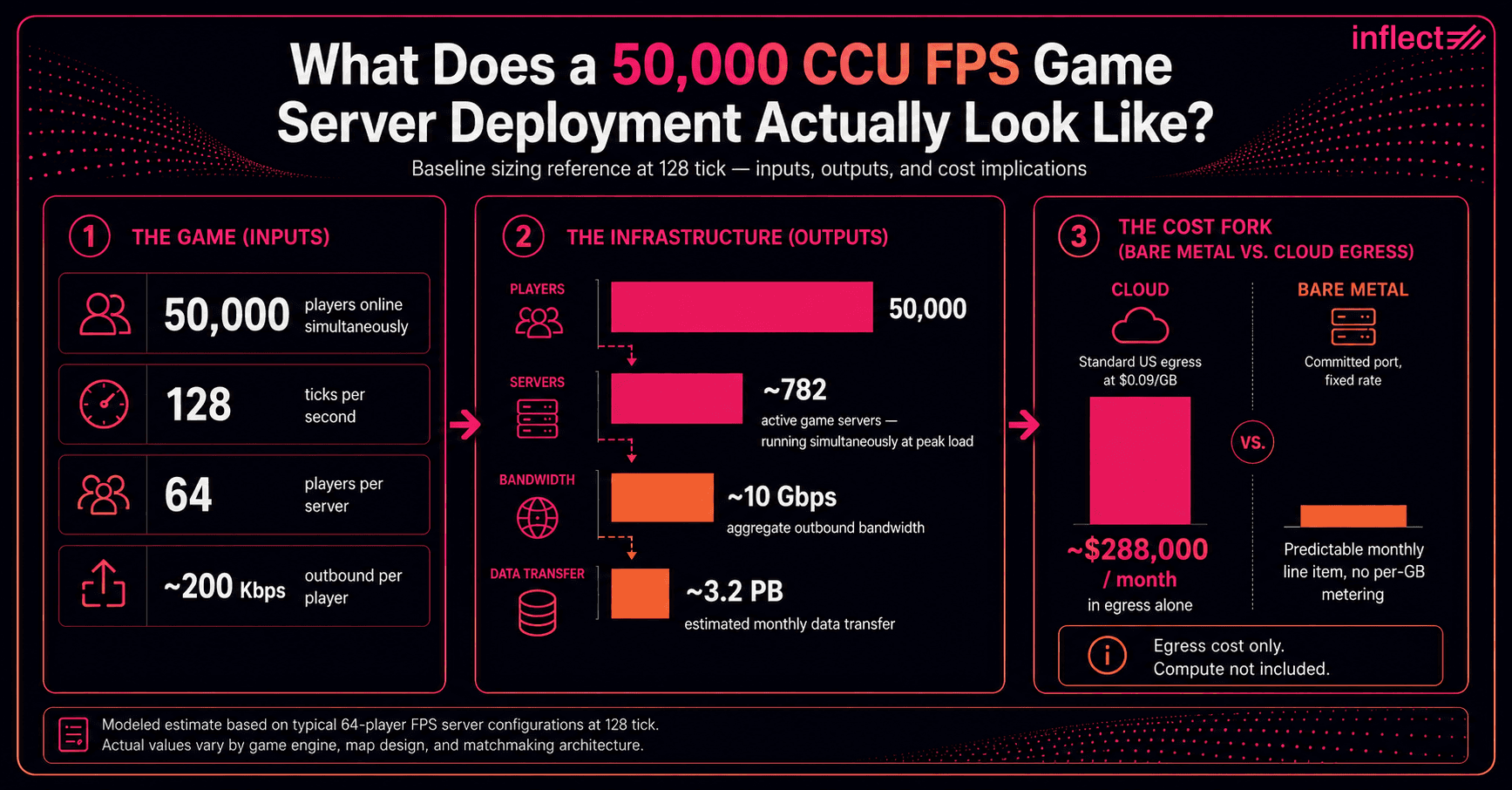
These figures are modeled estimates based on typical 64-player FPS server configurations at 128 tick. Actual values vary by game engine, map design, player behavior, and matchmaking architecture.
At 3.2 PB of monthly transfer, cloud egress at standard US rates generates costs that, in most configurations, exceed the compute bill by a significant margin. This is the sizing context behind the egress crossover observation in the section above. Studios can adjust inputs for their own player-per-server ceiling and tick rate to derive a comparable baseline.
Tick Rate, CPU Clock Speed, and Single-Thread Performance
High frequency CPU game servers prioritize single-thread performance over core count because game server tick loops execute sequentially on a single thread per server instance. A processor running at 5GHz with strong single-thread IPC handles more tick iterations per second at lower jitter than a higher-core-count processor at 3.5GHz. Cloud VMs abstract away the underlying CPU model, meaning a studio cannot guarantee which physical processor an instance lands on, how RAM is allocated across co-located workloads, or whether that processor is a current-generation part. Dedicated servers for gaming on bare metal eliminate that uncertainty.
Tick rate targets by game type: competitive FPS and battle royale titles typically target 60–128Hz; MOBA and action RPG titles typically run 30–64Hz; MMO and open-world titles typically run 20–30Hz. The server count in the baseline sizing reference above scales inversely with tick rate. A 64Hz deployment of the same 50,000 CCU FPS title requires roughly the same server count but reduces per-server CPU load by approximately half, which extends the viable player-per-server ceiling and lowers the cost-per-player on bare metal.
Network Latency Targets by Game Genre
Game server latency optimization targets differ materially by genre, and bare metal network configuration including dedicated NICs, low-latency switching, and direct peering is what allows each target to be met consistently. For FPS and tactical shooters, the target is below 50ms round-trip under typical conditions, with 80ms as the playable ceiling; above 80ms, hit registration inconsistency becomes noticeable to experienced players. MOBA titles operate well below 80ms and become problematic above 100ms. Battle royale titles tolerate up to 100ms in low-intensity phases but require below 80ms for engagement accuracy. MMO and open-world titles are the most tolerant, with sub-150ms generally acceptable for most interactions.
Jitter tolerance for competitive game server hosting for FPS titles is tighter than the raw latency figure suggests. Variance of more than 2–5ms between consecutive ticks, or packet loss above 0.1%, is perceptible to trained players even when average latency appears acceptable; this is why p99 is the operationally meaningful metric rather than mean latency. The 50k CCU baseline sizing reference above provides the bandwidth context behind these targets. Meeting p99 latency thresholds at that player count requires colocation in markets with direct peering to the player population, which the scaling section below addresses.
Scaling Bare Metal Infrastructure for Multiplayer Game Launches
Scalable game server infrastructure on bare metal requires both proactive capacity planning and a reactive playbook for conditions that deviate from forecast. Multiplayer infrastructure scaling on bare metal differs from cloud scaling in one fundamental way: capacity must be committed in advance rather than provisioned on demand, which changes how studios structure launch windows.
Pre-Provisioning, Lead Times, and Regional Deployment
Bare metal provisioning for new capacity runs hours to days depending on the provider and region; cloud instance provisioning runs minutes but introduces the performance tradeoffs under load documented in the comparison table above. These are not equivalent options with different timelines; they are different operational models with different performance contracts under load.
The standard approach for multiplayer game server hosting at launch is to treat bare metal as the latency-sensitive baseline and cloud as burst capacity with relaxed service-level objectives for non-competitive game modes or overflow matchmaking. Studios typically overprovision bare metal baseline capacity by 20–40% during the first 24–72 hours post-launch to absorb demand uncertainty before player distribution patterns stabilize. This intentional overprovisioning is not waste; it is the operational buffer that prevents a degraded player experience during the highest-visibility window of a title's lifecycle.
Global game server deployment for a title targeting North American, European, and Southeast Asian player bases requires colocation in at minimum six to eight data centers across major markets to reduce latency to below 50ms for the majority of the player population. Commonly targeted markets for low latency colocation gaming include Northern Virginia, Chicago, and Dallas for North America; Frankfurt, Amsterdam, and London for Europe; Singapore, Tokyo, and Sydney for Asia-Pacific. Each market selection should be validated against the studio's player telemetry rather than assumed from population data alone.
Failure Recovery and Load Shedding on Launch Day
Launch-day failure recovery is a pre-launch engineering requirement, not an incident response plan. The three mechanisms that matter for real time multiplayer server architecture under unexpected load are connection queue systems, dynamic instance caps, and graceful degradation protocols.
Connection queue systems front-end matchmaking to prevent server exhaustion when player inflow exceeds provisioned capacity, converting a crash condition into a managed wait state with visible queue position. Dynamic instance caps set a ceiling on players per server that adjusts under load, trading some player density for tick rate stability. Graceful degradation protocols reduce tick rate under sustained overload conditions, from 128Hz to 64Hz for example, which roughly doubles the effective player capacity of existing servers without requiring new provisioning. Region locking as a last resort prevents players from routing to already-saturated markets, which degrades global reach but preserves the experience for connected players.
None of these mechanisms should be designed during a live incident. They are architectural decisions that require integration with the matchmaking layer, monitoring instrumentation, and defined trigger thresholds before the launch window opens. Studios that treat them as incident-response tools rather than pre-launch infrastructure discover this distinction at the worst possible moment.
What to Evaluate in a Bare Metal Game Server Hosting Provider
The criteria that separate viable game server hosting providers from non-viable ones are not feature differences; they are operational thresholds below which a provider cannot support a live-service multiplayer title. Evaluate each provider against these thresholds before shortlisting, not after.
Network Infrastructure: Peering, Anycast, and Private Backbone Routing
Peering quality and ISP proximity determine latency consistency more than raw bandwidth capacity for multiplayer game server hosting. A provider with 100 Gbps of capacity connected to the public internet through a single upstream transit provider is a worse choice than a provider with 40 Gbps connected via direct peering arrangements with major residential ISPs in the target market. Providers without private backbone routing options introduce public internet path variance that is not acceptable for latency-sensitive game server workloads; this should be a disqualifying condition, not a tradeoff to weigh.
Anycast IP support matters for studios routing players to the nearest healthy server cluster across a multi-region deployment. Anycast allows the routing layer to absorb regional outages or capacity events without client-side reconfiguration, which is operationally significant during a launch window. The presence or absence of anycast support is a binary capability that should be confirmed in writing before contracting, not assumed from marketing materials.
DDoS Mitigation, CPU Consistency, and Operational SLAs
Providers without at least 100 Gbps per-region DDoS protection for game servers are not viable for public multiplayer titles. The gaming industry accounts for 37% of all DDoS traffic globally, making it the most targeted sector by attack volume (Source: SentinelOne, 2026). Attacks are frequently coordinated: 63% of gaming respondents who identified a threat actor attributed the attack to a competitor, showing most gaming DDoS attacks come from rivals (Source: StationX, 2026). Game servers are specifically targeted with UDP flood attacks, connection exhaustion, and application-layer attacks designed to increase latency for opponents rather than take a service fully offline. For studios with competitive ranked modes or any esports-adjacent audience, evaluate providers at 400 Gbps mitigation capacity or higher.
The disqualifier that most provider evaluation frameworks miss is CPU model consistency across regions. Providers that cannot guarantee consistent CPU SKUs across all deployed regions introduce tick rate variance between regional server clusters; a game engine tuned on a specific processor family behaves differently on an AMD Ryzen part at an equivalent clock speed. This inconsistency complicates matchmaking fairness, performance tuning, and bug reproduction across regions and is a legitimate reason to disqualify a provider regardless of how their other specifications compare.
Operational requirements for a live-service multiplayer title: IPMI or equivalent out-of-band access for all servers, time-to-provision SLA of 24 hours or better for additional capacity, consistent NVMe storage and RAM configurations verified across all regions, hardware refresh commitments within the contract term, and tiered support with a defined response time for P1 incidents. Downtime SLAs and reliability guarantees should appear as explicit contract terms, not verbal commitments. Each of these should appear as explicit contract terms, not verbal commitments.
How Inflect Helps Gaming Studios Source Bare Metal at Scale
Once requirements are defined to this level of specificity, the challenge becomes sourcing and comparing game server hosting providers that actually meet them. Most studios reach out to four to six providers individually, wait days for quotes, and then compare proposals that use different pricing structures and non-equivalent hardware specifications.
Inflect is a digital infrastructure marketplace with instant pricing across bare metal, colocation, and dedicated internet access from providers in 6,000+ facilities across 100+ countries. Gaming infrastructure teams can search by region, filter by hardware specification, and compare providers side by side without a sales call. Providers available on Inflect include Equinix and Digital Realty at the premium tier, TierPoint and Flexential at the mid-market, and regional operators across key gaming markets in North America, Europe, and Asia-Pacific.
Concrete workflows on Inflect for multiplayer infrastructure teams: comparing low latency servers from bare metal providers in Frankfurt versus Amsterdam to determine optimal EU player distribution routing; identifying providers in Singapore and Tokyo that offer high-frequency CPU configurations at 5GHz or above for Asia-Pacific low latency colocation gaming; sourcing providers with verified per-region DDoS mitigation capacity above 100 Gbps across a multi-region deployment. Each search returns instant pricing from multiple providers, with free expert advisory available for studios that want a second opinion on shortlists, hardware spec equivalency, or contract terms.
Search Inflect to compare bare metal game server hosting providers:
Search by region, CPU specification, and committed bandwidth to find providers that match your latency and tick rate requirements
Compare p99-relevant network configurations and peering arrangements across providers in the same market
Identify providers with verified DDoS mitigation capacity by region, before committing to a contract
Access free expert advisory with no obligation to purchase
About the Author

Haley Rogers
Content & Social Media Specialist
Haley Rogers is the Content & Social Media Specialist at Inflect, bringing over two years of experience in social media, marketing, and content strategy — including time at a fast-paced tech company before joining the Inflect team. She specializes in translating complex digital infrastructure topics into clear, engaging content, with a particular focus on blog writing and brand storytelling across channels.
Contact: