12 mins
Bare Metal for Game Hosting: How to Reduce Latency and Improve Performance
It is 6pm on a Friday. Your new title just went live and player count is climbing past 10,000 concurrent sessions. Discord starts filling with lag complaints and rubber-banding reports from players sitting a few hundred kilometers from the nearest server. Your team checks the metrics: CPU utilization looks normal, network throughput is within spec, but tick rate has dropped from 128 to 60 and jitter is spiking on every load burst. The hardware is not the problem. A neighboring workload on the same physical host is.
For real-time multiplayer games, latency is not a secondary concern, it is the product. Akamai has continued to frame gaming as a low-latency workload in its State of the Internet research, reinforcing that even small delays can directly degrade player experience and session continuity in competitive environments (Source: Akamai, 2026). The global games market in 2026 is expected to exceed $200 billion, with continued growth driven across mobile, PC, and console platforms (Source: Kevuru Games, 2026). For studios shipping competitive titles, the infrastructure model is a direct product quality decision.
This post covers the server infrastructure differences between bare metal and cloud, the layers where latency originates, how to configure and evaluate dedicated hardware, and how to source bare metal game hosting efficiently.
Why Bare Metal Servers Outperform Cloud for Competitive Game Hosting
What Is Bare Metal Server Hosting and Why It Matters for Real-Time Games
Bare metal server hosting is the deployment of game server software directly on physical hardware without a hypervisor or virtualization layer, giving a single tenant exclusive access to all CPU cores, memory channels, network interfaces, and storage I/O on that machine. For real-time multiplayer games, this exclusivity is essential because game loops, physics calculations, and network state updates require deterministic CPU scheduling: any competing process introduces timing variance that surfaces as latency for connected players.
Why Cloud Game Servers Underperform
Cloud game servers run inside virtual machines on physical hosts shared with other tenants, where CPU time, memory bandwidth, and network resources compete with workloads the operator cannot observe or control. Under sustained load, the hypervisor arbitrates those competing demands. For game servers, that arbitration introduces delays in the game process: tick rate drops, jitter spikes, and inconsistent packet delivery.
The Noisy Neighbor Problem and Why Virtualization Hurts Game Performance
The noisy neighbor problem occurs when a co-tenant workload on the same physical host consumes a disproportionate share of CPU cycles, memory bandwidth, or network I/O, degrading adjacent virtual machines. Game servers are particularly vulnerable because their performance requirements are constant and time-critical: a 5ms scheduling interruption in the game loop is immediately perceptible to players as lag, unlike most enterprise workloads that would not register that delay at all.
How Dedicated Hardware Eliminates Resource Contention for Game Workloads
Bare metal eliminates resource contention by giving game operators complete control over the physical host: no shared CPU scheduler, no memory bandwidth competition, no network queue pressure from neighboring tenants. This isolation is what makes high tick rate dedicated game server hosting viable at production scale, delivering consistent performance because nothing else on that machine competes for the same resources.
Bare Metal vs. Cloud: Benchmarks Under Load
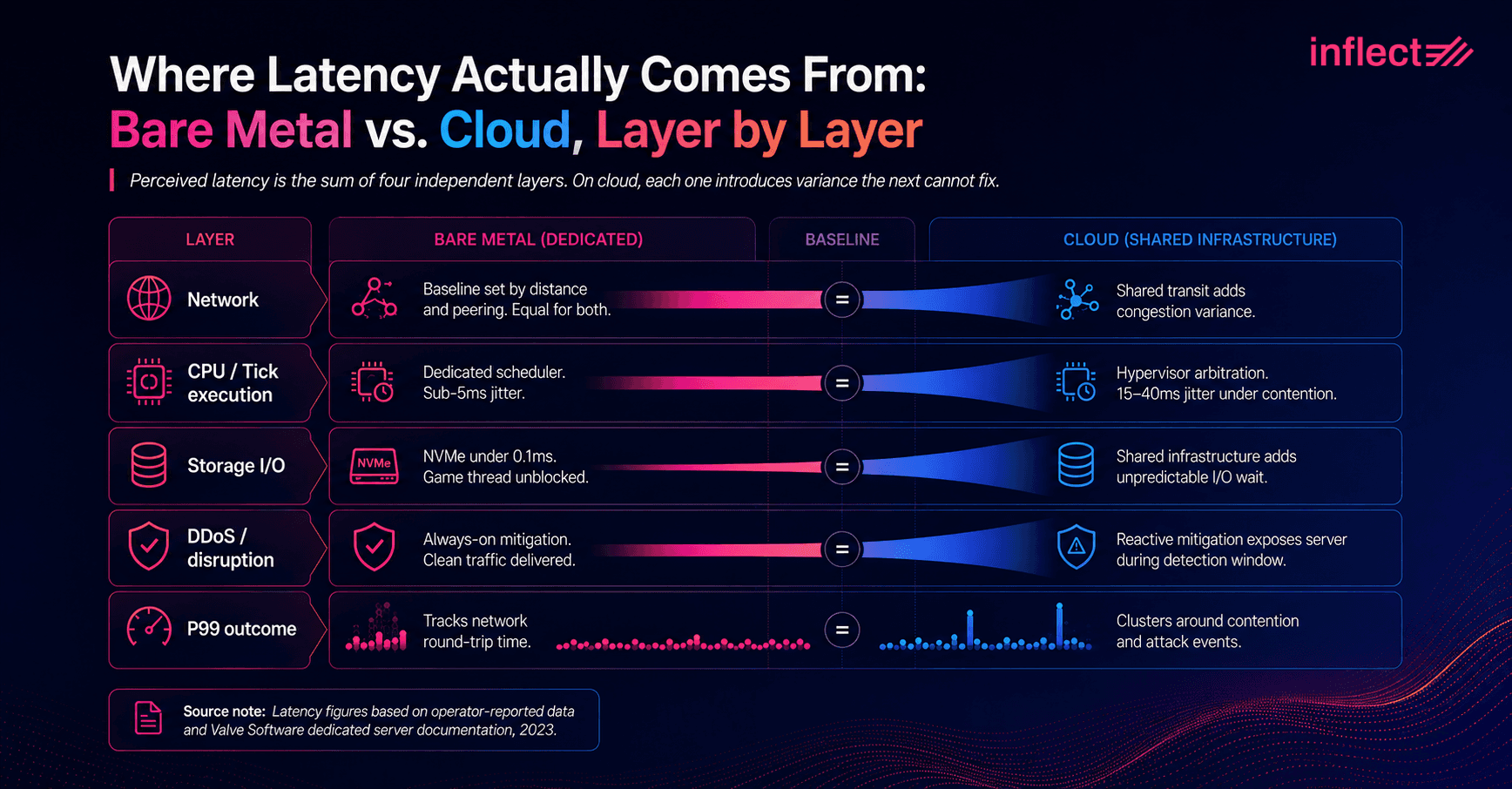
Under 80 to 90 percent CPU utilization during a player spike, bare metal game servers consistently outperform cloud instances on tick rate stability, network jitter, and p99 latency, according to infrastructure analysis comparing dedicated and virtualized platforms. Cloud VM schedulers prioritize fairness across tenants, not deterministic execution for a single process. When a co-tenant workload spikes on the shared host, preemption intervals interrupt the game thread. Infrastructure teams running competitive titles report jitter spikes of 15 to 40ms under contention, compared to sub-5ms variance on bare metal under equivalent load (Source: Cherry Servers, 2026). At p99, cloud latency events cluster around contention periods, while bare metal p99 tracks the underlying network round-trip time.
When Cloud Hosting Is Still the Better Choice for Game Servers
Cloud hosting is the better choice for game servers in three scenarios: early-stage titles with unpredictable player counts that require elastic scaling, burst workloads like public betas where committing to dedicated hardware would be cost-inefficient, and casual mobile or online games where geographic elasticity matters more than tick precision. Studios shipping their first title should validate player demand on cloud before committing to their own server infrastructure on bare metal.
The Key Layers of Latency in Game Server Infrastructure
Network Latency: How Distance, Routing, and Peering Affect Player Ping
Network latency is the time required for a data packet to travel from a player's client to the game server and back, determined by physical distance between the player and the server, the number of network hops in the routing path, and the quality of peering agreements between the networks on that path. For low ping game server hosting, physical placement relative to the player base is the single most impactful variable: light-speed propagation sets an irreducible floor that no hardware optimization can overcome.
How Packet Loss and Jitter Degrade Multiplayer Game Performance
Jitter is variance in packet arrival time, and packet loss is the failure of packets to arrive at all: together they are more damaging to multiplayer game performance than elevated but stable round-trip latency. A consistent 60ms RTT outperforms an average 30ms RTT with 20ms of jitter, because jitter makes player movement and hit registration unpredictable. Above certain thresholds, game engine compensation breaks down, stable gameplay gives way to rubber-banding, and game state becomes desynced.
Tick Rate, CPU Speed, and Compute Latency
Compute latency is the processing time required to complete one full tick of the game simulation: reading player inputs, running physics and collision detection, updating game state, and dispatching updates to all connected clients. At 128Hz, that full cycle must complete in under 7.8ms. CPU single-thread performance is the dominant hardware variable, and any scheduling interruption that delays the tick cycle increases perceived latency for every connected player.
How Storage I/O Bottlenecks Slow Game World Loading and State Updates
Storage I/O affects game server performance in two areas: initial world loading when a server instance starts, and persistent state writes in games with live rankings, inventories, or in-session events. NVMe SSDs deliver random read latencies under 0.1ms compared to 0.5 to 1ms for SATA SSDs, preventing storage waits from blocking the game thread (Source: SimplyBlock, 2026). For titles writing match state during real-time play, storage I/O speed is a direct latency variable.
How DDoS Attacks Create Latency
Distributed denial of service attacks targeting game servers introduce lag spikes and outages by flooding network interfaces with junk traffic, forcing the server's network stack to process attack packets instead of player packets. Gaming is consistently one of the most DDoS-targeted industries: Cloudflare's 2025 Q4 DDoS Threat Report identified customers in the Gaming industry as heavily targeted in 2025, alongside customers providing Generative AI services (Source: Cloudflare, 2026). For any game server operation, DDoS protection and network security are not optional infrastructure.
Why Latency Compounds and How Bare Metal Fixes It
Total perceived latency is the sum of network propagation delay, compute tick latency, storage I/O wait, and scheduling jitter: on cloud infrastructure, each layer introduces independent variance that compounds. Bare metal addresses the compute and contention layers directly by removing the hypervisor and gives operators full control over storage and, with dedicated internet access, over bandwidth contention. Network propagation remains a function of placement, which is why geographic distribution of bare metal nodes matters as much as hardware specification.
Configuring Bare Metal for Minimum Latency
CPU Selection: Single-Thread Performance, Core Count, and Cache
The right CPU for a game server prioritizes single-thread clock speed over core count, because most game engines run their simulation loop on a single thread. High-frequency processors with a base clock above 3.5GHz and large L3 cache reduce memory access latency for game state data. Core count becomes relevant when running multiple game instances per server, where the tradeoff between single-thread performance and parallelism depends on the engine and instance density required.
How Network Interface Cards and Uplink Speed Affect Game Server Latency
A 10Gbps NIC provides sufficient bandwidth for most game server deployments, but the more important specification is interrupt handling and offloading capability. Modern NICs with receive-side scaling distribute packet processing across CPU cores, reducing per-packet CPU overhead that would otherwise interrupt the game thread. For high tick rate servers handling hundreds of concurrent players, NIC configuration is a measurable latency source if not sized and tuned correctly.
Choosing the Right Data Center Location for Your Player Base
Game server placement should minimize the median network distance to the active player base, but the relevant metric is latency, not kilometers: a server in a well-peered facility 50km away may outperform one in a poorly-connected facility 20km closer. Players more than 150ms RTT from the nearest server will report lag in any precision multiplayer game, ruining the gaming experience and making regional distribution a requirement for international titles.
How DIA Reduces Latency Compared to Shared Bandwidth
Dedicated internet access provides a committed bandwidth circuit between the data center and the internet backbone, eliminating the contention that occurs on shared transit where multiple tenants compete for the same upstream bandwidth. For game servers handling more than a few hundred concurrent players, DIA ensures consistent packet delivery during traffic spikes, helping reduce ping variance for players, and the consistency gains typically justify the cost over shared alternatives.
Advanced Server Tuning: CPU Pinning, NUMA Awareness, and NIC Offloading
Four configuration choices produce measurable latency improvements beyond the choice of high performance hardware alone. CPU pinning assigns the game loop thread to a dedicated physical core, eliminating context-switching latency that introduces timing variance in tick delivery. NUMA awareness prevents the memory access penalty on multi-socket systems when a game process reads memory allocated on the wrong socket: that misalignment adds consistent latency to every tick cycle. NIC interrupt offloading reduces the CPU overhead competing with the game thread. NVMe storage eliminates disk I/O as a blocking variable for titles with persistent session state.
Evaluating Bare Metal Providers: Six Performance Criteria
Network SLAs, Uplink Speed, and Peering Agreements
A bare metal provider's network SLA should commit to specific packet loss and latency thresholds, not just uptime percentage: a server delivering 5% packet loss is operationally failed for a game workload even if technically available. Uplink speed should include headroom for DDoS mitigation traffic. Peering agreements determine how efficiently the provider reaches the residential ISPs your players use, and poor peering adds 20 to 30ms of latency regardless of physical proximity.
Network Topology, Carrier Density, and Edge Proximity
Network topology describes how a provider's infrastructure connects to the internet backbone: direct connections to multiple Tier 1 carriers at a carrier-neutral facility deliver lower, more consistent latency than a single upstream transit provider. Carrier density determines how many routing paths exist between the server and a player's ISP. Edge proximity determines whether player packets travel over premium interconnect or commodity transit for their final hops, a difference that can account for 10 to 20ms of latency independent of server hardware.
DDoS Protection Standards and Mitigation Capacity
A bare metal provider's DDoS mitigation should be evaluated on three criteria: always-on detection versus reactive triggering, clean traffic capacity (the maximum volume the scrubbing infrastructure can handle while still delivering player packets), and time-to-mitigation. For esports and competitive game hosting, always-on mitigation is required, and reactive systems leave the server exposed during the detection window. Attack volumes in gaming regularly exceed 100Gbps, with record assaults reaching terabit scale in recent years (Source: Cloudflare, 2026).
Provisioning Speed and Flexibility for Scaling During Game Launches
Bare metal provisioning time determines how quickly additional capacity can be brought online during a launch or traffic spike. Providers with automated provisioning and instant setup deliver new instances in under an hour; manual workflows at legacy providers can take 24 to 72 hours. For studios planning title launches, the inability to expand capacity during a launch window causes player-visible degradation at the highest-value moment in the game's lifecycle.
Pricing Models for Bare Metal Game Servers: Hourly, Monthly, and Reserved
Bare metal game server plans are available under three pricing structures: hourly billing for development and testing flexibility, monthly contracts for stable production workloads, and reserved pricing where a 12 to 36-month commitment reduces per-unit cost significantly. For studios with established player count patterns, reserved pricing delivers the best unit economics. Hybrid approaches combining a reserved baseline with hourly burst capacity are standard for production operations with variable but forecastable traffic.
Support Response Times and Technical Expertise for Game Infrastructure
A bare metal provider's support SLA should commit to under 15 minutes for severity-1 incidents affecting active game sessions, because game server downtime has immediate player impact that most enterprise IT incidents do not. The practical test is the ability to reach the provider's network engineers during a live incident, not account managers who open internal tickets. Game studios need to rely on support teams with demonstrated experience in game workloads specifically, not just general infrastructure, and that expertise separates a functional operational partner from a commodity provider.
How Teams Actually Source Bare Metal Game Infrastructure
Sourcing bare metal game hosting means evaluating providers across geographic availability, network topology, DDoS protection tier, provisioning speed, and pricing model simultaneously. Doing that evaluation provider by provider, each with its own quoting process and sales cycle, is the friction that delays decisions and narrows the options teams actually compare. Aggregation solves the visibility problem.
How Instant Pricing Works for Bare Metal Game Server Buyers
Inflect delivers instant pricing for bare metal game servers from providers across 6,000+ facilities in 100+ countries, without a sales call or RFQ process required. Buyers enter configuration requirements and receive side-by-side pricing from multiple providers, enabling direct comparison on the variables that matter for game workloads: location, hardware spec, network SLA, and cost. The evaluation process that typically takes days of vendor conversations completes in minutes.
Which Bare Metal Providers Are Available for Game Hosting
Bare metal and dedicated server inventory on Inflect spans providers including Lumen, Zayo, Colt, and GTT alongside hundreds of regional and global operators, with global reach across North America, Europe, and Asia Pacific. For studios requiring placement in specific markets like Singapore, Frankfurt, or Chicago, Inflect surfaces available inventory with hardware specifications and live pricing, without a separate inquiry process for each provider.
How to Compare Bare Metal Locations for Minimum Player Latency
Inflect's location search allows buyers to filter bare metal inventory by specific market and compare providers in a target city or region side by side on hardware, network specifications, and price. For studios optimizing for minimum player latency, this means identifying providers with physical presence nearest the player base and comparing network SLAs without a separate sales process for each one.
How the Free Advisory Service Helps Game Studios Choose Infrastructure
Inflect provides free expert advisory covering provider evaluation, configuration guidance, and procurement support at no charge to the buyer. For studios without a dedicated infrastructure team, or teams sourcing in new geographic markets, advisory access removes the expertise gap that would otherwise require external consulting or a lengthy RFP process.
Making the Infrastructure Decision for Latency-Sensitive Games
For latency-sensitive, competitive multiplayer games, bare metal is often the correct infrastructure model. Dedicated hardware eliminates the virtualization-layer contention that makes cloud game servers unreliable at scale, and bare metal's configuration flexibility gives engineering teams direct control over tick rate, jitter, and p99 latency. Cloud remains viable for early-stage validation and burst workloads, but any title where player experience is a product differentiator will encounter the ceiling that shared infrastructure imposes.
The practical barrier is sourcing: the right providers, in the right markets, compared on the right criteria, without a weeks-long vendor process. Inflect removes that barrier with instant pricing, broad provider coverage, and advisory support at no cost to the buyer.
Start Sourcing Bare Metal Game Hosting on Inflect
Inflect gives game studios and infrastructure teams instant access to bare metal pricing across thousands of facilities worldwide, including providers with game hosting expertise and DDoS-protected network infrastructure. No sales call required.
Search bare metal inventory in any market globally, with live pricing and hardware specs side by side
Compare providers on network SLA, DDoS protection tier, and provisioning speed
Access free expert advisory on configuration, provider selection, and contract structure
Get pricing on dedicated internet access to pair with your bare metal game servers
About the Author

Haley Rogers
Content & Social Media Specialist
Haley Rogers is the Content & Social Media Specialist at Inflect, bringing over two years of experience in social media, marketing, and content strategy — including time at a fast-paced tech company before joining the Inflect team. She specializes in translating complex digital infrastructure topics into clear, engaging content, with a particular focus on blog writing and brand storytelling across channels.
Contact: