16 mins
Bare Metal for Fast Market Entry: How to Launch in New Regions Quickly
A new data center site in the United States now waits an average of four years just for a grid connection, according to JLL's North America Data Center Report Year-End 2025 (Source: JLL, 2025). That single number explains why almost no company building a market-entry infrastructure plan today is still treating ground-up construction as a realistic option. It also explains why bare metal, physical servers provisioned by a provider rather than built in-house, has become the default answer for companies that need real hardware performance on a timeline measured in days, not years.

The cost of getting this wrong is not abstract. A company that commits to a market ahead of a competitor, ahead of a regulatory deadline, or ahead of a customer contract captures share that is difficult to win back later. A company still waiting on hardware, permits, or provider onboarding when that window closes pays for the delay in lost revenue, not just in sunk infrastructure cost. Speed to market has become an infrastructure decision as much as a go-to-market one.
This post lays out how bare metal compares to cloud and colocation on deployment speed, what actually determines how fast a company can stand up capacity in a new region, which markets move fastest and slowest, and how to evaluate providers and avoid the mistakes that turn a fast launch into a slow one.
How Bare Metal Compares to Cloud and Colocation for Speed to Market
Where Bare Metal Sits on the Speed-Cost-Control Spectrum
Bare metal, public cloud, and colocation sit at three different points on the speed-cost-control spectrum: public cloud offers the fastest setup with the least hardware control, colocation offers the most control with the longest build timeline, and bare metal sits between the two, delivering dedicated hardware performance without the construction or procurement delay of owning the equipment. Bare metal servers offer direct access to an entire physical machine rather than a virtual machine sharing that hardware with other tenants, which removes the virtualization overhead that comes with a multi-tenant setup. The term is sometimes used interchangeably with traditional dedicated servers, though modern bare metal platforms add the API-driven, on-demand provisioning that legacy dedicated server contracts lacked. For a company entering a new region, this middle position is often the deciding factor. It removes the multi-year construction timeline of self-built colocation while still giving technical teams full control over the single-tenant performance and configuration that shared cloud instances cannot match.
When Speed to Market Becomes the Primary Constraint
Speed to market becomes the primary infrastructure constraint in four common scenarios: a competitive launch where a rival is entering the same region first, a regulatory deadline that fixes a hard go-live date, a contractual SLA tied to a customer's own launch schedule, and a seasonal or event-driven demand spike that will not wait for a standard procurement cycle. In each of these cases, the infrastructure decision is no longer just about long-term total cost of ownership. It is about whether the company can be live and serving traffic before the window that justified the expansion closes.
Bare Metal vs. Building Owned Infrastructure in a New Region
Building owned data center infrastructure in a new region takes significantly longer than provisioning bare metal capacity inside an existing provider's footprint. Self-built sites face grid connection waits now averaging four years in the United States alone (Source: JLL, 2025), before accounting for permitting, zoning, and construction. Bare metal servers in an already-live facility, by contrast, can typically be under contract and provisioning within days once a provider and configuration are selected. The capital outlay follows the same pattern: owned infrastructure requires upfront capex for land, power, and hardware, while bare metal shifts that spend to an operating expense tied to actual usage.
Bare Metal vs. Public Cloud for International Expansion Speed
Public cloud beats bare metal on raw setup speed. An instance can launch in minutes with no contract negotiation, and cloud servers or virtual servers running in shared, virtualized environments remain the fastest way to test demand in a brand-new market. Bare metal beats public cloud on sustained cost and predictable performance for steady, latency-sensitive workloads, including high performance computing, once a region has been live for more than a few months. That cost gap is a meaningful driver behind broader repatriation trends: respondents reported that about one-fifth of their workloads had been repatriated from public cloud to private cloud or on-premises data center environments in the last year, according to Flexera's 2025 State of the Cloud Report, based on responses from 759 global IT professionals and executives (Source: Flexera, 2025). A separate IDC analysis found that only 8 to 9% of companies plan to repatriate an entire workload, even as close to half of cloud buyers reported spending more on cloud infrastructure than expected in 2023, with 59% anticipating similar overruns in 2024 (Source: IDC, 2024). For a new-market launch specifically, the practical pattern is to use cloud solutions for the first weeks of unpredictable demand and move to dedicated instances on bare metal once traffic in that region stabilizes.
Typical Bare Metal Deployment Timelines vs. Cloud and Colocation
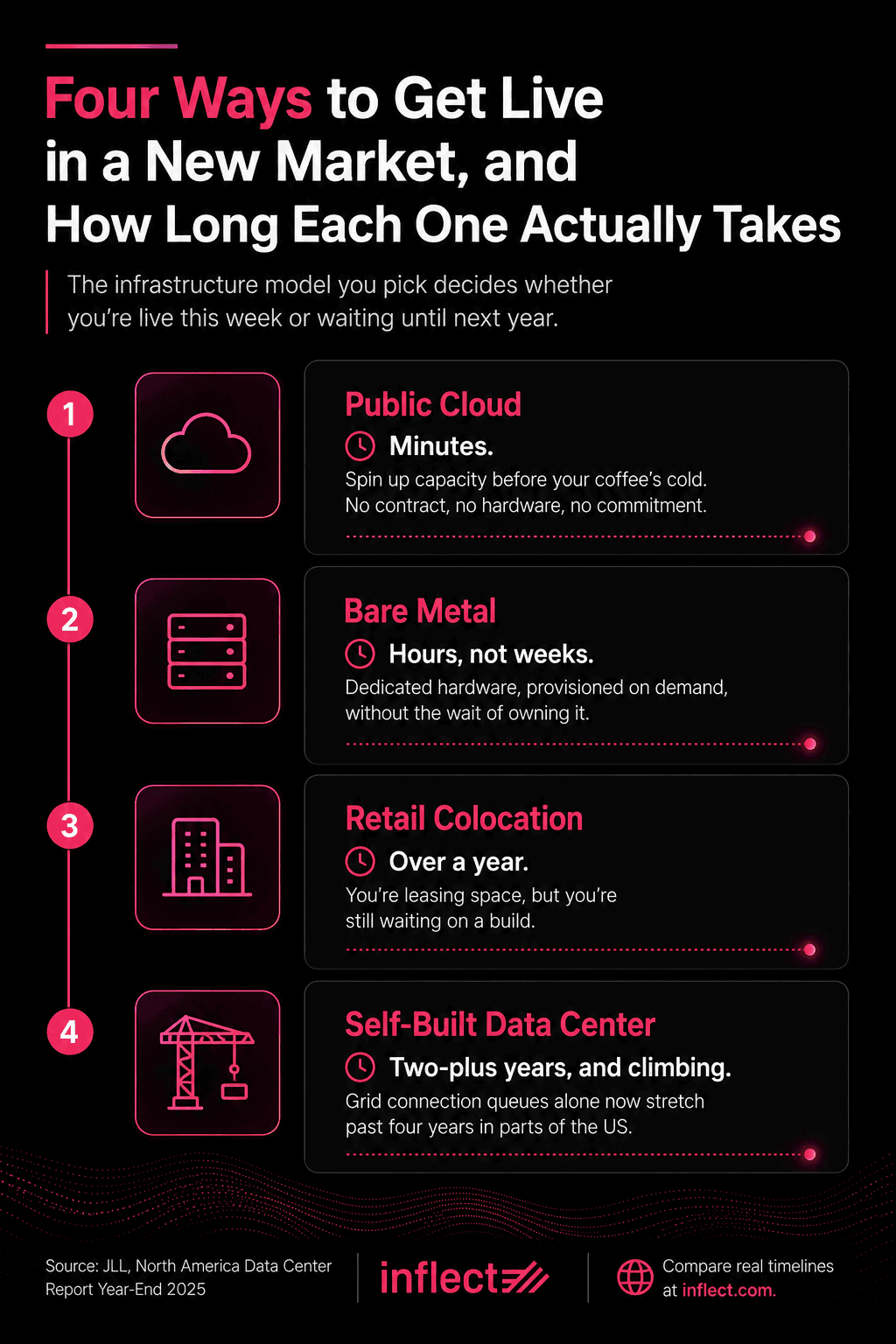
Typical deployment timelines vary sharply by infrastructure model. A public cloud instance can be running in minutes. Modern automation and automated provisioning mean a pre-built bare metal server typically completes the entire provisioning process within 30 minutes to 48 hours, while a custom hardware configuration can extend to several days depending on component availability (illustrative industry range, not a single-source figure). A retail colocation build-out is generally estimated at 12 to 18 months (modeled industry estimate). A self-built data center now takes 24 months or longer once grid connection queues are factored in, per JLL's four-year average grid connection wait (Source: JLL, 2025). The gap between the fastest and slowest options is not a matter of degree. It is the difference between launching this quarter and launching in three years.
How to Map Timelines to Your Launch Requirements
Mapping a provider's published timeline to an actual launch date requires accounting for four buffers most vendor timelines omit: contract negotiation and legal review, network circuit turn-up and network settings configuration at the new facility, security and compliance validation before go-live, and a testing window before production traffic moves. That published timeline also often excludes operating system installation and software stack setup, both of which typically happen inside the provisioning window but still take real time. Each of these can add days to weeks on top of the hardware provisioning number a provider quotes in a sales conversation.
For technical teams: request the provider's actual order-to-rack SLA in writing, separate from marketing copy, and add your own internal review cycle on top of it. A provider quoting 24-hour provisioning is quoting hardware availability, not your total time to first production request.
What Determines How Fast You Can Deploy Bare Metal in a New Region
Data Center Footprint and Provider Density in the Target Market
Data center footprint density in a target market sets the ceiling on deployment speed, because a provider can only offer fast bare metal provisioning where it already has live racks, power, and connectivity in that specific metro. A provider with a strong footprint in Frankfurt but no presence in Johannesburg cannot deliver the same timeline in both markets, regardless of what its global marketing promises.
Network Connectivity and Peering Availability
Network connectivity determines both how fast a bare metal deployment goes live and how it performs afterward, since a facility without local internet exchange peering or carrier density forces traffic through longer, higher-latency routes to reach end users. A region that looks fast on paper because racks are available can still underperform in practice if the facility sits outside the main peering fabric for that market.
Data Residency and Regulatory Requirements
Data residency and regulatory requirements can add weeks to a bare metal deployment regardless of hardware availability, and the compliance landscape keeps expanding. Researchers at the European University Institute counted 331 data localization regulations across 155 countries as of December 2024 (Source: European University Institute, 2024). Single-tenant bare metal hardware also offers enhanced security and audit isolation that some data protection regimes specifically require, which is one more reason compliance review needs to happen before a launch date is set, not after. A launch plan that treats data residency as a checkbox rather than a review step is one of the most common reasons a technically ready deployment stalls in legal.
Hardware Lead Times and Remote Hands Support
Hardware lead times and remote hands availability determine whether a bare metal deployment finishes on schedule once the contract is signed. Custom server configurations requiring specific CPUs, memory capacity, or data storage components can extend delivery well beyond a standard pre-built server with physical components already in inventory, and a facility without reliable local remote hands support turns a minor issue with the physical setup or other hardware resources into a multi-day delay when no engineer can travel to the site.
Procurement, Legal, and Internal Approval Cycles
Procurement, legal review, and internal approval cycles frequently add more delay to a bare metal launch than the infrastructure itself. Security review, vendor risk assessment, and contract redlines often run on parallel tracks that a technical team cannot accelerate on its own, and a company that only plans for the provider's provisioning timeline is routinely surprised by how much of the total schedule sits inside its own organization. Some companies offload part of this review to managed services partners who specialize in vendor risk assessment, which can compress the internal timeline without removing the review itself.
Which Regions Offer the Fastest Bare Metal Deployment Timelines
What Makes a Region Fast or Slow for Deployment
A region's deployment speed for bare metal capacity is set by four compounding factors: the density of existing provider facilities, the maturity of local power and grid infrastructure, the complexity of local data protection and localization law, and the number of established network carriers already present in that market. Regions strong on all four generally support a launch measured in days; regions weak on more than one typically stretch that timeline to weeks.
Markets With the Shortest Bare Metal Deployment Timelines
The fastest-growing colocation markets globally, and generally the fastest for bare metal deployment because of the provider density that growth brings, include Johor, Lagos, Santiago, Chennai, Kuala Lumpur, Queretaro, Jakarta, and Mumbai, according to Synergy Research Group's colocation market forecast (Source: Synergy Research Group, 2025). Established top-ten global colocation metros also remain reliably fast, growing at an average of 8% year over year even as the next thirty metros grew 12% and the following thirty grew 17%, meaning most bare metal orders in these established markets can still be filled from a deep existing provider base (Source: Synergy Research Group, 2025).
Markets That Require Longer Lead Times
Markets that typically require longer bare metal lead times share three traits: a limited existing provider footprint, developing power grid capacity, and newer or still-evolving data protection regulation that requires additional legal review before go-live. None of these traits rule out a launch in that market. They simply mean a company should build the extra review time into its schedule from the start rather than discover it midway through procurement.
How to Evaluate Bare Metal Providers for a Multi-Region Launch
The evaluation discipline buyers already apply when comparing cloud providers should extend to bare metal contracts, since the same speed, cost, and control tradeoffs apply.
Provisioning Speed and Deployment SLAs
Provisioning speed and deployment SLAs are the first contract terms to verify with any bare metal service provider, and buyers should require a written commitment covering order-to-rack time, not marketing language about instant or rapid deployment. Automated processes have compressed most of this window, but the contract should still spell out what steps, if any, remain manual. A specific number with a financial remedy attached is worth more than a range quoted verbally in a sales call.
For technical teams: ask for the SLA's remedy structure, not just the target time. A provider offering service credits for a missed provisioning window signals more confidence in its own timeline than one offering only a verbal estimate.
Contract Flexibility and Exit Terms
Contract flexibility and exit terms matter more for a market-entry deployment than for steady-state infrastructure, because a launch that underperforms or a market that closes earlier than planned leaves a company paying for capacity it no longer needs. Shorter minimum terms and clear early-termination language reduce the downside of a launch that does not go as expected.
Scalability for Post-Launch Growth
Scalability for post-launch growth should be evaluated before signing, not after a launch succeeds, since a provider without additional rack space, computing resources, or network capacity in that facility can force a second migration within months of go-live. Rapid scaling only works if the provider's resource allocation process for additional capacity is as fast as the original provisioning window. A successful market entry that outgrows its own infrastructure within a quarter is a common and avoidable failure mode.
Common Mistakes That Delay International Bare Metal Deployments
Underestimating Data Residency and Compliance Review Timelines
Underestimating data residency and compliance review timelines is the most common cause of a delayed bare metal launch, since legal and security review of a new region's data protection requirements often takes longer than the physical provisioning itself.
Choosing a Single Provider Without Regional Failover
Choosing a single provider without a regional failover option leaves a company with no fallback if that provider's facility in the target market runs into capacity, power, or connectivity issues during the launch window.
Ignoring Network Latency and Peering in Provider Selection
Ignoring network latency and peering quality during provider selection produces a facility that meets the deployment deadline but fails the performance requirements the launch was built around, particularly for latency-sensitive workloads serving local end users.
Overestimating "Instant" Provisioning Claims
Overestimating vendor claims of instant or same-day provisioning leads buyers to build a launch date around marketing language rather than a contractual SLA, then absorb the gap when actual delivery includes hardware and firmware validation, network turn-up, and security configuration on top of the base provisioning window.
Failing to Validate Capacity in Target Regions Before Committing
Failing to validate real-time capacity availability in a target region before committing to a launch date results in companies discovering, after signing, that the specific rack space, power density, or switch ports they need are not actually available in that facility.
Choosing the Right Infrastructure Model for Your Market Entry Timeline
The right infrastructure model for a new-market launch depends on how long the company can wait, how much initial investment it can commit, and how predictable early demand will be. A launch with an immovable deadline and unknown early traffic favors starting with cloud computing and shifting to bare metal once demand stabilizes. When a firm performance requirement exists from day one, whether a latency-sensitive workload or a compliance mandate tied to physical infrastructure, bare metal offers unmatched performance and complete control from the outset in a market with strong provider density. A launch tied to a long-term regional presence and sustained high volume is the one scenario where colocation's longer timeline can still make sense, provided the company starts that build well ahead of the actual launch date. In nearly every case, the deciding variable is not which model is best in the abstract. It is which model matches the actual timeline the business is working against.
Sourcing Bare Metal Capacity for Global Expansion on Inflect
Inflect is a digital infrastructure marketplace where companies can search, compare, and get instant pricing on bare metal, colocation, and network capacity across a global data center footprint of 6,000+ data centers and facilities in 100+ countries, without the back-and-forth of a traditional sales process. That structure directly addresses the sourcing delays and regional fragmentation described earlier in this post: instead of contacting individual hosting providers market by market, a team comparing bare metal setup options for a launch in Johor, Mumbai, or Santiago can evaluate offers from providers including Equinix, Digital Realty, NTT, CoreSite, TierPoint, and Flexential side by side in one search, shortening the entire process from shortlist to signed contract.
Because pricing is instant and available without a sales call, infrastructure and procurement teams can shorten the internal evaluation cycle that this post identifies as one of the biggest hidden sources of delay. Free expert advisory is also available at no charge, which matters most for the data residency and provider evaluation questions that otherwise require separate legal and technical research for every new region. In a bare metal market this fragmented, comparing server infrastructure and performance benefits side by side, rather than provider by provider, is itself one of the biggest time savings a sourcing platform can offer.
Compare instant bare metal and colocation pricing across your exact target metro, not a generic regional estimate.
Get free expert advisory on data residency requirements and realistic deployment timelines before committing to a launch date.
Search live capacity by rack, power density, and network port availability instead of relying on a provider's published averages.
Start your search on Inflect to scope pricing and deployment timelines for your next market entry
About the Author

Haley Rogers
Content & Social Media Specialist
Haley Rogers is the Content & Social Media Specialist at Inflect, bringing over two years of experience in social media, marketing, and content strategy — including time at a fast-paced tech company before joining the Inflect team. She specializes in translating complex digital infrastructure topics into clear, engaging content, with a particular focus on blog writing and brand storytelling across channels.
Contact: