19 mins
Bare Metal for Business Continuity: How to Build a Reliable Recovery Plan
The average cost of a single hour of downtime now exceeds $300,000 for more than 90 percent of mid-size and large enterprises (Source: ITIC, 2024). That figure excludes litigation, regulatory penalties, and the slower bleed of customer churn that follows a prolonged outage. It exists because most recovery plans are built to survive a system crash or a single hardware failure, not a coordinated ransomware attack, a regional cloud outage, or a compliance audit that requires proof the recovery environment matches production.

Enterprises that build business continuity plans on shared, virtualized recovery capacity inherit someone else's noisy neighbor problem at the exact moment they can least afford it. Veeam's 2025 Ransomware Trends and Proactive Strategies Report found that 69 percent of organizations experienced a ransomware attack in the past year, and only 28 percent fully recovered all affected data (Source: Veeam, 2025). More than half of organizations whose most recent serious outage cost over $100,000 also point to cyber-related incidents, not hardware failure, as the cause of their most severe disruptions (Source: Uptime Institute, 2024). A recovery plan that cannot deliver production-level performance under real conditions is not a recovery plan. It is a documented hope.
This post lays out how to architect a bare metal business continuity system, evaluate providers against the criteria that actually predict recovery success, and weigh the real cost of bare metal disaster recovery against cloud DRaaS and traditional colocation backup.
What Is Bare Metal Disaster Recovery and Why Does It Matter for Business Continuity?
Bare metal disaster recovery is a business continuity approach that runs recovery infrastructure on dedicated, non-virtualized servers instead of shared cloud instances, giving enterprises full control over performance, security configuration, and resource allocation during a failover event. This matters because high-performance disaster recovery infrastructure has to perform like production, not like a discounted afterthought. A recovery environment that runs meaningfully slower than production because it shares hardware with other tenants extends the actual outage even after failover technically succeeds.
Bare Metal vs. Cloud-Based Disaster Recovery: Key Differences
Bare metal disaster recovery differs from cloud-based disaster recovery in four ways: dedicated hardware instead of shared virtualized environments, fixed and predictable performance instead of variable multi-tenant performance, direct control over the operating system and network stack instead of a managed abstraction layer, and provisioned capacity that does not compete with other customers during a regional incident. This bare metal DR vs. cloud DR distinction is why many enterprises run a hybrid model rather than choosing one exclusively, trading some elasticity for guaranteed performance where it matters most.
How Bare Metal Supports RTO and RPO Targets
Bare metal infrastructure supports aggressive recovery time objective (RTO) and recovery point objective (RPO) targets because dedicated hardware eliminates the resource contention and variability that can slow failover on shared cloud infrastructure. For technical teams: RTO is the maximum acceptable time to restore service, and RPO is the maximum acceptable data loss measured in time, and both are easier to guarantee contractually when the recovery environment is not sharing CPU, storage I/O, or network bandwidth with unrelated tenants, which is what ultimately delivers minimal downtime during a real incident.
Which Workloads Require Bare Metal Disaster Recovery (AI, HPC, Latency-Sensitive Applications)
Four workload types typically require bare metal disaster recovery: AI training and inference pipelines that need sustained GPU utilization, high-performance computing (HPC) workloads with tightly coupled node-to-node latency requirements, real-time trading or transaction systems where microseconds affect outcomes, and databases with I/O profiles that degrade sharply under virtualization overhead. Workloads that are largely stateless, such as web front ends or batch processing jobs, generally recover well on cloud DRaaS without the added cost of dedicated hardware.
Performance Isolation: Why Noisy Neighbors Break Recovery SLAs
Noisy neighbor issues break recovery SLAs because shared cloud infrastructure allocates compute, storage, and network resources across the virtual machines of multiple tenants, and a spike in demand from another customer during a regional disaster can degrade the recovery environment at the exact moment it needs to perform at its best. Bare metal recovery infrastructure removes this variable because the hardware is dedicated to a single organization.
When Bare Metal Disaster Recovery Is Overkill
Bare metal disaster recovery is overkill for organizations with low-throughput applications, infrequent recovery testing requirements, small data footprints, and budgets that cannot absorb dedicated infrastructure costs for a recovery environment that may never activate. In these cases, cloud DRaaS or a managed backup service typically delivers adequate recovery outcomes at a fraction of the cost.
Bare Metal DR vs. Colocation-Based Recovery: What's the Difference?
Bare metal disaster recovery and colocation-based recovery differ in ownership and management: bare metal DR provides dedicated servers that the provider owns, provisions, and often manages on the buyer's behalf, while colocation-based recovery means the buyer owns and ships its own physical servers into a third-party facility and manages it directly. Colocation gives buyers full hardware control at the cost of longer provisioning timelines, while bare metal DR trades some of that control for faster deployment and provider-managed maintenance.
How Do You Architect a Bare Metal Business Continuity System?
Architecting a bare metal business continuity system requires six coordinated decisions: secondary site selection, storage architecture, data replication method, network and IP failover design, orchestration and automation tooling, and documented incident response runbooks.
Choosing a Secondary Site and Geographic Diversity
Choosing a secondary site for bare metal disaster recovery requires geographic separation from the primary site, typically a minimum of 100 to 150 miles to avoid shared exposure to the same regional power grid, weather system, or natural disaster. Buyers sourcing capacity in multiple metros should also confirm the secondary site sits on a different utility grid and a different set of upstream network carriers than production.
Storage Architecture: Local vs. Distributed vs. Object Storage for DR
Bare metal recovery environments typically use one of three storage architectures: local block storage for the fastest failover of transactional workloads, distributed storage for workloads that need to scale across multiple nodes, and object storage for large, infrequently accessed datasets such as AI training sets and long-term backups. The right choice depends on how fast data needs to be available after failover and how large the dataset is, since distributed and object storage both add replication overhead that local block storage avoids.
Data Replication Strategies for Bare Metal Environments
Bare metal environments typically replicate data using one of three methods: synchronous replication for zero data loss at the cost of latency, asynchronous replication for lower latency with a small recovery point gap, and snapshot-based replication for periodic point-in-time copies at the lowest infrastructure cost. Synchronous replication is usually reserved for financial transaction systems and other workloads where any data loss is unacceptable. Regardless of method, replication should include integrity checks that catch data corruption before it propagates to the recovery copy, since data consistency between primary and secondary sites is what actually determines whether a recovery point is usable, and the chosen method becomes the backbone of the organization's broader backup strategy.
Networking and IP Failover Design
Networking and IP failover design determines how traffic reaches the recovery environment during an incident, typically through DNS failover, anycast routing, or IP address migration via BGP announcement from the recovery site. Network-related issues caused 12 percent of impactful data center outages in 2024, which is one reason failover design has to account for network path diversity and not just server redundancy (Source: Uptime Institute, 2024). For technical teams: BGP-based IP failover avoids DNS propagation delay entirely, which matters when RTO targets are measured in minutes rather than hours.
Orchestration and Automation Tooling for Failover
Orchestration and automation tooling reduces failover time and human error by scripting the sequence of steps, from bringing recovery servers online to redirecting traffic and validating application health, rather than relying on a manual runbook executed under pressure. Infrastructure-as-code tools and configuration management platforms let teams version and test failover sequences the same way they test application code.
Runbooks and Incident Response Workflows
Runbooks and incident response workflows document the key components of a failover: the exact sequence of actions, owners, and decision points required to execute it, including who has the authority to declare a disaster and trigger the recovery process. A runbook that has not been reviewed since the last infrastructure change is a liability, not a safeguard.
How Do You Evaluate Providers for Bare Metal Disaster Recovery?
Evaluating providers for bare metal disaster recovery requires assessing six criteria: SLA and uptime commitments, compliance certifications, deployment speed, hardware standardization with production, support model, and network capacity guarantees.
SLA and Uptime Commitments to Verify
Buyers evaluating bare metal disaster recovery providers should verify uptime SLAs stated as a specific percentage with defined financial remedies, the provider's actual outage history rather than marketing claims, and whether the SLA covers the full recovery environment or only the underlying data center facility. A facility-level SLA of 99.99 percent uptime says nothing about whether the provider's support team can actually execute a failover within the buyer's RTO target.
Compliance Requirements for Regulated Industries
Regulated industries evaluating bare metal disaster recovery providers should confirm coverage for the frameworks that apply to their data, commonly HIPAA for healthcare, PCI DSS for payment data, SOX for public financial reporting, and GLBA for financial services. The BFSI sector already represents the largest share of bare metal cloud demand, at 23 percent of the market in 2025, driven specifically by its regulatory and performance requirements (Source: Grand View Research, 2025).
Speed of Deployment: How Fast Can You Stand Up Recovery Infrastructure?
Deployment speed for bare metal disaster recovery infrastructure ranges from same-day activation for pre-provisioned standby capacity on the same hardware configuration as production, to several weeks for a custom build ordered after an incident begins. Buyers with aggressive RTO targets should confirm pre-provisioned or reserved capacity is written into the contract, not just theoretical capacity the provider may or may not have on hand.
Hardware Standardization and Compatibility With Production Environments
Hardware standardization means the recovery environment's CPU architecture, storage configuration, and network interfaces match production closely enough that applications behave identically after failover, without last-minute compatibility fixes. Mismatched hardware is one of the most common causes of a failover that succeeds technically but fails operationally, because the application behaves differently on different underlying hardware. Hardware compatibility should be verified before signing and re-verified after every refresh cycle, since compatible hardware today does not guarantee compatible hardware once either environment is upgraded.
Support Model: Hands-On vs. Self-Managed Recovery Infrastructure
Bare metal disaster recovery providers offer either a hands-on managed support model, where the provider's team executes or assists with failover, or a self-managed model, where the buyer's own team retains full operational control. Organizations without a 24/7 infrastructure team should weight the support model heavily, since a recovery event rarely happens during business hours.
Network Capacity and Failover Bandwidth Guarantees
Network capacity and failover bandwidth guarantees determine whether the recovery site can actually absorb production-level traffic during an incident, not just host the servers that generate it. Buyers should confirm guaranteed bandwidth, not burstable or best-effort bandwidth, particularly for the data-intensive replication traffic that runs continuously between primary and secondary sites.
What Does a Bare Metal Recovery Plan Cost Compared to Alternatives?
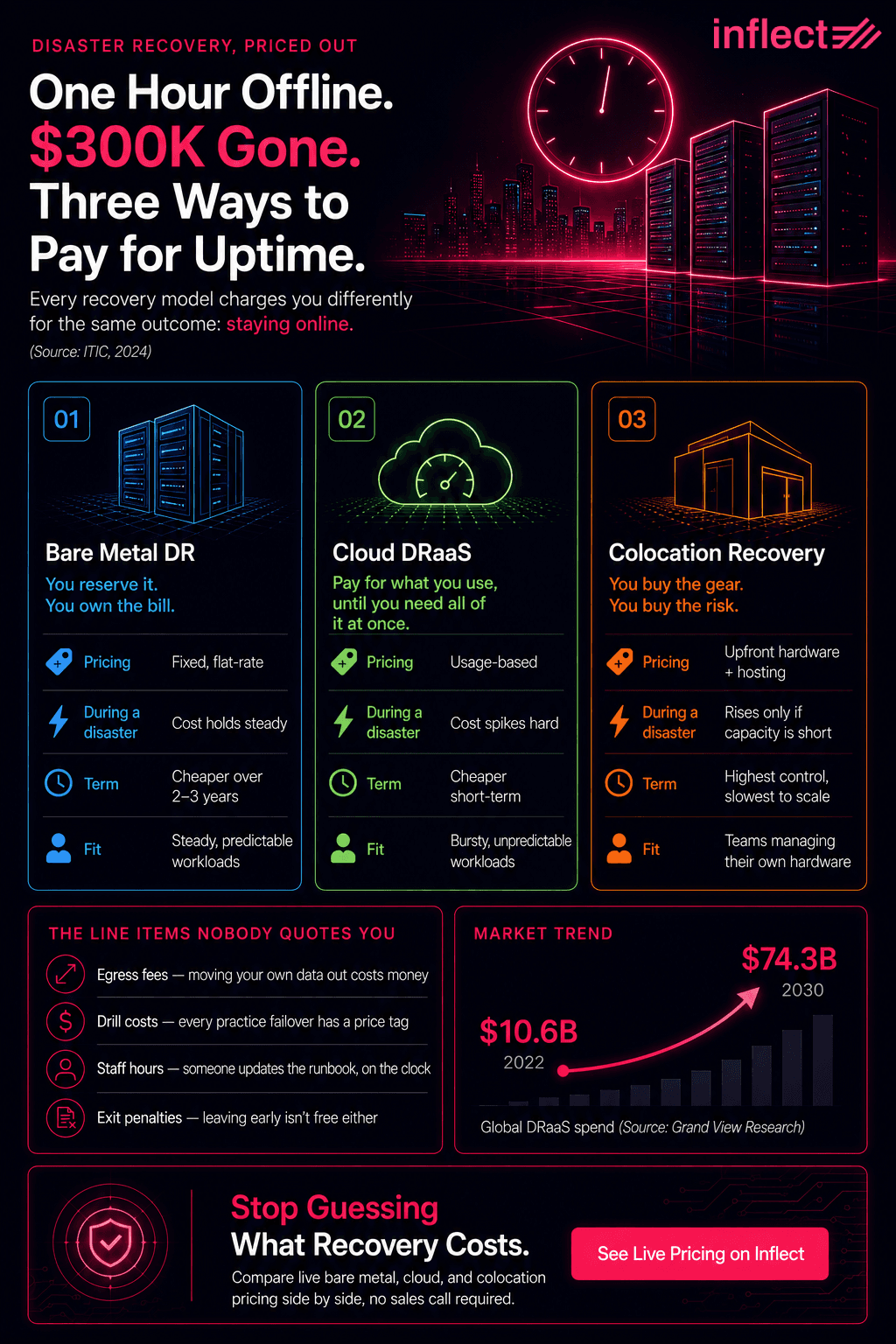
A bare metal recovery plan typically costs more per server than cloud DRaaS on a monthly basis but less over a multi-year term than maintaining an equivalent amount of always-on cloud capacity, because bare metal pricing is fixed while cloud costs scale with usage, storage, and data transfer. These costs are a direct consequence of the evaluation criteria above: providers offering stronger SLAs, faster deployment, and dedicated support price accordingly, and buyers who evaluate correctly find those costs easier to justify against downtime risk.
Bare Metal vs. Cloud DRaaS Cost Comparison
Bare metal disaster recovery typically carries higher fixed monthly costs than cloud DRaaS because it reserves dedicated hardware whether or not a disaster occurs, while cloud DRaaS charges primarily for storage and compute consumed during replication and testing. The global DRaaS market was valued at $10.62 billion in 2022 and is projected to reach $74.34 billion by 2030, reflecting how many enterprises are choosing consumption-based recovery pricing over dedicated capacity for at least part of their environment (Source: Grand View Research, 2023).
CapEx vs. OpEx: Bare Metal Recovery Compared to Colocation
Bare metal disaster recovery is priced as an operating expense billed monthly by the provider, while colocation-based recovery typically requires a capital expenditure to purchase hardware plus an ongoing operating expense for space, power, and connectivity. Finance teams evaluating the two should compare total cost of ownership over the expected hardware refresh cycle, not just the sticker price of the first year.
Cost Predictability vs. Burst Pricing in Cloud-Based Recovery
Bare metal recovery costs remain fixed regardless of how much compute or storage the environment actually uses during an incident, while cloud-based recovery costs can spike sharply during an actual failover event when compute, egress, and API call volume all increase at once. This is the scenario where a recovery event compounds a bad month into a bad quarter: the outage itself is expensive, and the cloud bill for surviving it arrives afterward.
Hidden Costs Buyers Miss in Recovery Planning
Buyers evaluating recovery plans commonly miss four cost categories: data egress fees charged when moving backup data back to production during failback, testing costs for regular failover drills, staff time required to maintain runbooks and automation, and contractual penalties for early termination or capacity changes. Egress fees in particular can turn a routine failback into an unbudgeted five-figure line item on a cloud provider's invoice.
Calculating the Cost of Downtime Avoided
Calculating the cost of downtime avoided starts with the enterprise's own hourly downtime cost, which averages more than $300,000 for over 90 percent of mid-size and large enterprises, multiplied by the hours of outage a given recovery architecture is expected to prevent (Source: ITIC, 2024). A recovery plan that cuts RTO from eight hours to one hour is worth roughly seven hours of avoided downtime cost every time it activates, which is the number that should anchor the budget conversation with finance.
Scaling Costs: What Happens During a Real Failover Event?
Costs during a real failover event scale differently across recovery models: bare metal costs stay flat because capacity is already reserved, cloud DRaaS costs rise sharply as idle standby resources convert to full production billing, and colocation costs rise only if additional hardware or bandwidth must be provisioned on short notice. Buyers should model this scenario explicitly during procurement rather than discovering it during an actual incident, when there is no time left to negotiate.
How Do You Test and Maintain a Bare Metal Recovery Plan Over Time?
Testing and maintaining a bare metal recovery plan over time involves six practices: building a recurring testing schedule, running both partial and full failover tests, managing infrastructure drift between production and recovery environments, keeping documentation under version control, understanding the most common reasons recovery plans fail, and deciding where to automate testing versus validate manually.
Building a Recovery Testing Schedule
A recovery testing schedule for bare metal disaster recovery typically includes monthly partial tests of individual components, quarterly full failover tests of complete workloads, and an annual full-scale test that includes the staff who would actually execute the plan during a real incident. Testing frequency should scale with how often the underlying production environment changes, since environments with frequent deployments need more frequent testing to catch configuration drift early.
Partial Failover vs. Full Failover Testing
Partial failover testing validates individual components, such as a single application or database, while full failover testing validates the entire recovery environment under conditions that simulate a real disaster, including network cutover and staff response time. Partial tests are lower risk and easier to schedule frequently, but only full tests reveal whether the complete system actually meets its RTO target under realistic conditions.
Managing Infrastructure Drift Between Production and Recovery Environments
Infrastructure drift occurs when the production environment changes, through patches, configuration updates, or new dependencies, without a corresponding update to the recovery environment, leaving the two out of sync at the moment failover is needed. Configuration management tools that track both environments from a single source of truth are the most reliable way to prevent drift from accumulating unnoticed.
Documentation and Version Control for Recovery Plans
Documentation and version control for recovery plans means treating runbooks, network diagrams, and failover scripts as code, stored in a version-controlled repository with a clear change history and an assigned owner for every update. A recovery plan stored as a static document that nobody has opened since it was written is effectively undocumented, regardless of how detailed it once was.
Common Reasons Recovery Plans Fail During Real Incidents
Recovery plans most commonly fail during real incidents for four reasons: infrastructure drift that went undetected between tests, staff unfamiliarity with a runbook that was written but never rehearsed, network dependencies that were not accounted for in the failover design, and data replication that was not actually current when the incident occurred. Every one of these failure modes is preventable through the testing cadence and documentation practices described above, which is why testing discipline matters as much as the underlying infrastructure.
Automating DR Testing vs. Manual Validation Approaches
Automating DR testing reduces the time and staff burden of frequent partial tests and catches configuration drift faster than manual review, while manual validation remains necessary for full-scale tests that require human judgment about application behavior and business impact. The most resilient organizations automate routine validation and reserve manual testing for the full-scale drills that only happen a few times a year.
When Should You Choose Bare Metal for Disaster Recovery, and When Should You Not?
Organizations should choose bare metal disaster recovery when they run latency-sensitive, compliance-bound, or high-throughput workloads that cannot tolerate shared-tenant performance variability, and should consider alternatives when workloads are stateless, budgets are constrained, or recovery testing needs are minimal. Three alternatives fit these situations well: cloud DRaaS for organizations running bursty, variable workloads in cloud environments that do not justify dedicated capacity; hybrid DR, combining bare metal for critical systems with cloud DRaaS for secondary workloads, for cost-sensitive organizations that still need some dedicated performance; and colocation-based recovery, where the buyer owns and manages its own hardware, for organizations running predictable legacy environments that change infrequently.
The decision ultimately comes down to how much performance variability a workload can absorb during the exact moment it can least afford it. A CRM system running on shared cloud infrastructure during failover will likely still function, just slower. A HIPAA-regulated database, a real-time trading system, or an AI training pipeline running on that same shared infrastructure may not meet its compliance, latency, or throughput requirements at all.
A reliable bare metal business continuity plan is the product of four decisions made in sequence: an architecture that matches production performance, a provider evaluated against SLA, compliance, and support criteria rather than price alone, a cost model that weighs fixed bare metal pricing against the true cost of downtime it prevents, and a testing cadence rigorous enough to catch drift before an actual incident does. Organizations that treat any one of these decisions as optional tend to discover the gap during the outage itself, when the cost of a wrong assumption is highest and the time to fix it is shortest.
The enterprises that get this right do not necessarily spend the most on recovery infrastructure. They spend deliberately, on the specific combination of dedicated capacity, provider accountability, and testing discipline their actual workloads require, and they revisit that combination as often as their production environment changes.
Sourcing Bare Metal Disaster Recovery Capacity Through Inflect
Sourcing bare metal disaster recovery capacity typically means weeks of calls with individual providers before a single price quote appears, which works against every RTO target discussed in this post. Inflect is a digital infrastructure marketplace where enterprises can search, compare, and receive instant pricing on bare metal, colocation, and private networking capacity across 6,000+ data centers and facilities in 100+ countries, without a sales call.
Buyers building a business continuity plan can search directly for dedicated disaster recovery servers in a specific secondary market, whether that means a different power grid in the next state or a facility on another continent entirely, and compare providers including Equinix, Digital Realty, CoreSite, TierPoint, and Flexential side by side on the criteria covered in this post: SLA terms, deployment speed, and support model. Inflect's advisory team, available at no charge, can also help validate that a proposed recovery architecture actually meets the RTO and RPO targets a buyer has committed to internally, before capacity is under contract.
Ready to build a bare metal disaster recovery plan that holds up during a real incident?
Search live bare metal and colocation availability in secondary markets with instant, comparable pricing
Compare providers on SLA terms, deployment speed, and support model before signing a contract
Get free expert advisory to validate your recovery architecture against your actual RTO and RPO targets
Source dedicated capacity in the specific geography your business continuity plan requires
Start comparing bare metal disaster recovery providers on Inflect today.
About the Author

Haley Rogers
Content & Social Media Specialist
Haley Rogers is the Content & Social Media Specialist at Inflect, bringing over two years of experience in social media, marketing, and content strategy — including time at a fast-paced tech company before joining the Inflect team. She specializes in translating complex digital infrastructure topics into clear, engaging content, with a particular focus on blog writing and brand storytelling across channels.
Contact: